
How can you identify an Asian hornet queen?
Contents
-
Morphological Identification: What Does a Hornet Queen Look Like?
-
Major Differences Between Queens, Workers, and European Hornets
-
Observation Period and Behavior: When and How to Identify It?
A large, dark insect has been circling your garden shed ever since the first warm days of spring. Could it be an Asian hornet queen? It’s possible, but its size alone isn’t enough to confirm it. Colors help identify the species; the season and behavior help identify a founder. Making this distinction helps prevent many mistakes.
To identify an Asian hornet queen, it’s best to look for specific details rather than relying on a gut feeling. Here are the key features to look for, the differences from the European hornet, and the proper steps to take if an Asian hornet queen begins to establish a nest on your property. The goal: to take effective action without taking risks or destroying local insects.
Things to remember
-
This educational guide turns the reader into a knowledgeable observer through simple visual comparisons
-
This approach emphasizes the protection of the European hornet while providing specific guidance on how to identify and respond to Asian queen hornets during their critical spring life cycle
-
What does a hornet queen look like?
-
Major Differences Between Queens, Workers, and European Hornets
Morphological Identification: What Does a Hornet Queen Look Like?
About 25 to 35 mm: this is the approximate size of an Asian hornet queen, with variations among individuals. This length refers to the body, from the head to the tip of the abdomen, excluding the antennae and legs. From a distance, it’s impossible to accurately gauge a difference of just a few millimeters. An insect seen up close can easily appear larger than it actually is.
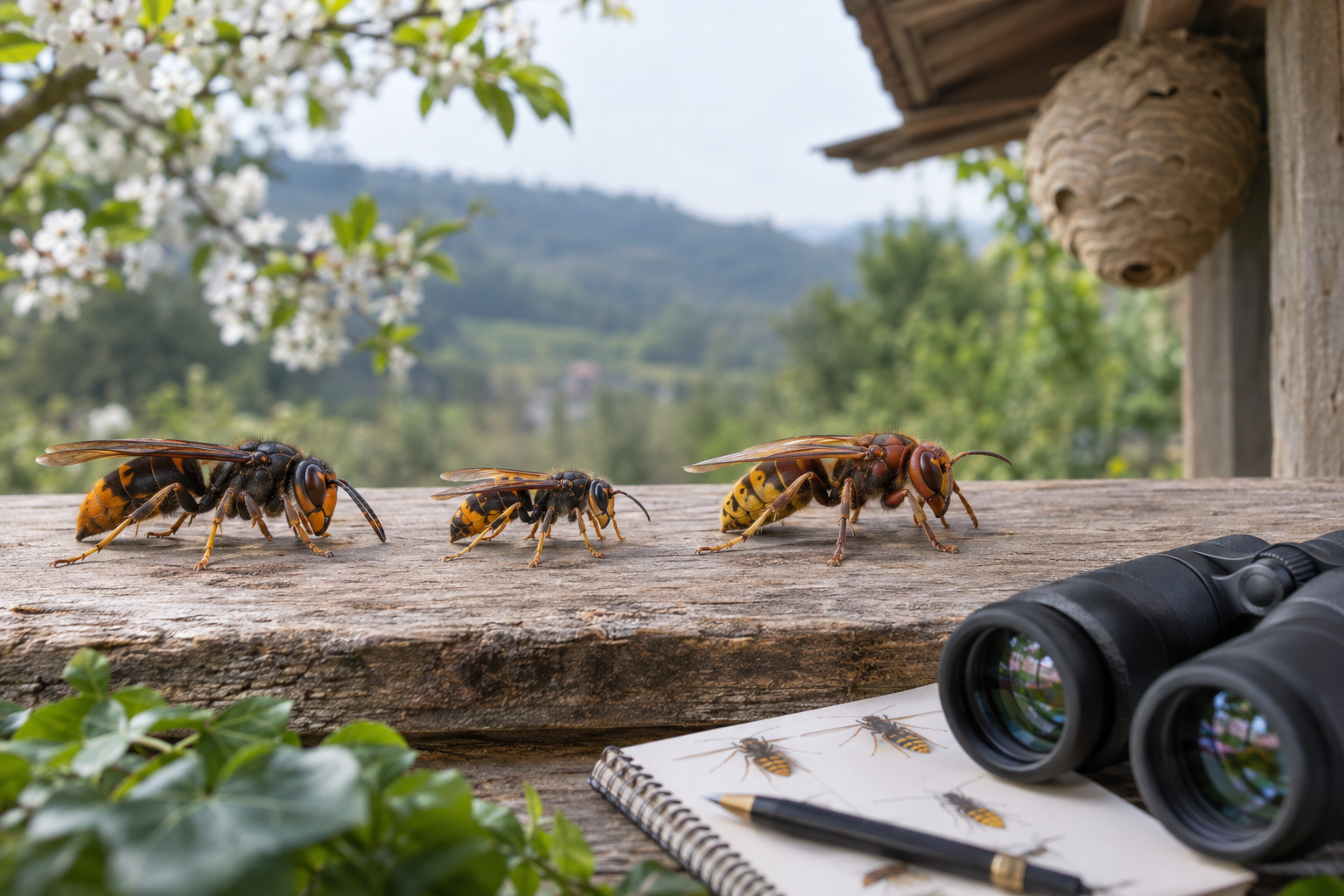
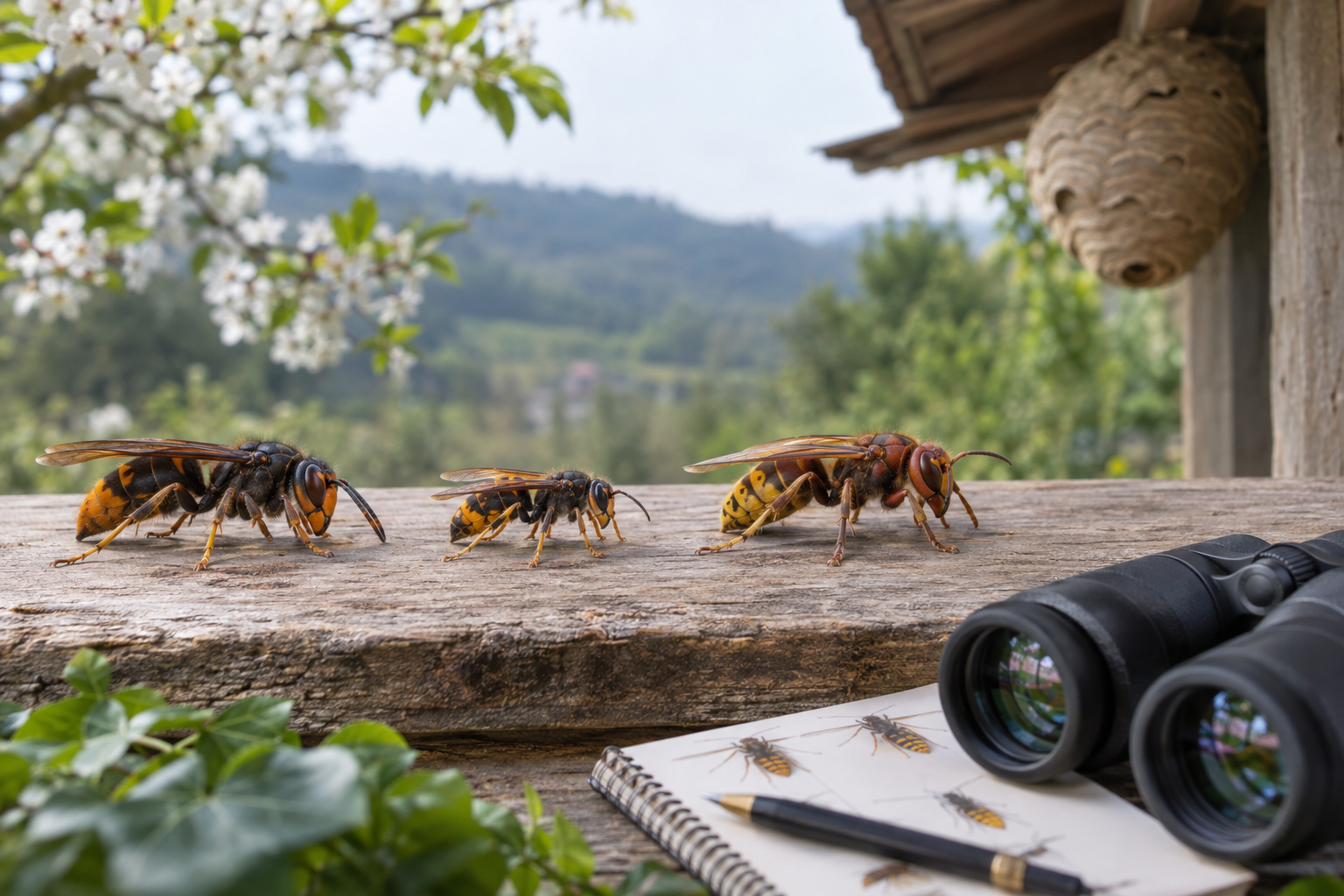
The first step is to identify the Asian hornet by its yellow legs, Vespa velutina. Its overall appearance is dark, much darker than that of the European hornet. The body structure of a queen shares the same characteristics as that of the workers: a clearly distinct head, thorax, and abdomen; a narrow waist; and two pairs of slightly mottled wings.
Four visual characteristics must be present to identify the species with confidence:
-
A black to very dark brown thorax: This central part, where the wings and legs are attached, has a dark, velvety appearance.
-
A predominantly dark abdomen: It has a wide orange or yellow-orange band extending toward the rear on the fourth segment, as well as thinner stripes.
-
Yellow tips on the legs: The part of their body closest to their body is dark. The insect looks as if it’s wearing little yellow socks.
-
An orange-colored side: When viewed from the front, the head has an orange-yellow area, while the top remains dark.
The Asian hornet’s black thorax is a good starting point, but not conclusive evidence on its own. A black insect could belong to an entirely different species. The carpenter bee, for example, is large and dark, with purple iridescence on its wings, but it lacks both the characteristic orange abdominal band and the yellow tips on its legs.
What about the yellow abdomen? If it is mostly yellow, with black markings across several segments, it’s more likely to be a European hornet. In the Asian hornet, dark colors dominate. Remembering this color pattern is more reliable than memorizing an exact shade, which changes depending on the light.
To photograph the insect, use the zoom without getting too close—ideally when it is perched on a flower. A side view shows the legs and the abdominal stripe; a top view provides information about the thorax. Do not try to hold it still to measure it. A photograph can confirm the species, but rarely the queen status on its own.
Major Differences Between Queens, Workers, and European Hornets
How can you tell if it’s a queen rather than a large worker? The answer is clear: there is no specific color associated with the Asian hornet queen. Both have the same dark coloration, the same orange band, and the same yellow tips on their legs. Looking for a special mark on the head or abdomen won’t help.
The difference between a hornet queen and a worker is based primarily on size, but there is some overlap in their dimensions. Asian worker hornets often measure around 17 to 24 mm; the largest may exceed this range and approach the size of some small queens. The first workers of the season are generally smaller than those produced later. A visual comparison is therefore only a rough guide.
A queen typically has a sturdier body and a more developed abdomen. However, the angle of view, her posture, or a distended abdomen can be misleading. An Asian hornet observed alone in early spring is likely a founder; the same insect, if spotted in the summer, cannot be classified as such based on that observation alone. During this time, the queens usually stay in the nest, and the workers handle the foraging.
When comparing the European hornet and the Asian hornet, the differences are more pronounced:
-
Asian hornet : Thorax almost black; abdomen mostly dark with a broad orange band; dark legs with yellow tips.
-
European hornet : Head and thorax with a mixture of reddish, brown, and black areas; abdomen mostly yellow with black markings; legs mostly reddish-brown.
-
European hornet queen: Often measuring between 25 and 35 mm, it can appear just as large—or even more impressive—than an Asian queen. Its size does not make it an invasive species.
The color of a hornet’s legs is particularly helpful when a photo doesn’t clearly show its back. Be careful, though, of glare: a brown leg illuminated by the sun may appear golden. Always cross-check this detail with the color of the thorax and the distribution of yellow on the abdomen.
The European hornet is a native species that preys on many insects and plays a role in the functioning of the garden. Don't kill it just because it looks like an Asian hornet. Its presence near a tree or compost does not warrant intervention. However, a nest located in the immediate vicinity of a frequently used path does require a risk assessment.
Another possible source of confusion is the bush wasp, whose queen may resemble a small hornet. This is why it’s important to identify the insect based on multiple criteria, especially before deciding to destroy it. If the image is blurry, it’s better to err on the side of caution than to misidentify the insect.
Observation Period and Behavior: When and How to Identify It?
Imagine the scene: in April, a dark hornet keeps returning to the roof of a shed, then disappears behind a beam. This repeated path is more revealing than its size. A queen hornet may be building her first nest in this sheltered corner.
The life cycle of the Asian hornet begins anew in the spring with the future queens—which were mated in the fall—that have spent the winter in a shelter. In Belgium, they often resume activity in March or April, sometimes earlier during a mild spell. Local weather conditions matter more than a specific date. Not all of them emerge at the same time.
The Asian female first searches for sugary food sources to regain energy. She may feed on flowers, sap, or other sources of sugar. She then chooses a spot sheltered from the rain and builds a small nest out of chewed wood fibers. Initially, she handles the construction, egg-laying, and feeding of the first larvae all by herself.
The primary nest in the spring looks like a small, beige-to-brown paper envelope, often measuring just a few centimeters at first. It can be found under a awning, in a garden shed, an open garage, or another covered area. A nest in the early stages of development isn’t necessarily Asian: wasps and European hornets also build structures made of papery material. Identifying the insect inhabiting the nest remains essential.
The first worker bees appear after several weeks, often between May and June, depending on conditions. They gradually take over outdoor tasks. The colony may then move and build a secondary nest, often at a height, although this relocation is not always the case.
Do you suspect a break-in? Here's what to do:
-
Keep your distance. Do not touch the insect or the nest's support structure, and keep children and pets away.
-
Take note of these helpful hints: date, exact location, approximate height, and whether there is one or more hornets.
-
Take a photo only if you can do so without putting yourself at risk. Do not use a ladder to get a better angle.
-
Request identification from Frelons.be or your local reporting system. Once a nest has been confirmed, appropriate action may be taken.
Can a hornet queen sting? Yes. She has a stinger and can sting multiple times, especially if she is cornered, handled, or if her nest is disturbed. A hornet queen’s sting isn’t automatically more serious than a worker’s: the allergic reaction, the number of stings, and where they occur are the deciding factors. If you experience difficulty breathing, feel unwell, or have swelling in your mouth or throat, call the 112.
Avoid using makeshift traps filled with beer or syrup: they also catch non-target insects. Any trapping should be done in accordance with local guidelines, using appropriate equipment and with regular monitoring. Locating an occupied nest and having it treated by a qualified professional is a much more targeted approach than placing numerous bottles throughout the garden.
Conclusion
Accurate identification leads to an appropriate decision, not to automatic destruction. Have you spotted a European hornet foraging far from walkways? Let it go about its business. Have you photographed an Asian hornet without locating a nest? Report the sighting along with its location, without trying to catch it. Do you see them flying back and forth to a small structure under your roof? Have that structure inspected.
To identify an Asian hornet queen, keep in mind, above all, the limitations of the observation: It is easier to identify the species than the caste. The combination of the dark thorax, the orange abdominal band, and the yellow tips of the legs provides strong clues as to the species. The spring setting and the construction activities further suggest that this is a female. It would be misleading to draw further conclusions based solely on a silhouette.
When requesting identification, a clear photo along with a few details is better than an alarmed description. Be sure to specify whether the insect was just passing through or returning to the same spot. If a nest is visible, also note its proximity to a door, a patio, or a playground: this information helps assess the actual urgency of the situation.
At Frelons.be, vigilance against the Asian hornet continues year-round, with measures tailored to each season. In the spring, the focus is on queen hornets and the first nests; in the summer and fall, on established colonies and high-risk situations. Winter is also a time for identifying nests and preparing for the following season. An old nest discovered after the leaves have fallen is generally no longer active and will not be reused the following year; therefore, its discovery alone does not warrant urgent removal.
Do you have a concern about your garden? Contact Frelons.be to have the insect identified or the suspicious nest assessed. In the meantime, don’t block its access, don’t spray any chemicals, and avoid pruning or doing any DIY projects nearby. Observing without disturbing it protects both those around you and the local species we’re trying to preserve.
Frequently asked questions
What characteristics can help you identify an Asian hornet without getting close to it?
Look for a combination of four characteristics: an almost black thorax, a mostly dark abdomen with a broad orange band toward the rear, yellow leg tips, and an orange face. Use the zoom when it is perched, without trying to keep it still: a side view shows the legs and abdomen, while a top view helps examine the thorax.
How can you tell if the Asian hornet you've spotted is a queen or a worker?
The queen and the workers are the same color; size alone isn’t enough either, since their dimensions can overlap. A queen measures about 25 to 35 mm and usually has a sturdier body, but these characteristics are difficult to assess from a distance. A solitary individual in early spring, especially if she is building a nest, is likely a founder; a photo alone rarely confirms this status.
Is a very large yellow-bodied hornet necessarily an Asian queen?
No: a largely yellow abdomen with black markings is more indicative of the European hornet, whose queen can appear just as imposing as an Asian queen. Also check for reddish and brown patches on the head and thorax, as well as reddish-brown legs. This native species plays a role in the garden’s ecosystem: its mere presence does not justify extermination, unlike a situation near a frequently used path that would require a risk assessment.
At what age can an Asian woman start a family in Belgium?
Queen wasps often resume activity in March or April—sometimes earlier if the weather is mild—and then seek out a sheltered spot to build their first nest. Regular back-and-forth trips under an awning or behind a beam, near a small, beige-to-brown paper-like structure, are useful clues. The first workers appear after several weeks, often between May and June, but the occupant must be identified: wasps and European hornets also build papery nests.
What should I do if a queen bee seems to be building a nest in my garden shed?
Stay at a safe distance, keep children and pets away, and do not touch the nest or its support; do not block access to it, and do not spray any chemicals on it. Note the date, location, approximate height, and flight patterns, then take a photo—but only if you can do so without putting yourself at risk. Request identification from Frelons.be or your region’s reporting service, specifying the nest’s proximity to a door, patio, or playground.
Should you trap an Asian queen with beer or syrup in the spring?
Avoid makeshift traps using beer or syrup: they also catch non-target insects and are not a sufficiently selective solution. Any trapping should follow local guidelines, using an appropriate device and including regular monitoring. Locating an occupied nest, confirming the species, and entrusting its treatment to a qualified professional remains a more targeted approach than placing numerous bottles throughout the garden.
 French
 English
 Dutch
0 Comments