
How can you tell if a wasp nest is active or abandoned?
Contents
-
Physical and auditory signs for identifying an active wasp nest
-
Understanding the life cycle of wasps to determine whether the nest is empty
-
How to Tell the Difference Between a Wasp Nest and an Asian Hornet Nest and Take Action Safely
You’ve spotted a grayish ball under the eaves, in the hedge, or in the back of the garage. The first question that comes to mind is: Is there still anyone in there? The answer changes everything. An empty nest is just a chewed-up piece of cardboard that will eventually fall on its own. An inhabited nest in the middle of August means several thousand worker bees ready to defend their colony if you mow the lawn within three meters of it.
Things to remember
-
Beyond simply tracking their movements, we offer a diagnostic method based on the biological calendar of hymenoptera and species differentiation from the Asian hornet
-
The goal is to reassure users through expert analysis while reminding them of the need for constant vigilance regarding invasive species.
-
Physical and auditory signs for identifying an active wasp nest
-
Understanding the life cycle of wasps to determine whether the nest is empty
The good news: you don’t need to be an entomologist to tell the difference. All you have to do is look, listen, and—most importantly—know what time of year it is. Wasps follow a biological calendar with astonishing regularity, and that calendar gives you 80 % of the answer before you’ve even looked up.
Let’s go through this step by step: the visible signs, then the seasonal patterns, and finally the topic that keeps us busy all year round here at Frelons.be—namely, the difference between a typical wasp nest and an Asian hornet nest. Because in that case, we’re talking about an entirely different kind of intervention.
Physical and auditory signs for identifying an active wasp nest
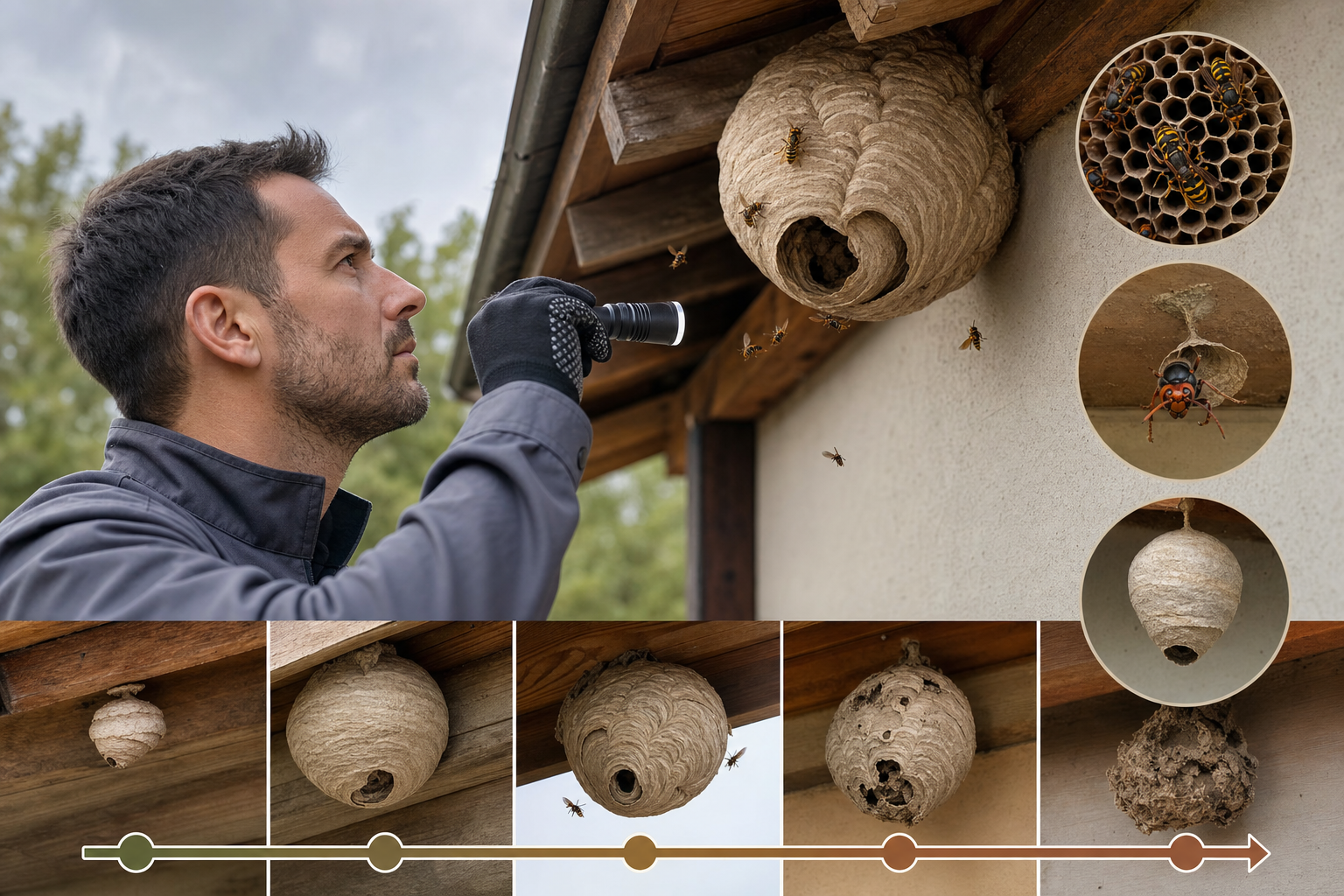
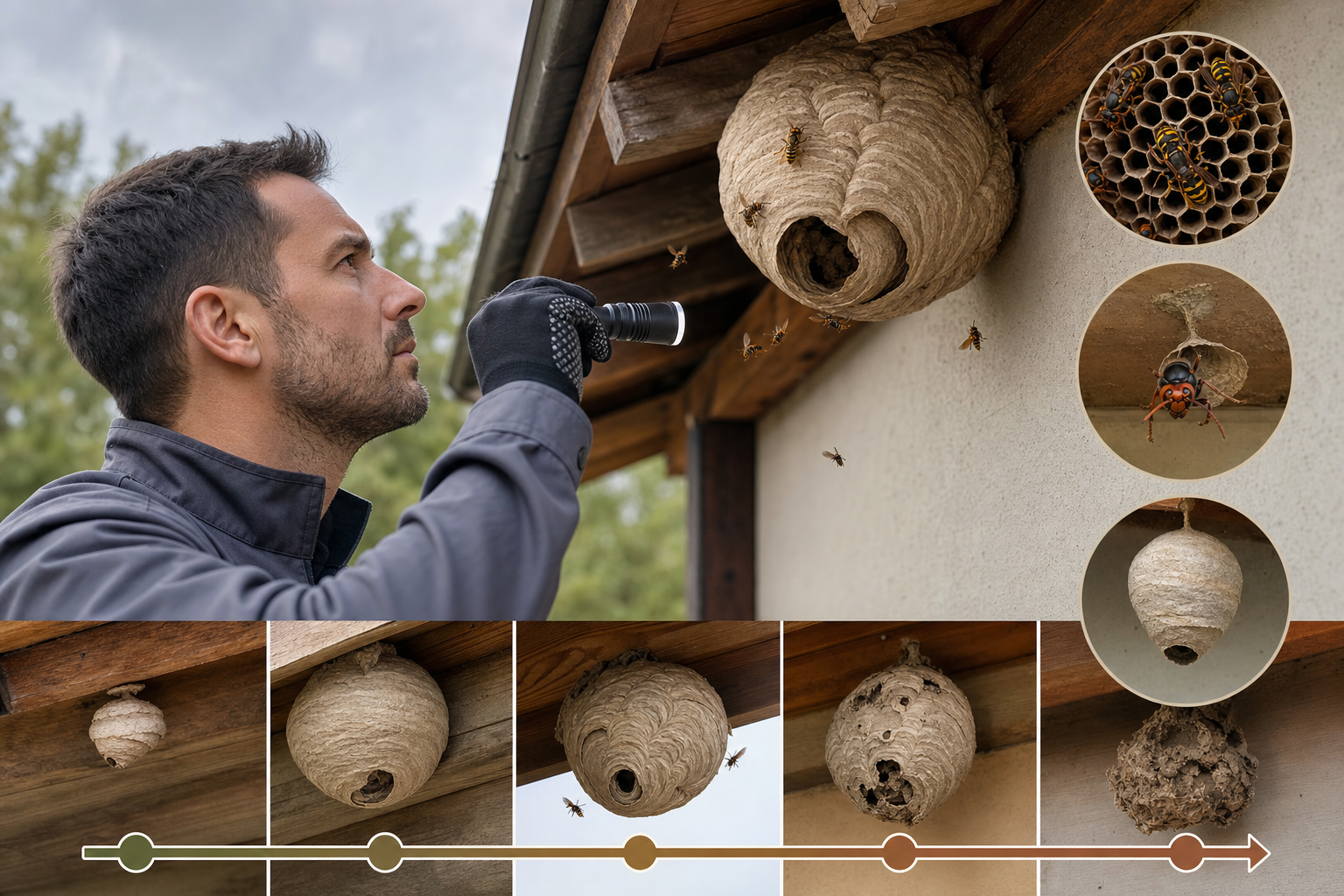
Stand ten meters away, in the shade, and watch for five minutes. It’s the most reliable test there is. A active wasp nest It functions like an airport: there is a constant flow of activity, with some insects flying out in a straight line and others returning loaded. On a hot July day, you can count several dozen trips per minute at the entrance to a mature colony. There’s no room for ambiguity.
The exit hole is, in fact, an excellent indicator. On an occupied nest, it is neat, clean, and unobstructed, often with two or three sentinels stationed right next to it. On an abandoned nest, the opening is torn, widened, and sometimes completely ripped open by birds or rodents that have come to eat the remaining larvae. A chickadee pecking quietly at a nest is a sure sign of a dead colony.
Next, sound. Get close to a wall or a roller shutter box where you suspect there might be a hidden installation: a low hum, a continuous sound—like a soft electrical hum—betrays the colony’s presence. This noise comes from the nest’s ventilation system, as the workers flap their wings to regulate the temperature. It’s most noticeable in the evening, when everyone has gone home and the garden is quiet. Some customers also describe a scratching sound, like crumpled paper: this is the sound of the bees chewing wood to enlarge the cells. An abandoned nest, on the other hand, makes no sound at all. Ever.
Other clues are piling up. Dark streaks running down a wall (the colony’s waste), a slightly sweet and sour smell nearby, and wasps that consistently fly to the same spot in the garden. If you see insects scraping at the wood of your shed or patio furniture, they’re making paper pulp, which means the nest is very much active and nearby.
One last tip—and this is the most important one: to watch from a distance. Don’t shine a flashlight at the entrance at night, don’t spray water, and don’t poke it with a stick to «see if anything’s moving.» A disturbed colony will send out dozens of worker wasps to defend itself, and wasps sting multiple times. Binoculars or your phone’s zoom feature do the job perfectly, without the slightest risk.
Understanding the life cycle of wasps to determine whether the nest is empty
Timing is half the diagnosis. The life cycle of the wasp It's annual—strictly annual—and once you've got it in your head, you know almost for sure what's going on inside that ball of paper.
It all begins in April. A queen that was mated the previous fall emerges from hibernation, finds shelter, and builds a small nest on her own—about the size of a ping-pong ball. She lays her eggs, feeds her first larvae—she does it all. In May and June, the first workers take over, and the queen does nothing but lay eggs. That’s when the colony really takes off.
July and August are the peak months. The nest can grow to the size of a soccer ball—sometimes even larger—and house between 2,000 and 5,000 individuals, depending on the species. This is also when wasps become the most of a nuisance: as natural sources of sugar become scarce, they start showing up on patios, around trash cans, and in soda cans.
September–October: The colony produces its future queens and drones. They mate, and the young queens go off to hide under a piece of bark, in a pile of wood, or in an attic. And that’s when everything falls apart. The old queen dies, the workers die, and so do the last larvae. By the time the first real frosts arrive, no one is left.
Direct consequence: In winter, a wasp nest is an abandoned nest. Period. If you find a papier-mâché structure in your attic in January, it’s empty. And it will never be reoccupied: wasps don’t reuse their nests; each queen starts from scratch in the spring. So you can take it down without worry, or leave it where it is—it poses no health risk.
This seasonality It also explains why a nest may appear to be abandoned in the middle of summer when it isn’t. In cold, rainy weather or early in the morning, activity drops dramatically. A nest observed at 7 a.m. in the drizzle will seem deserted. Try again at 2 p.m. in good weather before jumping to any conclusions. And be wary of the reverse logic: a nest that’s still active in early November during a mild fall is not unheard of, especially given the increasingly mild winters we’ve been experiencing in Belgium.
One final point that reassures many people: a nest found in the spring that’s tiny and shows no visible activity. If it’s less than 5 cm and is completely dry, light gray, and brittle, it’s a remnant from last year. If it’s lighter in color, almost damp, with a solitary queen flying in and out, it’s the start of a new colony. Treat it now, and you’ll avoid ending up with a soccer ball-sized nest by August.
How to Tell the Difference Between a Wasp Nest and an Asian Hornet Nest and Take Action Safely
That's what we really need to watch out for here, and it's an issue year-round. The Asian hornet (Vespa velutina) is established in Belgium; its population is growing every year, and its nest is nothing like that of a common wasp.
How can you tell them apart? Here are a few simple tips:
-
Size : A wasp nest rarely exceeds 30 cm. An Asian hornet nest commonly reaches 60 to 80 cm in height and is shaped like a pear or a rugby ball.
-
Location : Wasps like to nest in cavities (the ground, shutter boxes, roofs, and garden sheds). The Asian hornet very often builds its nest high up, in the treetops, at a height of 10 or 15 meters, where it remains hidden as long as the leaves are there.
-
The Entrance : downward-facing opening in the common wasp, side opening in the Asian hornet.
-
The Insect : The Asian hornet is larger (up to 3 cm), very dark—almost black—with a wide orange band on its abdomen and, most notably, yellow legs. That's the detail that gives it away.
-
Behavior : If it’s hovering in front of your beehives or in front of a patch of flowering ivy, chasing away the bees, it’s not a wasp.
Why is this so important? Because an Asian hornet nest can house up to 2,000 individuals and releases several hundred future queen hornets in the fall. Every nest that isn’t destroyed leads to dozens of new colonies the following year. And in terms of safety, the species defends its nest over a much wider area than a wasp: a lawn mower, a hedge trimmer, or even a simple vibration five meters away can trigger a mass attack.
Hence the golden rule: never try to handle it yourself. Over-the-counter aerosol cans don’t reach the center of a large nest; they just agitate the colony, and every year people end up in the ER because of this. No ladders, no gasoline, no fire, no plastic bags. Seriously.
For the nest destruction, the best time is early in the morning or late in the evening, when all the bees have returned to the hive and the temperature has dropped. A professional exterminator arrives equipped with a certified full-body suit, a telescopic pole for high-up nests, and approved products that eliminate the entire colony, including the queen. The procedure usually takes just a few minutes.
At Hornets.be, we carry out operations year-round, not just during the summer peak. Winter and early spring are the best times to locate primary nests and set selective traps, because eliminating a queen in April means a nest of 2,000 hornets will never come into existence. If you’re unsure about what you have at home, take a photo from a distance and send it to us: we can identify it in just a few minutes, and you’ll know right away whether to take action or simply let nature take its course.
Conclusion
Keep three things in mind. An active nest is given away by constant coming and going during the hottest part of the day and a continuous buzzing in the evening. An abandoned nest is silent, often torn open, and in winter this is always the case, since the colony dies with the first frosts. And if the insect is very dark with yellow legs, forget about the wasp diagnosis: call us.
Leaving a wasp nest away from high-traffic areas at the end of the season isn’t a big deal. Leaving an Asian hornet nest, however, is. Have any doubts? See a suspicious lump in a tree or hear a noise coming from a shutter box? Contact Frelons.be—we travel throughout Belgium, identify the nest, and safely remove it. You, meanwhile, should stay ten meters away with your binoculars.
Frequently asked questions
How can you tell in five minutes if a wasp nest is still inhabited?
Stand about ten meters away, in the shade, and watch the entrance for five minutes. An active nest operates like an airport: dozens of comings and goings per minute on a hot day, a clear, unobstructed entrance with two or three guards standing nearby. Use binoculars or your phone’s zoom feature—never a stick or a water spray.
Can a nest found in the attic in the middle of winter still be dangerous?
No. The wasp life cycle is strictly annual: the old queen and the workers die with the first frosts, so a papier-mâché nest discovered in January will be empty. It will never be reoccupied either, since each founder starts from scratch in the spring. You can take it down or leave it; it poses no health risk.
My nest seems empty in the morning—should I conclude that it's been abandoned?
Not at all. In cold, rainy weather or early in the morning, activity drops sharply, and a thriving colony may appear deserted at 7 a.m. in the drizzle. Check again around 2 p.m. in good weather before making a decision. Conversely, given the mild autumns we experience in Belgium, it’s not at all unusual for a nest to still be active in early November.
What sounds indicate a colony hidden in a shutter box or a wall?
A low, continuous hum, similar to an electric purr, indicates that the worker bees are ventilating the nest; it is most noticeable in the evening, when the garden is quiet. Some people also describe a sound like crumpled paper being scraped, which is caused by the workers chewing wood. An abandoned nest, on the other hand, makes absolutely no sound.
How can you tell an Asian hornet nest apart from a wasp nest?
Size and location are the first clues: a wasp nest rarely exceeds 30 cm and is typically found in a cavity, whereas an Asian hornet nest can reach 60 to 80 cm in length, is pear-shaped, and is often located at the top of a tree, with a side opening. The insect itself is very dark, up to 3 cm long, with an orange band and distinctive yellow legs.
Why should you never treat a nest yourself with an over-the-counter spray?
Over-the-counter aerosol sprays don’t reach the center of a large nest—they merely agitate the colony, and every year people end up in the emergency room. The Asian hornet also defends its nest over a wide area; even a simple vibration five meters away can trigger a swarm attack. No ladders, no gasoline, no fire: treatment must be carried out early in the morning or late in the evening by a properly equipped professional.
 French
  English
  Dutch
Dutch
0 Comments