

How to Find a Wasp Nest: A Practical and Safe Guide
Contents
-
Favorite Hiding Spots: Where to Look for a Wasp Nest in Your Home?
-
Observation Method: How Can We Track Wasps Back to Their Nest?
-
Hidden Nests and Safety: What Should You Do Once You've Found the Nest?
You hear a constant buzzing near the roof. You’ve seen wasps circling the same window for the past three days. And yet, you can’t seem to find the nest. Don’t worry—this is normal: a well-established wasp nest is almost always invisible from where you’re standing.
Things to remember
-
This article stands out by proposing a ‘detective-style’ method based on the observation of flight paths and sound signals
-
Unlike traditional lists, we include specific information about the Asian hornet to raise awareness about biodiversity conservation year-round
-
Where should you look for a wasp nest in your home?
-
How can you follow the wasps to their nest?
The good news is that you don’t need to search the house from top to bottom. Wasps leave clues—sounds and habits. They fly in a straight line, they always come in through the same hole, and they’re active at the same times. All you have to do is observe them the way a detective would observe a suspect: ten minutes sitting in the garden are better than an hour of climbing ladders and lifting roof tiles.
At Frelons.be, we search for nests year-round—common wasps, European hornets, and especially Asian hornets. And trust us: the method matters more than the equipment. Here’s how to spot a wasp nest safely, and how to recognize, along the way, the specific situations that warrant an immediate call.
Favorite Hiding Spots: Where to Look for a Wasp Nest in Your Home?
A wasp looks for three things to start a colony: a dry shelter, a narrow entrance, and peace and quiet. That narrows down the list of suspects considerably. Before you start looking, check out these typical locations—it’ll save you a ton of time.
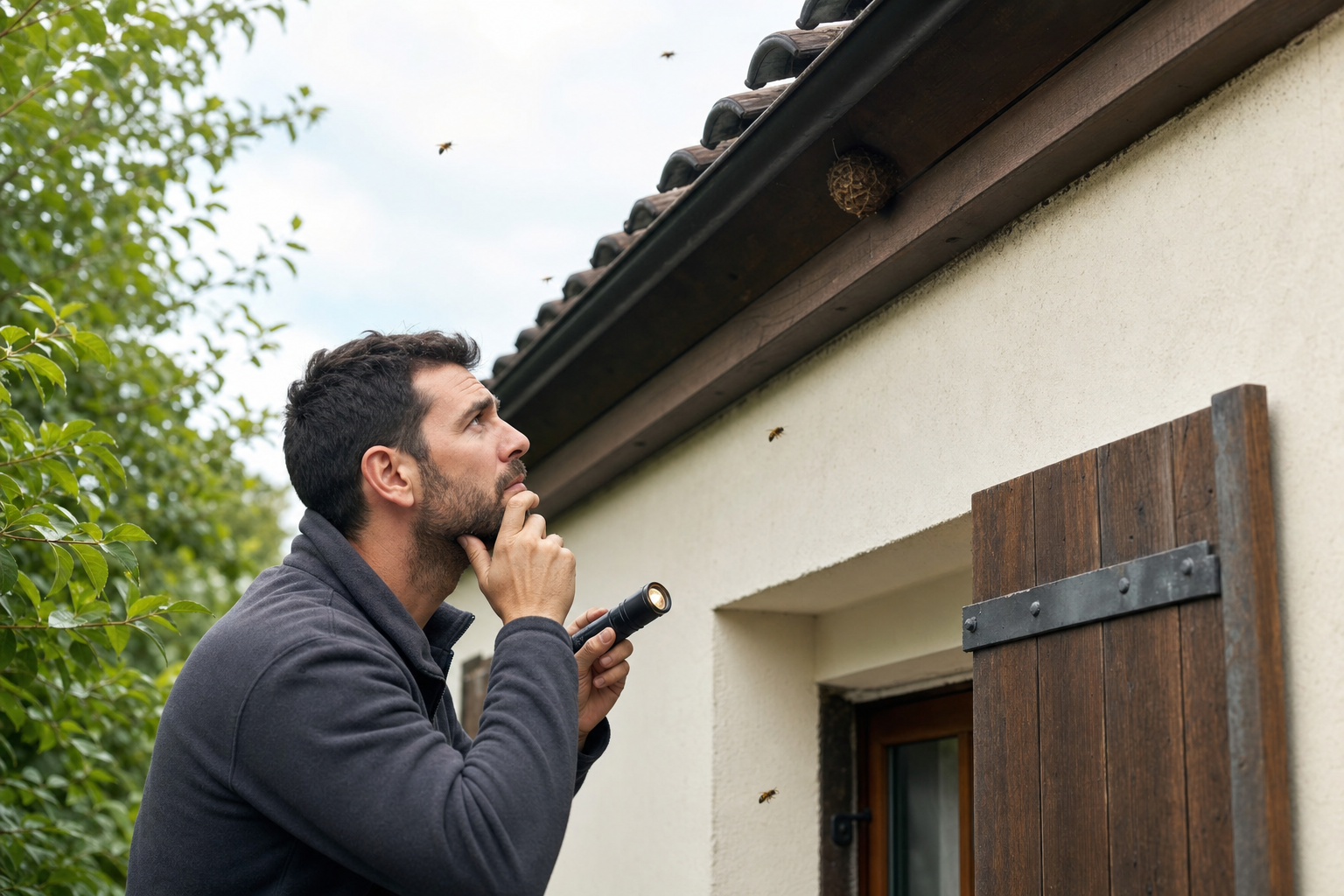
The roof—the champion in every category. A wasp nest under the roof is a classic Belgian problem. The insects slip in between two misaligned roof tiles, under the ridge, behind a damaged fascia board, or through a roof vent. You can’t see anything from the ground, but if you watch the edge of the roof for a couple of minutes and notice wasps disappearing in the same spot every time, you’ve found the entrance.
Roller shutter boxes. Warm, dry, sheltered, with a perfect opening to get inside. When residents tell me they hear scratching behind the bedroom wall, that’s the first place I check. The same goes for blind boxes, false walls, and the spaces behind siding.
The attic and the loft. How can you tell if there’s a wasp nest in your house? You’ll often see isolated worker wasps pressed up against a window on the top floor, along with a few very fine wood shavings falling to the floor. A wasp nest in the house is almost always located in a space that no one opens: the attic, the basement, a drop ceiling, a utility shaft, or behind a piece of furniture that’s never been moved.
The garden: another hunting ground. A wasp nest in the garden can be suspended (in a dense hedge, laurel bush, garden shed, tool shed, or under a pergola) or underground. German wasps love to reuse an old field mouse burrow, an abandoned molehill, or the space beneath a wooden deck. If you see wasps emerging from a hole in the lawn, do not mow that area under any circumstances: the vibrations from the mower trigger the most violent attacks of the summer.
The corners we tend to forget. Mailbox, closed-top grill, folded-up umbrella, trailer trunk, unused doghouse, outdoor electric meter, pile of firewood. I’ve already removed a nest the size of a soccer ball from a set of patio furniture that had been covered with a tarp all winter.
A word about the Asian hornet: it’s in a league of its own. Its primary spring nest is hidden under a shelter (carport, shed, door frame, or under a gutter) and is about the size of a tennis ball. Then, in the summer, the colony moves to a secondary nest, often perched 10 or 15 meters up in a tree, invisible until the leaves have fallen. That’s why we keep looking for them in November and December.
Observation Method: How Can We Track Wasps Back to Their Nest?
That’s the crux of the matter. Locating a wasp nest isn’t about looking for the nest—it’s about following the insects that lead you to it. A worker wasp returning to the nest flies in a straight line, without detours, at a constant altitude. This flight path is your breadcrumb trail.
Choose the right moment. Between 10 a.m. and 5 p.m. on hot, dry days, when traffic is at its peak. Avoid windy or rainy conditions and the early morning. Position yourself five or six meters from the suspicious area, remain still, and watch for a good ten minutes. Patience accounts for 90% of the work.
That thing about spots that sparkle in the sun. Stand with your back to the sun or slightly backlit: the wasps’ wings catch the light and turn into tiny sparkling dots darting through the air. You’ll then see what you couldn’t see before—a veritable highway of insects. Count the traffic: more than 15 round trips per minute to the same spot indicates a mature nest, not just foragers passing through.
Use triangulation. Note the direction of flight from an initial observation point, then move fifteen meters to the side and repeat the process. The intersection of the two directions gives you the approximate location of the nest, within a few meters. This is the same method beekeepers have always used to track wild swarms. Then, narrow down the location by getting closer, but never within three meters.
Use bait. A piece of chicken breast, fish, or a slice of ham left on a plate attracts wasps and hornets in late summer. Once a worker has loaded up her meat ball, she heads straight back to the nest. Follow her with your eyes as far as possible, move forward ten meters, and repeat. After three or four such passes, you’ll often stumble right upon it.
Listen. At dusk, when the house grows quiet, press your ear against the suspicious wall or ceiling. An active nest produces a steady rustling sound, sometimes accompanied by a faint crunching sound like paper mache. This is often how you detect a nest inside a wall, even before you see a single wasp outside.
Think about who you're following. Identifying the Asian hornet is easy once you know the key features: a completely black, velvety thorax; a dark abdomen with a single broad orange band; and, most notably, yellow tips on its legs. It measures 2.5 to 3 cm, smaller than the European hornet, which is noticeably more reddish and yellow. Another unmistakable clue: its helicopter-like hovering in front of a beehive or flowering ivy. If you see this, make a note of the location and let us know. Every nest detected means thousands of bees saved.
Hidden Nests and Safety: What Should You Do Once You've Found the Nest?
You’ve spotted the entrance. Your first reaction should be to back away. A wasp nest at the height of the season is home to between 2,000 and 6,000 wasps; an Asian giant hornet nest can also contain up to 2,000 hornets, and they defend a perimeter of several meters. Stay at least five meters away—even further if the nest is underground or high up.
Here's what you should never do—and I see it every summer:
-
Plug the entry hole. Wasps dig another exit, often leading into the house. That's how you end up with three hundred wasps in a child's bedroom.
-
Splash water on it, burn it, or hit it. You launch a massive attack, and a fire breaks out on a roof—we know what happens next.
-
Use a commercial spray on an inaccessible nest. It kills the hundred or so worker bees present, but not the queen or the brood. Two weeks later, everything is back to normal.
-
Climb the ladder. Most serious accidents are not caused by the stings themselves, but by the fall that follows the panic.
How do you destroy a wasp nest that you can’t see, inside a wall or under a roof? That’s the real headache. A hidden nest is treated through the entrance hole, using a telescopic pole and a suitable product injected in the right spot at the right time of day. The contaminated workers carry the treatment back into the nest, and the colony dies off within 24 to 48 hours—without you ever seeing the nest. That’s precisely what a pest control expert does: treat what’s invisible, without having to open up your ceiling.
While waiting for the technician to arrive, close the windows on the affected side, seal off the room if the nest is inside, keep children and pets away from the area, and do not turn on any lights near the entrance at night. Mark the spot with tape or take a clear photo—this will save the technician valuable time.
When it comes to dealing with Asian hornets, the rule is even stricter: never, ever try to handle the situation yourself. This species attacks from several meters away from the nest and stings repeatedly. Please report the location—even if it’s only approximate—along with a photo if you can take one from a distance. We respond year-round, including in winter when secondary nests become visible in bare trees, because spotting a nest in January can sometimes help us determine where the queen wasps will settle the following spring.
One last point, and it’s an important one: not all nests need to be destroyed. A small paper wasp nest under a garden shed, with its bare cells and about twenty peaceful individuals, doesn’t warrant treatment. Wasps eat caterpillars and flies by the kilo; the colony dies off naturally with the first cold snap, and the nest is never reused the following year. You should only treat nests that pose a real risk—those near a walkway, a patio, or an entrance.
Conclusion
Finding a wasp nest is all about observation, not brute force. Look for likely hiding spots, sit down, follow the glints of light in the sun, use triangulation, and listen to the walls at night. In twenty well-spent minutes, you’ll know where it is. And you won’t have touched a single tile.
Next, leave it to those who have the right equipment and protective suits. Not sure what species it is? Is there a nest high up, a buzzing sound in a wall, or even the slightest suspicion of an Asian hornet? Contact Frelons.be: we’ll come out, identify the problem, and treat it only when necessary. All year round, summer and winter.
Frequently asked questions
At what time of day should you watch for wasps to locate their nest?
The best time is between 10 a.m. and 5 p.m., on hot, dry days, when worker bee activity is at its peak. Avoid windy or rainy conditions and the very early morning. Set up about five or six meters from the suspected area, stay still, and observe for a good ten minutes: patience accounts for 90 % of the work.
How can you tell if the nest is hidden in a wall or a partition?
In the evening, when the house is quiet, press your ear against the suspicious wall or ceiling: an active nest produces a steady rustling sound, sometimes accompanied by a faint crunching sound like paper mache. Other clues reveal an indoor colony, such as isolated workers wedged against a top-floor window and fine wood shavings falling to the floor.
Where are the most common places for a nest to be built in a home?
The roof is the most common entry point in our area: between two misaligned tiles, under the ridge, behind a damaged fascia board, or through an under-roof vent. Next are roller shutter boxes, attics, basements, and drop ceilings, as well as the garden, where German wasps readily reuse an old field mouse burrow or the space beneath a wooden deck.
How can you tell an Asian Hornet from a European Hornet?
The Asian hornet has an entirely black, velvety thorax, a dark abdomen with a single broad orange band, and, most notably, yellow legs at the tips; it is 2.5 to 3 cm long. The European hornet is distinctly more reddish-brown and yellow. Another unmistakable sign: its helicopter-like hovering in front of a beehive or flowering ivy.
What should you absolutely avoid once you've located the nest?
Never block the entrance hole: wasps will dig another exit, often into the house. Don’t spray water on it, don’t burn it, don’t hit it, and don’t use store-bought insecticide on an inaccessible nest—it kills the workers but not the queen or the brood. Also, avoid using a ladder: the fall that follows a panic causes more serious accidents than the stings themselves.
Should you always destroy a wasp nest?
No. A small paper wasp nest under a garden shed—with its bare cells and about twenty peaceful wasps—does not warrant any treatment: wasps devour caterpillars and flies by the kilo, the colony dies with the first cold snap, and the nest isn’t reused the following year. Action should only be taken when there’s a real risk, such as near a walkway, a patio, or an entrance.
 French
  English
  Dutch
Dutch
0 Comments