
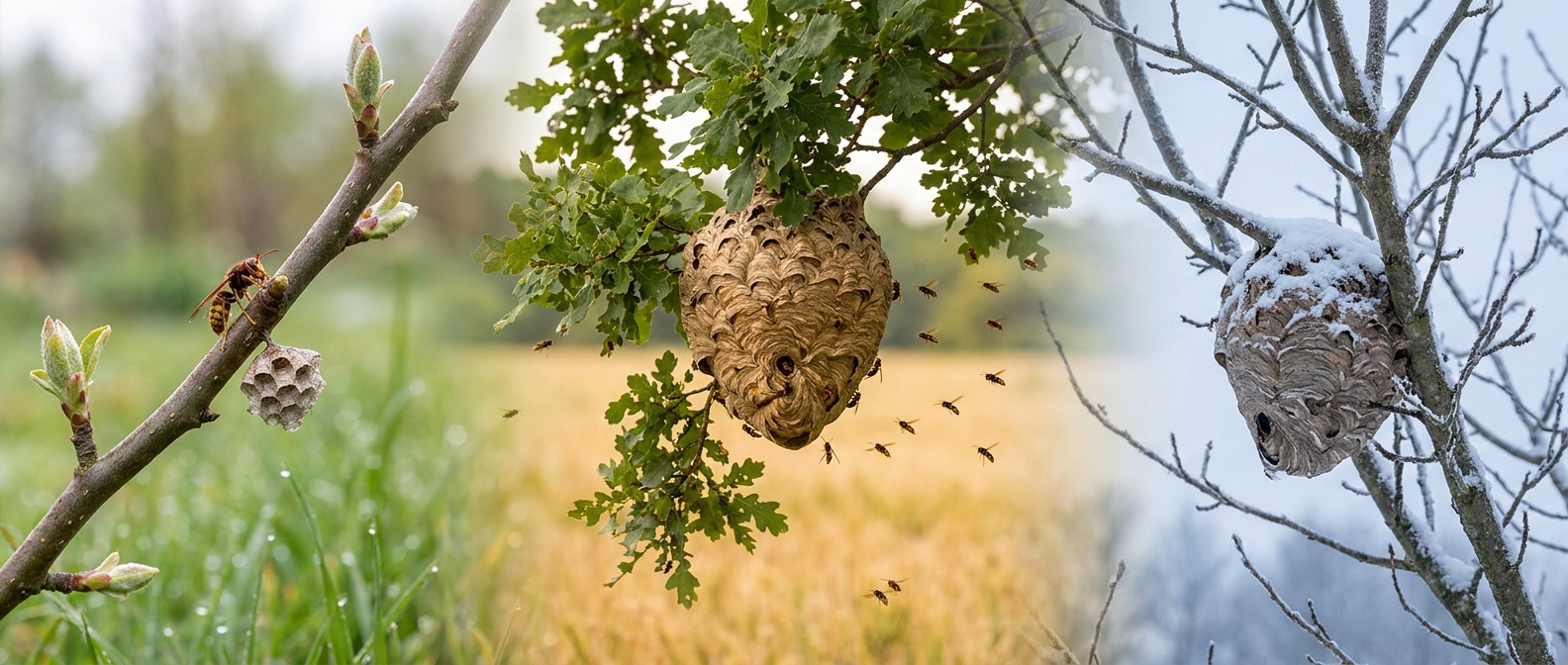
The Asian Hornet Life Cycle, Month by Month: The Definitive Guide
Contents
-
Spring Awakening: The Basics of the Life Cycle and the Founding of Colonies
-
The Reproductive Phase and Hibernation: The Final Cycle in Winter
The Asian hornet doesn’t just show up out of nowhere in the middle of summer. Its story begins much earlier, quietly, in a corner of your attic or under an eave. And if you understand how this insect lives throughout the seasons, you’re already one step ahead in dealing with it.
Things to remember
-
This article stands as the definitive reference, analyzing the complex biology of Vespa velutina through a rigorous chronological lens
-
Unlike simplistic guides, we link each biological phase to specific environmental indicators, underscoring Frelons.be’s expertise.
-
in monitoring and proactively combating this invasive species throughout the year
-
The basics of the cycle and the founding of the colonies
Vespa velutina follows a remarkably precise schedule. Each month corresponds to a well-defined biological phase, each with its own vulnerabilities. A solitary queen in the spring, a colony of several thousand individuals in the fall, and then the death of the entire nest in the winter—except for the future queens, who will set out to fight again the following year.
At Frelons.be, we track this cycle all year round—not just when the nests become visible and everyone starts to panic. So here’s the Asian hornet’s life cycle, month by month, broken down phase by phase, so you’ll know exactly when to take action.
Spring Awakening: The Basics of the Life Cycle and the Founding of Colonies
It all starts with a single female. In March—sometimes as early as late February if the winter has been mild—the Asian hornet queen emerges from her winter shelter. She is known as the founder. She spent the cold months hidden under a pile of wood, in an old wall, or under the bark of a tree, and now she has a mission: to start a new colony all on her own.
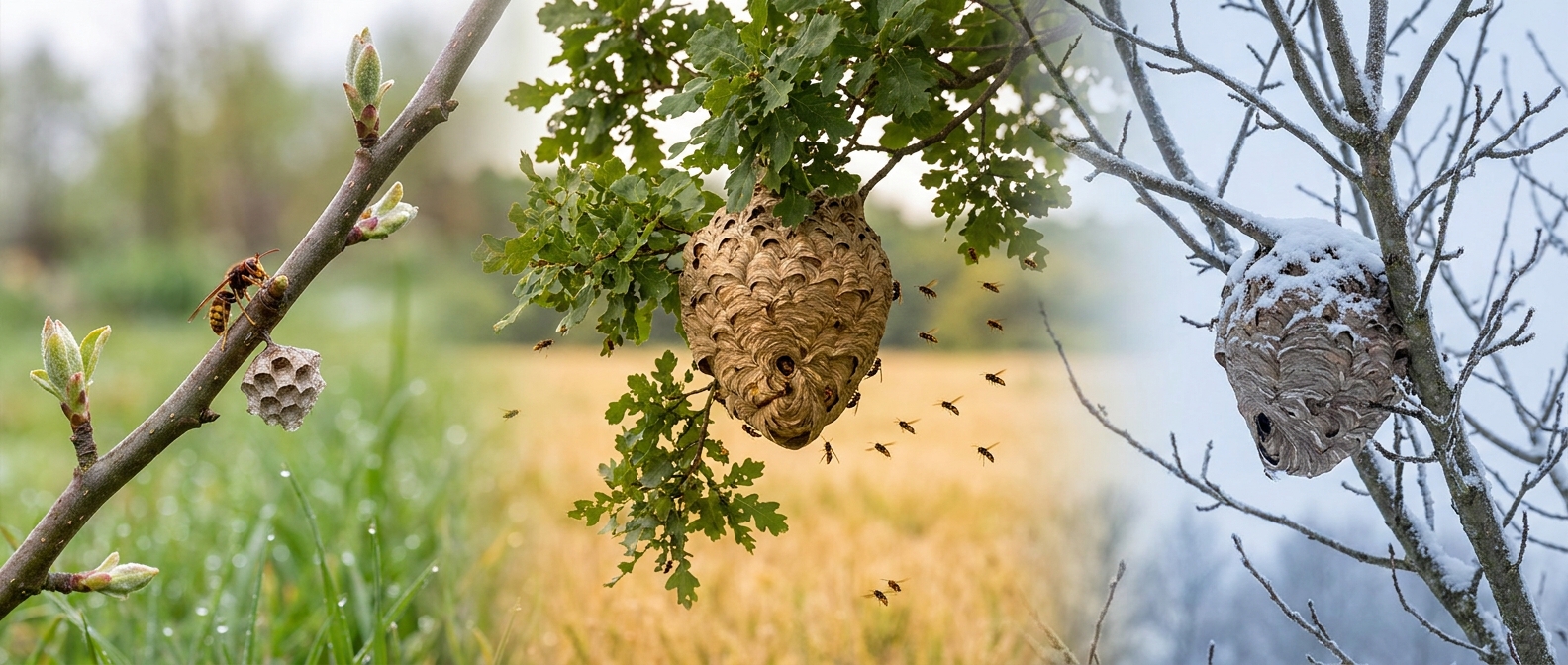
During her first days outdoors, she feeds mainly on sugars—tree sap, spring flowers, anything that restores her energy after her winter fast. Once she has regained her strength, she looks for a sheltered spot and begins to build her primary nest. This first nest is small, about the size of a tennis ball or an orange, and is often built in a spot sheltered from the rain: a garden shed, a storage shed, under a patio, or in a garage with the door slightly ajar.
In April, the founder lays her first eggs and takes care of everything on her own. She builds the cells, hunts to feed the larvae, and maintains the nest. This is the most vulnerable moment in the entire life cycle of the Asian hornet. A single queen, without help, completely exposed. If she disappears now, the colony will never come into existence.
That is precisely why the spring trapping It makes sense. Catching a queen in March or April means eliminating an entire colony at once—one that could have numbered in the thousands by fall. The math is simple. Be careful, though: improper trapping can also catch beneficial insects. It’s better to use selective traps and keep a watchful eye.
Toward the end of spring, the first worker bees emerge. From that point on, the queen stops going out. She devotes herself entirely to laying eggs, while her daughters take over everything else. The colony grows in size. And that’s when things really start to pick up speed.
Summer and Fall Expansion: Nest Function and Development
Once the first female workers Once they are operational, the colony goes into overdrive. They resume building the nest, expand it, hunt, and feed the new larvae. The queen does nothing but lay eggs. As a result, the nest grows at an impressive rate between June and August.
The colony often moves. The primary nest becomes too small or is in a bad location, so the hornets build a secondary nest, usually much higher up. In the treetops, under a roof truss, or in a dense bush. This nest can grow to the size of a basketball, or even larger. In July and especially in August, it becomes enormous and can house several thousand workers.
This is also the time of year when the Asian hornet is most hated. The predation is in full swing. To feed all these hungry larvae, the workers need protein, and their favorite target is the honeybee. They hover in front of the hives and catch the foragers as they return. A single nest can decimate a bee colony in just a few weeks. Beekeepers know this all too well, and the pressure is at its peak in the middle of summer.
When should you be concerned about a nest? As soon as you spot it, frankly. In the summer, an active nest is already well-developed, and hornets will aggressively defend their territory if you get too close. Never try to destroy it yourself. A disturbed nest means hundreds of hornets swarming out all at once. This is the kind of situation where you call in professionals with the right equipment.
The behavior of hornets at this time of year is quite fascinating, it must be said. Each worker has her own role, and the division of labor is incredibly efficient. The nest functions like a small factory churning out hornets. And as summer progresses, the colony prepares more and more for what’s to come: the next generation. Because a nest, as imposing as it may be, has only one ultimate goal: to reproduce before winter.
The Reproductive Phase and Hibernation: The Final Cycle in Winter
Around September–October, the colony enters its final phase. Until then, the queen had produced only sterile workers. Now, she lays fertile individuals: males and future sexed queens. This marks the major turning point in the cycle. The colony stops growing for its own sake and begins to produce the generation that will replace it.
Next comes the phase of reproduction. The males and young queens leave the nest to mate. Once fertilized, these queens have only one goal: to survive the winter. They gorge themselves on sugars to build up reserves, then set out to find a secluded and hidden shelter. The males, on the other hand, die shortly after mating. Their role ends there.
This is also the time when many people wonder when the Asian hornet season ends. The answer comes with the cold weather. In November, the original queen dies, along with the last of the workers, and the nest empties completely. It’s worth knowing that an abandoned nest will never be reoccupied the following year. There’s no need to worry about it once winter has set in.
As for the future queens, they enter diapause. It’s a kind of deep hibernation that protects them from freezing. They tuck themselves under bark, in a pile of leaves, or in a crack in a wall, and slow down their entire metabolism. In December, they are completely motionless, invisible, and waiting. Of all those that hibernate, very few will actually survive the winter. The cold, predators, and disease eliminate a large portion of them.
But those that survive will become queens again the following spring. And the cycle begins anew. That’s why taking action early in the year, right when they emerge from hibernation, remains the most effective strategy. Understanding the Asian hornet’s life cycle means knowing where and when to strike. Every season has its weakness.
Conclusion
The Asian hornet is not an unpredictable enemy. Its life cycle is as predictable as clockwork: a solitary founder in the spring, an explosive colony in the summer, reproduction in the fall, and then the winter diapause of the future queens. Each phase has its moment of vulnerability, and that’s when we can really make a difference.
Targeted trapping in the spring, monitoring nests in the summer, and staying vigilant in the fall: it all comes down to knowing the timeline. Are you unsure about a nest, have you noticed suspicious activity in your yard, or do you simply want to be sure? Contact Frelons.be. We’re here year-round, at every stage of the cycle, to protect your environment and your bees.
Frequently asked questions
When do Asian hornet queens emerge from hibernation?
Queen ants generally reappear between late February and April, depending on the temperature. They begin by feeding, then look for a sheltered spot to build their first nest and lay their eggs.
When is the primary nest built?
The primary nest develops mainly in the spring. It is often built at a low height under a shelter, in a garage, a shed, a hedge, or under a roof overhang. At this stage, it remains relatively small and houses only a queen and her first workers.
When does the Asian hornet build its secondary nest?
Between June and August, the colony may build a larger secondary nest, often high up in a tree or under a roof. Not all colonies move, but those that do gradually abandon their first nest.
When are Asian hornets most active?
Activity generally peaks between August and October. At that time, the nest contains many workers and gradually produces males and future queens. This is also the period when pressure on the hives and risks near the nest are at their highest.
Does an Asian hornet nest remain active in the winter?
No. As the weather gets colder, the old queen, the worker bees, and the drones gradually die off. Only the young, fertilized queens overwinter elsewhere. The abandoned nest is not normally reused the following year.
When is the best time to destroy an Asian hornet nest?
An active nest must be reported and treated as soon as it is discovered, without waiting for it to grow larger. Early intervention limits the production of worker bees and future queens. In winter, destroying a completely abandoned nest generally serves no biological purpose.
 French
  English
  Dutch
Dutch
0 Comments