

Hornet's nest in Sint-Pieters-Leeuw: our local response
Contents
-
Hornet Emergency in Sint-Pieters-Leeuw: Contact Information and Reporting Procedures
-
Identification and Safety Guide for Residents of Leeuw-Saint-Pierre
Last week, a resident of Vlezenbeek called us late in the morning. His voice was tense, his sentences short: «There’s something huge under my roof; it’s been buzzing nonstop for three days. » A hornet’s nest in Sint-Pieters-Leeuw—yet another one. Since the start of the season, we’ve been responding to an increasing number of calls in the town and its surroundings, from Zuun to Ruisbroek.
Things to remember
-
An immersive guide based on a real-life event in Sint-Pieters-Leeuw
-
We combine practical reporting information with an ultra-local on-the-ground account (from the Vlezenbeek neighborhood) to demonstrate our expertise and our close connection with the residents of the 1600th district
-
Contacts and reporting procedures
-
Removal of an Asian hornet nest in Vlezenbeek
What’s striking is that many residents don’t know who to turn to when they discover a nest. The fire department? The local government? A private professional? The answers vary, and in the meantime, the nest keeps growing. We’ve decided to put everything we know down in black and white: how to report it, who to contact, how much it costs, and most importantly, what we actually do when we arrive at your home to remove a hornet’s nest in Leeuw-Saint-Pierre.
This article serves both as a practical guide and as an account of a real-life incident. Because understanding what happens on the ground is reassuring. And it helps you make the right decisions at the right time.
Hornet Emergency in Sint-Pieters-Leeuw: Contact Information and Reporting Procedures
First things first: in Belgium, the Leeuw-Saint-Pierre Fire Department no longer automatically responds to reports of wasp or hornet nests. The policy changed a few years ago. Unless there is an immediate danger on public roads, they will refer you to a licensed pest control professional. This surprises a lot of people, but it’s the reality. There’s no point in calling 112 for a nest in your yard—you’ll just be wasting your time.
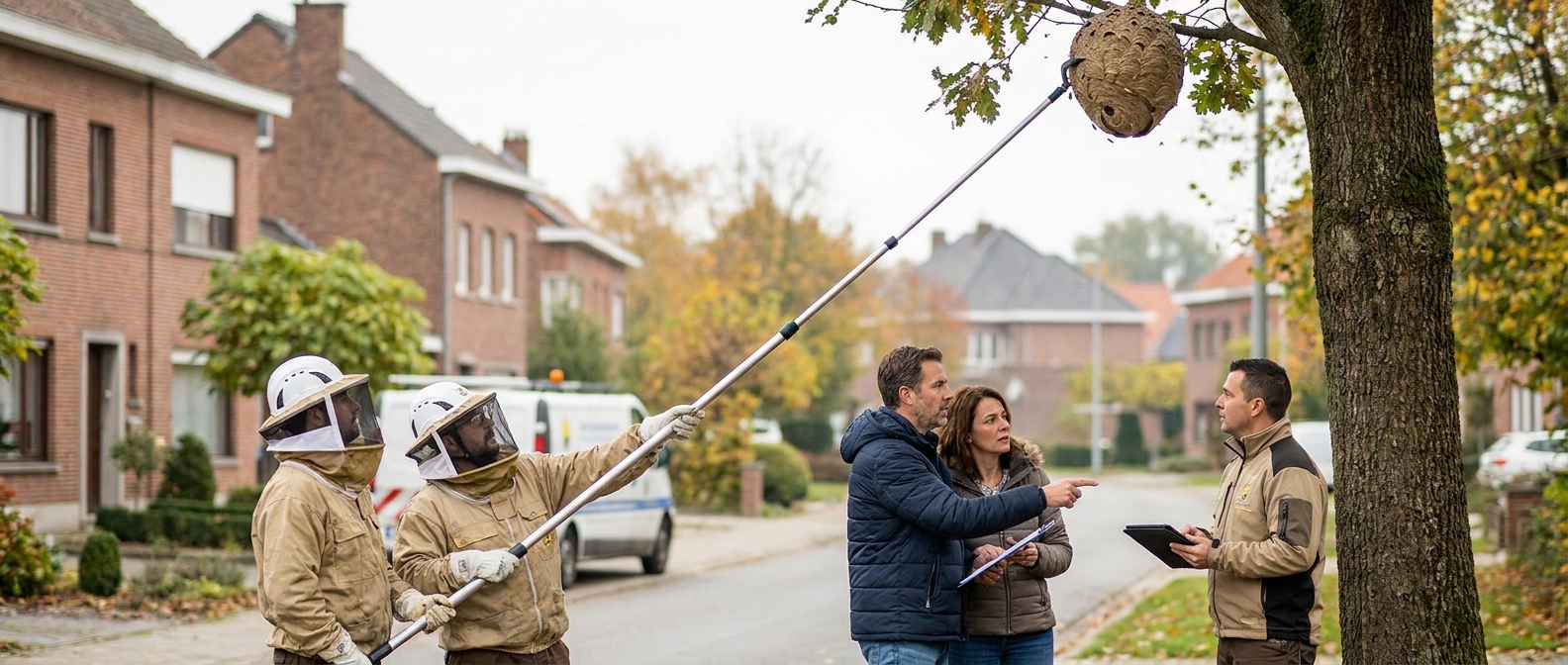
To report a hornet's nest in Sint-Pieters-Leeuw, the procedure depends on the species. If you suspect an Asian hornet (we'll discuss how to identify one below), you should report it via the platform vespawatch.be. This is the official channel in the Flemish Region. You take a photo, upload it to the website along with the location, and a network of Vespa Hunters verifies the identification. The Vespa Hunter assigned to Sint-Pieters-Leeuw can then take action to destroy the nest as part of the regional plan.
For European hornets and wasps, the situation is different. Reporting is not required, but removal is just as necessary when the nest is near a residential area. In that case, you should contact a pest control professional in the 1600 area code directly.
Here are the specific steps:
-
Identify the insect (Asian hornet, European hornet, wasp). If you’re not sure, take a photo from a distance.
-
If it is an Asian hornet: report it on vespawatch.be and contact us at the same time.
-
If it’s a European hornet or wasps: call a local pest control expert right away.
-
Don't touch anything. No DIY projects with a garden hose, no open flames, and no insecticide sprays from the supermarket. We see this happen way too often, and it never ends well.
The question of how much it costs to remove a hornet’s nest comes up with every call. Let’s be transparent: for wasp nest removal in the 1600 area, expect to pay between 80 and 150 euros, depending on accessibility. A nest under a roof tile six meters up is not the same job as a nest in a hedge at eye level. For an Asian hornet nest, the price may be slightly higher because the procedure is more involved: full-body suit, specialized product, and removal of the nest after treatment to prevent secondary contamination.
Some municipalities in Flemish Brabant offer subsidized removal services for Asian hornets. In Sint-Pieters-Leeuw, contact the municipality’s environmental department for more information. The terms and conditions vary from year to year, but financial assistance is available and can cover a significant portion of the cost.
One last important point: urgency. A hornet’s nest in Sint-Pieters-Leeuw in the middle of summer isn’t something you can put off. Nests double in size within a few weeks. The longer you wait, the more complex and costly the removal will be. If you spot any suspicious activity—even a small primary nest the size of a tennis ball in the spring—it’s time to take action.
Case Study: Removal of an Asian hornet nest in Vlezenbeek
Mid-August, 10:30 a.m. We received the call I mentioned in the introduction. The homeowner lives in a detached house in a quiet neighborhood in Vlezenbeek, near the park. He’s noticed unusual activity on his roof for the past few days. His seven-year-old daughter plays in the yard every afternoon. You can understand the urgency.
We arrive at 2 p.m. Our first instinct: to observe from a distance. Through binoculars, we spot the entrance to the nest under the eave on the southwest side. The flow of insects is steady, with one landing every three to four seconds. That’s a sign of a well-established colony. Not a small primary spring nest, no. A mature secondary nest.
There’s no doubt about it: yellow legs at the tips, a dark thorax, and an abdomen with a single orange segment. It is indeed the Asian hornet in Leeuw-Saint-Pierre, Vespa velutina. This is immediately reported on the tracking platform.
Access is the first challenge. The nest is about five meters above the ground, wedged between the roof sheathing and a roof overhang. It’s impossible to reach it from the inside without risking damage to the nest. We opt for an exterior approach, using a telescopic pole equipped with an injector.
We put on our suits. Not the standard beekeeper’s suits, mind you. For hornet extermination in Flemish Brabant, we use special anti-hornet suits made of fabric thick enough to withstand stings. The Asian hornet is more aggressive than the European hornet when you approach its nest. It attacks in groups. This is no myth.
The biocide is injected directly into the nest entrance. We use an insecticide powder with a residual effect. The hornets that return to the nest in the following hours contaminate the rest of the colony. It’s a radical solution. Within twenty minutes, activity drops noticeably. The insects leaving the nest are disoriented; they fall to the ground.
We return the next morning to completely remove the nest. This is a step that some service providers skip—and they’re wrong to do so. A dead nest left in place can attract other colonies, and it still contains brood that may hatch. We take down the structure, put it in an airtight bag, and take it away. The homeowner watches us from the first-floor window. When we show him the nest, he can’t believe his eyes: 40 centimeters in diameter, hundreds of cells. All of this just two meters from his daughter’s bedroom.
As a local pest control expert, we carry out several of these treatments each week during the season. Every nest is different. Every home presents its own challenges. But we follow a strict protocol, and that’s what sets an effective treatment apart from a dangerous DIY job.
Identification and Safety Guide for Residents of Leeuw-Saint-Pierre
Three insects look alike and can cause confusion: the common wasp, the European hornet, and the Asian hornet. Knowing how to tell them apart is essential. You don’t need to be an entomologist—just a few key characteristics are enough.
The common wasp It measures between 1 and 1.5 cm. It has bright yellow and black stripes that stand out clearly. You’ll often see it flitting around your plate on the patio. Its nest is gray and made of papier-mâché, often found in a garden shed or under an awning.
The European hornet is significantly larger: 2 to 3.5 cm. Its dominant color is reddish-brown with yellow on the abdomen. It flies at night, attracted to light. It looks impressive but is not very aggressive unless you approach its nest.
The Asian hornet (Vespa velutina) is the one that causes the most problems. It is medium-sized, about 2 to 3 cm long. Its distinguishing features: a very dark, almost black body, with a single orange abdominal segment and yellow tips on its legs. If you see this in Sint-Pieters-Leeuw, that’s the one. There’s no doubt about it once you know these characteristics.
Recognizing the Asian hornet is all the more important given its highly aggressive behavior. The danger posed by an Asian hornet nest lies in their collective reaction. If you come within five meters of an active nest, you risk a swarm attack. Dozens of them in just a few seconds. For someone with an allergy, a single sting can cause anaphylactic shock. For others, multiple stings may require hospitalization.
Where is the nest usually located? This is a question we hear often. In the spring, the founding queen builds a small primary nest, often in a sheltered spot: a roof overhang, a garden shed, or a dense hedge. In summer, the colony sometimes moves to a larger secondary nest located high up: a tree top, under the roof, or an unused chimney. In Vlezenbeek and Zuun, with their tree-lined gardens, nests high up in trees are common. In Ruisbroek, a more urbanized area, they are found more often on buildings.
The safety rules are simple:
-
Never approach a suspicious nest. Stay at least five meters away.
-
Never try to destroy a nest yourself. Don’t use water, fire, or a stick. Videos on the internet show what not to do.
-
Keep children and pets away from the area.
-
If you have multiple stings or an allergic reaction (swelling of the face, difficulty breathing), call 112 immediately.
-
Please report any sightings of Vespa velutina in Sint-Pieters-Leeuw, even a single individual. It helps track the species’ spread.
The Asian hornet is an invasive species. It decimates bee colonies, disrupts pollination, and its population will not decline on its own. Every nest destroyed means one fewer queen for the following year. The fight against it is a collective effort, and it begins with vigilance on the part of every local resident.
One often-overlooked point: the fall season. Many people think the problem goes away with the cold weather. The worker bees do die, yes. But the young, fertilized queens leave the nest to overwinter in the ground, in woodpiles, or under tree bark. They will emerge the following spring to establish new colonies. If you spot a nest in October or November, report it anyway. Even a «dead» nest provides useful information for preparing for the next season.
Conclusion
When a hornet's nest appears at your home in Sint-Pieters-Leeuw, every day counts. Identifying the nest, reporting it, and taking swift action make all the difference between a manageable problem and a dangerous situation.
We serve the entire municipality: Vlezenbeek, Zuun, Ruisbroek, and the city center. We’re familiar with the roofs, gardens, and local building styles. This is our territory. If you suspect a nest, hear a suspicious buzzing, or see hornets circling your home, give us a call. We’ll assess the situation, provide a clear quote, and respond quickly. No unpleasant surprises, no unnecessary waiting.
Pest control in the 1600s is part of our daily routine. And your peace of mind is our top priority.
Frequently asked questions
What should you do if you find a hornet's nest in Sint-Pieters-Leeuw?
Never approach the nest within five meters, and do not attempt to remove it yourself. If you suspect it is an Asian hornet, take a photo from a distance and submit a report on the official platform vespawatch.be. For a quick and safe response in the 1600 area, contact our local pest control service immediately.
Do the firefighters in Leeuw-Saint-Pierre destroy hornet nests?
No, the local fire department no longer routinely responds to wasp or hornet nests, except in cases of immediate danger on public roads. For a nest located in your yard or under your roof, they will refer you to a licensed pest control professional. Contacting our local team directly saves you valuable time.
How much does it cost to remove a hornet's nest in Vlezenbeek or Zuun?
The cost of removing a standard wasp or hornet nest generally ranges from 80 to 150 euros, depending on its accessibility (height, under the roof, etc.). For Asian hornets, the cost may be slightly higher due to strict safety protocols and the specific equipment required. Please note that the Sint-Pieters-Leeuw Environmental Department sometimes offers financial assistance or subsidies, depending on the time of year.
How can you tell an Asian Hornet from a European Hornet?
The Asian hornet (Vespa velutina) is distinguished by its very dark, almost black body, a single orange abdominal segment, and bright yellow tips on its legs. In contrast, the European hornet is larger, has reddish-brown coloring, and features an abdomen that is mostly yellow and black, similar to that of a large wasp.
Why is it urgent to destroy an Asian hornet nest?
The Asian hornet is an aggressive invasive species whose colony grows at an exponential rate during the summer, sometimes reaching the size of a basketball. The longer you wait, the greater the risk of a dangerous swarm attack on your family and neighbors in Leeuw-Saint-Pierre. Furthermore, every nest removed helps protect local bee populations and biodiversity.
 French
  English
  Dutch
Dutch
0 Comments