
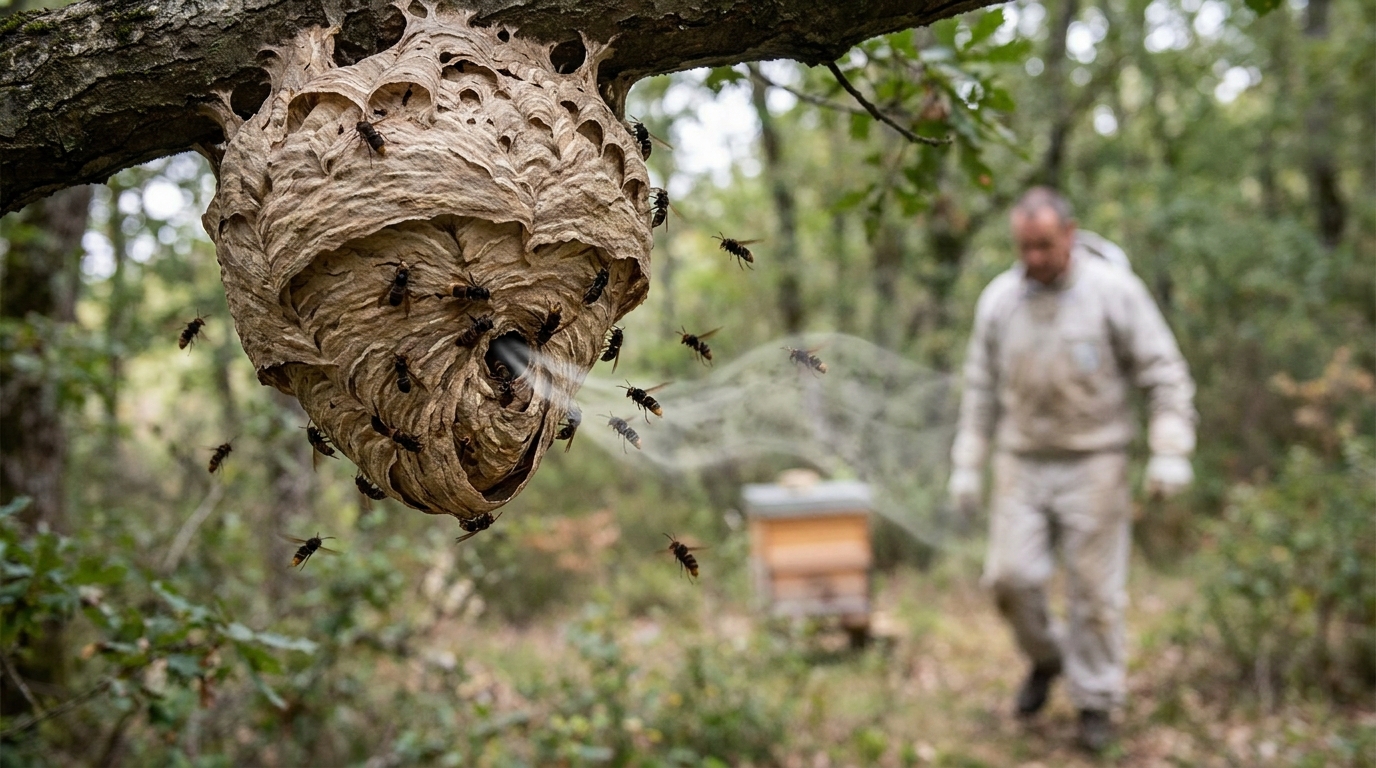
Can the Asian hornet attack in a coordinated swarm?
Contents
A gardener trimming his hedge on a Sunday morning. A hiker who gets too close to a hollow tree. A beekeeper opening a hive at the wrong moment. Three banal situations, yet each can trigger a mass hornet attack in a matter of seconds. Not an isolated sting: dozens, sometimes hundreds of insects swarming towards you in a coordinated fashion.
Things to remember
-
We go beyond the simple fact to explain the science of collective attack
-
By deciphering the role of warning pheromones, we offer a pragmatic safety guide to understanding how and why this insect mobilizes its swarm with lightning speed.
-
how the hornet organizes itself
-
survival reflexes in the face of an attack
The Asian hornet, Vespa velutina, is not just an invasive insect you see on the news when it's hot. It's a social, organized predator, capable of mobilizing its entire colony to defend its nest. And when we say «coordinated», we don't mean it as a figure of speech. There's a real chemical communication system behind it all, a frighteningly effective mechanism that transforms a peaceful swarm into a war machine in less than ten seconds.
Let's take a look at how it works, what to do (and what not to do) if you find yourself in this situation, and why bees are the first victims of this invasive species. There's no need to panic, but there's no need to be naive either: the danger from the Asian Hornet is real, and it's best to understand it to protect yourself.
The mass attack mechanism: how the hornet organizes itself
Imagine a silent, invisible, yet highly effective alarm system. That's exactly what alarm pheromones are at Vespa velutina. When a hornet feels threatened, or is crushed (more on this later), it releases a chemical cocktail into the air. This signal is picked up within seconds by the other members of the colony. The result: what was once a single agitated hornet becomes an organized collective attack.
There's nothing random about this social behavior. The hornet's nest functions like a military society. There are guardian workers posted at the entrances, scouts patrolling a perimeter around the nest, and workers inside ready to emerge as reinforcements. When the alert pheromone is detected, the message spreads from one to the next. The guards come out first, followed by the reinforcements. In a matter of seconds, you can have 30, 50, sometimes more than 100 hornets flying around you.
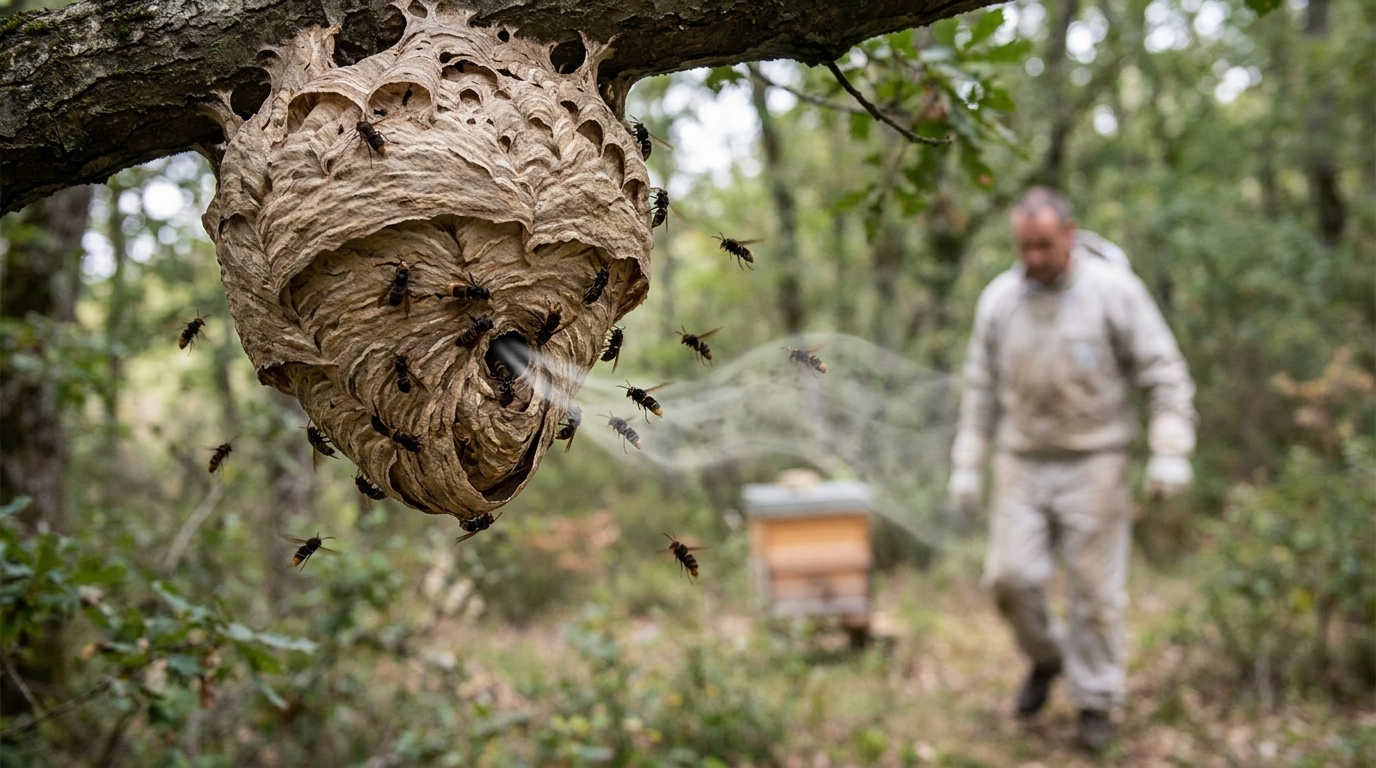
Nest defense is the colony's top priority. A mature Asian hornet nest can house between 1,500 and 3,000 individuals at the height of summer. Fortunately, not all of them emerge at the same time, but the fraction that does mobilize is more than enough to inflict serious damage. Hornets don't sting at random: they target anything that moves, anything dark (dark clothing is more attractive), and above all anything that remains within their defense zone.
And let's talk about this zone. It varies according to nest size and season. In spring, when the nest is small, the reaction perimeter is barely a few meters. In autumn, with a nest the size of a washing machine, the safety distance easily climbs to 5 or 10 metres, sometimes more. That's why some people are attacked «for no apparent reason»: they don't even see the nest, hidden in a tree or under a roof.
A detail that changes everything: why is it not advisable to swat an Asian Hornet? Precisely because of those pheromones. When you swat a hornet, its body releases a massive amount of the chemical warning substance. If you're near a nest, this is the worst signal you can send. You've literally sounded the general alarm. The swarm attack that follows is not rabies: it's a genetically programmed defense protocol. The hornet doesn't «choose» to attack you. They're executing a biological program that's millions of years old.
What makes the Asian hornet particularly dangerous compared to the European hornet is the density of its colonies. A European hornet nest rarely exceeds 400 individuals. The Asian Vespa velutina can have five to eight times as many. The defensive response is therefore proportionally more massive, faster and harder to escape.
Danger to humans: survival reflexes in the face of an attack
Three people died in France in just one summer after hornet attacks. A father and his 15-year-old son died after unknowingly disturbing a nest. These are not exceptional cases. Every year, multiple stings by Asian hornets send hundreds of people to emergency departments in France and Belgium.
Let's be clear about one thing: a single Asian hornet sting is generally not fatal for a non-allergic person. It hurts a lot more than a wasp sting, because the stinger is longer and the venom more concentrated. But the real danger is quantity. In a mass hornet attack, a person can receive 20, 50 or even more than 100 stings in a matter of minutes. At this stage, even without an allergy, the volume of venom injected can cause kidney failure, heart problems or toxic shock.
For allergy sufferers, a single sting is enough to trigger anaphylactic shock. Symptoms: rapid swelling of the face and throat, difficulty breathing, drop in blood pressure, loss of consciousness. Without an injection of adrenaline within minutes, it's potentially fatal.
So what should you do if you are attacked by a hornet swarm? Here are the emergency measures that can save your life:
-
Run away. Quickly. Without hesitation. Don't stay in place to protect your face. Run for it. Hornets defend a perimeter. If you step outside, they'll stop the chase. Move at least 50 meters away, ideally more.
-
Don't fidget on the spot. Sudden movements without displacement only excite the insects more. If you move, move to get away, not to struggle.
-
Protect your face and neck during the escape. These are the most vulnerable areas. A piece of clothing, a bag, anything.
-
Don't jump into the water. Contrary to popular belief, hornets will be waiting for you at the surface. Eventually, you'll need to breathe, and they'll be there.
-
Take refuge in an enclosed space if possible: car, house, garden shed. Close all openings.
After the attack, if you have received more than 10 stings, go to the emergency room. Even if you feel fine immediately. The effects of the venom can be felt several hours later, particularly on the kidneys. If you notice abnormal swelling, breathing difficulties or dizziness after even a single sting, call 15 (or 112 in Belgium) immediately.
The safe distance from a spotted nest is at least 5 meters, and even that's a minimum. In autumn, when colonies are at their peak, you're looking at 10 to 15 metres. Never try to destroy a hornet's nest yourself. Not with a hose, not with fire, not with a stick. Every year, people end up in hospital because they tried to «solve the problem» on their own. Call in equipped professionals. That's what we do at Frelons.be, and we intervene all year round, not just in summer.
Why does the Asian hornet attack bee swarms?
When we talk about the danger of the Asian hornet, we first think of humans. But its first victims, those it actively and methodically targets, are bees. Predation on beehives is at the heart of its way of life, and this is where the impact on biodiversity becomes truly worrying.
Vespa velutina is a specialized hunter. Workers hover in front of the entrance to a hive, some 30 cm away, and intercept the bees one by one when they return loaded with pollen. The hornet catches the bee in flight, kills it, cuts off the thorax (the part richest in protein) and brings this «package» back to the nest to feed the larvae. A single hornet can capture between 25 and 50 bees a day.
But the problem goes far beyond direct predation. When several hornets are stationed in front of a hive, the bees eventually stop daring to come out. They stay indoors, stop foraging, and the colony gradually weakens. Less food comes in, fewer reserves for the winter, and the queen lays fewer eggs. In just a few weeks, a strong hive can collapse completely. Beekeepers in Belgium and southern France are familiar with this scenario. Some lose 30 to 50% of their colonies every year due to this pressure.
Why do Asian hornets attack beehives with such obstinacy? Because they're a concentrated, easily accessible, renewable source of food. A beehive means thousands of prey in one place. From the hornet's point of view, it's a supermarket. And unlike Asian bees (Apis cerana), which have developed collective defence strategies such as the «heat ball» (they encircle the hornet and kill it by hyperthermia), our European bees (Apis mellifera) have no effective response. They simply haven't evolved with this predator.
The impact on biodiversity is not limited to domestic beehives. The Asian hornet also drives out wild bees, hoverflies, butterflies and other pollinators. Fewer pollinators means less fruit, fewer seeds and less plant diversity. The domino effect is real and has been documented by researchers at the Muséum national d'Histoire naturelle.
There are several ways to protect bees. Trapping the founding queens in spring, muzzling hive entrances to prevent hornets from gaining direct access to the bees, and above all, systematically destroying nests spotted before autumn, when the future queens have not yet left the colony to found new nests the following year. Every nest destroyed in summer means potentially dozens less the following year.
If you spot a nest or suspicious hornet activity around your hives, don't wait. Report it. Every week of delay means a nest gets bigger, bees die, and intervention becomes more complex and risky.
Conclusion
Yes, the Asian hornet attacks in coordinated swarms. It's not a myth, it's not an exaggeration. It's a precise biological mechanism, triggered by warning pheromones and amplified by the impressive size of the colonies of Vespa velutina. For humans, the risk is serious as soon as you unknowingly approach a nest. For bees, it's an existential threat.
The right reflexes are simple: keep your distance, don't try anything alone in front of a nest, and in the event of an attack, flee without hesitation. If you spot a hornet's nest in your home, garden or near beehives, contact us. At Frelons.be, we intervene all year round to secure your environment and limit the spread of this invasive species. The earlier we act, the less risk there is for you and for pollinators.
Frequently asked questions
Can the Asian hornet really attack in a group?
Yes, the Asian hornet is a social insect capable of launching a coordinated mass attack. When a worker feels threatened or is crushed, she releases warning pheromones that signal the rest of the colony to leave the nest and attack the intruder simultaneously.
Why is it dangerous to swat a hornet near a nest?
Crushing a hornet instantly releases a massive dose of chemical alarm signals. If you are within the defense perimeter (up to 10 meters for a large nest), this will trigger a lightning defensive reaction from the rest of the swarm, which will identify your position as an immediate threat.
What to do in the event of a hornet swarm attack?
The vital reflex is to flee immediately: run as fast as you can for at least 50 meters to get out of their protection zone. Don't try to struggle or jump into the water, just protect your face and neck as you move away to an enclosed area.
How many hornet stings are enough to become lethal?
While a single sting is enough to cause shock in an allergic person, the danger to a healthy person comes from the sheer quantity of venom. Beyond 10 to 20 simultaneous stings, emergency hospitalization is essential to prevent toxic shock or organ failure.
Why do Asian hornets target bee hives?
The Asian hornet is a specialized predator that sees the hive as a protein «supermarket» for its larvae. It hovers in front of the entrance to capture bees one by one, causing such stress that the colony eventually starves to death and stops foraging.
 French
  English
  Dutch
Dutch
0 Comments