
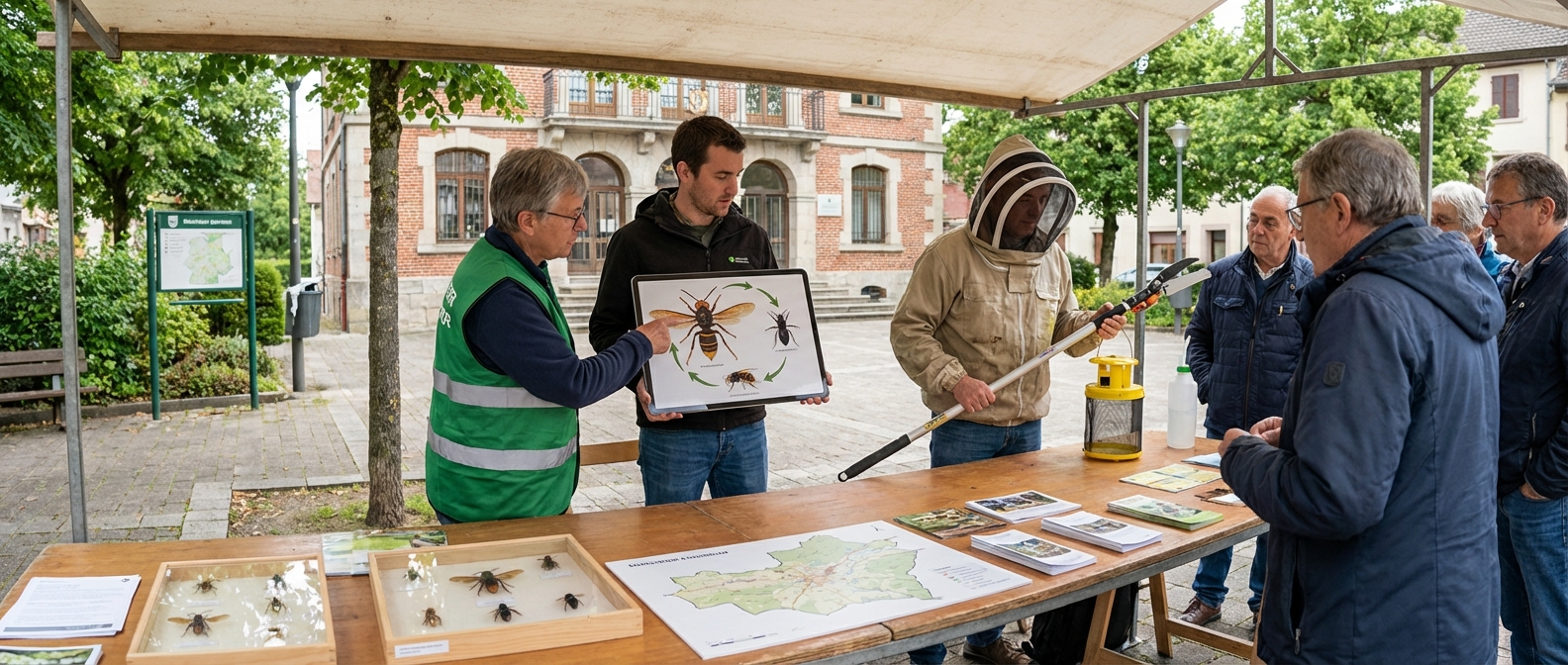
Asian hornets in Woluwe-Saint-Pierre: Instructions for use
Contents
-
Identifying and understanding the presence of the Asian hornet at WSP
-
How to report a nest in Woluwe-Saint-Pierre: Step-by-step guide
-
Local extermination solutions: Who to call and at what price?
Last summer, a neighbor on Avenue de Tervueren found a nest of Asian hornets the size of a football, hidden in his Christmas tree. He hadn't noticed anything for weeks. That's how it often starts in Woluwe-Saint-Pierre: you spot an insect a little too big on a flower, figure it's a European hornet, and move on. But it's not. The Asian hornet has taken up residence in postal code 1150, and has no intention of leaving.
Things to remember
-
This article focuses on Woluwe-Saint-Pierre's strong local roots, explaining the unique synergy between Vespa Hunter 1150 volunteers, the municipal administration and professionals for effective year-round eradication.
-
Identifying and understanding the presence of the Asian hornet at WSP
-
Step-by-step guide
-
Who to call and at what price?
What makes the situation in Woluwe-Saint-Pierre a little different from that in other Brussels communes is the way in which residents have organized themselves. Between the volunteers of Vespa Hunter 1150, the commune which relays reports and the professionals who intervene all year round, there is a real local network. It's just a question of knowing how to use it. That's exactly what this article is all about: giving you the keys to recognizing the bug, reporting a nest correctly and finding the right extermination solution without breaking the bank.
Identifying and understanding the presence of the Asian hornet at WSP
First thing to know: the Asian hornet (Vespa velutina) has nothing in common with the European Hornet. Both are big, both are scary, but that's where the similarity ends. To recognize an Asian Hornet, look at its body. It's mostly black, with a single orange segment on the abdomen. Its legs have yellow tips, as if it were wearing socks. The European Hornet, on the other hand, is much more yellow and brown, with an abdomen striped like an XXL wasp. If you're still unsure, size can help: Asian hornets measure between 2.5 and 3 cm for workers. The queen can reach 3.5 cm, but is still smaller than the queen of the European hornet.
Why is it so important to know the difference? Because the European hornet is a local species, useful in the ecosystem, and protected in certain regions. Killing it by mistake is counter-productive. The Asian hornet, on the other hand, has been an invasive species in Belgium since 2016. It first settled in Wallonia before moving up towards Brussels. In Woluwe-Saint-Pierre, the first confirmed reports date back a few years, and since then, the number of nests discovered has increased every season.
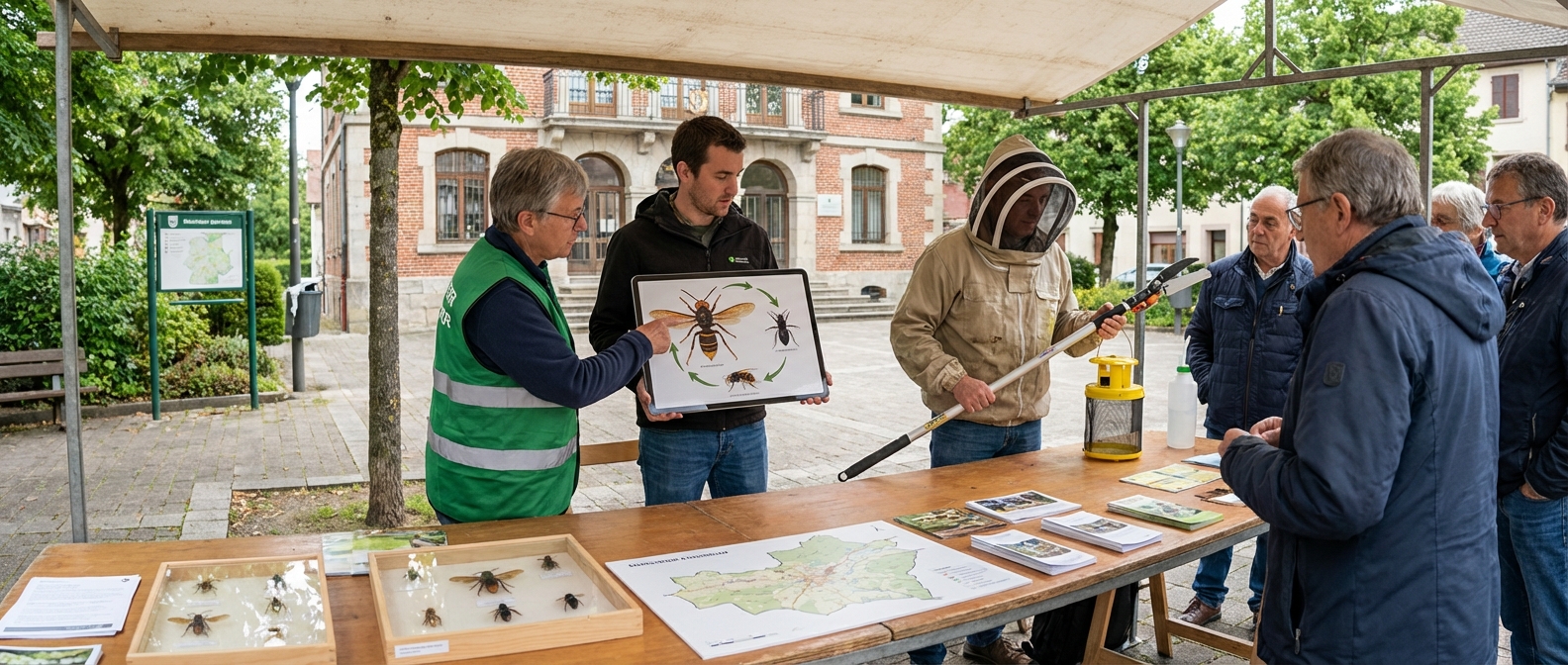
What is it that attracts this species to our commune? Quite simply, the tree-lined gardens. Woluwe-Saint-Pierre abounds in parks, large private gardens and dense hedges. Parc de Woluwe, Domaine des Silex, the outskirts of the Forêt de Soignes: these are all areas where Asian hornets find perfect nesting sites. They build their primary nests in spring (often in shelters, under awnings, in low hedges), then migrate to secondary nests high up in summer, sometimes 15 or 20 meters up in trees.
The real problem is their impact on bees. A single nest of Asian hornets can decimate an entire hive in a matter of weeks. Workers hover in front of the hive entrance and pick off bees one by one. Local beekeepers know all about it: some have lost entire colonies. And beyond the bees, it's the whole local pollination system that suffers.
What should you do if you see one in your garden? Above all, don't try to kill it by hand or with a homemade trap. An isolated hornet is not an immediate danger (it's not particularly aggressive away from its nest), but crushing a few individuals won't make any difference to the colony. The important thing is to find out where they're coming from. If you see several Asian hornets returning to the same spot, there's probably a nest nearby. And that's when you need to report it.
How to report a nest in Woluwe-Saint-Pierre: Step-by-step guide
A suspicious nest in your garden or the neighbor's? Don't panic, but don't delay either. Quickly reporting a nest in the 1150 is what makes the difference between a simple intervention and a nest of 2,000 individuals that needs to be neutralized as a matter of urgency.
Here's how to do it, step by step.
Step 1: Take a photo. It sounds silly, but it's the basics. If you see a hornet or a nest, photograph it. Up close if it's safe to do so, at a distance if not. Volunteers and experts need an image to confirm the species. An Asian hornet nest is pear-shaped, often with a small side opening. Its texture is a bit like grayish papier-mâché. Don't confuse it with a wasp nest (smaller, lighter gray) or a European hornet nest (bottom opening).
Step 2: Contact Vespa Hunter 1150. This is the network of volunteers active in Woluwe-Saint-Pierre. These people are trained to identify Asian hornets and locate nests. You can reach them via their Facebook page «Vespa Hunter 1150 Woluwe-Saint-Pierre» or via the iNaturalist platform for geolocated reporting. They respond quickly, often within the day.
Step 3: Notify the commune too. The municipal administration of Woluwe-Saint-Pierre has set up a reporting channel for Asian hornets. You can contact the Environment Department by telephone or via the online form on the commune's website. This dual reporting system (volunteers + commune) enables data to be centralized and interventions to be organized more efficiently.
Step 4: Use the national platform. Le site comments.be allows you to report an Asian hornet nest anywhere in Belgium. Each report feeds an interactive map that helps authorities and beekeepers track the progress of the species. It takes just two minutes and is useful for everyone.
An important point: never attempt to destroy a nest yourself. Even a small primary nest in spring. Asian hornets become extremely aggressive when their nest is threatened, and their stings are painful, sometimes dangerous for allergy sufferers. People have been known to hose down a nest or try to remove it with a stick. The result: dozens of stings and a trip to the emergency room.
The role of the Vespa Hunter 1150 is precisely to make the link between your report and a safe intervention. They check and confirm the species, assess the size and accessibility of the nest, and then direct you to the right person: the fire department or a private professional, depending on the situation. This field work is invaluable. Without these volunteers, many nests would go under the radar until they reach a critical size in late summer.
Local extermination solutions: Who to call and at what price?
So, how much does it cost to destroy a hornet's nest? It's the question on everyone's lips, and the answer depends on a number of factors.
Let's start with the fire department. In Brussels, the fire department may be called out to deal with a hornet or wasp nest, but this is not always the case. In principle, the fire department intervenes when the nest represents an immediate danger to public safety (nest in a busy passageway, near a school, etc.). The cost of an intervention by the Brussels fire department is generally lower than that of a private service provider, but delays can be long at the height of the season. If your nest is 18 meters away in an oak tree at the bottom of the garden, they're likely to refer you to a professional.
For private professionals, the cost of destroying a hornet's nest varies between 100 and 250 euros on average. Nest extermination rates depend on the height of the nest (a nest accessible by ladder costs less than one requiring a gondola), its size and the time of year. At the start of the season, primary nests are small and easy to treat. In September-October, we come across secondary nests that can exceed 60 cm in diameter, with several thousand individuals. Intervention is more complex and more expensive.
For wasp and hornet extermination in Woluwe-Saint-Pierre, several specialist companies cover the area. At Frelons.be, we work all year round in the 1150 area, including in winter for residual nests. Why in winter? Because an abandoned nest may still contain hibernating queens in the vicinity, and spotting empty nests makes it possible to map areas at risk for the following season.
A few tips to help you choose your service provider:
-
Check that it is registered for the use of biocides in the Brussels-Capital Region.
-
Ask for a fixed price before intervention, not a vague estimate.
-
Make sure it deals specifically with Asian hornets (some pest control companies offer this service without any real expertise).
-
Choose someone who knows the local terrain. A professional who regularly works in Woluwe-Saint-Pierre will know where to look for secondary nests in the neighborhood's tall trees.
A final point on costs: some Belgian communes partially subsidize the destruction of Asian hornet nests. In Woluwe-Saint-Pierre, check with the commune's Environment department to find out whether financial assistance is available. Policies evolve every year, and with the increase in reports, there's every chance that schemes will be put in place if they haven't already.
And above all, don't wait. A nest spotted in May with around ten individuals can be treated in 30 minutes at moderate cost. The same nest in August, which has become a colony of 1,500 hornets, will require a major, riskier and more expensive intervention. It's the speed of reporting that really makes all the difference.
Conclusion
Asian hornets in Woluwe-Saint-Pierre are not inevitable. The municipality is fortunate to be able to count on an ecosystem of responses that works: responsive Vespa Hunter 1150 volunteers, an administration that takes the subject seriously, and professionals capable of intervening quickly.
Your role in this? Keep an eye out. Learn to recognize an Asian hornet. Report any suspicious nests without delay, whether via Vespa Hunters, the local authority or the national platform. And leave the destruction to the pros.
If you have any doubts about an insect or a nest in your garden in Woluwe-Saint-Pierre, contact us at Frelons.be. We're active all year round, and we'd rather move around for nothing than let a nest grow in silence.
Frequently asked questions
Does the commune of Woluwe-Saint-Pierre take action against Asian hornets?
The policy is not yet known for the 2026 season.
What should I do if I see an Asian hornet nest in Woluwe-Saint-Pierre?
Report it to your local authority or to one of the dedicated reporting sites.
Is the Asian hornet present in Woluwe-Saint-Pierre?
Yes, like everywhere in Brussels since 2016.
How much does it cost to remove an Asian hornet nest in Woluwe-Saint-Pierre?
80 € incl. VAT: This is the basic rate for a hornet or Asian hornet nest removal operation on a private home. In general, the cost of eliminating a nest ranges from €80 to €260 inc. tax, with an average price of €110 inc. tax.
 French
  English
  Dutch
Dutch
My wife has captured an insect in our house that really looks like an Asian hornet.
What should we do with it?
Thank you for your advice.
Our address; avenue de l'oiseau bleu, 6 - 1150 Woluwe -Saint -Pierre