
Asian hornets in Schaerbeek: Local intervention guide
Contents
-
Understanding the proliferation of the Asian hornet in the urban environment of Schaerbeek
-
Practical safety guide and reporting procedures for Schaerbeekers
Last September, a resident of rue Royale Sainte-Marie called us on a Sunday morning. He had spotted a suspicious coming and going under the cornice of his building. Dark insects, larger than wasps, were constantly popping in and out. His first instinct was to Google «Asian hornet in Schaerbeek». And he was right, because that's exactly what it was.
Things to remember
-
A narrative approach describing a real-life intervention in the heart of Schaerbeek (Josaphat Park, residential neighborhoods) to humanize the service, while providing a technical guide to insect biology and safety procedures specific to the 1030 municipality.
-
Understanding the proliferation of the Asian hornet in the urban environment of Scha...
-
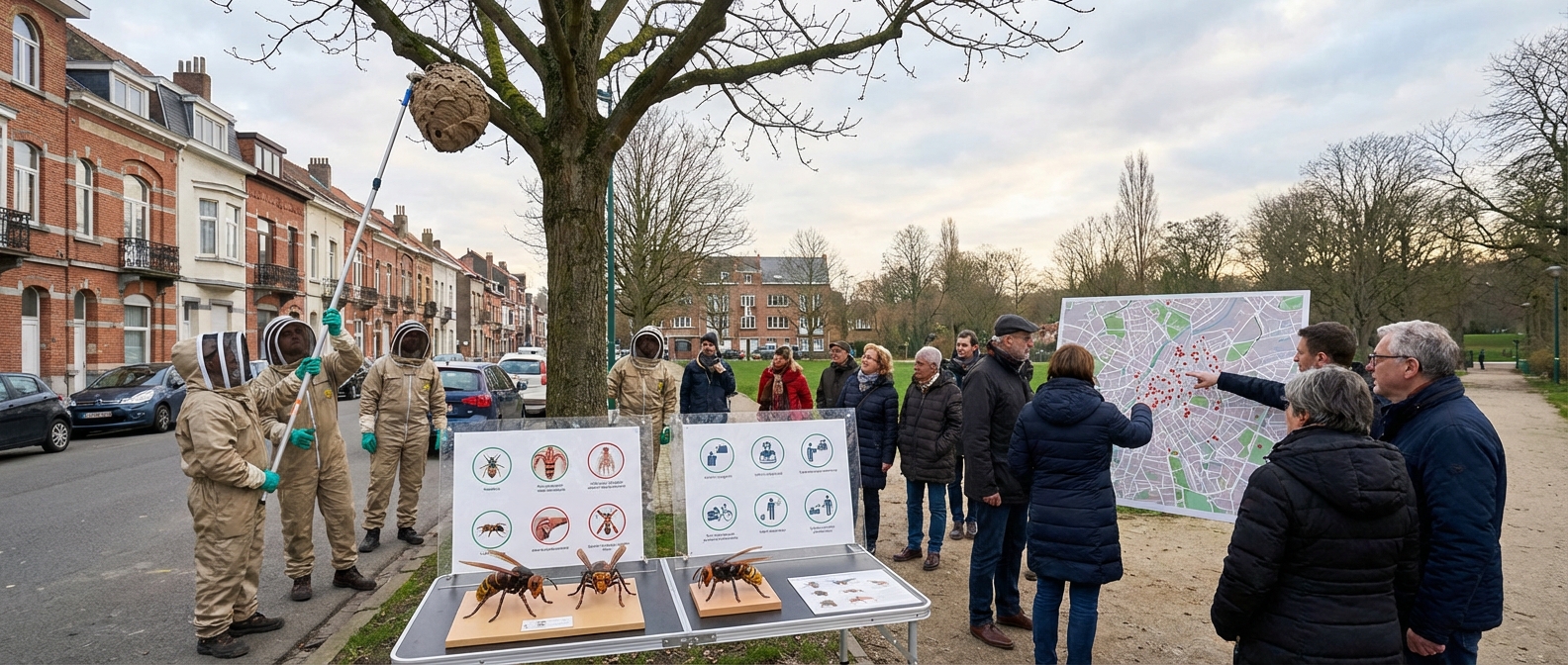
A typical hornet nest destruction operation in Schae...
-
Practical safety guide and reporting procedures for Schaerbeekers
The Asian hornet is no longer an exotic curiosity reserved for the south of France. It's here, in Brussels, in your gardens, on your terraces, sometimes even in your attics. Schaerbeek, with its many green spaces, old buildings and mature trees, offers an ideal breeding ground for this species. And every year, the number of reports increases.
This is the guide we wished we'd had when the first calls started pouring in from the commune of 1030. We're going to talk biology, practical intervention and the steps to follow. Don't panic, but don't be naive either: the Asian hornet is a real problem, and you need to know how to react.
Understanding the proliferation of the Asian hornet in the urban environment of Schaerbeek
Its scientific name is Vespa velutina nigrithorax. A long name for an insect that's easy to recognize: dark, almost black body, with an orange stripe on the abdomen and yellow legs at the tips. It's smaller than the European Hornet, contrary to what many people think. Around 3 centimetres for a worker, a little more for a queen.
How did it happen in Schaerbeek? The same story as all over Europe. The species arrived in France in 2004, probably in a shipment of Chinese pottery. Since then, it has been moving northwards at a steady pace: around 60 to 80 kilometers a year. Belgium has been affected since 2016, and Brussels has not been spared. Schaerbeek, with its dense population and green corridors, has become a hot spot for sightings.
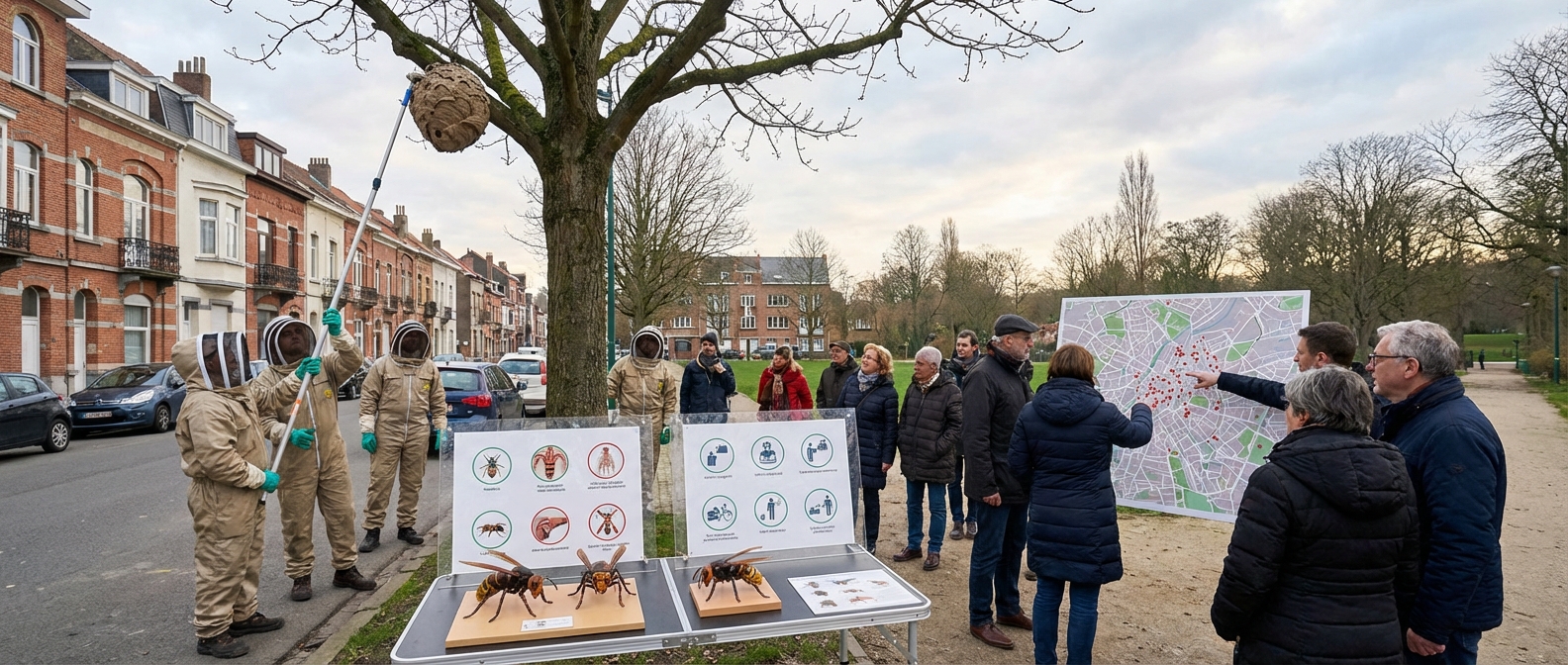
Why has this invasive species become so well established in Schaerbeek? There are several reasons. Old buildings provide perfect cavities for primary nests in spring: under-roofs, shutter boxes, sheds. Josaphat Park, the commune's green lung, is home to a concentration of high-canopy trees where colonies build their secondary nests in summer, sometimes 15 or 20 meters high. These nests can reach the size of a basketball, or even larger.
The impact on biodiversity in Brussels is real and documented. The Asian hornet is a formidable predator of honeybees. A single colony can capture between 30 and 50 bees a day in front of a hive. As beekeepers in Schaerbeek are well aware, some have lost entire colonies. Wild pollinators are also suffering: hoverflies, bumblebees, solitary bees. All this little world that keeps the town's gardens and vegetable patches going.
We're often asked: where are there the most Asian hornets in the commune? To be honest, there's no neighborhood that hasn't been affected. The areas around Parc Josaphat are the most frequent, but we also regularly intervene on the Helmet side, around Place Colignon, and in the residential streets lined with lime trees between Schaerbeek station and Square Riga. The insect goes where it finds food (garbage cans, insects, ripe fruit) and a sheltered place to nest.
A detail that often surprises locals: the Asian hornet doesn't really disappear in winter. The workers and males die, yes. But the young, fertilized queens hibernate in gaps, under bark or in woodpiles. And from March-April, they wake up and found new colonies. That's why we stay active all year round at Frelons.be: prevention in spring is just as important as destroying nests in summer.
A word about the frequent confusion with the wasp's nest in Schaerbeek. They look the same from a distance, but the structure is different. The Asian hornet's nest has a side entrance (not from below like wasps), and its texture is reminiscent of coarse papier-mâché, often grayish. If in doubt, don't approach to check. Take a photo from a distance and send it to us.
A typical hornet's nest removal operation in Schaerbeek
Tuesday, 2:30 pm. The call comes from a building manager on Chaussée de Haecht. A tenant on the third floor has noticed hornets entering through a crack in the shutter box of his bedroom. He hasn't dared open the window for three days.
We always start by asking a few questions on the phone. How long have you been seeing them? Approximately how many? Are there any children or allergy sufferers in the building? This information enables us to assess the urgency of the situation and prepare the appropriate equipment. In this case, the tenant describes a dozen or so insects that are constantly coming and going. It smells like a well-established colony.
Destroying a hornet's nest in Schaerbeek is rarely a sprint. It's methodical. We arrive on site an hour later with the equipped vehicle. First instinct: observe. Stand at a safe distance and watch the traffic. The flight path of the hornets tells us the exact size and location of the nest. Here, they all converge on the same point on the formwork, on the right-hand side of the window.
Protective equipment is non-negotiable. Anti-sting full-body suit, reinforced gloves, closed boots. The Asian hornet is less aggressive than the European hornet when encountered in flight, but when close to the nest, it's a different story. Workers defend the colony with impressive determination, and they can sting through conventional jeans. Each sting injects a venom which, even without allergy, causes intense pain and swelling lasting several days.
A telescopic pole fitted with an injector is used for this operation. The formwork is drilled at a precise point, and a professional biocide is injected directly into the nest. The effect is rapid: in just a few minutes, activity drops drastically. You wait. Observe. Then remove the nest, because leaving a dead nest in place means risking other insects moving in.
The building manager asks us how much it costs. The price for destroying a nest varies according to the situation: height, accessibility, response time. For an accessible nest like this one, in a shutter box on the third floor, we're within a reasonable range. We always give a clear estimate before we intervene, so there are no surprises at the end. For a nest perched 20 meters up in a tree in Josaphat Park, the price will be different, because you'll need a gondola or a rope system.
What we often hear: «But I've read that you shouldn't kill Asian hornets.» Let us clarify this point. The recommendation not to kill a lone hornet makes sense: crushing a hornet releases warning pheromones that can attract other hornets. If a hornet is alone in your kitchen, you guide it towards the exit with a glass and a piece of cardboard. An active nest two meters from your window, on the other hand, requires professional extermination. The species is classified as invasive, and its destruction is encouraged by the authorities.
At Frelons.be, we offer 24-hour intervention for urgent situations. A nest above a school entrance, a swarm settling on a balcony where children are playing: these things don't wait for Monday morning. Our radius of action covers the entire 1030 commune and the rest of Brussels. The exterminator arrives equipped, assesses, acts and cleans. No coming and going, no appointments three weeks later.
Practical safety guide and reporting procedures for Schaerbeekers
You're in your garden and spot a large, dark insect circling your hedge. What should you do when faced with an Asian hornet? First of all, don't panic. A hornet in flight, far from its nest, is generally not aggressive. They're just looking for food. Don't make any sudden movements, don't blow on them (CO2 irritates them), and move away calmly.
The situation changes completely if you discover a nest. Rule number one: keep a safe distance. At least 10 metres, ideally more. Don't throw anything at it, don't shake the branch, and certainly don't try to remove it with a broom or burn it. We've seen people try it with a garden hose. The result: dozens of furious hornets racing into the house. Multiple stings can cause a severe toxic reaction, even in someone who isn't allergic.
There are several options for reporting a nest in Schaerbeek. The commune of 1030 participates in the Asian hornet surveillance network coordinated by Bruxelles Environnement. You can report your sighting via the iNaturalist, observations.be or directly to your local environment department. Take a photo if you can (using your phone's zoom, not by getting close), and note the exact address and approximate height of the nest.
Who should you contact if you have Asian hornets in your home? Not the fire department, except in a life-threatening emergency. Not your handyman neighbor. A professional. Frelons.be operates throughout the Schaerbeek commune, and knows the specifics of the local terrain: terraced buildings with complicated access, the trees of Josaphat Park, the sloping roofs of typical Brussels houses. We know what to expect, and we have the equipment for every configuration.
A few preventive measures for the safety of Schaerbeek residents. In spring, inspect the nooks and crannies of your home: under roofs, garden sheds, outside gas meters. Founding queens look for sheltered places to build their primary nest, which is small (the size of a golf ball) and easy to eliminate at this stage. If you spot one before May, it's the ideal time to take action, before the colony develops.
Avoid leaving ripe fruit on the ground in your garden. Asian hornets love pears, apples and grapes. Cover your sweet drinks on the terrace. If you have beehives, install hornet muzzles at the entrance. Local beekeepers are well organized, so don't hesitate to contact them via local associations for advice.
An important point about stings. If you're stung, remove the stinger if it's still in place (which is rare with hornets, unlike bees), disinfect and apply cold. Watch out for signs of an allergic reaction: swelling that extends beyond the stung area, difficulty breathing, dizziness. In this case, call 112 immediately. People who know they are allergic to Hymenoptera should always have their adrenaline kit to hand, especially between July and November when colonies are at their peak.
For Schaerbeek building managers and trustees: you have a legal responsibility. If a tenant reports a nest in the common areas, it must be dealt with quickly. An active nest in a condominium is a risk for all occupants. Contact us, we can intervene quickly and provide an intervention report for your file.
Conclusion
The Asian hornet is now part of the Schaerbeek landscape. It's not inevitable, but it's a reality that needs to be dealt with seriously. Knowing how to recognize the insect, keeping your distance from a nest, reporting it quickly: these simple reflexes make all the difference between a controlled situation and an accident.
At Frelons.be, we're in the field all year round. Spring for prevention, summer and autumn for destruction, winter for monitoring. If you have the slightest doubt about an insect or a nest in your Schaerbeek neighborhood, give us a call. We'd rather go out of our way for nothing than intervene too late.
Frequently asked questions
Who should be involved in Asian hornet nest removal in Schaerbeek?
Owners have a legal obligation to have nests removed from their property.
What should I do if I see a nest of Asian hornets in Schaerbeek?
You can report your observations via the iNaturalist platform, observations.be or directly to the local environmental department.
Where are the most Asian hornets in Schaerbeek?
No place is spared. Naturally, they are more likely to be found in green spaces, but this is not an absolute rule.
Who should I contact to take action against Asian hornets?
Contact the hornets.be team for a fast response.
 French
  English
  Dutch
Dutch
April 26
Hello, could you send me a clear photo that describes the differences in color of Asian hornets compared to European specimens?
For what? I caught a hornet and have it in a jar;
Should I release it or shoot it?
Thank you for your reply