
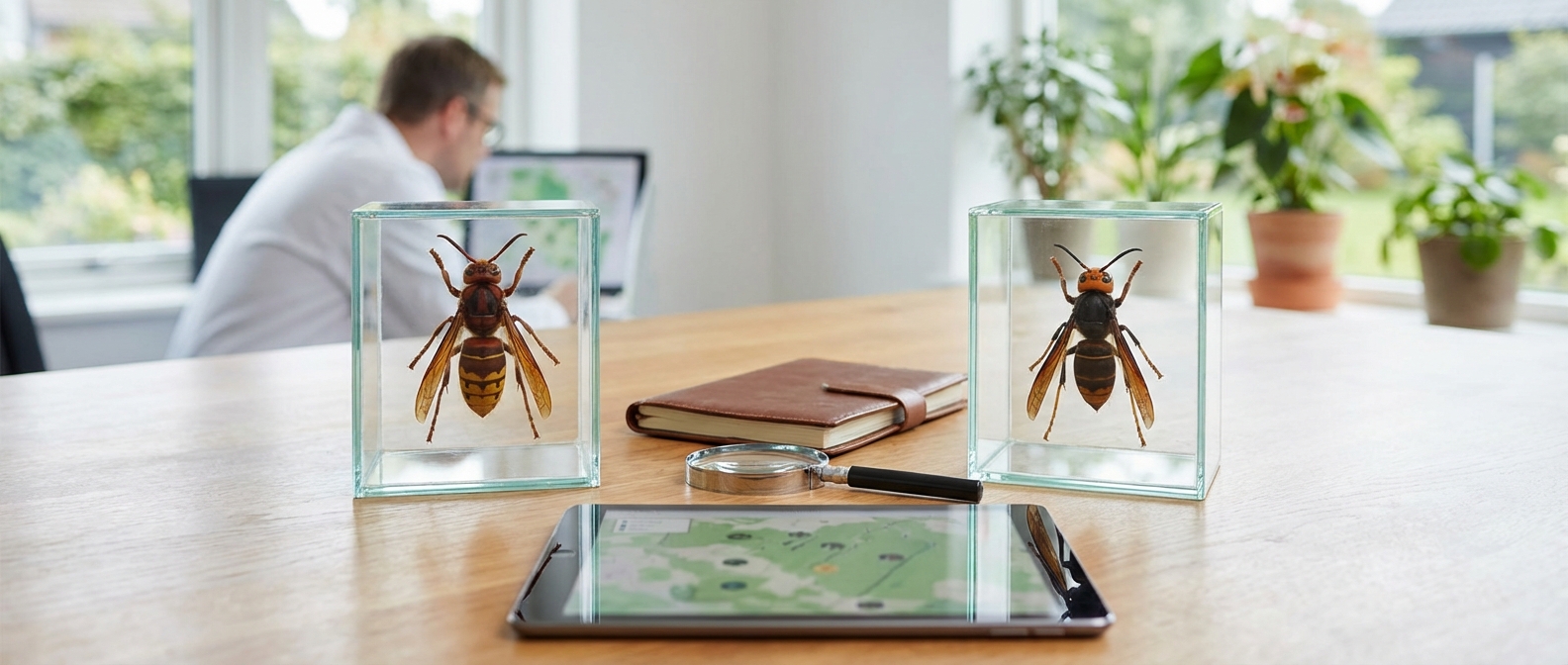
Conflict between European and Asian hornets: who dominates?
Contents
-
European and Asian hornets: comparing strengths and behaviors
-
Who wins the fight? Analysis of predation and actual interactions
-
Between natural duel and invasion: when professional intervention becomes vital
Ever since the Asian hornet became established in Belgium and much of Western Europe, the question has been asked again and again: will the European hornet, our own beetle, take over? Vespa crabro, can stand up to the invader Vespa velutina ? We sometimes hear that nature will solve the problem on its own, that the two species will fight it out and the strongest will win. If only it were that simple.
The reality of the conflict between the European and Asian hornets is far more nuanced than a boxing match. The two species cross paths, yes. They interact, sometimes violently. But is this enough to curb the invasion? Let's break it all down together: the forces at work, what we're really seeing in the field, and above all why relying solely on a «natural bulwark» to protect your garden is a mistake.
Things to remember
-
Dive into the duel between the European and Asian hornets
-
We analyze their real-life confrontations and the effectiveness of the European hornet as a natural bulwark.
-
Contrary to popular belief, this biological warfare is not enough to protect your gardens.
-
Compare the different options before deciding.
At Frelons.be, we take action against Asian hornets all year round, and what we see on a daily basis doesn't always match up with what we read on the internet. So let's set the record straight.
European and Asian hornets: comparing strengths and behaviors
First things first: these two hornets are not in the same league, and not necessarily in the way you'd expect. The European hornet (Vespa crabro) is larger. A queen can reach 35 mm, while workers are around 25 mm. The Asian hornet (Vespa velutina) is slightly smaller, with worker bees measuring 20 to 25 mm. On paper, a local advantage.
But size isn't everything. Far from it.
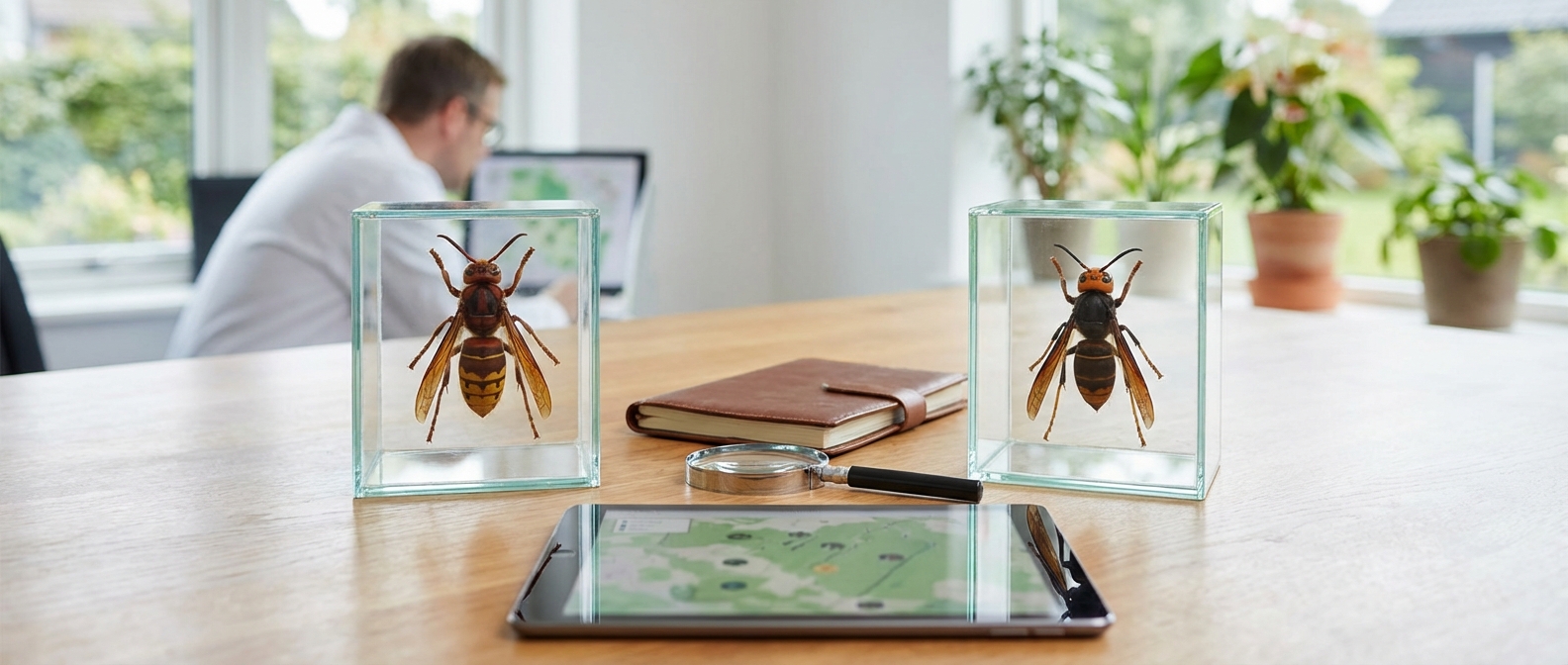
The major difference between the European and Asian hornets lies in their behavior, and in particular in their colonial organization. A colony of Vespa velutina can number up to 2,000 individuals at its peak, sometimes more. On the European side, there are rarely more than 400 to 700 workers. The numerical balance of power is overwhelming. When it comes to conflict between species, this figure changes everything.
Hunting behavior also differs radically. The Asian hornet is a specialized predator of bees: it hovers in front of hives and captures foragers one by one. It's methodical, efficient and devastating for bee colonies. The European Hornet hunts more opportunistically: various insects, flies, wasps, sometimes bees too, but without this systematic siege strategy.
Another crucial point: aggressiveness. Contrary to popular belief, the European Hornet is not particularly aggressive towards man. They may sting if you get too close to their nest, like any other Hymenoptera, but they tend to remain rather quiet. The Asian hornet, on the other hand, defends its nest with greater intensity. Within 5 metres of an active nest, group attacks are frequent. And this is where the danger of hornets takes on a concrete dimension for private individuals.
Which is more dangerous, an Asian hornet or a European hornet? In terms of pure venom, the two stings are comparable. The European hornet even injects slightly more venom per sting. The real danger of the Asian hornet comes from its collective defensive behavior: when it attacks, it attacks as a group. And with a colony of 2,000 individuals, that's quite a difference.
The nests also say a lot. Vespa crabro often nests in cavities: hollow trunks, attics, nesting boxes. Vespa velutina builds its primary nests in spring in sheltered spots (hedges, garden sheds), then moves in summer to the treetops, sometimes over 15 meters high. These secondary nests, shaped like large balls, can exceed 80 cm in diameter. Some weighing several kilos have been removed.
In short, on the one hand we have a local hornet, strong but few in number, and on the other a smaller but massively organized invader. The Asian Hornet's behavior is its real weapon.
Who wins the fight? Analysis of predation and actual interactions
A European hornet versus an Asian hornet in a one-on-one duel: the European often wins. Its larger size and more powerful mandibles give it a real physical advantage. We have documented sightings of Vespa crabro killing Vespa velutina isolated. So, who's winning the battle against the Hornet? The individual, the local. No doubt about it.
The problem is that this is almost never the case in the wild.
Asian hornets don't fight duels. They work en masse. When a colony of Vespa velutina settles on a territory, it saturates the environment. Food resources (insects, nectar) are monopolized by numbers. The European hornet doesn't lose a battle: it loses the war for resources. It's more subtle than a direct confrontation, but the result is the same.
Do European hornets eat Asian hornets? It happens, yes. Vespa crabro is a generalist predator, and will occasionally capture Vespa velutina, especially isolated workers. There have been cases of European hornets attacking Asians hovering in front of hives. However, these events remain anecdotal. It's not systematic predation, it's opportunism.
To regard the European hornet as a natural predator capable of regulating the invasion of the Asian hornet is to give it a role it cannot play. The figures speak for themselves: in regions where Vespa velutina has been well established for 10 or 15 years (in south-west France, for example), European hornet populations have done absolutely nothing to curb expansion. On the contrary, some studies suggest a local decline in Vespa crabro where the Asian dominates, probably due to competition for nesting sites and resources.
So what's the Asian Hornet's natural enemy? In Europe, it doesn't really have any. A few birds, such as the Honey Buzzard, attack nests, and some chickadees gobble up workers, but no predator effectively regulates populations. In Asia, its continent of origin, local bees (Apis cerana) have developed a fascinating defense technique: they form a ball around the intruder and raise the temperature until they kill him. Our European bees (Apis mellifera) haven't had time to evolve and develop this response. They are vulnerable.
And why is it inadvisable to crush an Asian hornet? Because a crushed hornet releases warning pheromones that can attract other hornets. If you're near a nest, this is the best way to trigger a mass attack. Trapping or crushing a few individuals is of no use against a colony of 2,000: it's a drop in the ocean, and a potentially dangerous one at that.
The evidence is clear: relying on the European Hornet as a bulwark against invasion is wishful thinking. Protecting biodiversity from Vespa velutina requires more than crossing one's fingers and hoping nature will take care of it.
Between natural duel and invasion: when professional intervention becomes vital
We regularly receive calls from people who have spotted a nest in their garden and are hesitant. «Maybe they're Europeans, they're useful, aren't they?» Yes, the European hornet has an ecological role. They regulate insect populations and even play a part in pollination. We never recommend destroying a European hornet nest. Vespa crabro if it does not pose a direct safety problem.
The Asian hornet is a different story.
Vespa velutina is classified as an invasive alien species. Its presence directly threatens domestic and wild bees, pollinators in general, and by extension the entire ecosystem that depends on pollination. A single Asian hornet nest can decimate 5 to 6 hives within a radius of a few kilometers. For beekeepers, this is catastrophic. For local biodiversity, it's a silent disaster.
Destroying an Asian hornet nest is not something you can improvise. We're talking about nests often perched 10, 15, sometimes 20 meters high, containing hundreds of insects ready to defend their colony. Every year, people are injured trying to deal with them themselves: falls from ladders, multiple stings, severe allergic reactions. A poorly treated nest is also a nest that can reactivate itself or cause the colony to move without being eliminated.
A pest control expert has the right equipment: sting-resistant full-body suit, telescopic poles, targeted biocides, gondolas if necessary. The hornet's nest is destroyed safely, ensuring that the queen is eliminated. Without this, the colony can survive and rebuild.
At Frelons.be, we work all year round. Not just in summer, when the nests are huge and visible. In spring, the founding queens emerge from hibernation and build primary nests, often the size of tennis balls, in hedges or under roofs. This is the ideal time to act: a queen eliminated in spring means a colony of 2,000 individuals that will never exist in summer. In autumn, the new queens leave the nest to hibernate. In winter, the nests are empty, but their location enables us to map the areas at risk for the following season.
Professional intervention isn't just about «killing hornets». It means correctly identifying the species (mistaking a European hornet for an Asian one happens more often than you might think), assessing the situation, choosing the right method, intervening safely, and monitoring progress. It's also an act of biodiversity protection: every Vespa velutina neutralized, thousands of bees and pollinators are spared.
As we've seen, waiting for the European hornet to solve the problem doesn't work. Artisanal traps sold in garden centres? They mainly capture other beneficial insects and a few workers, with no real impact on the colony. The only effective response to an active Asian hornet nest is targeted intervention by a trained professional.
If you spot a suspicious nest, don't take any chances. Observe from a distance, take a photo if possible, and contact a specialist. A nest caught early means fewer risks for you, your neighbors and the bees in your neighbourhood.
Conclusion
The European hornet is bigger, more imposing, and capable of killing an Asian hornet in single combat. But that's not enough. Faced with colonies of 2,000 individuals, faced with a species that reproduces faster and monopolizes resources, Vespa crabro can't play the natural bulwark role we'd like it to.
The conflict between the European and Asian hornets exists, but it's not on the right side. The only strategy that works is early detection of nests and their destruction by professionals. Not in six months' time. Now, whatever the season.
Do you have any doubts about a nest in your garden, under your roof or in a tree? Contact Frelons.be. We intervene all over Belgium, all year round, to secure your environment and protect pollinators. Don't wait for the problem to grow.
Frequently asked questions
Do European hornets eat Asian hornets?
The European hornet can also eat Asian hornets, not by predation, but by opportunism.
Which is more dangerous, an Asian hornet or a European hornet?
The Asian hornet is no more dangerous to humans than its congeners. In the garden, however, it is a formidable predator of our pollinating insects, particularly bees.
Why is it not advisable to crush an Asian hornet?
Stamping on an Asian hornet triggers a chemical alarm that can attract other hornets and provoke a mass attack, especially if the nest is close by. This action increases the risk to humans and has no impact on the proliferation of the species.
What is the Asian Hornet's natural enemy?
A few birds, such as the Honey Buzzard, prey on nests, and some chickadees gobble up workers, but there are no effective predators to regulate populations.
 French
  English
  Dutch
Dutch
0 Comments