
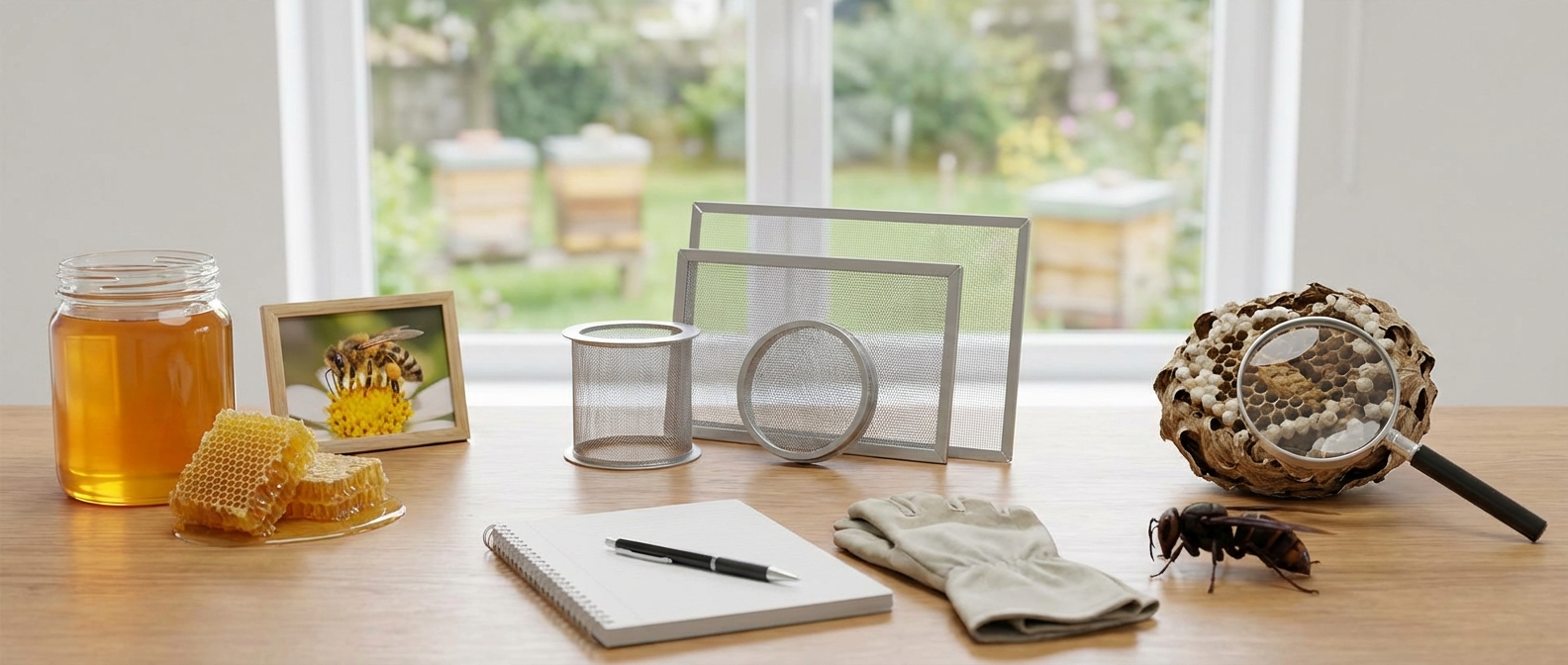
Asian hornet and honey: between predation, myths and protection
Contents
-
Asian Hornet vs. Bee: Why one produces honey and the other plunders it
-
Ecosystem benefit vs. Scourge: Does the Hornet have positive aspects?
-
Protect your crops: Criteria for choosing an effective hornet trap
No, the Asian hornet doesn't make honey. I know, the question comes up all the time, and that's normal: when you see such a big insect prowling around hives, you might wonder if it doesn't have its own little production too. But then again Vespa velutina is not a producer. It's a predator. And a damn good one, unfortunately for our bees.
What makes the subject of Asian hornets and honey so confusing is the mixture of two realities. On the one hand, a social insect that lives in colonies and, yes, feeds on sugar. On the other, bees that transform nectar into honey thanks to a biological process that the Hornet is simply incapable of reproducing. The Hornet produces nothing. It takes. And that's exactly what we're going to break down here: the fundamental difference between these two insects, the real impact of the hornet on the ecosystem, and above all how to protect your hives with the right tools.
Things to remember
-
This article deconstructs the myth of honey production by the Asian hornet
-
We compare its lifestyle to that of the bee, analyze its real impact on the ecosystem and provide precise purchasing criteria for choosing the best protection systems for your hives.
-
Why one produces honey and the other plunders it
-
Does the Hornet have any positive aspects?
Whether you're an amateur beekeeper or simply curious to understand why this hornet is so much in the news, this article is for you. We're also going to dispel a few preconceived ideas in the process.
Asian Hornet vs. Bee: Why one produces honey and the other plunders it
The difference between the bee and the hornet can be summed up in one word: enzyme. Bees have an enzyme in their crop called invertase, which transforms flower nectar into honey. This honey production process is unique in the world of social insects. Bees gather nectar, bring it back to the hive, pass it from mouth to mouth between workers, then store it in wax cells that they fan for hours to evaporate the water. The result: a stable, sugar-rich food that can be stored for years.
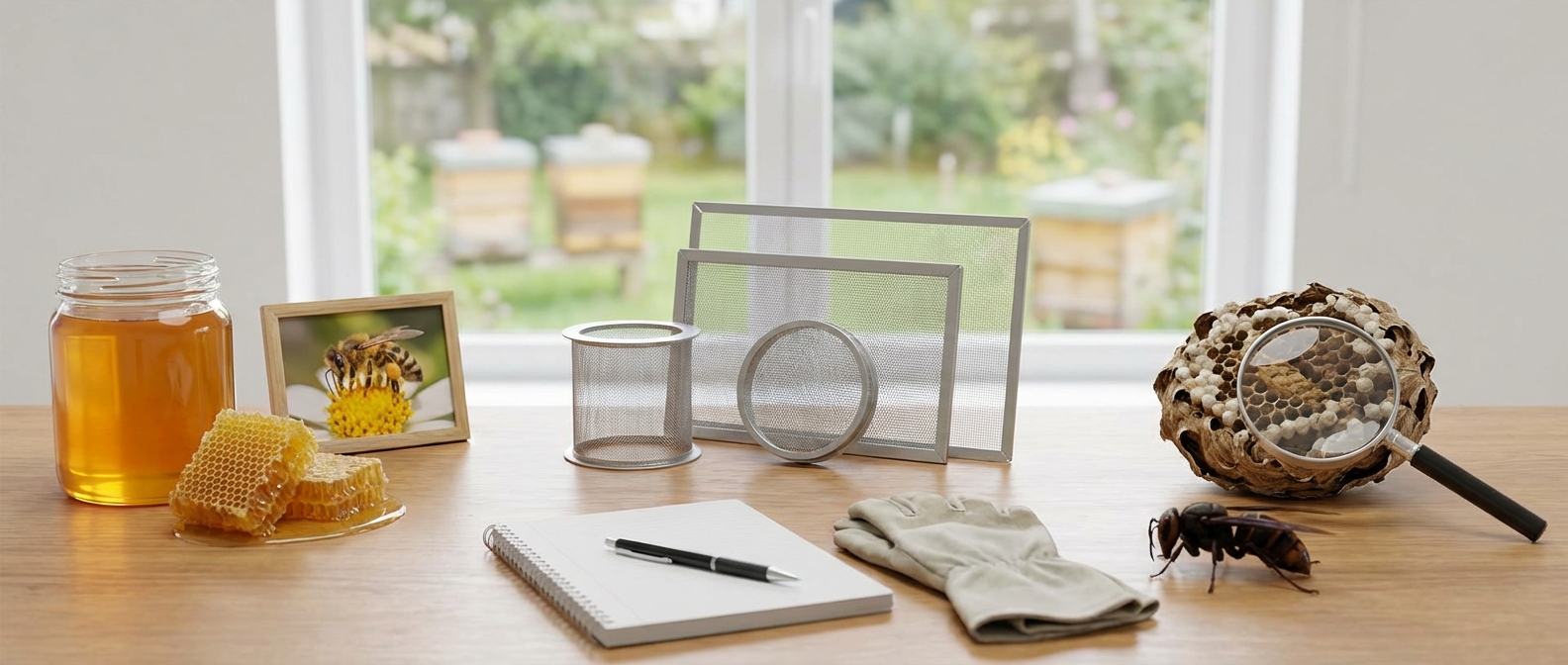
The Asian hornet? It doesn't do any of that. Its nest is made of papier-mâché (wood fibers mixed with saliva), not wax. It has no storage cells. It doesn't forage in the literal sense. When Vespa velutina approaches a flower, it's to lick some nectar and consume it immediately, not to process it. Its biology simply doesn't allow it.
So why do we associate Asian hornets and honey? Because honey clearly attracts Asian hornets. Honey is an accessible caloric bomb. And hornets, which need fast sugars to fuel their flight muscles and feed their larvae proteins (in the form of ground-up insects), find a hive a double jackpot: honey to plunder and bees to hunt.
Asian hornet hive raiding is methodical. The hornets hover in front of the hive entrance, sometimes by the dozen. They catch the bees in mid-flight, decapitate them, keep the thorax (the part richest in protein) and leave the rest. A hornet colony can kill hundreds of bees a day. Over a season, that's thousands of fewer workers. The hive weakens, honey production plummets, and in the worst cases, the bee colony collapses completely.
Asian honeybees (Apis cerana), on the other hand, have developed a fascinating response: they form a ball around the intruding hornet, raising its temperature until it dies of hyperthermia. Our European bees (Apis mellifera) have no such defense. They are helpless in the face of a predator they have never encountered in their evolutionary history. That's why the Hornet's impact on European bees is so devastating: they simply haven't had time to adapt.
An important point: do hornets make honey, even in small quantities? No. Some websites refer to «hornet honey» in Asia, but this is actually honey stolen from bees and temporarily stored in the nest, not produced by them. The hornet is a plunderer, not a producer. The nuance is crucial.
Ecosystem benefit vs. Scourge: Does the Hornet have positive aspects?
70 000. This is the estimated number of Asian hornet nests destroyed each year in France alone. Given these figures, it's hard to see anything positive about this insect. And yet, the question deserves to be asked honestly.
In its native Southeast Asia, Vespa velutina acts as a natural predator, perfectly integrated into the ecosystem. It regulates populations of flies, caterpillars, butterflies and other insects. Asian bees, as we have seen, know how to defend themselves against it. A balance exists. The Hornet has a real ecological role to play: it contributes to the food chain, controls certain populations of harmful insects, and even marginally pollinates a few plants in search of nectar.
The problem is that in Europe, this balance doesn't exist. The Asian hornet arrived in France in 2004, probably in a batch of pottery imported from China. Since then, it has colonized almost the whole of France, as well as large parts of Spain, Portugal, Italy and Belgium, and is still on the move. With no effective natural predator in our latitudes, its population is exploding.
Are there any positive aspects here? Let's be frank: very few, and they don't outweigh the damage. Yes, the Asian hornet also eats flies and wasps. Yes, some birds like the shrike and the buzzard occasionally feed on them. Some chickadees have even been observed pecking at hornets. But these predations remain anecdotal in view of the species' speed of reproduction.
The impact on biodiversity is well documented. The Asian hornet doesn't just target honey bees. It attacks all pollinators: wild bees, bumblebees and hoverflies. These insects are already weakened by pesticides, habitat loss and climate change. Adding an invasive predator on top of them is a blow too far for already declining populations.
And is the Asian hornet dangerous to humans? Its sting is painful, comparable to that of a wasp, but no more venomous. The real danger is for allergy sufferers or in cases of multiple stings (when a nest is accidentally disturbed). For bees, on the other hand, the danger is existential. A MNHN study has shown that in areas with high hornet densities, bee colony losses increase by 30 to 50% compared with unaffected areas.
So no, I'm not going to tell you that the Asian hornet is «useful» in Europe. That would be dishonest. It's an invasive species that destabilizes an already fragile ecosystem. The only responsible response is active management: trapping, destroying nests and protecting apiaries. All year round, not just in summer.
Protect your crops: Criteria for choosing an effective hornet trap
Do you have hives, or are you thinking of installing one? The question is no longer if the Asian hornet will come, but when. And when they do, you need to be prepared. Here's what to look out for before investing in a protection system.
First criterion: selectivity. This is by far the most important point. An Asian hornet trap that also catches bees, butterflies or bumblebees is counter-productive. You're trying to protect biodiversity, not exacerbate it. The best traps use selective bait (often brown beer, blackcurrant syrup and a little white wine, whose scent repels bees) combined with calibrated grids that let out insects smaller than the hornet.
Second criterion: the type of trap. Broadly speaking, there are three families:
-
Classic funnel traps Simple, inexpensive (€5 to €15), often in plastic bottles. Effective in spring for capturing founding queens. Their limitation: they are not always very selective if the bait is badly dosed.
-
Potting traps with non-return system More elaborate (€20 to €40), they allow small insects to escape through side openings. This is the best efficiency/selectivity ratio for amateur beekeepers.
-
Electric harps The hornet's first line of defence: frames of electrified wire placed in front of the hives. The hornet touches the wires and falls into a bin. Price: €80 to €150. Very effective, highly selective (the bees pass between the wires), but best suited to medium to large-sized apiaries.
Third criterion: the trapping period. Many people set traps only in summer, when hornets are visible. This is a mistake. Spring trapping (February to May) is strategic: every founding queen caught at this time means 2,000 to 3,000 fewer nesters in the autumn. At Frelons.be, we're active all year round against the Asian hornet, and we really don't recommend waiting until July to take action.
Fourth criterion: location. A trap placed anywhere is useless. Place it close to the apiary, ideally 5 or 10 meters from the hives, high up (1.5 m from the ground), in a semi-shaded area. What do Asian hornets hate to smell? Not much, unfortunately. Some beekeepers are testing repellents based on essential oils (clove, citronella), but scientific results are mixed. Better to bet on a good trap than on a hypothetical repellent.
For the purchase of bait and traps, If you're interested in beekeeping, choose specialized beekeeping suppliers rather than garden superstores. Commercial selective baits (Véto-pharma, Trappit) have been tested and validated for their low impact on non-target species. If you make your own bait, the classic recipe remains: one third dark beer, one third blackcurrant or grenadine syrup, one third white wine. The white wine is what makes the difference: its scent repels bees, but not hornets.
One last point in this protection comparison: don't overlook hive muzzles. These are metal grids that attach to the hive entrance and prevent the hornet from hovering directly in front of it. As the bees pass by, the hornet can no longer hunt effectively. Cost: €10 to €25 per hive. Simple, long-lasting, and life-changing for an apiary under pressure.
Conclusion
The Asian hornet doesn't make honey. It steals it, it kills the bees that produce it, and it weakens a pollination ecosystem on which we all depend. Myths about this insect are hard to dispel, but the facts are clear: it's an invasive species that we need to take concrete action against, not just a «big bug» we can ignore.
If you have hives, get equipped. Selective traps in spring, harps or muzzles in summer, nest monitoring in autumn. And if you spot an Asian hornet nest, don't try to destroy it yourself: call in the professionals. At Frelons.be, we're on hand all year round to destroy nests and advise on beehive protection. Don't wait for the problem to take hold.
Frequently asked questions
Does honey attract Asian hornets?
Yes, but it's the bees in particular that attract them, offering them a delicious meal once they've been chased away.
Do Asian hornets make honey?
No; it's a plunder by a honey producer.
What scent does the Asian hornet hate?
Asian hornets dislike certain powerful scents such as citronella or geranium. By diffusing them strategically, we can reduce their presence without chemicals or complex efforts. Simple homemade recipes based on bicarbonate, lemon or vinegar can help repel hornets.
Is the Asian hornet dangerous for bees?
Yes, by attacking the hives, it creates stress and bee populations decline.
 French
  English
  Dutch
Dutch
0 Comments