
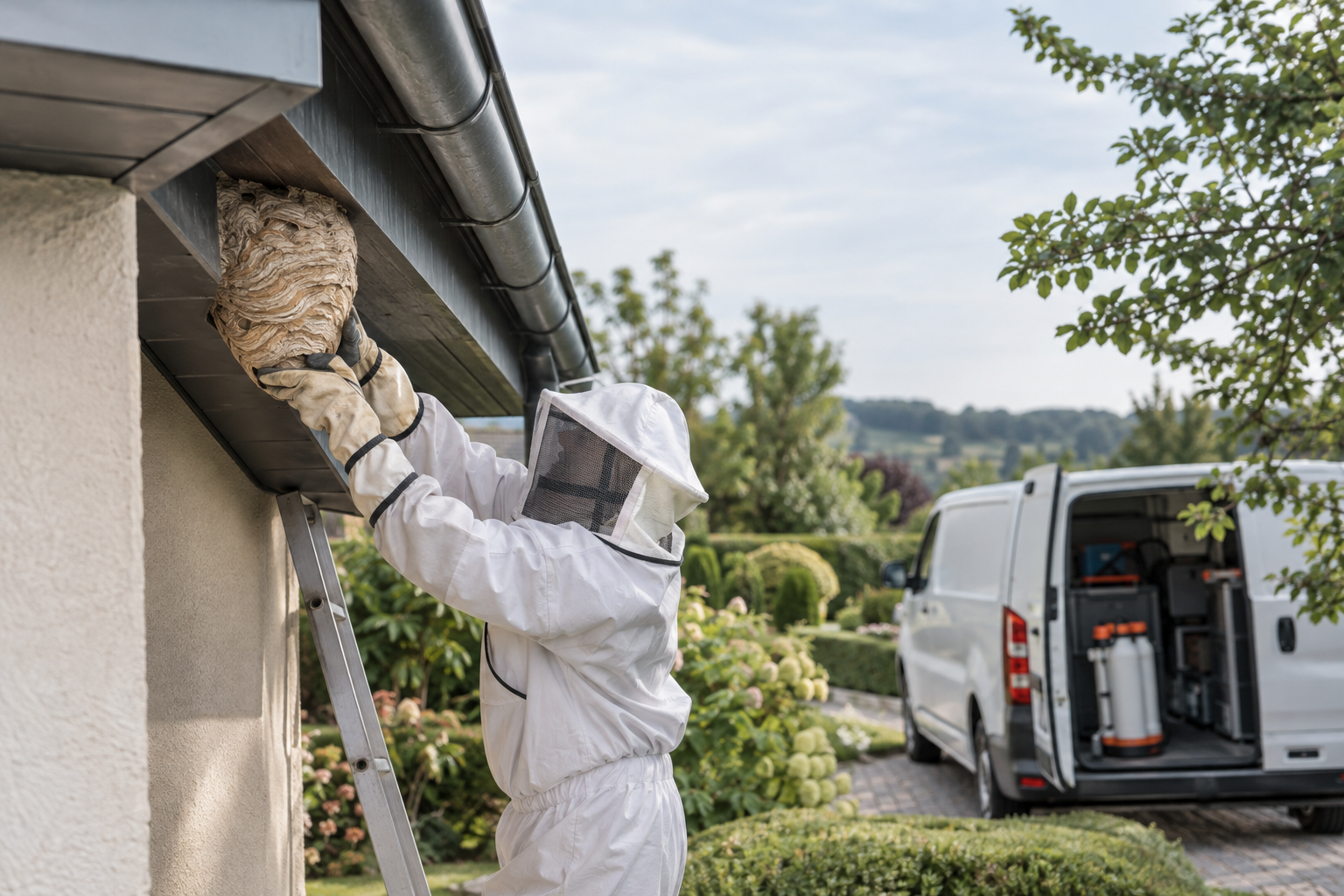
Should the nest be removed after it has been neutralized?
Contents
The wasps aren't swarming around the roof anymore, the treatment has been done, and the nest is still there. Should we take it down? After chemical neutralization, the removal process should be planned in consultation with the service provider, not just to make the exterior look clean. The nest and dead insects may contain traces of insecticide.
So there is also an environmental concern: preventing these residues from spreading throughout the garden or exposing other animals. The Federal Public Service (FPS) Public Health’s recommendations regarding biocides emphasize the need to minimize risks to health and the environment. For your nest, how these recommendations are applied depends on the product used, its instructions for use, and access to the site.
Things to remember
-
The article stands out by emphasizing the recommendations of the Federal Public Service for Public Health: removing the nest is not just a matter of aesthetics, but an ecological necessity to limit the spread of insecticides into the natural environment.
-
We explain when and how to take action, while highlighting Frelons.be’s expertise in providing safe service year-round
-
Compare options and take action.
Here's how to arrange for removal, understand what's included in the price, and contact Frelons.be at any time of year—including for a treated nest that remains in place during the winter.
Key Steps for Removing a Nest After Chemical Treatment
How long should you wait before touching the nest? There is no universal safety margin. Advice found online is no substitute for instructions from a professional or those provided with the product. Furthermore, the absence of foraging for a few minutes does not prove that the entire colony has been eliminated.
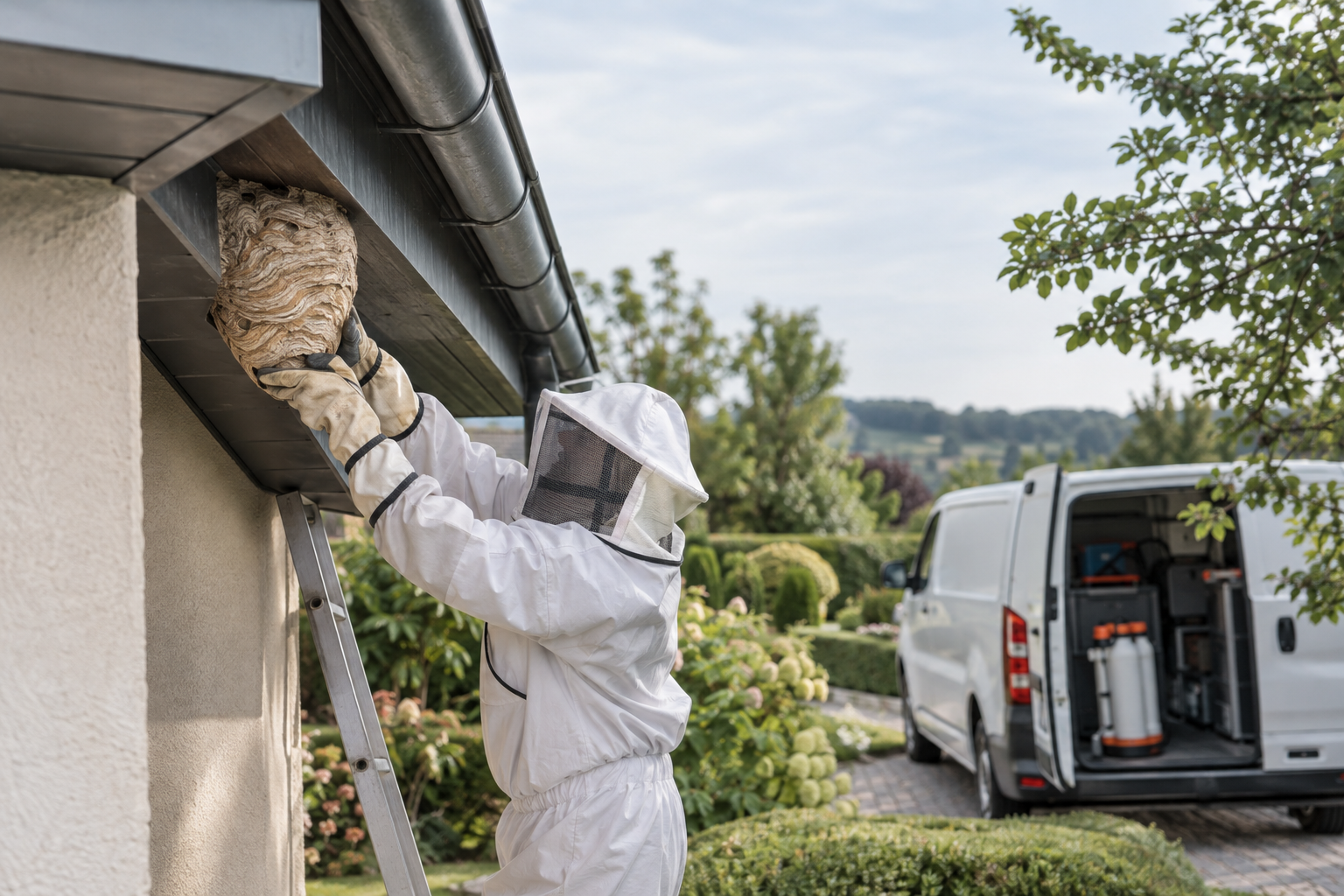
To remove a nest after it has been treated, the correct procedure is simple: let the treatment take effect, verify that it is effective, and then arrange for the nest to be removed and disposed of. Removing the nest too soon can expose you to insects that are still alive and interrupt the treatment’s intended effect.
-
Get the speaker's instructions. Ask for the date of the treatment, the name of the product used, the expected waiting period before re-entry, and any access restrictions. A stated waiting period of 24 or 48 hours must be confirmed for your visit; do not assume it applies everywhere.
-
Please keep your distance while you wait. Keep children and pets away. Do not tap on the nest to check if there are any occupants left, and do not block an entrance that is still in use.
-
Have the neutralization confirmed. Any persistent signs of activity should be reported. The professional will determine whether they are caused by returning insects, residual activity, or inadequate treatment.
-
Plan for a spill-free unloading process. The nest must be retrieved using precautions appropriate for the product and the surface. Breaking it, shaking it, or dropping it on the ground unnecessarily scatters potentially contaminated fragments.
-
Specify where the waste will be sent. The removal of the nest, debris, and accessible dead insects must comply with the product instructions and local collection regulations.
The Federal Public Service for Public Health is the leading Belgian authority on the regulation of biocides. Limiting the spread of insecticide into the environment is one of the essential precautions. Removing a nest after treatment is part of this process, particularly when it remains accessible to birds or is at risk of deteriorating. This does not mean that the same removal requirement applies to every nest: the specific conditions must be verified for the treatment that was performed.
So don’t automatically throw a treated nest into the compost, burn it, or rinse it off with a hose. Ask how to dispose of it properly. If it’s enclosed within a wall, opening the wall without proper preparation can result in greater exposure than leaving it temporarily secured.
Can you remove it yourself? For a nest that has been treated with chemicals, especially if it's high up or in an enclosed space, It's best to have a professional remove it. Safety around a wasp nest isn't just about the risk of being stung; you also have to deal with debris and falling objects.
Prices and Offers: How Much Should You Budget for Nest Removal?
The term «nest removal» can refer to two different services: neutralizing the colony and physically removing the nest structure. These services are not necessarily included in the same package. This is the first point to clarify before comparing prices.
The price for removing a wasp nest may cover travel and treatment, but not include a follow-up visit. Conversely, a quote may include inspection, removal, and disposal. A lower amount listed on the first line of the estimate is therefore not necessarily cheaper overall.
The cost of removing a hornet's nest depends mainly on how accessible it is. A nest under a shelter that’s accessible from the ground and a nest perched above a porch require neither the same amount of time nor the same resources. Size matters, but it alone doesn’t explain the professional cost.
Here are the items you should specify in your service estimate:
-
The trip: Is it already included in the initial neutralization fee, or is it billed separately for the return?
-
Prior Review: What happens if the hornets are still active on the scheduled day?
-
Access: Do you need a cherry picker, special equipment, or permission to access a neighbor’s property?
-
Removal: Is the nest directly accessible, or is it hidden behind a cover?
-
Cleaning and disposal: Is the contaminated debris collected and removed?
-
Possible work: Is the opening and repair of formwork included, or is that handled by another trade?
To understand the comparison, let's take a Fictitious calculation example; this does not represent a Frelons.be rate : A transaction fee of 120 euros followed by an 80-euro withdrawal totals 200 euros. A package deal priced at 180 euros would be cheaper only if it actually covers the same services, with the same terms of access and applicable taxes. It’s the included services that need to be compared, not just the listed price.
Without knowing the location of the nest and the specifics of the initial treatment, it would be misleading to provide a firm quote. Please send a photo taken from a distance, indicate the approximate height, and specify whether a ladder or aerial lift can reach the site. This information will help us provide a useful estimate rather than a revised price upon arrival.
Also ask if your municipality offers assistance with Asian hornets. The programs vary by region and time of year; coverage for treatment does not automatically include removal. Be sure to confirm this before incurring any expenses.
Where to get assistance and schedule your nest removal
The professional who performed the treatment remains your primary point of contact: they know the product, the date of application, and any issues that arose. If they are not handling the removal, ask them to pass this information on to the professional who will be continuing the work.
You can contact Frelons.be year-round to arrange the next steps for your service. The fight against the Asian hornet isn't limited to the weeks when the swarms are most visible. An old nest discovered after the leaves have fallen, a delayed removal, or any concern about a structure under the roof are also reasons to contact a professional.
To request immediate assistance, please have a few simple items ready. They will help us assess the situation without putting you at risk:
-
Your municipality and the nest's location: tree, building facade, attic, chimney, or outbuilding.
-
A wide-angle photograph taken from a safe location, without climbing a ladder.
-
Estimated height and obstacles: porch, cables, slope, narrow passageway, or parking area.
-
The date of neutralization and, if possible, the report or the name of the product used.
-
The possible presence of theft, fallen debris, or an area frequented by children and animals.
-
Your specific need: inspection, nest removal after treatment, disposal, or a combination of these services.
A complete application makes planning easier, but "Speed" does not mean "immediate withdrawal". The Asian hornet expert must be able to allow sufficient time for the treatment to take effect, check access conditions, and choose an appropriate method. Weather conditions may also prevent safe work at heights.
The time of the service should not be chosen solely based on your availability. To neutralize an active nest, the times when more insects are present at the nest may be relevant, depending on the species and the method. When it comes to post-treatment installation, confirming the treatment’s effectiveness and ensuring the safety of the worksite are the top priorities. Working at night does not guarantee safety for a homeowner.
Not sure which species it is? Report it before taking any action. A swarm of bees or an established colony requires a different approach, often involving consultation with a beekeeper. A colony can sometimes be left in place if it does not cause any coexistence issues; whether it should be moved depends on the circumstances. It should not be treated like a wasp nest.
An empty, untreated wasp nest can also be left in place if it does not cause any problems. Old nests are generally not reoccupied, although the same location may attract a new colony. A chemically treated nest raises a different issue: that of residues. Always provide this history to Frelons.be, even in the middle of winter.
Conclusion
Keep this distinction in mind: neutralizing the insects and properly completing the job are two separate steps. After destroying a hornet’s nest, the restored silence around the roof is not enough to conclude that everything can be handled without caution. The treatment must have taken effect, activity must be assessed, and residues must be taken into account.
The recess is therefore not merely an aesthetic touch. When a treated nest is at risk of breaking apart or exposing other animals, removing it allows for better control over the fate of the contaminated materials. This approach aligns with the environmental precautions governing the use of biocides. It must be applied in accordance with the product’s instructions, without establishing a standard timeframe or a single method applicable to all situations.
Before considering the matter closed, obtain three written responses: when will access to the area be restored, who is responsible for removal, and where will the waste be taken? An email or a note in the meeting minutes is often enough to avoid misunderstandings. Also keep a record of the product used: this information will be useful if another contractor needs to access the roof or formwork later on.
If the nest falls before your appointment, do not try to pick it up with your bare hands. Keep children and pets away, block access to the area without putting yourself at risk, and notify the professional. Follow the same procedure if activity resumes: report what you observe from a safe distance, without reopening or shaking the structure.
Finally, make sure the repairs are specified if the removal leaves an opening in the building. Proper repairs can limit future installations, but they must be carried out only after the situation has been assessed—not by hastily closing off a passageway that is still in use.
Contact Frelons.be with a photo of the area and details about the treatment to request a customized quote. Whether the nest is visible in the summer or uncovered in the winter, the goal remains the same: to complete the job without getting stung, without falling, and without causing any avoidable spread of insecticide in your environment.
Frequently asked questions
Is it mandatory to remove a nest after chemical treatment in Belgium?
The recommendations from the Federal Public Service for Public Health regarding biocides do not establish that removal is mandatory in all cases: the product’s specifications and the specific situation must be verified. Removal is, however, beneficial from an ecological standpoint when the nest is at risk of deteriorating or remains accessible to birds, as its structure and the dead insects may contain insecticide residues.
How long should you wait before removing a neutralized nest?
There is no universal waiting period: a 24- or 48-hour wait must be confirmed by the service provider based on the product used and the treatment conditions. You must allow the treatment to take effect, verify its effectiveness, and then arrange for removal; a few minutes without visible insects are not enough to confirm that the treatment has worked. While waiting, keep children and pets away and report any ongoing insect activity.
Can I remove the nest myself if I don't see any wasps anymore?
It’s best to have a chemically treated nest removed by a professional, especially if it’s high up or in an enclosed space: the absence of flying insects does not eliminate the risk posed by insects that are still alive, nor the risk associated with residues and falling debris. If the nest is hidden inside a wall, opening it without proper preparation can result in greater exposure than temporarily securing access.
Does the price for extermination also include nest removal?
Not necessarily: the elimination of the colony and the physical removal of the nest may be billed separately. When comparing quotes, check to see if the inspection, return trip, access methods, removal and disposal of debris, and any necessary restoration work are included. The cost depends mainly on accessibility; no firm estimate can be provided without knowing the location and conditions of the initial treatment.
Can an old nest discovered in the winter just be left where it is?
An empty, untreated wasp nest can be left in place if it is not causing any problems; old nests are generally not reoccupied, although the location may attract a new colony. A nest that has been treated with chemicals requires a different assessment due to possible residues. Frelons.be can be contacted year-round to schedule an inspection or a delayed removal: always specify the treatment history, even in the middle of winter.
What should I do if the treated nest falls before the scheduled removal appointment?
Do not pick it up with your bare hands: keep children and pets away, prevent access to the area without putting yourself at risk, and notify a professional. Do not put the nest in the compost, burn it, or rinse it with a hose, to minimize the spread of debris. Ask how to have the nest, debris, and dead insects removed in accordance with the product instructions and local collection regulations.
 French
  English
  Dutch
Dutch
0 Comments