
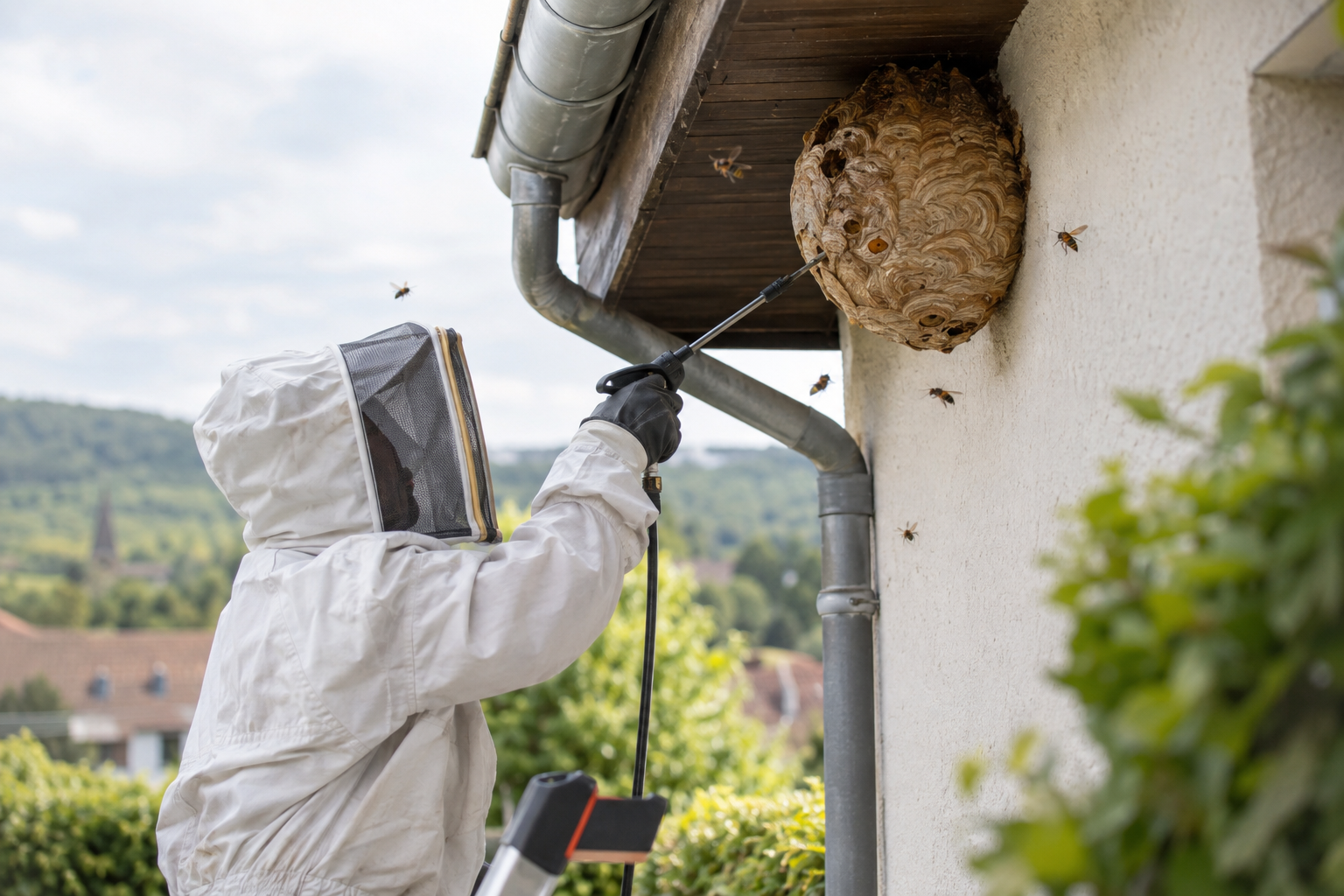
After a nest has been destroyed: How long do the hornets remain?
Contents
-
The extermination process: How long does it take for the insecticide to take effect?
-
The hornets remaining after the treatment: Why are they still there, and how long will they stay?
-
When should the nest be permanently removed, and how can you ensure complete eradication year-round?
The professional has left, the nest has been treated… and several hornets are still circling near the roof. Did the treatment work? Can we open the window again or let the children play outside? Their presence after the treatment is concerning, but it doesn’t necessarily mean the colony is still active.
Things to remember
-
We set ourselves apart by specifically addressing the anxiety that follows a treatment: the persistent presence of ‘orphaned’ hornets’
-
The article provides a scientific explanation of why insects remain visible, how long they survive without their queen, and when the danger has completely passed.
-
How long does it take for the insecticide to take effect?
-
Why are they still here, and for how long?
After a hornet's nest is destroyed, some insects may remain visible for several hours, and sometimes even several days. A marked decrease in activity is generally observed within the first 24 to 48 hours following appropriate insecticide treatment. This timeframe is merely a guideline, not a guarantee of safety: worker bees that were absent at the time of treatment may return, and some may survive without their queen.
To understand what’s happening right outside your home, you need to distinguish between three things: the product’s effect, the return of the hornets that went out to forage, and the actual cessation of activity around the nest.
The extermination process: How long does it take for the insecticide to take effect?
Why do we still see hornets flying around even though the nest has just been treated? Because the application of an insecticide and the complete elimination of a colony do not occur simultaneously. The product must reach the insects, and not all of them are necessarily in the nest at the time of treatment.
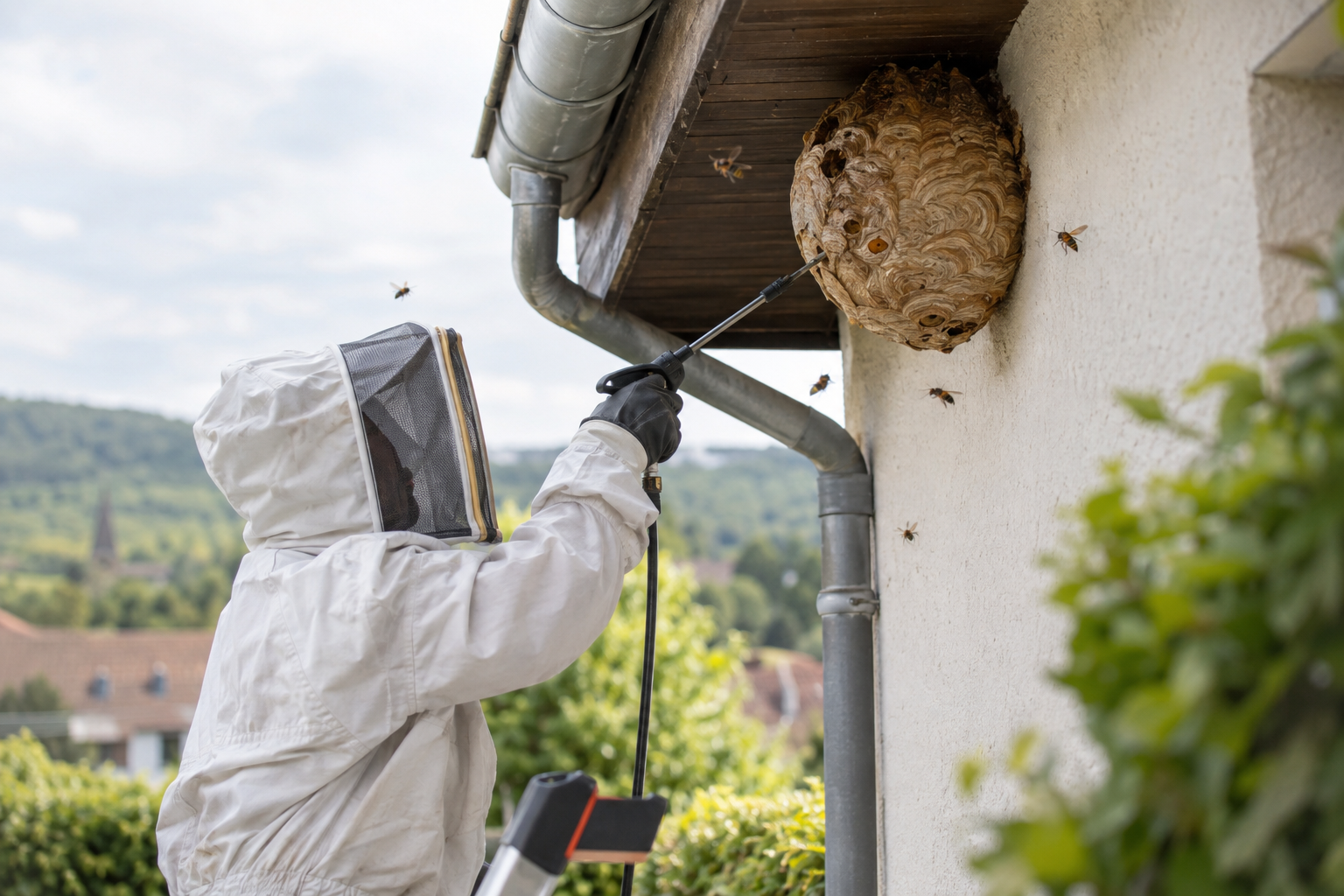
Visit insecticide's duration of action depends on its active ingredient, its formulation, and how the hornets are exposed to it. Some products act quickly on individuals that are directly exposed, within a few minutes. To see an overall decrease in activity, however, it takes several hours. Only the technician can specify the expected timeframe based on the product and method used at your location.
A nest that is easily accessible is not treated the same way as a colony located in a duct or at the top of a tree. Access to the center of the nest, its size, and the presence of obstacles all affect the effectiveness of the treatment. Weather conditions can also affect exposure to the product and make observations of hornets less representative.
When destroying a nest, the time spent on site is therefore not the time required for the insects to disappear. The treatment itself may be brief, whereas preparing for it, securing the area, and gaining access to the nest require more work. A rapid response does not indicate either inadequate treatment or immediate elimination.
The typical sequence of events following insecticide treatment is as follows:
-
In the first few hours: Occasional flights may still occur, involving disoriented or weakened insects. The area should still be avoided.
-
Over the next 24 to 48 hours: A marked decrease in foot traffic is generally expected.
-
If business remains steady or picks up again: The company must reassess the situation in accordance with the announced review deadline.
The duration of effectiveness of a hornet treatment also depends on the product’s persistence under normal conditions of use. A residual effect may affect hornets that return after the treatment has been applied. However, it does not protect the entire property against future infestations.
What about the best time to take action? Whether you’re destroying a wasp nest or treating an Asian hornet infestation, acting early in the morning or in the evening may allow you to find more insects in the nest. This isn’t a universal rule: the method, access, and safety considerations determine the time slot chosen by the professional. Don’t try to take advantage of the night to handle the situation yourself—a colony at rest remains dangerous when disturbed.
The hornets remaining after the treatment: Why are they still there, and how long will they stay?
Forty-eight hours after the treatment, a few hornets are still searching for the entrance under a ledge. This scenario is consistent with an effective treatment: these individuals may be workers who were outside during the treatment. However, if there is regular and heavy traffic, it warrants further inspection.
Worker hornets—or more precisely, female workers—leave the nest to forage for sugary foods, capture prey, or gather materials. Upon their return, they find their way back to the nest using their landmarks. Even if the nest has been removed, these landmarks do not disappear immediately. This explains why they continue to fly around a now-empty branch or a former entrance.
These individuals are often referred to as «orphan hornets». The term helps explain the situation, but it encompasses several scenarios: some have lost their nests, others are returning to a treated colony, and still others have already been exposed to the insecticide. Their survival following the destruction is therefore not uniform.
The queen's death does not automatically kill the worker bees. An adult hornet can feed itself, particularly on sugary foods. Without lethal exposure to the product, it can survive for several days or even several weeks, depending on its age, the temperature, and access to food. It would be incorrect to say that all hornets die exactly two days after their queen.
It’s also important to distinguish between an insect’s survival and its presence around your home. An insect that is still alive may leave the area—you won’t see it anymore, but that doesn’t necessarily mean it’s dead. Conversely, a few stray workers may return to search for their nest for some time. A decrease in these search attempts is a more reliable indicator than a theoretical countdown.
Can they rebuild a colony? Worker bees without a queen do not become queen bees capable of normally reestablishing a sustainable colony. In the case of the Asian hornet, some workers can lay unfertilized eggs that produce males, but this does not replace a fertilized queen and does not restore the usual life cycle.
These remaining hornets can still sting. They aren’t out to «get even,» but a hornet trapped in clothing, grabbed, or disturbed still poses a risk. Keep your distance, keep children and pets away from the area, and do not crush any insects near the old nest. A hornet that appears to be motionless should not be picked up with bare hands.
To monitor the situation, observe from a safe location without getting too close to film. A few sporadic appearances that become less frequent are actually reassuring. Repeated entries and exits at the same spot, a persistent cluster, or hornets entering the home warrant calling the exterminator again immediately, without delay, if the situation puts the occupants at risk.
When should the nest be permanently removed, and how can you ensure complete eradication year-round?
A quiet nest isn't necessarily one that can be safely removed. After treatment, removing the nest depends on the method used, its accessibility, and the product's instructions. This isn't something you should try to do on your own with a trash bag and a ladder.
When a residual insecticide has been applied, the professional may ask that the nest be left in place temporarily so that returning workers are also exposed. Removing it too early may compromise this effect. Other approaches, on the other hand, call for removal during the treatment, with appropriate management of the insects present. Therefore, there is no universal 48-hour withdrawal period.
The right time to remove a hornet nest is determined after assessing the nest’s activity and following the treatment guidelines. The absence of movement in cold weather or rain is not sufficient evidence: hornets may simply be coming out less often. The assessment must take into account the conditions under which the observation is made.
Physical removal is not always necessary, particularly for a nest that has been neutralized, is inaccessible, and poses no particular hazard. Old nests built by social wasps and hornets are generally not reused the following year. However, the same shelter—such as a roof or a suitable cavity—may host a new colony. Once the nest has been confirmed as neutralized, the professional may recommend sealing off the affected entry points, without ever trapping a colony that is still active.
For the Asian hornet in winter, the situation changes. In our part of the world, the colony typically follows an annual cycle: the workers, males, and the old queen disappear at the end of the season, while young, fertilized queens spend the winter in shelters, usually outside the nest. Destroying an old, empty nest in January therefore does not eliminate the founder queens that have already dispersed.
A mild winter can extend the local activity period. It is important to assess the situation rather than assume that a specific date on the calendar is enough to rule out the risk. At Frelons.be, the fight against the Asian hornet is a year-round effort : Locating foundations in the spring, treating active colonies during the season, and assessing nests discovered in the winter. Taking action year-round does not mean spraying year-round.
Finally, a «guaranteed service» must have a specific meaning. Before making a reservation, ask:
-
What results are expected, and by when?
-
When should a persistent activity be reported?
-
Is a follow-up inspection or a second visit included, and under what conditions?
-
Is nest removal included in the service?
The elimination of the targeted colony is a verifiable objective. Promising that no hornets will ever cross your yard again is not: individuals from other nests may still be present in the neighborhood. Safety depends on appropriate treatment and follow-up, not on a promise of the complete absence of insects.
Conclusion
The right indicator is the change in activity, not just the number of hours that have passed since the technician left. After a hornet nest has been destroyed, a few isolated returns may be due to workers that were absent during the treatment. Constant activity at the same entry point suggests something else: you should discuss this with the company that performed the treatment.
Keep track of three distinct indicators. The product may act quickly on exposed insects. An overall decline in foraging activity is often observed within the first 24 to 48 hours. However, an unaffected worker bee may survive for much longer, since the death of the queen does not result in the death of all adults. These timeframes describe different phenomena; they do not contradict each other.
To be able to use your patio or garden again, follow the instructions you’ve been given rather than testing the hornets’ reaction on your own. Do not shake the branch, block the entrance, or add household spray to the professional treatment. You risk scattering the insects or exposing yourself unnecessarily, without addressing the root cause of their presence.
When can we consider the danger to have been averted? Once the elimination of the colony has been confirmed and the restrictions related to the intervention have been lifted. This does not mean that no hornets from elsewhere will ever appear in the area. The goal is to eliminate the risk associated with the treated nest, while conducting an appropriate inspection if activity persists or if the nest is located near a busy thoroughfare.
Are there still hornets near your home? First, contact the technician with the date of the treatment, the location of the nests, and how the situation has changed since they were there. A photo taken from a distance can be helpful; there’s no need to get closer to get a better shot.
To submit a request to hornets.be, also specify whether the insects are staying outside or entering a room. This detail helps assess the urgency of the situation. Whether it’s summer or winter, the response should be based on what’s actually present in your home: an active colony, a few isolated workers, or an old, now-empty nest.
Frequently asked questions
Is it normal to still see hornets 48 hours after the nest has been treated?
A few isolated hornets may still return after 48 hours, even if the treatment was successful: worker hornets that were absent during the treatment find their way back to the original location using their landmarks. A significant decrease in foraging activity is generally expected within the first 24 to 48 hours, but this timeframe does not guarantee safety. Regular and heavy foraging activity warrants further monitoring.
How long do «orphaned» hornets survive without their queen?
The queen’s death does not automatically lead to the death of the worker bees: without lethal exposure to insecticide, they can survive for several days or even several weeks, depending on their age, the temperature, and access to food. They may also leave the area before dying, which distinguishes their survival from their presence around your home. These worker bees do not become queen bees capable of successfully reestablishing a sustainable colony.
When can the children go back to the playground after the procedure?
A 24- to 48-hour waiting period is not long enough to allow children to return to the area near the treated nest: any remaining hornets may still sting. Keep children and pets away from the area and follow the instructions you’ve been given until the colony has been confirmed as eliminated and the restrictions related to the treatment have been lifted. This eliminates the risk posed by the treated nest without preventing hornets from other areas from entering.
What signs should prompt you to contact the healthcare professional after treatment?
Repeated entries and exits at the same location, a persistent cluster, or activity that remains sustained or resumes are grounds for calling the service provider back according to the scheduled follow-up timeline. Do not wait if hornets enter the home or pose a threat to the occupants. Note the date of the treatment, the location of the swarms, and how the situation is developing; a photo taken from a distance can also help assess the situation.
Should you remove the nest as soon as the hornets no longer seem active?
A quiet nest isn’t necessarily safe, especially if cold weather or rain are simply limiting the bees’ foraging trips. After certain treatments, the professional may temporarily leave the nest in place to expose returning workers to the product’s residual effect; other methods call for immediate removal. Removal therefore depends on the instructions and verification of activity, and is not always necessary for a nest that has been neutralized and is inaccessible.
What should you check when a company offers a guaranteed service?
Before booking, ask what results are expected, how soon you should report any persistent activity, and whether a follow-up inspection, a second treatment, or nest removal are included—and under what conditions. The guarantee must cover the elimination of the targeted colony, not the absence of all hornets in the garden. The treatment does not protect the entire property against future infestations.
 French
  English
  Dutch
Dutch
0 Comments