
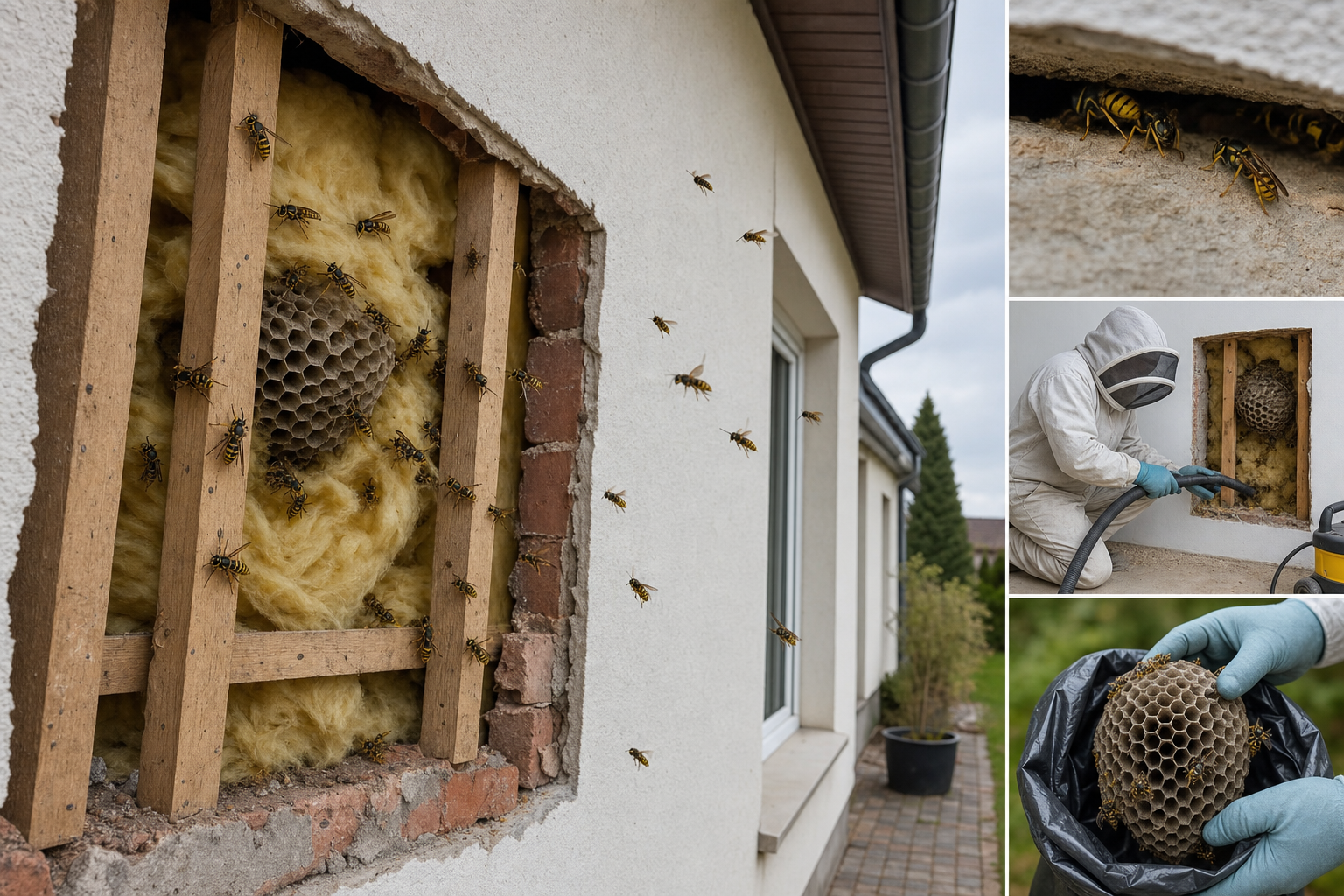
Wasps coming out of a hole in the wall: what should you do?
Contents
-
Identifying Risks: Should You Be Worried About Your Home and Your Health?
-
How to Remove a Nest from a Wall: Solutions and Common Mistakes
You’re sitting in the garden, and you notice a steady stream of activity at a specific spot on the facade. Always the same hole. One insect comes out, three others go back in. This is no coincidence: when wasps emerge from a hole in the wall in such an organized manner, there’s a nest behind it. Not in the hole. Behind it.
Things to remember
-
Beyond a simple tutorial, we explain why modern insulation materials are attractive to queen bees
-
The article emphasizes the importance of education in addressing structural risks (destruction of fiberglass insulation) and the critical danger of blocking access, while also reminding readers of the need for constant vigilance against the Asian hornet in Belgium
-
Understanding Why Wasps Nest in Your Walls
-
Should you be worried about your home and your health?
And that’s where it gets interesting, because most people completely underestimate what’s going on on the other side of their brick wall. A wasp nest in the wall isn’t just a little ball hanging under a gutter that you can knock off with a broom. It’s a colony growing in an enclosed space—often in direct contact with your insulation—that can reach several thousand individuals by late summer.
We respond to these types of situations year-round in Belgium, and the number of calls skyrockets between July and September. But be careful: a hole in a facade doesn’t always mean wasps. The Asian hornet also settles in cavities, and that changes the whole situation. Let’s take a look at how to recognize the signs, assess the actual risk to your home, and—most importantly—avoid the mistake that turns a manageable problem into a nightmare: blocking off the entrance.
Understanding Why Wasps Nest in Your Walls
It all starts in April. A queen wasp emerges from hibernation—alone and hungry—and sets out to find a place to establish her colony. Her criteria are simple: dry, dark, sheltered from the wind, and with a stable temperature. Guess which place checks all the boxes? Your wall.
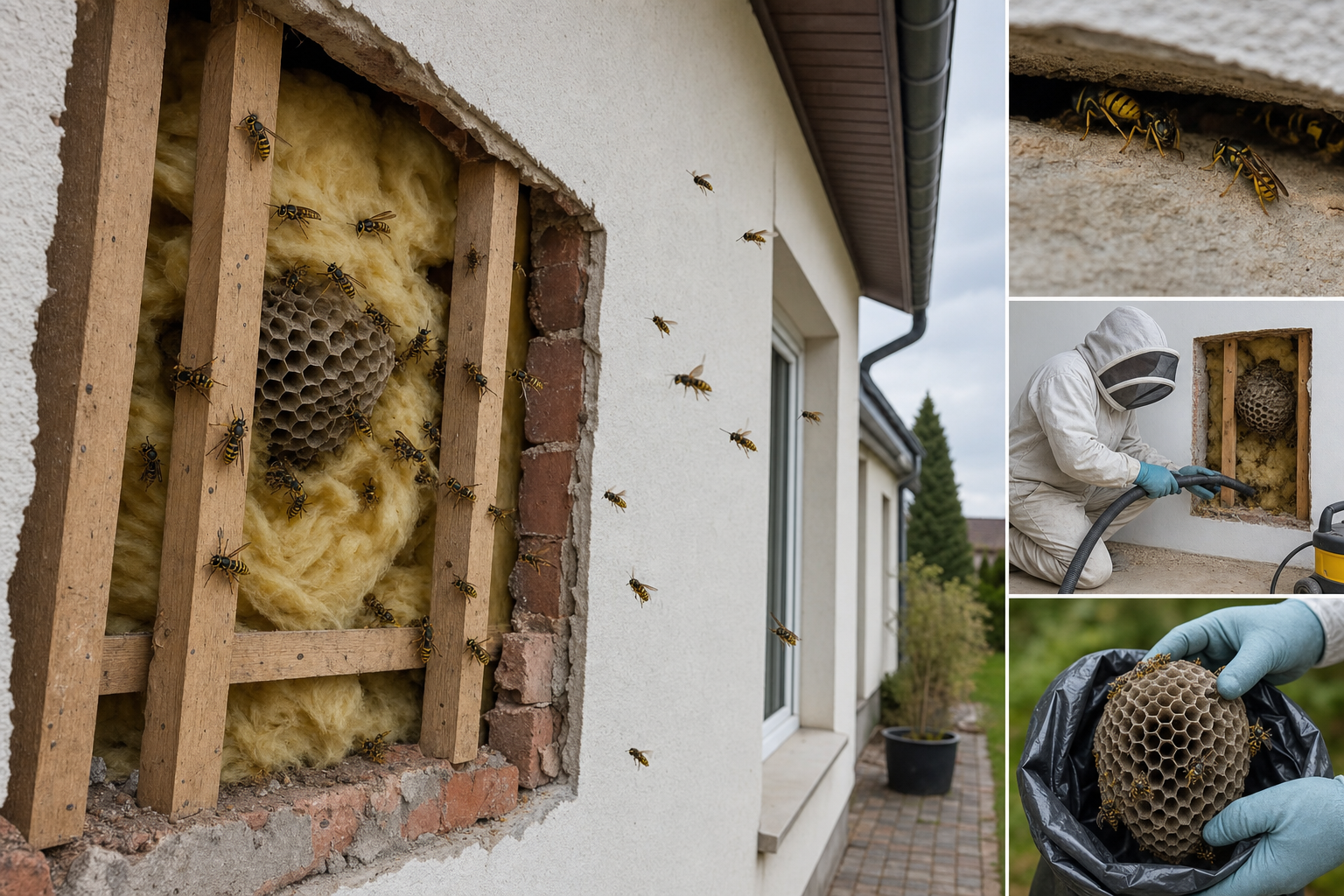
Belgian homes are an ideal breeding ground. A cavity wall with an air gap between the facing and the load-bearing wall is literally a ready-made wall cavity. All it takes is a faulty seal, a ventilation grille without a screen, an expansion joint that hasn’t been properly sealed, or an electrical cable opening that was never patched up. The queen can squeeze through a hole just a few millimeters wide, and she’s right at home.
Wasp nests in stone walls are even more common in old Ardennes buildings or Brabant farmhouses. The stones, the lime mortar joints that erode over time, and the spaces behind the lintels—all of these provide access points. We’ve already discussed colonies that have settled between two cut stones, invisible from the outside except for that familiar, repetitive flight path.
But there's one factor that few homeowners are aware of: heat. Modern insulation is a game-changer. A south-facing facade insulated from the outside, or a roof with a sub-roof and glass wool, creates areas that remain warm at all times. Queens seek out these microclimates. For a colony, every degree gained means faster development, healthier larvae, and a larger population. The result: well-insulated homes attract more colonies than old, drafty shacks. It’s paradoxical, but that’s what we’re seeing in the field.
Do wasps burrow into walls? No, not into masonry. They don’t attack brick, concrete, or stone. However, they do gnaw through and move anything soft: glass wool, polystyrene, wood-fiber panels, deteriorated plaster, and worm-eaten wood. They don’t dig just for the sake of digging; they clear out space to expand their nest. And we’ll come back to that distinction later, because it explains the damage we find afterward.
A helpful note: it’s not always the common wasp. In a wall cavity, you might find the German wasp, the European hornet, and—increasingly often—secondary colonies of Asian hornets if the cavity is large enough. Each species requires a different treatment, with appropriate products and protective measures. That’s also why we never recommend just winging it with an aerosol can bought at the supermarket.
Identifying Risks: Should You Be Worried About Your Home and Your Health?
There are three questions that come up time and time again on the phone: Will it damage my wall? Will it fit in my home? And is it dangerous for children? Here are my honest answers, in that order.
Damage to insulation is a real problem. A colony nesting against glass wool compacts it, gnaws at it, and soils it. A mature nest can occupy a volume equivalent to a basketball, or even more. That volume has been created at the expense of your insulation. Compacted fiberglass loses much of its insulating power, and it never settles back into place on its own. Add to that the moisture generated by the colony, larval residue, and the carcasses that accumulate at the end of the season, and you have a permanent cold spot in the wall. During a job in Wavre last year, we had to remove one square meter of drywall to take out the nest and replace the insulation: the wool was black and compressed to a depth of about thirty centimeters.
Next, noise. What kind of noise does a wasp nest make inside a wall? It’s not a continuous buzzing sound, as one might imagine. It’s more like a dry, irregular scraping sound, somewhat like sandpaper being gently rubbed against the wall. Some describe it as a scraping sound inside the wall; others as a faint crackling, especially audible at night when the house is quiet. This sound comes from the wasps chewing on the wood and building their cells. One detail that confuses many people: this sound is almost indistinguishable from that of a mouse or a dormouse. The difference? Rodents make noise intermittently, often at night; wasps are mainly active during the day, with a peak during the hottest hours.
As for the crack in the facade, let’s be clear: wasps don’t cause cracks in a wall. They use an existing crack. However, a colony that settles in an expansion joint or behind peeling plaster accelerates deterioration, because constant traffic and moisture wear down the already weakened material.
Now, the risk of getting stung. As long as no one gets within a meter of the hole, a wall-dwelling colony remains relatively inconspicuous. The problem arises when the hole is at eye level near a front door, above a sandbox, or right next to a bedroom window. In such cases, the risk of daily incidents becomes serious. The wasps defend a perimeter around the entrance, and vibrations make them aggressive: a drill, a lawn mower, or scaffolding against the building’s facade are enough to trigger a swarm attack.
And then there’s the scenario no one anticipates: wasps burrowing their way inside. When the colony runs out of space and the exterior exit is blocked, the workers gnaw through the drywall or squeeze through electrical conduits. You end up with dozens of insects in your attic or bedroom. This happens more often than you’d think, and it’s almost always the result of a blocked exterior exit.
How to Remove a Nest from a Wall: Solutions and Common Mistakes
Let's start with mistake number one—the one that accounts for half of our emergency calls. Do not cover the hole. Never. Not with silicone, not with expanding foam, not with a rag, and not with mortar. It’s the most logical instinct in the world—and it’s the worst.
Why? Because a sealed-off nest doesn’t die. Wasps have a vital need to go out and find food and building materials, so they’ll look for another way out. They find that way out by burrowing inward: through ceiling plaster, baseboards, recessed spotlights, electrical outlets, and attic hatches. You’re turning a facade problem into an infestation inside your home. We’ve seen families evacuate their bedrooms because thirty wasps were emerging from an LED spot light three days after it had been sealed with polyurethane foam.
Second mistake: using insecticide spray sold at supermarkets and spraying it into the hole. It kills a handful of worker wasps at the entrance, agitates the entire colony, and never reaches the heart of the nest, which is sometimes located 50 cm or a meter from the entry point. The result: you get stung, and the wasps stay. The same goes for boiling water, gasoline (dangerous and illegal), or a vacuum cleaner (yes, we’ve heard that one before).
Effective treatment of a cavity nest relies on a residual insecticide powder injected into the perch. The principle is simple yet highly effective: the powder settles around the entrance and inside the access tunnel. Every wasp that enters or exits becomes coated with it and carries it deep into the nest, onto the larvae and the queen. The colony poisons itself. Depending on the size of the nest, complete elimination takes between a few hours and 48 hours. In the vast majority of cases, there is no need to cut into the wall, which eliminates the need for masonry work.
When should you call a professional exterminator? Honestly, in almost any situation where there’s a nest in a wall. An accessible nest in a hedge—at a stretch, that’s debatable. But a cavity in a wall? No: you can’t see the nest, you don’t know its size or the species involved, and you’re often working high up on a ladder with angry insects. At Hornets.be, wasp nest removal is performed using a certified full-body suit, a telescopic pole extending up to 10 meters, and approved products that are not available to the general public.
What we ask you to do before coming: note the time when activity is at its peak, take a photo from a distance (using the zoom, not a selfie from 30 cm away), and, most importantly, note the size and color of the insects. A dark abdomen with an orange band and yellow legs indicates an Asian hornet. In this case, the response is a priority and the protocol differs, because a colony of Asian hornets inside a wall can number several thousand individuals and poses a threat that extends beyond your home. We handle these reports year-round, including in winter for primary nests and founding queens spotted early on.
One last point: prevention. Once the nest has been destroyed and the colony is inactive (allow a good week for this), only then should you seal off the access point. Install insect screens over vents, repoint worn-out masonry, brush down expansion joints, and install mosquito netting over roof skylights. A wasp won’t return to a former nest, but another queen will choose the same wall the following year if conditions remain just as hospitable.
Conclusion
Wasps coming out of a hole in the wall aren’t inevitable, nor are they a disaster. It’s a warning sign: a colony has taken up residence in your wall, it’s growing, it’s likely damaging your insulation, and it will become more defensive as the summer progresses. The right course of action boils down to two things: don’t block anything, and have the species identified.
Whether it’s a common wasp, a European hornet, or an Asian hornet, the treatment isn’t the same, and just looking at the nest from the ground three meters away isn’t enough. One call, a few questions, a photo—and we know what we’re dealing with.
Have you noticed this coming and going on your building's facade? Contact Frelons.be. We serve all of Belgium, seven days a week, and provide a clear estimate before any work begins. And if it’s an Asian hornet, we make it a priority to respond: every nest we destroy means hundreds fewer queens the following spring.
Frequently asked questions
Why is it especially important not to block the hole through which the wasps are coming out?
A sealed-off nest doesn’t die: the worker ants need to go out to find food and building materials, and they’ll gnaw through plaster, baseboards, electrical conduits, or recessed lights to find another way out. Silicone, expanding foam, rags, or mortar can therefore turn a problem on the exterior into an infestation inside the home—sometimes in as little as three days.
Can wasps damage my wall or insulation?
They do not attack brick, concrete, or stone, but they gnaw on and compact anything soft: glass wool, polystyrene, wood fiber, and deteriorated plaster. A mature nest can be as large as a basketball, and the compacted, soiled, and damp insulation creates a permanent cold spot that never recovers on its own.
How can you tell the difference between a wasp nest and a mouse nest in a wall?
The sound of a colony resembles a dry, irregular scraping—a bit like sandpaper being gently rubbed—caused by the gnawing of wood and the construction of the cells. The main difference lies in the rhythm: the rodent is active intermittently, often at night, while the wasps work during the day, peaking during the hottest hours.
Why do well-insulated houses attract more queen bees?
Modern insulation creates microclimates that remain warm at all times, particularly on a south-facing facade insulated from the outside or under a roof with a roof underlayment and glass wool. Yet every degree of temperature increase accelerates the development of larvae and causes the colony to grow. Paradoxically, newer, energy-efficient homes therefore harbor more termites than older, drafty buildings.
Is an insecticide spray from the supermarket enough?
No. When sprayed into the opening, it kills a few worker wasps at the entrance, agitates the entire colony, and never reaches the center of the nest, which is sometimes located fifty centimeters or even a meter from the entry point. The usual result: stings for you, and the wasps are still there. Boiling water, gasoline, or a vacuum cleaner are just as ineffective—and can even be dangerous.
How can you identify an Asian hornet, and why is this more urgent?
Look for a dark abdomen with an orange band and yellow legs. This species readily settles in fairly large wall cavities, where a colony can number several thousand individuals. Frelons.be treats these reports as a priority year-round, including in winter for primary nests: every nest destroyed means hundreds fewer queens in the spring.
 French
 English
 Dutch
0 Comments