
Wasps getting under the roof tiles: Is this something to worry about?
Contents
-
How can you identify a wasp nest under the roof tiles and assess the situation?
-
The Potential Dangers and Damage a Wasp Nest Can Cause to Your Home
-
What are some safe ways to remove a wasp nest from under the roof?
You’re in the garden, you look up at the roof, and you see this little spectacle: insects going back and forth in the same spot, between two tiles or under the eave. One, then two, then ten in five minutes. The question always comes up the same way on the phone: «Is it serious, doctor?»
Things to remember
-
This article puts the presence of wasps in the attic into perspective by providing a detailed diagnostic guide
-
It highlights the risks to insulation and the building’s structure, while emphasizing the need for year-round vigilance against the Asian hornet
-
How can you identify a wasp nest under the roof tiles and assess the situation?
-
The Potential Dangers and Damage a Wasp Nest Can Cause to Your Home
Honest answer: In most cases, no, it’s not a disaster. A colony of common wasps under a roof is a common occurrence in Belgium, especially between July and September. But «not a disaster» doesn’t mean «just let it be.» Because a nest in the attic eats away at the insulation, can stain a ceiling, and often ends up sending worker wasps into your youngest child’s bedroom through a recessed light fixture.
And then there’s the other scenario, one we’re seeing more and more often: they’re not wasps, but Asian hornets. At Frelons.be, we deal with this species year-round, including in winter when it comes to locating primary nests or securing a site. So before you try to fix anything yourself with an insecticide spray from the supermarket, let’s take five minutes to identify what’s really living under your roof tiles.
How can you identify a wasp nest under the roof tiles and assess the situation?
The first thing to do: sit down and watch. Seriously. Sit down about five or six meters from the entry point, in the shade, and observe for ten minutes. This simple exercise provides 80 % of the information a professional needs.
What you're looking for is a Regular and targeted traffic. If wasps are entering under the roof tiles in the same spot—always the same one—at a steady pace (several times per minute during peak season), that’s a sign of an active colony behind them. If you see three insects flying around randomly without ever going inside, they’re probably just passing through—not a nest.
Next, see who’s stealing. That’s where it really comes down to:
-
The common wasp or German wasp : 1.5 cm, bright yellow with black stripes, slender, with a lively, jerky flight. A barbecue classic.
-
The European hornet : Large, up to 3.5 cm, reddish-brown and yellow, with a deep flight call. Impressive but generally peaceful. A beneficial species; should only be removed if the nest is truly problematic.
-
The Asian hornet : about 2.5 to 3 cm, very dark, almost black body, a single broad orange band on the abdomen, and most notably yellow tips on the legs. That's the telltale sign. If you see yellow legs, give us a call.
-
The Bee : hairy, brownish-orange, stockier. A colony of bees under the roof isn't destroyed—it's salvaged.
Location matters, too. Wasps under the roof love three locations: the space between the shingles and the roof sheathing, the eave boxes and trim boards, and especially the unused attic space when there’s a way in (ventilation, broken shingle, poorly sealed joint). The Asian hornet, on the other hand, prefers the outdoors, in trees, but regularly builds its primary nests in the spring under a shelter: eaves, carports, sheds, or skylight frames.
To identify a wasp nest with certainty, go up into the attic during the day, without shining a bright light directly on the nest. A wasp nest looks like a gray-beige, streaked ball of papier-mâché, about the size of a grapefruit in June and a soccer ball in September. You’ll hear a continuous, very distinctive buzzing sound, like distant frying. Don’t get within three meters and don’t touch anything.
A quick seasonal guide to help assess the urgency: in May and June, a colony consists of a few dozen individuals and is easy to treat. By late August, a common wasp nest can have 2,000 to 5,000 workers. The difference in risk between the two is enormous. The sooner you act, the simpler, faster, and cheaper the treatment will be.
One last sign to watch for: wasps that get under the roof tiles sometimes end up getting into your home. If you spot isolated worker wasps in a bedroom, bathroom, or hallway on the top floor—with no open windows—it means there’s a nest in the roof that has found a way inside. At this point, there’s no time to waste.
The Potential Dangers and Damage a Wasp Nest Can Cause to Your Home
«They don’t bother me; I’m going to let them stay through the winter.» We hear that a lot. And that’s when we need to explain what’s really going on overhead.
Let's start with the most concrete point: damage to the insulation. A colony that has taken up residence in an attic builds its nest against or inside the fiberglass insulation. The wasps dig, pack down, and push aside the fibers to make room for themselves. A mature nest can easily create a cavity 40 to 60 cm in diameter within a layer of insulation. The result: a thermal bridge, reduced thermal performance, and a heating bill that creeps up quietly. Add to that the moisture generated by the colony (an active colony releases water vapor), and you end up with insulation that compacts and permanently loses its effectiveness.
The nest itself is lightweight—ranging from a few hundred grams to a few kilograms—so damage to the roof structure caused by wasps is rarely structural. The real problem lies elsewhere: wasps scrape away at the wood to make their paper. On old, untreated rafters, you can see superficial grooves. This isn’t a major issue in itself, but scratched wood that’s been exposed to moisture in certain areas becomes a breeding ground for wood-decaying fungi. Damage to the roof structure, when it does occur, is therefore indirect and gradual. But it does happen.
There's also the scenario of the an abandoned nest that's leaking. In the fall, the colony dies. The nest, filled with dead larvae and moisture, begins to decompose. If it is pressed against a drywall ceiling, it leaves a brown stain, sometimes a smell, and attracts secondary pests: moths, dermestid beetles, and sometimes rodents that come to feed on it. A dead nest is not harmless. It must be removed.
Visit noise pollution, next. The sound of a wasp nest in the ceiling isn’t the buzzing of a single insect; it’s a continuous hum, punctuated by sharp crackles, like crumpled paper. These are the worker wasps chewing on wood fibers and ventilating the nest by flapping their wings. You can hear it mostly at night, when the house is quiet, and it gets downright annoying in an attic bedroom. Many people describe it as «sand flowing through the wall.» If you hear that, you have your confirmation.
Finally, the health risk. A wasp stings without losing its stinger, so it can sting multiple times. A disturbed colony sends out 20 to 50 worker wasps to defend itself. For a non-allergic adult, several stings are manageable. For a child, an elderly person, or someone with an allergy, it’s a medical emergency. About 3 % of the population develops a significant allergic reaction to hymenoptera stings. This is the number one reason why it is strongly advised against attempting to treat a nest high up on your own, while standing on a ladder with your arms raised above your head.
And what about the Asian hornet? Its nests under roofs are rarer but heavier—weighing up to 6 or 8 kg—and, most importantly, the colony defends a 5-meter perimeter with a level of aggression that wasps do not exhibit. Not to mention the impact on nearby apiaries. In that case, there’s no debate: we take action.
What are some safe ways to remove a wasp nest from under the roof?
Let's get down to business. You have a nest, and you want it gone. Here's what works, what doesn't, and what's downright dangerous.
What doesn't work: Block the entry hole. That’s the classic mistake, and it backfires on you. Wasps don’t die when trapped; they look for another way out. And that other way out is very often into the house: the attic hatch, an electrical conduit, or around a light fixture. You’ll end up with dozens of wasps in your living room. The same goes for water, fire, or smoke. A fire in the roof structure—well, you can imagine the consequences.
Here's what might work in a specific situation: A long-range aerosol can, aimed at a small, visible nest that’s accessible from the ground or a stable platform, early in the season (May–June), applied at dusk when all the workers have returned to the nest. Wear full-body coveralls, gloves, goggles, and a hood, and ensure there is a clear escape route behind you. No one else should be nearby. If even one of these conditions is not met, stop immediately.
However, under a roof, almost none of these conditions are met. The nest is high up. It’s often hidden, wedged between the roof underlayment and the roof battens. You’re standing on a ladder. You raise your arms. And you’re spraying insecticide right into your own face. Every year, people fall off ladders while trying to escape a swarm. The falls cause more damage than the stings.
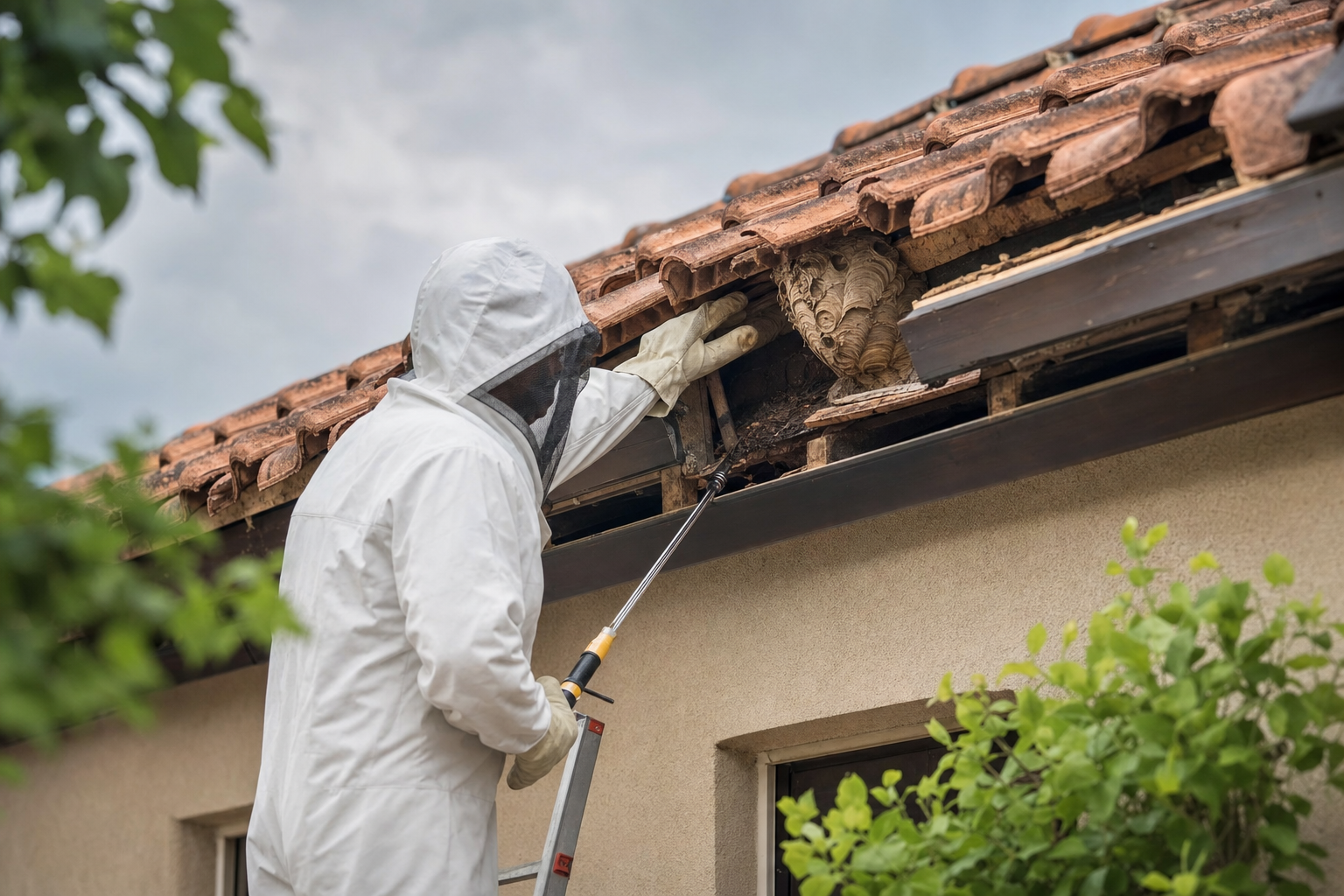
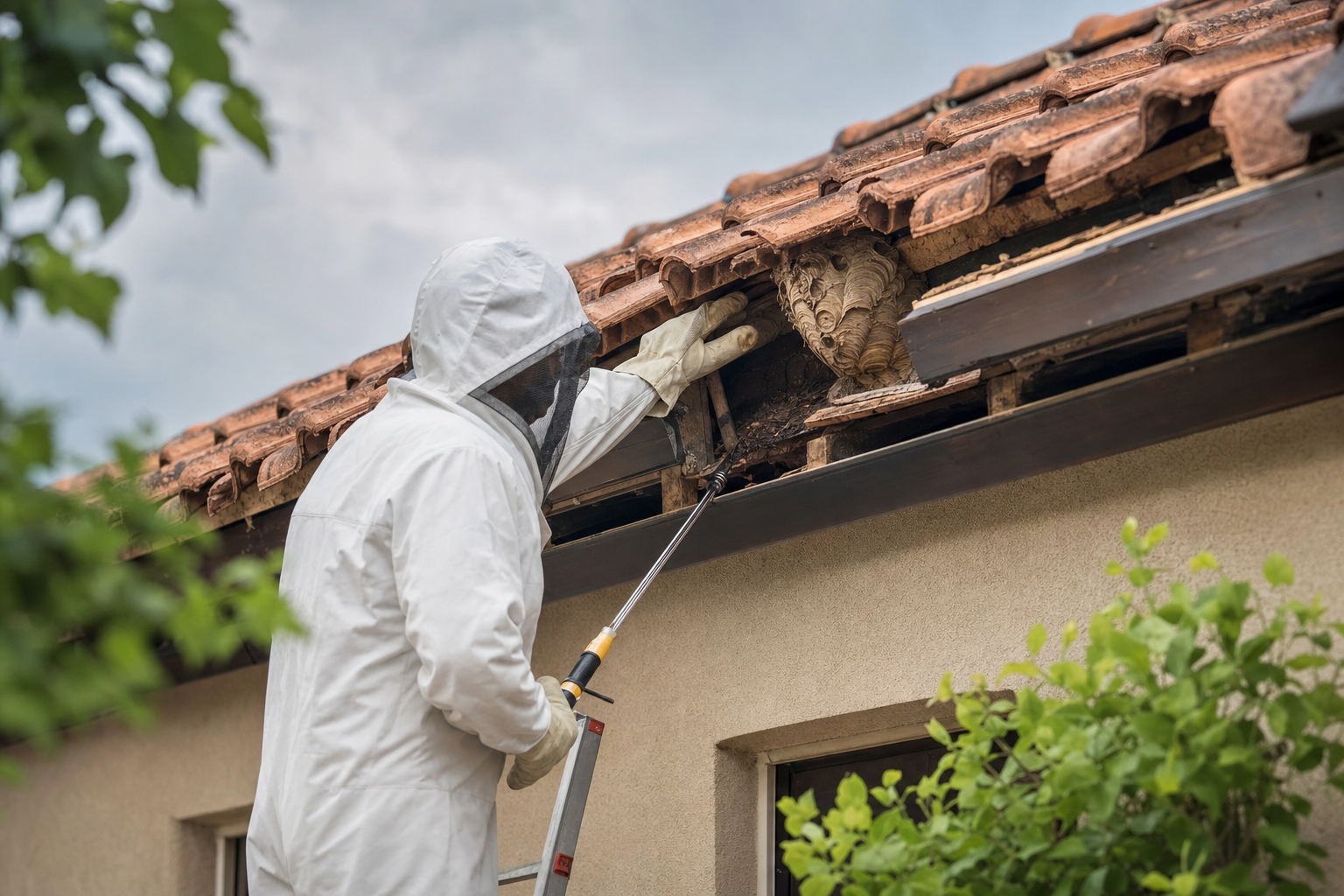
That leaves the most frequently asked question: How do you deal with an inaccessible wasp nest? The one we hear, the one we sense, but the one we can’t see. That’s exactly where professional pest control makes all the difference. We use a telescopic pole equipped with an injector that delivers an insecticidal powder directly into the cavity, up to 8 or 10 meters from the ground. The worker wasps become contaminated as they pass through and carry the product back to the heart of the nest. The colony collapses within 24 to 48 hours, without having to remove a single roof tile.
Here's how a service call at Frelons.be works, in practical terms:
-
You describe the situation to us over the phone (height, type of insect, whether there are children or pets present). We identify the species, often based on a photo.
-
We usually make a house call within 24 to 48 hours, and we'll come right away if a member of the household has an allergy.
-
Accurately identify the entry point and the affected area, then select the product and technique (pole injection, dusting, attic treatment).
-
Treatment, with the area secured. Stay inside with the windows closed for about an hour.
-
Recommendations for monitoring and, if necessary, removal of the dead nest and sealing of access points once activity has ceased.
This last point is essential. It’s not enough to remove a wasp nest if you leave the door open. Once the colony has been eliminated, seal up the area: install insect screens over the roof vents, repair cracked roof tiles, caulk the eaves, and install an eave trim at the roof’s edge. Wasps never reuse an old nest, but they’ll happily reuse a good location. An accessible attic will remain accessible the following year.
For the Asian hornet, the procedure is different, and our work doesn’t end in September. In the spring, we remove the primary nests (about the size of a golf ball, often found under an eave or in a garden shed): at this stage, only a single queen is present, and destroying her prevents a colony of 2,000 individuals from forming by September. In winter, we locate nests that have become visible in bare trees and secure at-risk sites. Being active year-round isn’t just a marketing slogan—it’s the only effective way to curb the spread of this species.
Conclusion
Wasps getting into the attic isn’t the end of the world, but it’s not something to ignore either. First, take a look: the type of insect, the entry point, how much traffic there is, and the noises coming from the ceiling. These four clues tell you almost everything. And if you spot yellow legs and a dark abdomen with a single orange stripe, don’t think twice.
Key takeaways: Never block the entrance to an active nest, don’t climb a ladder with an insecticide spray, and take action as early in the season as possible. A nest treated in June costs less, takes just twenty minutes to handle, and saves you three months of buzzing above your bedroom.
Not sure what’s flying around your roof tiles? Send us a photo, and we’ll identify the species for free and give you an honest assessment of whether you need to take action or not. Frelons.be provides service year-round for wasps, European hornets, and Asian hornets throughout Belgium.
Frequently asked questions
How can I tell if there really is a nest under my roof tiles or if it's just some wasps passing through?
Set up about five or six meters from the entrance, in the shade, and observe for ten minutes. Steady, directed traffic—always in the same spot, with several visits per minute during peak season—indicates an active colony inside. Three insects flying around randomly without ever entering indicate just passing through—not a nest.
How can you tell an Asian hornet apart from a wasp or a European hornet?
The Asian hornet measures 2.5 to 3 cm, with a very dark, almost black body, a single broad orange stripe on the abdomen, and yellow tips on its legs—that’s the telltale sign. The common wasp is 1.5 cm long, bright yellow with black stripes, and the European hornet is up to 3.5 cm long, reddish-brown and yellow.
Can a wasp nest in the attic damage the insulation and the roof structure?
Yes. A mature nest can easily hollow out a cavity 40 to 60 cm deep in the fiberglass insulation, creating a thermal bridge and driving up heating costs. The moisture released compacts the insulation. Wasps also gnaw on the wood of the rafters, which indirectly promotes the growth of wood-decaying fungi.
Why is it especially important not to block the entrance to the nest?
Wasps don’t die when trapped; they look for another way out. And that way out is very often inward—through the attic hatch, an electrical conduit, or around the edge of a recessed light fixture. You’ll then find yourself with dozens of wasps in your living room. The same goes for water, smoke, or fire in a roof structure.
Is it better to take action in June or wait until the end of summer?
As soon as possible. In May and June, a colony consists of just a few dozen individuals and is very easy to treat. By late August, a common wasp colony can have between 2,000 and 5,000 workers. A nest treated in June costs less, takes just twenty minutes to handle, and saves you three months of buzzing above your bedroom.
How do you deal with a nest that you can hear but can't see?
A telescopic pole equipped with an injector delivers insecticide powder directly into the cavity, up to 8 or 10 meters above the ground. The worker bees become contaminated in the process and carry the product back to the heart of the nest: the colony collapses within 24 to 48 hours, without having to remove a single tile.
 French
  English
  Dutch
Dutch
0 Comments