
How to Find an Asian Hornet Nest: Methods and Tips
Contents
You see three or four hornets circling your ivy in late summer, and you wonder if the nest is on your property or your neighbor’s. That’s a fair question. A mature nest is home to between 1,000 and 2,000 hornets, and it continues to produce queen hornets until November. Every nest destroyed in time could mean dozens fewer colonies the following year.
Things to remember
-
This guide stands out for its detailed seasonal approach, explaining how to distinguish between primary spring nests and secondary summer nests
-
We offer a visual tracking method based on the observation of flight paths for precise and secure location tracking
-
Where are the hornets hiding?
-
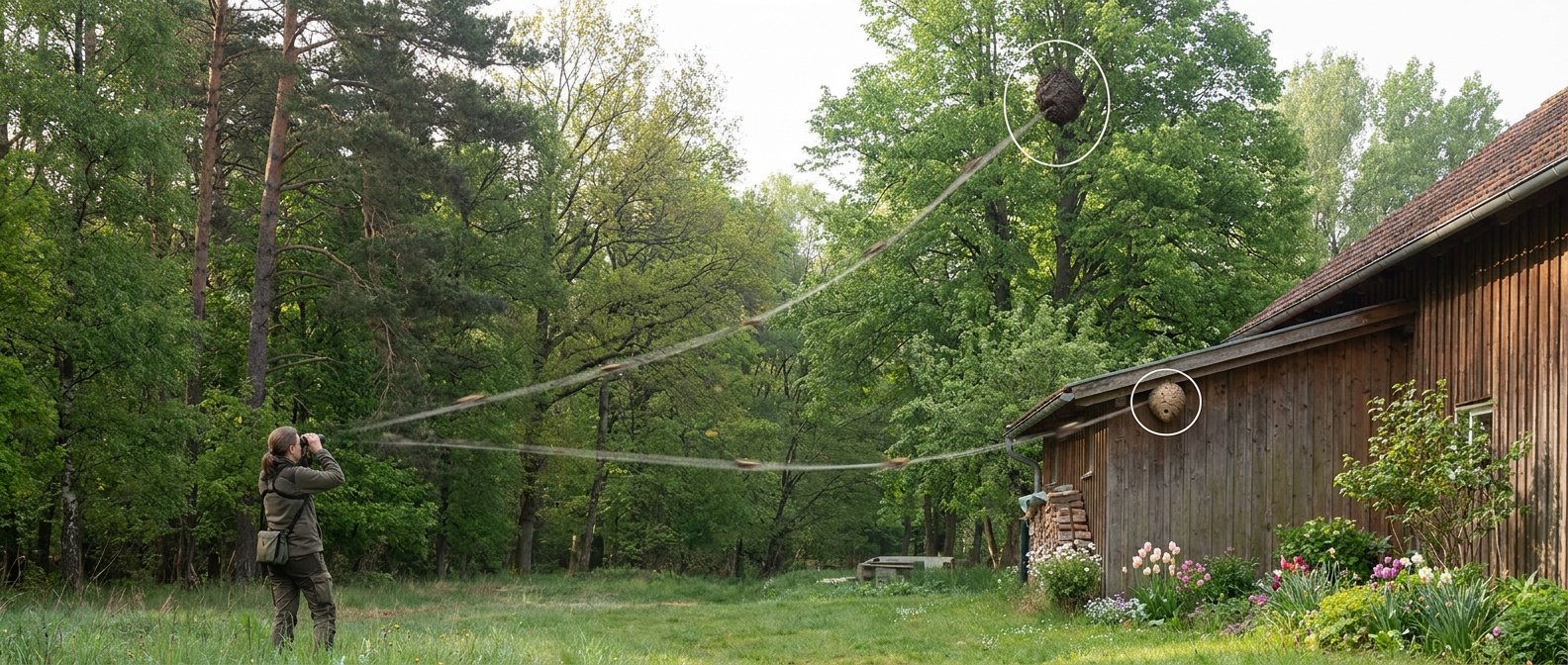
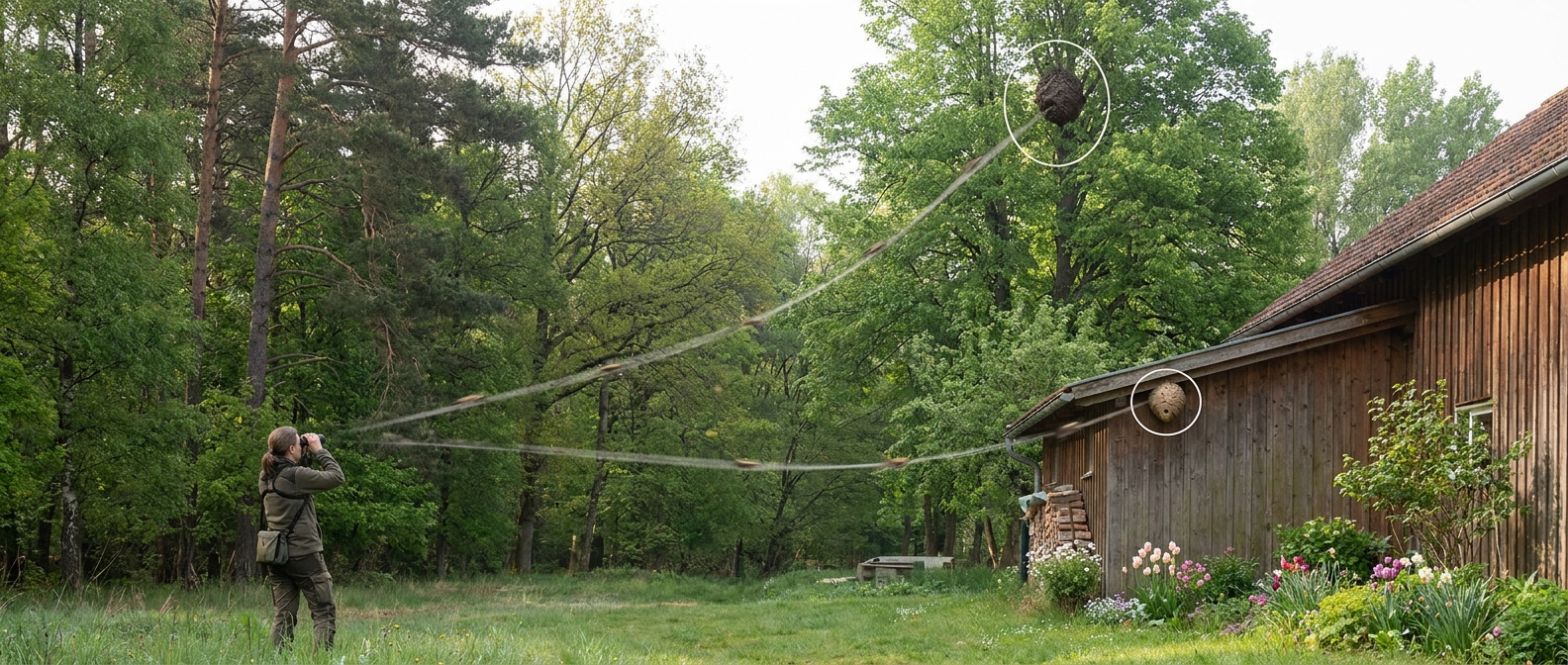
Visual Tracking Techniques and Observation of Flight Paths
The problem is that the Asian hornet (the so-called yellow-legged hornet, Vespa velutina) is a master of camouflage. Its nest looks like a large ball of beige-brown papier-mâché, often perched 15 meters up in a plane tree, invisible as long as the leaves remain on the tree. And in the spring, it looks nothing like that: it’s small, round like a tennis ball, and hides under your garden shed.
It’s precisely this difference between the two seasons that most guides overlook. Here, we’ll go over everything: where to look depending on the month, how to interpret flight paths to trace them back to the colony, and when to stop playing detective and call someone. At Frelons.be, we’re on call year-round, from trapping queen wasps in March to late-season exterminations in November.
Favorite nesting spots: Where do hornets hide?
Two nests, two seasons, two completely different places. If you look in the wrong place at the wrong time, you won't find anything.
From March to June, people talk about the primary nest. The female, who spent the winter alone in a pile of wood or under a roof tile, wakes up and builds a small spherical nest all by herself. It’s the size of a ping-pong ball at first, then grows to the size of a grapefruit by May. It’s always sheltered from the rain and built at a low height, generally between 1 and 3 meters. Look under the metal roof of your garden shed, in a carport, under a windowsill, in a storage shed, under a covered trailer, in an outdoor electric meter box, or behind a shutter that’s never opened. I’ve seen a primary nest in an unused mailbox and another in an upside-down flowerpot. This type of nest is recognizable by its small, downward-facing entrance hole.
Starting in June or July, the colony becomes too large. It moves and builds a secondary nest, the one everyone knows: a sphere or pear-shaped nest measuring 40 to 90 cm, made of chewed wood fibers, with a side opening. Here, the height of the trees becomes the number one factor. About 70 % of secondary nests are built more than 10 meters above the ground in large deciduous trees: oaks, plane trees, poplars, linden trees, and black locusts. Often at the very top of the canopy, where there is plenty of sunlight.
But beware of the common misconception that all nests are high up. A significant number are at eye level, and that’s where accidents happen. A dense privet hedge, a cherry laurel bed, a photinia bush—these are all perfect hiding spots. A gardener who trims their privet hedge in September without checking first is a classic recipe for getting stung multiple times. Also keep in mind barn frames, wood sheds, abandoned birdhouses, hollow embankments, and even cavities in the ground in wet areas.
A simple rule for spotting a hornet’s nest in a tree: wait until October or November. When the leaves fall, the nests suddenly become visible. This is the time of year when we receive the most reports. The nest may be empty at that point, but its presence tells you one crucial thing: the area has been colonized, and you’ll need to keep an eye on it next year.
Visual Tracking Techniques and Observation of Flight Paths
You know there’s a nest somewhere, but where? The “triangle” technique, used by beekeepers and field teams, works remarkably well. It’s based on a single idea: hornets fly in a straight line between their nest and their food source. Literally, an aerial corridor.
Start by identifying a point of attraction. A beehive, a compost bin, a pear tree laden with ripe fruit, a trash can, a patio where people eat outdoors, or a water source. Water is often overlooked: hornets come to drink and collect moisture for nest-building, especially in hot weather. A pond, a watering trough, a swimming pool, or a persistent puddle attracts a constant stream of visitors.
Stand next to this spot, about 3 or 4 meters away, with a pair of binoculars if you have them. Then apply the 15-Minute Method : Observe for a quarter of an hour and write down the flight path the direction from which each hornet takes off. Not the direction it arrives from, but the direction it takes off in—when the insect is loaded with food and heads straight back to the colony. Note the direction using a compass or your phone’s compass app. After about fifteen flights, a dominant direction will clearly emerge. You now have your first axis.
Then move 50 to 100 meters perpendicular to that direction, find another active spot, and repeat the process. The intersection of the two axes gives you an area about 100 meters on each side. That’s already a huge step forward. A third survey further refines the result.
That leaves the question of distance. An Asian hornet typically travels 500 to 700 meters from its nest, with the most daring foragers sometimes venturing as far as 1 kilometer. So if you see three of them on your patio, the nest isn’t necessarily in your yard. On the other hand, if you count more than ten per hour in the same spot, you’re within 200 meters. Counting is more reliable than guesswork.
It's a matter of timing now. The period of activity Activity peaks between 10 a.m. and 5 p.m. on dry, sunny days, with two peaks: in the morning around 10–11 a.m. and in the afternoon around 3–4 p.m. And what time do the hornets return to the nest? They return gradually as dusk falls, and everyone is inside about 30 minutes after sunset. This detail matters: an active nest still shows a flurry of comings and goings visible at dusk, which helps confirm its location. Never try to locate a nest in strong winds or rain—the hornets will stay in the nest, and you’ll be wasting your time.
One last tip for spotting them: follow the sound. An active secondary nest produces a low, continuous hum that can be heard from 4 or 5 meters away in a quiet garden. Close your eyes, listen, and turn around. It works better than you might think.
What should you do after locating the nest, and how should you proceed with Frelons.be?
You found it. Congratulations—seriously, that’s the hard part. Now, here’s the golden rule: don’t touch anything.
No water, no fire, no insecticide spray from the supermarket, no hitting with a pole, no gun (yes, it happens). A nest that’s been clumsily disturbed releases dozens of worker bees in defensive mode. They sting repeatedly, aiming for the face, and can chase you for 30 to 50 meters. The hospitalizations reported each year in Belgium and France result almost exclusively from makeshift nest destruction attempts by private individuals. An aerosol can sprays up to 5 meters; a hornet can reach you in a second from that distance.
Visit safety distance The minimum distance to maintain is 5 meters around a primary nest and 10 meters around an active secondary nest. Increase this to 20 meters if you need to use a lawn mower, brush cutter, or chainsaw nearby: the vibrations and noise trigger an attack long before you are physically present. Keep children and animals away, cordon off the area with simple construction tape, and notify your neighbors.
Next, you need to report the nest. In Belgium, sightings are reported through the official Asian hornet monitoring platform, and you can also contact us directly. Please have the following three pieces of information ready: the exact address or GPS coordinates, the estimated height of the nest, and a photo taken from a distance using the zoom function. This photo allows us to confirm that it is indeed a yellow-legged hornet and not a wasp nest or a European hornet nest, and, most importantly, to select the appropriate equipment before we arrive. A nest 18 meters up in a poplar tree requires a different approach than a primary nest under a awning.
Visit destruction of a hornet's nest The procedure is carried out using a full-body suit certified to protect against hornets, a telescopic pole that can reach up to 20 meters, and an approved insecticide injected directly into the nest. It’s best to carry out the procedure early in the morning or in the evening, when the entire colony has returned to the nest: this is the only way to neutralize all the workers at once. The nest is then removed and disposed of whenever possible, which prevents it from serving as a landmark the following year. Expect the process to take 30 to 60 minutes on-site, depending on access.
Our team of hornet experts serves all of Belgium year-round. In the spring, we remove primary nests (a quick, cost-effective procedure that eliminates the colony before it reaches 2,000 individuals). In the summer, we manage secondary nests located at heights. In the fall, we handle the high volume of reports in November, and in the winter, we provide advice on selectively trapping queen wasps. A professional intervention is always less expensive than a trip to the emergency room, and it protects your beehives, fruit trees, and neighbors.
Conclusion
Finding an Asian hornet nest requires, above all, a systematic approach and a little patience. Look low and in sheltered areas in the spring, high up in trees and in dense hedges in the summer, and use flight paths to pinpoint its location. Fifteen minutes of careful observation are better than an hour of random searching.
And once you’ve spotted the nest, stop right there. Take a photo, note the distance, and call us. Have you spotted something suspicious in your yard or a neighbor’s yard? Contact Frelons.be—we travel anywhere in Belgium, any time of year, to safely identify and remove the colony.
Frequently asked questions
What is the difference between a primary nest and a secondary nest of the Asian hornet?
The primary nest is built from March to June: a small sphere, first the size of a ping-pong ball and then a grapefruit, always sheltered from the rain at a height of 1 to 3 meters, with an opening facing downward. Starting in June or July, the colony moves to a secondary nest measuring 40 to 90 cm, made of chewed wood fibers, with a side opening.
Where should you look for a nest in the spring rather than in the summer?
In the spring, look for them low to the ground and in sheltered spots: under the metal roof of a garden shed, in a carport, under a windowsill, behind a shutter that’s never opened, inside an electric meter, or even in an unused mailbox. In summer, look higher up in tall deciduous trees—oaks, plane trees, or poplars—as well as in dense hedges of privet, cherry laurel, or photinia.
How does the flight corridor method work to locate the colony?
Hornets fly in a straight line between their nest and their food source. Stand three or four meters away from an attraction point (beehive, compost bin, ripe fruit, water source) and, with a compass in hand, record the initial flight path of each insect for fifteen minutes. After about fifteen flights, a dominant direction will emerge; repeat the process 50 to 100 meters further away and cross-reference the flight paths.
How far from my yard can the nest be?
An Asian hornet typically travels 500 to 700 meters from its colony, with some reaching up to one kilometer. So seeing three of them on your patio doesn’t necessarily mean the nest is on your property. However, if you count more than ten per hour in the same spot, you’re within 200 meters of the nest. Counting is more reliable than guesswork.
What is the best time of day and of the year to spot a nest?
Activity is at its peak between 10 a.m. and 5 p.m. on dry, sunny days, with peaks around 10–11 a.m. and 3–4 p.m. Avoid strong winds and rain, as the hornets stay in the nest during such conditions. For nests high up, October–November is still the ideal time: as the leaves fall, the nests suddenly become visible, which explains the spike in sightings.
Why should you never destroy a nest yourself?
A hive that is attacked clumsily releases dozens of worker wasps in defensive mode: they sting repeatedly, target the face, and pursue their prey for 30 to 50 meters. An aerosol can only spray up to five meters, a distance the hornet can cover in a second. Hospitalizations reported in Belgium result almost exclusively from makeshift nest removal attempts by private individuals.
 French
  English
  Dutch
Dutch
0 Comments