
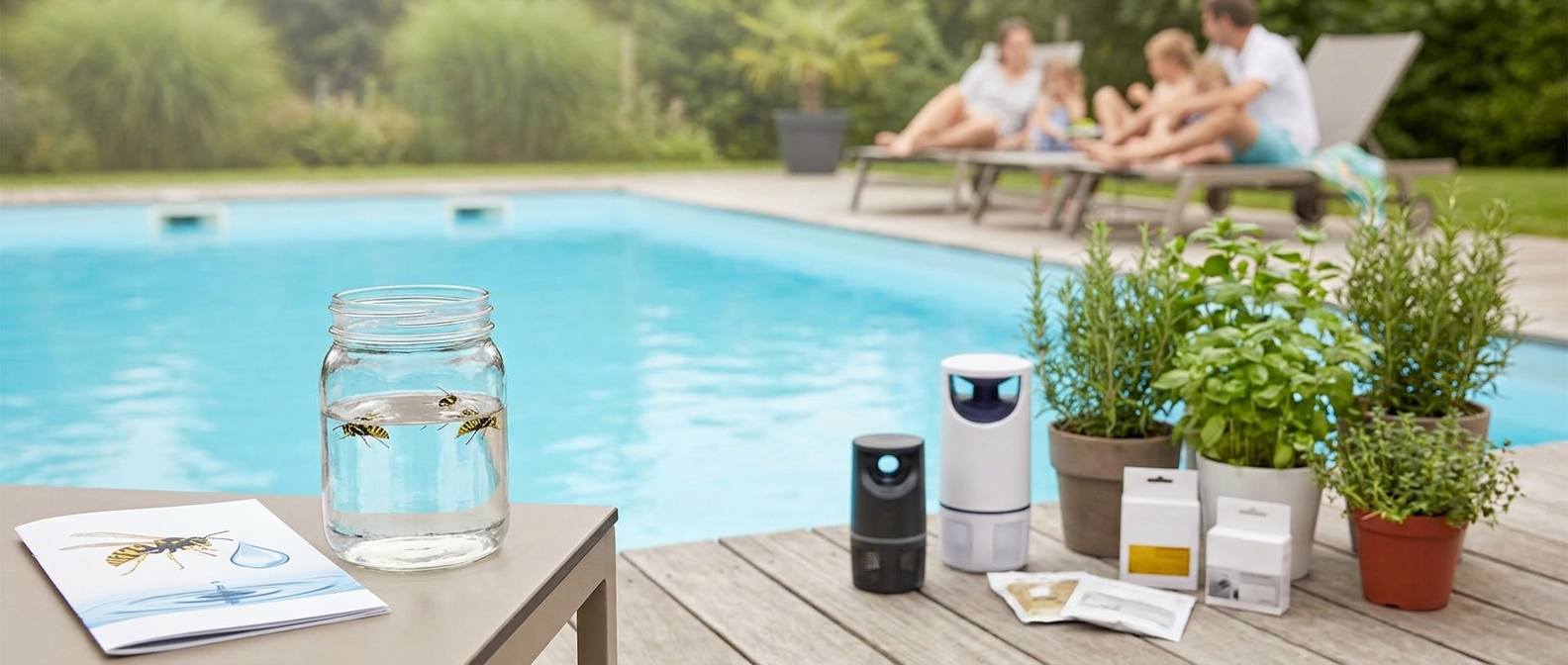
How to Keep Wasps Away from Your Pool: A Complete Guide
Contents
-
Repellents and Traps: A Comparison of the Best Deals and Prices on the Market
-
Where to Buy and How to Install Safety Equipment for Safe Swimming
You know the scene. It’s a July afternoon, the water is 27°C, and suddenly a swarm of wasps shows up at the edge of the pool. It’s impossible to take a peaceful dip. They skim the surface, land on the pool edges, and circle around the glasses of rosé. And inevitably, someone ends up getting stung.
Things to remember
-
We go beyond simple old wives' tales by incorporating an entomological analysis of wasps' attraction to chlorinated water, combined with a comprehensive buying guide for professional and sustainable solutions.
-
Entomological Analysis
-
Comparison of the Best Deals and Prices on the Market
-
Compare options and take action.
Most of the advice you find online is limited to old wives’ tales: half a lemon studded with cloves, a bottle cut in half. These might help a little, but they don’t solve the underlying problem. Why? Because to keep wasps away from a pool for good, you first need to understand what attracts them. And that’s where we get into the biology of wasps—a field far more complex than home remedies.
In this guide, we’ll go beyond half-baked solutions. We’ll provide a thorough entomological analysis, a comparison of the most effective repellents and traps on the market, and installation tips validated by experts. The goal is simple: to help you enjoy safe swimming again—for you and your children.
Why Wasps Are Invading Your Pool: An Entomological Analysis
Let's start with something obvious that we always forget: a wasp gets thirsty. Like any living creature, it has a water requirement It's a constant need, and during heat waves, that need skyrockets. Your pool is the largest source of water in the neighborhood. For her, it's a giant, clean, and easily accessible watering hole.
But water isn't just for drinking. Wasps are social insects, they live in colonies that can number several thousand individuals in the height of summer. But a nest gets hot. The larvae need a stable temperature, and when the temperature rises, the workers bring water back to the nest to cool it down. This is what’s known as thermoregulation : They spread droplets over the honeycomb cells and then fan them with their wings. A natural air-conditioning system, powered directly by your pond.
This brings us to the question everyone is asking: Does chlorine attract wasps? The answer is more nuanced than you might think. The chlorine and wasps, it’s not a love story in the strict sense. Wasps aren’t attracted to the smell of chlorine itself. However, treated water remains stable and free of predators, allowing them to land there safely. It’s simply the ideal water source. Studies in applied entomology also show that hymenoptera detect water surfaces from a distance thanks to their sensitivity to moisture, long before they perceive any scent at all.
Another factor that is often overlooked: the pheromones. When a wasp crushes a piece of fruit that has fallen on the patio—or worse, when you kill one by swatting it—it releases an alarm pheromone. This chemical signal calls in other wasps and triggers defensive behavior. Have you ever noticed that after you squash a wasp, three more show up? That’s the explanation. It’s not bad luck—it’s chemical communication.
Add to that the food: barbecue leftovers, sugary drinks, and the kids’ ice cream. Especially at the end of summer, when the colony no longer has larvae to feed, the workers become addicted to sugar. Understanding these mechanisms is the first step toward knowing how to keep wasps away from the pool: cut off any accessible water sources elsewhere, don’t leave sugar or fruit lying around, and never swat a wasp near the pool. The rest comes down to the tools we’ll discuss next.
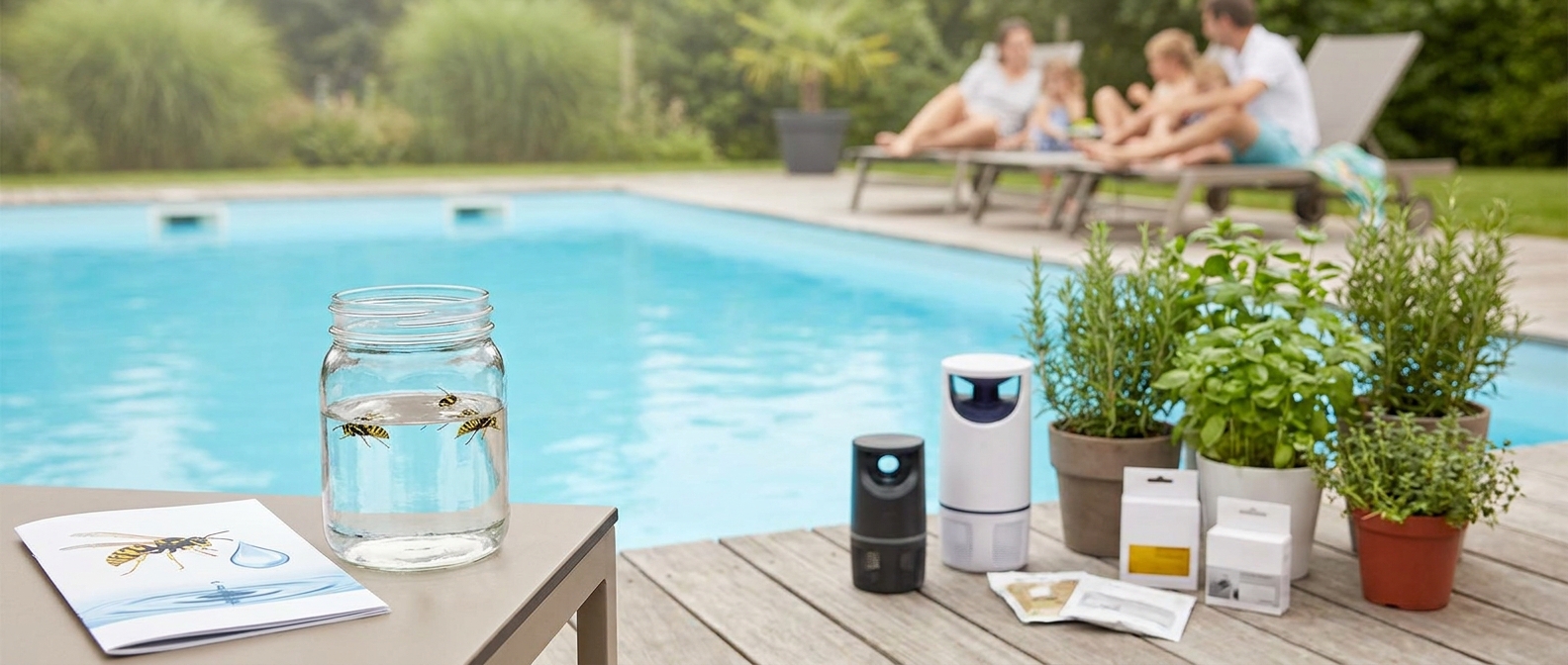
Repellents and Traps: A Comparison of the Best Deals and Prices on the Market
Now that we know why they appear, let’s move on to practical solutions. And let’s be blunt: not all products are created equal. Between a 3-euro gadget and a professional-grade device that lasts the entire season, the difference in’effectiveness is enormous.
Let's start with the pitfalls. A effective wasp trap is based on a simple principle: luring the insect with bait, then preventing it from escaping. On the price of a wasp trap, expect to pay between 8 and 15 euros for a reusable model made of rigid plastic, and up to 25 euros for decorative glass versions that you leave on the patio. The best practice: place them away from the swimming area—never right next to it. The goal is to divert the wasps, not to concentrate them where you swim. Instead, position them on the outskirts of the garden, 5 to 10 meters from the pool.
When it comes to bait, skip the plain sugar in the spring. Early in the season, wasps are looking for protein: a little meat or beer works better. By late summer, switch back to sugar syrup. This small detail makes all the difference in catch rates, and yet almost no one mentions it.
When it comes to repellents, there’s a clear distinction between consumer-grade solutions and professional-grade devices. The Professional Repellents Made with concentrated essential oils (clove, peppermint, lemongrass), these diffusers release a scent that wasps avoid. A good outdoor diffuser costs between 20 and 40 euros and covers an entire patio. It offers the best value for money for a pool wasp repellent that doesn't take away from the relaxing atmosphere of your space. Sprays, on the other hand, are useful from time to time, but their effect wears off within a few hours.
A word about false solutions. Electric rackets? Fun for five minutes, but essentially useless—and remember the alarm pheromone we mentioned earlier. Insecticide sprays used indiscriminately? Avoid them near a swimming pool: you’ll contaminate the water and the air your children breathe. That’s not a solution—it’s a health hazard.
My advice for the’purchase of wasp repellents : Combine two approaches. Place one or two traps on the outskirts to reduce the population, plus a high-quality repellent on the patio. On its own, each method has its limits. Together, they’ll get rid of the wasps around your pool much more reliably. It’s this systematic approach that Pest Patrol solutions prioritize, rather than the “miracle product” that doesn’t exist.
Where to Buy and How to Install Safety Equipment for Safe Swimming
73%: Bad experiences with wasp repellents are usually the result of sloppy installation, not a faulty product. People buy them, install them haphazardly, and then are surprised when they don’t work. Here’s how to do it right.
When shopping, be wary of large general merchandise stores where there’s no advice available. You end up picking whatever’s on the shelf—often entry-level products. The Pest Patrol Store Instead, it offers a selection of products designed for heavy-duty outdoor use, complete with detailed specifications on the range and battery life of each device. This is the kind of shopping tips which prevents you from wasting money on unsuitable equipment.
Let's move on to the Installation Steps, in order:
-
Identify the walkways. Watch where the wasps come from for two or three days. They almost always follow the same paths.
-
Place the traps around the perimeter. 5–10 meters from the pool, along these paths, in partial shade. Never on the pool coping.
-
Set up the repellent on the patio. At table height, where you eat and where the children run around.
-
Eliminate secondary water sources. Plant pot saucers, gutters, watering cans: empty anything that could serve as a source of water for animals.
-
Check it every week. Empty and rebait the traps; refill the dispensers. This is where most people give up, and this is where it all comes down to.
The issue of the pool safety This warrants special attention, especially around children or people with allergies. A wasp sting in the water carries the risk of panic and drowning. Always keep a first-aid kit within reach, including an antihistamine. And if anyone in your family has a known allergy to hymenoptera venom, talk to your doctor about getting an epinephrine auto-injector. That’s what a real swimming safety : Not just keeping wasps away, but preventing accidents.
One last note about the nest. If you see a constant stream of wasps always returning to the same spot (under a roof, in a low wall, in a tree), it means there’s a nest nearby. In that case, don’t try to handle it yourself. An active nest near a living area must be handled by a properly equipped professional. Getting rid of wasps around a pool sometimes requires this step, and trying to play the hero with a spray can often ends up with a trip to the emergency room.
Conclusion
Keeping wasps away from your pool isn’t a matter of luck or a magic solution. It’s about understanding their biology (water, thermoregulation, pheromones) and then implementing a consistent strategy: cutting off sources of water and sugar, setting traps around the perimeter, applying a high-quality repellent on the deck, and checking everything weekly. Simple, but methodical.
Tired of sharing your pool with wasps this summer? Visit the Pest Patrol store to choose devices that have been tested for outdoor use, along with expert advice. A peaceful pool takes some preparation—and it starts now.
Frequently asked questions
Why do wasps come to drink from the pool?
During hot weather, wasps look for water to drink and to cool their nests. A swimming pool provides a large, steady, and easily visible source of water. Sugary drinks, fruit, and food scraps left around the pool make it even more attractive to them.
Does chlorine attract wasps?
Wasps are primarily attracted to water, not to chlorine itself. However, they may return regularly once they have identified the pool as an accessible source of water. Slightly altering their access points is more effective than increasing the water treatment.
How can you keep wasps away without contaminating the water?
Store food and beverages, cover trash cans, and pick up fallen fruit. Avoid spraying insecticides near the pool. Alternative water sources placed far from the pool and traps set up around the perimeter can divert some of their activity.
Where should you place a wasp trap around the pool?
Set it up several meters away from the pool, along the path the wasps take and away from high-traffic areas. Never place a trap on the pool coping or near lounge chairs: it would attract more insects toward swimmers.
Do a lot of wasps around the pool indicate the presence of a nest?
Not necessarily. They may come from a nest located several tens or hundreds of meters away. However, a steady stream of activity toward a low wall, a roof, a hedge, or a hole in the ground may indicate that a colony has settled nearby.
When should you call in a professional?
Treatment is recommended when an active nest is located near the pool, a deck, or a frequently used walkway. It is also advisable if there are a large number of wasps despite preventive measures, or if someone with a wasp allergy regularly uses the pool.
 French
  English
  Dutch
Dutch
0 Comments