

Wasps in an Attic: Detection, Risks, and Solutions
Contents
A constant buzzing above your head, a brown stain spreading across the ceiling, a few insects circling near the skylight. These are the first signs. Wasps in an attic are more common than you might think, especially between June and October. The problem is that an attic is a space we rarely visit. So the colony has plenty of time to settle in undisturbed, out of sight.
Things to remember
-
We go beyond mere extermination by explaining how to tell the difference between wasps and Asian hornets in the darkness of the attic
-
The article emphasizes the prevention of property damage to insulation and the importance of constant vigilance—even outside the summer season—to protect homes
-
How can you detect and identify a wasp nest in your attic?
-
The Dangers of a Nest Under the Roof and the Importance of Taking Action
And where things get complicated is that people are quick to assume they’re dealing with wasps, when sometimes it’s actually something else. The Asian hornet also likes attics, and distinguishing it from a wasp in the dim light isn’t easy. Yet this confusion changes everything: the behavior, the risks, and how to respond.
At Frelons.be, we provide services year-round, not just in the summer. A nest that’s not properly treated or ignored can damage your insulation, weaken your roof structure, and turn a simple inconvenience into a real headache. Here’s how to spot a nest, understand the risks involved, and—most importantly—how to take action without taking unnecessary risks.
How can you detect and identify a wasp nest in your attic?
The first clue is almost always the sound. A noise in the attic that sounds like nothing you’ve ever heard before: a soft scratching, a low, steady hum—sometimes louder at the end of the day when the whole colony comes home. At first, many people mistake it for mice or birds. Then they go upstairs, and that’s when they realize what it is.
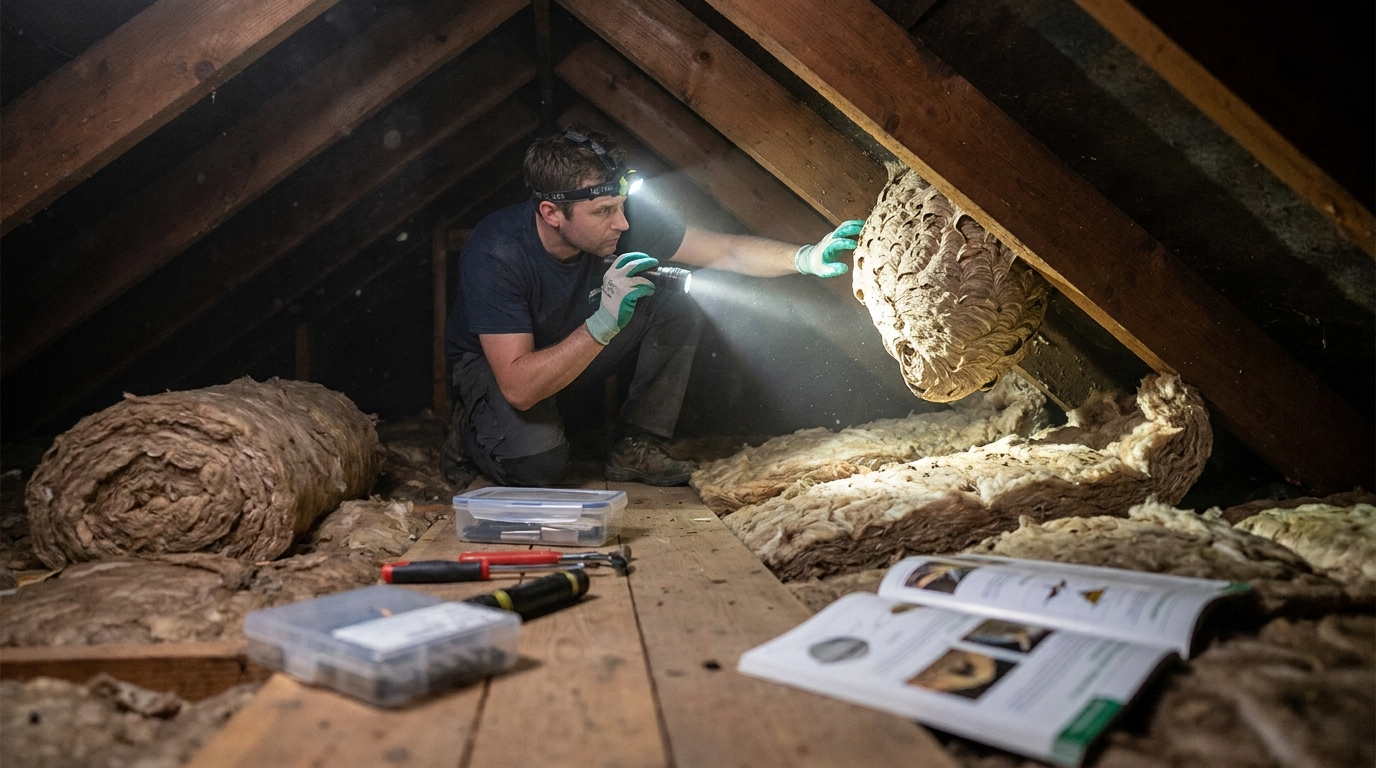
To identify a nest, first look for the insects’ path. Wasps always follow the same path in and out, usually through a loose roof tile, a crack under the roof, or a vent. Observe from a distance outside: if you see constant back-and-forth movement toward a specific spot on the roof, the nest is right behind it.
The nest itself has a distinctive shape. In the case of wasps, it resembles a gray papier-mâché ball, often hanging from the roof structure or a rafter, or tucked into the insulation. The texture is similar to thin cardboard, with ridges. A wasp nest in the attic can grow to the size of a soccer ball during peak season, and sometimes much larger if left unattended.
Be careful not to confuse this with the Asian hornet. Their presence in attics is becoming increasingly common in Belgium. Their nests are larger, often spherical or pear-shaped, with an entrance on the side rather than at the bottom. The insects themselves are darker in color, with very noticeable yellow tips on their legs. If you’re unsure in the dark, don’t go near it to check: that’s exactly when accidents happen.
Here are a few sure signs that you have wasps in your attic:
-
Dead insects piling up under a skylight or near a roof window
-
A damp or brown stain on the ceiling of the upper floor
-
A buzzing sound that gets louder in hot weather
-
Wasps that regularly appear in the upstairs rooms for no apparent reason
If you find yourself thinking, «I have a wasp nest in my attic,» the best thing to do is to check without forcing the issue. A headlamp and a quick glance from a safe distance will tell you a lot. There’s no need to dig through the insulation with your bare hands.
The Dangers of a Nest Under the Roof and the Importance of Taking Action
People always underestimate the impact that an established colony can have. The most obvious risk is bites. Unlike bees, wasps can sting multiple times, and a disturbed colony can send dozens of workers to attack. In an enclosed space like an attic, you have nowhere to run. For someone with an allergy, a single sting can trigger anaphylactic shock. This isn’t an exaggeration—it’s a fact.
The risk of being stung increases with the size of the nest. In early summer, just a few workers are hardly cause for concern. By September, the same colony numbers in the thousands and becomes much more aggressive, especially as resources become scarce. This is when the number of pest control calls skyrockets.
But the danger doesn’t stop at stings. There’s also property damage—the kind you don’t see coming. Wasps build their nests by chewing on wood and fibers. So they attack your roof structure, but most of all, they love to burrow into fiberglass insulation and panels made of’thermal insulation. A nest nestled in the insulation means the material is compressed, packed down, and soiled. The result: your insulation becomes less effective, your heating bill goes up, and sometimes you have to replace entire sections.
Damage to insulation is all the more insidious because it develops gradually. A colony that returns for several seasons in a row can ruin square meters of attic space. Not to mention moisture: abandoned nests attract other pests and promote mold growth.
Visit home security So it requires constant vigilance, even during the off-season. In winter, a nest is empty; the founding wasps are elsewhere. This is the ideal time to remove old nests and seal off the entrances before the warm weather returns. Waiting until summer to take action is always the wrong choice: the colony is at its peak, and the job becomes much more difficult.
Is it dangerous to have a wasp nest? Yes, as soon as it’s located in a high-traffic area or near your living spaces. A nest tucked away at the back of the yard can sometimes be tolerated. A nest in the attic, right above your bedrooms—no. You need to take action, and quickly.
What to Do When You Find a Wasp Nest: A Step-by-Step Guide
The first thing to understand: getting rid of a wasp nest in the attic is no Sunday DIY project. Over-the-counter sprays often just agitate the colony without killing the queen. And a nest in the attic, wedged between two beams, is particularly tricky to deal with. Here’s how to go about it the smart way.
Step 1: Never take action during the day while in the open. Wasps are active and numerous during the day. If you're going to try anything, do it early in the morning or late at night, when they've returned to their nests and are less reactive. But honestly, even that's risky in a closed attic.
Step 2: Make sure you're properly equipped. A protective equipment If you want to do it right, you’ll need a full-body wasp-proof suit, thick gloves, and a protective face veil. Not just a raincoat and swimming goggles. Wasps will find even the tiniest opening. Without the proper gear, you run the risk of getting stung dozens of times in an enclosed space.
Step 3: Identify all access points before taking action. A nest often has several exits. If you block one during treatment without addressing the others, the wasps will turn on you or swarm inside the house. That’s how you end up with wasps all over the hallway.
Step 4: Call a professional. Let's be honest, that's the real solution. A pest control technician has the equipment, approved products, and, above all, the experience to treat the nest without putting anyone in danger. The pest control Removing a nest from the attic often takes less than an hour if you know what you’re doing, and the result is permanent. At Frelons.be, we handle this all year round, including Asian hornet nests, which require special treatment.
Once the nest has been removed, don’t leave it in place indefinitely. A dead nest attracts moths and other insects. Remove it, inspect the insulation around it, and, most importantly, seal off entry points: misaligned roof tiles, cracks, and vents without screens. This will prevent a new queen from settling in the following year.
How can you get rid of wasps in the attic for good? By combining nest treatment with prevention. One without the other is useless. You can remove ten nests in a row, but if the attic remains full of holes, the problem will return every spring.
Conclusion
A wasp nest in the attic is never something to take lightly. Between the risk of getting stung in a confined space, damage to your insulation, and the possibility that it might actually be an Asian hornet, it’s best not to try to be a hero. Locate it, keep your distance, and have a professional confirm it if you have even the slightest doubt.
Don’t let your guard down once September rolls around. Checking your attic in the fall and spring will save you from a lot of surprises. Do you hear a suspicious noise above your head? Don’t let the colony get comfortable. Contact Frelons.be: we respond quickly, year-round, to secure your home and get rid of the problem for good.
Frequently asked questions
How can you tell if there's a wasp nest in the attic?
A steady buzzing sound, dead insects near a skylight, and wasps consistently entering through the same spot in the roof are the main signs. A brownish stain on the ceiling or wasps appearing in the upper rooms may also indicate a hidden nest.
Can we go up to the attic to check?
Avoid approaching the nest or disturbing the insulation. In an enclosed space, an attack leaves little opportunity to get away quickly. Observe the nest from outside and have a professional confirm its location.
Can wasps get into the rooms of the house?
Yes. They can enter through a crack, an electrical conduit, a hatch, or an opening in the ceiling. Block off access to the attic and seal off the affected room. Do not block their entry point from the outside while the colony is active.
Can a wasp nest damage the insulation or the roof structure?
A large colony can compact, soil, or dampen the insulation. Structural damage to the roof framing is generally limited, but the nest may reveal a displaced shingle or an existing opening. An inspection is recommended after treatment.
Should you remove an old nest found in winter?
An old nest is not normally reused, but removing it allows you to inspect the insulation and clean up any debris that might attract other insects. First, check to make sure there is no remaining activity, then seal off any entry points before spring.
How much does it cost to remove a nest from an attic?
The cost generally ranges from €80 to €150 for an accessible nest. It may be higher if the colony is deeply embedded in the insulation, difficult to access, or if it involves Asian hornets. The exact price must be quoted before the service is performed.
 French
  English
  Dutch
Dutch
0 Comments