

Wasps in a Hedge: A Complete Guide to Making Your Garden Safe
Contents
You approach your thuja hedge, pruning shears in hand, and there it is—that distinctive buzzing sound. Wasps. Not just two or three, but about ten of them circling the same spot. And that little voice telling you that pruning today might not be the best idea.
Things to remember
-
This article goes beyond simply advising that they be destroyed; it provides a scientific explanation for why aphids are attracted to hedges (wood fibers, aphid honeydew) and outlines a rigorous safety protocol for gardeners, based on CRAW recommendations and applied entomology.
-
Why are there so many wasps in my hedge?
-
Identify a wasp nest in a bush before pruning
-
How can you effectively get rid of wasps in a hedge?
Wasps in a hedge are one of the most common sights in the garden in late summer. And contrary to popular belief, their presence is no coincidence. There are specific biological reasons why they love your laurel, cedar, or thuja hedges.
In this guide, we’ll first figure out what attracts them (because understanding is already a step toward anticipating danger), then learn how to spot a nest before reaching for the hedge trimmer, and finally see how to get rid of them without ending up in the emergency room. All of this is based on applied entomology and recommendations from organizations such as CRAW (Walloon Center for Agronomic Research).
Why are there so many wasps in my hedge?
The answer can be summed up in one word that few people know: the honeydew. It’s a sweet, sticky substance produced by aphids that infest your plants. These tiny insects feed on the sugar-rich sap of your plants and excrete the excess in the form of droplets. The result? Your bay leaves or thuja leaves become veritable syrup dispensers for wasps.
And wasps love it. At the end of summer, wasps’ diet changes drastically. In the spring and early summer, they hunt insects to feed their larvae (they are, in fact, formidable garden helpers). But when the queen stops laying eggs, the workers no longer have larvae to feed and turn to sugars instead. Aphid honeydew then becomes an ideal food source—abundant and easily accessible.
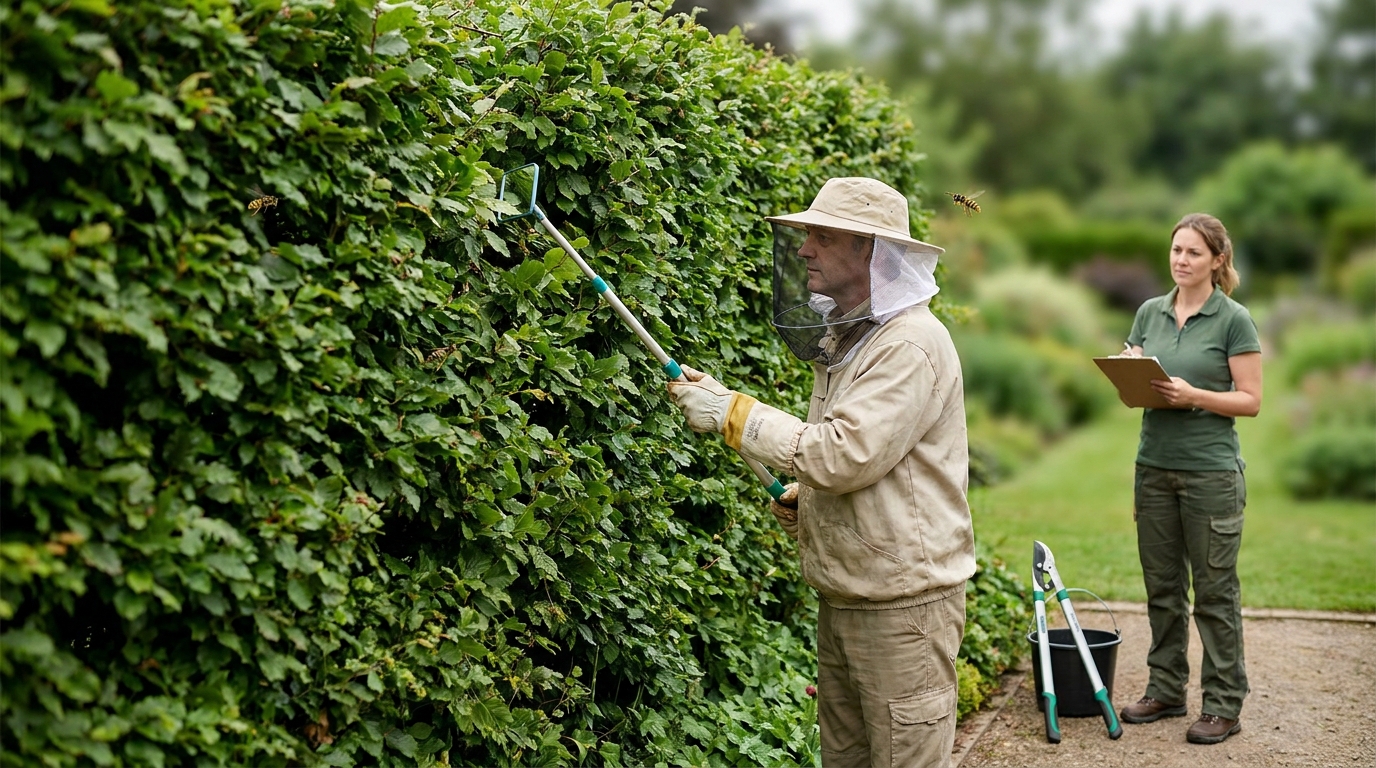
That’s why a hedge infested with aphids attracts so many wasps. The more stressed your plants are (due to drought, aggressive pruning, or lack of watering), the more they produce a rich sap that encourages aphids to multiply. It’s a vicious cycle.
There is a second, lesser-known reason: the wood fibers. Wasps build their nests by chewing wood and mixing it with their saliva to create a kind of papier-mâché. A dense hedge, with its dry branches and dead wood inside, provides both building material and ideal shelter. The center of a cedar or thuja hedge is dark and sheltered from the wind and predators. For a queen looking for a place to establish her colony in the spring, it’s the perfect spot.
Add to that the heat stored by the dense foliage, and you have the perfect microclimate. A study of the behavioral ecology of wasps shows that colonies prefer sheltered cavities that offer a stable temperature, which explains why so many wasp nests are found in hedges rather than out in the open. So if you have a lot of wasps in your yard, start by inspecting your hedges: nine times out of ten, that’s where it all happens.
Identify a wasp nest in a bush before pruning
Every year, gardeners get stung multiple times when they start up their hedge trimmers without checking where they’re putting their hands. The noise and vibrations from the tool trigger an immediate defensive reaction from the colony. A single wasp is manageable. An entire nest that feels under attack is a much more serious matter, especially if you’re allergic.
Caution before trimming any hedge is therefore non-negotiable. Here’s how to go about it the smart way. Before plugging anything in, observe the hedge from a distance for a good five minutes. Look for a spot where insects are converging—a veritable air traffic pattern with regular comings and goings in the same place. This is the most reliable sign of an active nest.
-
Observe early in the morning or late in the day, when their activity is more visible but the insects are less aggressive
-
Identify the entry and exit points concentrated in a specific area of the bush
-
Listen: A large nest produces a low, continuous hum.
-
Never tap the hedge with a stick to «check» it—that’s the best way to provoke an attack.
A crucial aspect of safe gardening: learn to identify plant species. The Asian hornet (Vespa velutina) often builds enormous, spherical nests, sometimes high up but also in dense hedges. Its population has exploded in France since its introduction in 2004, and its stings, while not more venomous individually, are dangerous in the event of a swarm attack. It can be recognized by its yellow legs and very dark thorax. If you suspect the presence of an Asian hornet, do not attempt to handle the situation yourself: report it to your local city hall or a certified professional.
Common wasps (Vespula) build smaller nests, often light gray in color, with that characteristic paper-like texture. In a hedge of thuja or cedar, the nest may be hidden deep within the foliage and remain invisible from the outside. This is why the observation phase is so important.
My advice? If you spot a wasp nest in your hedge during peak season (July–September), postpone pruning. The colony will die off naturally with the first frosts, and the nest won’t be reused the following year. Waiting until winter to trim is sometimes the simplest and safest solution. Your hedge will survive just fine if you wait a few months.
How can you effectively get rid of wasps in a hedge?
All right, let's say the nest is too close to the house, in the children's path, or that a family member has allergies. In that case, you need to take action. But not just any action.
Rule number one: Forget about DIY solutions like emptying a supermarket insecticide can at point-blank range. That’s the classic disaster scenario. You empty the can, you only hit the surface of the nest, and you end up with a furious colony chasing after you. Destroying a wasp nest requires a methodical approach and proper protection—not improvisation.
If you decide to take matters into your own hands anyway, there are a few guidelines to follow. Always act at night, when all the worker wasps have returned to the nest and activity is virtually nonexistent. Wear thick clothing that covers your entire body, gloves, and ideally a protective veil. Use a specific powdered or aerosol wasp insecticide, spraying it directly into the nest’s entrance. The powder has the advantage of being carried inside by the wasps themselves, which affects the entire colony. Turn off all white lights, as wasps are attracted to them; use a red light if necessary.
That said, I’ll be blunt: as soon as a nest is larger than a tennis ball, or is tucked deep inside a hedge that’s hard to reach, calling in a professional is the best option. It’s not a matter of courage; it’s a matter of risk. A pest control professional has a full-body suit, approved products that are more powerful than those available to the general public, and, most importantly, the experience to pinpoint the nest’s exact location and treat it in one go.
The cost of professional removal generally ranges from 80 to 150 euros, depending on accessibility and the region. Compare that to the cost of a trip to the emergency room after an anaphylactic shock, and the math is easy. For an Asian hornet nest in a hedge, it’s actually the only reasonable solution.
One last thing about prevention: treat your aphids. Since honeydew is what attracts wasps in large numbers, reducing aphid colonies (with ladybugs, a water spray, or diluted liquid soap) directly reduces your hedge’s appeal. This is a long-term gardening solution, and it will prevent the problem from returning the following summer.
Conclusion
Wasps in a hedge are neither inevitable nor a disaster, as long as you understand why they’re there and know how to take a systematic approach. Aphid honeydew, wood fibers, a sheltered microclimate: your hedge checks all the boxes for an ideal habitat. The golden rule is to observe the situation before pruning and, whenever possible, postpone the work until winter.
If you come across a large nest, an Asian hornet, or even the slightest risk of an allergic reaction, don’t try to be a hero. Contact a pest control professional: it’s safer, more effective, and often less expensive than you might think. Your yard should remain a place to enjoy, not a minefield. Take the time to observe, protect yourself, and never hesitate to call in an expert when in doubt.
Frequently asked questions
Why does my hedge attract so many wasps?
Wasps may be attracted to the sweet honeydew produced by aphids, the small insects they hunt, and the wood fibers used to build their nests. Their presence does not, therefore, automatically mean that a colony has settled in the hedge.
How can you tell if there's a nest in the hedge?
Observe the hedge from a distance for several minutes. Continuous comings and goings to a specific spot, accompanied by a localized buzzing sound, likely indicate an active nest. Do not shake the branches to check.
Can you trim a hedge that has a wasp nest in it?
No. The noise and vibrations from the hedge trimmer can trigger a mass attack. Stop working immediately, move children and animals to a safe distance, and wait until the nest has been neutralized before resuming trimming.
What should you do if Asian hornets are nesting in your hedge?
Do not approach the nest or attempt to cut the branches surrounding it. Take a zoomed-in photo from a safe location, then report the nest on Vespa-Watch in Belgium. Contact a trained professional to have it removed.
Should we wait until winter before removing the nest?
Yes, if the nest is located away from walkways and poses no immediate danger. The colony usually disappears when the weather turns cold, and the old nest is not reused. However, prompt action is recommended if the nest is near a home, a patio, or a playground.
How much does it cost to remove a nest from a hedge?
Professional removal typically costs between €80 and €150 for an accessible wasp nest. The price may be higher for a deeply hidden nest or for Asian hornets, which require additional precautions. The price must be confirmed before the service is performed.
 French
  English
  Dutch
Dutch
0 Comments