
Wasp Nest Under the Roof: How to Detect and Remove It?
Contents
-
Identifying a wasp nest under the roof: Is it possible, and how can you tell?
-
The Dangers and Potential Damage Caused by a Nest in Your Roof Structure
Do you hear a constant buzzing sound when you go up to the attic? Do you see wasps constantly flying in and out through the same spot, under the roof tiles? Don’t panic, but don’t put it off either. A wasp nest under the roof is more common than you might think, especially between June and October.
Things to remember
-
We confirm the possibility of a nest under the roof by offering a safe visual inspection method
-
The article stands out by addressing the threat posed by the Asian hornet and highlighting the importance of having professional expertise available year-round through Frelons.be
-
while advising against dangerous DIY projects
-
Is that possible, and how can I find out?
The space under the roof tiles is kind of like a five-star hotel for wasps. It’s warm, dry, sheltered from the wind and rain, and hard for predators to reach. In short, it’s the perfect place to set up a peaceful colony. The problem? We often don’t realize it until it’s too late, when the nest has already grown quite large.
And for the past few years, there’s been a surprise guest we really don’t want to see taking up residence up there: the Asian hornet. We’ll explain how to spot what’s hiding under your roof, why you should definitely not try to be a hero, and what concrete steps to take. At Frelons.be, we’re available year-round, even during the off-season.
Identifying a wasp nest under the roof: Is it possible, and how can you tell?
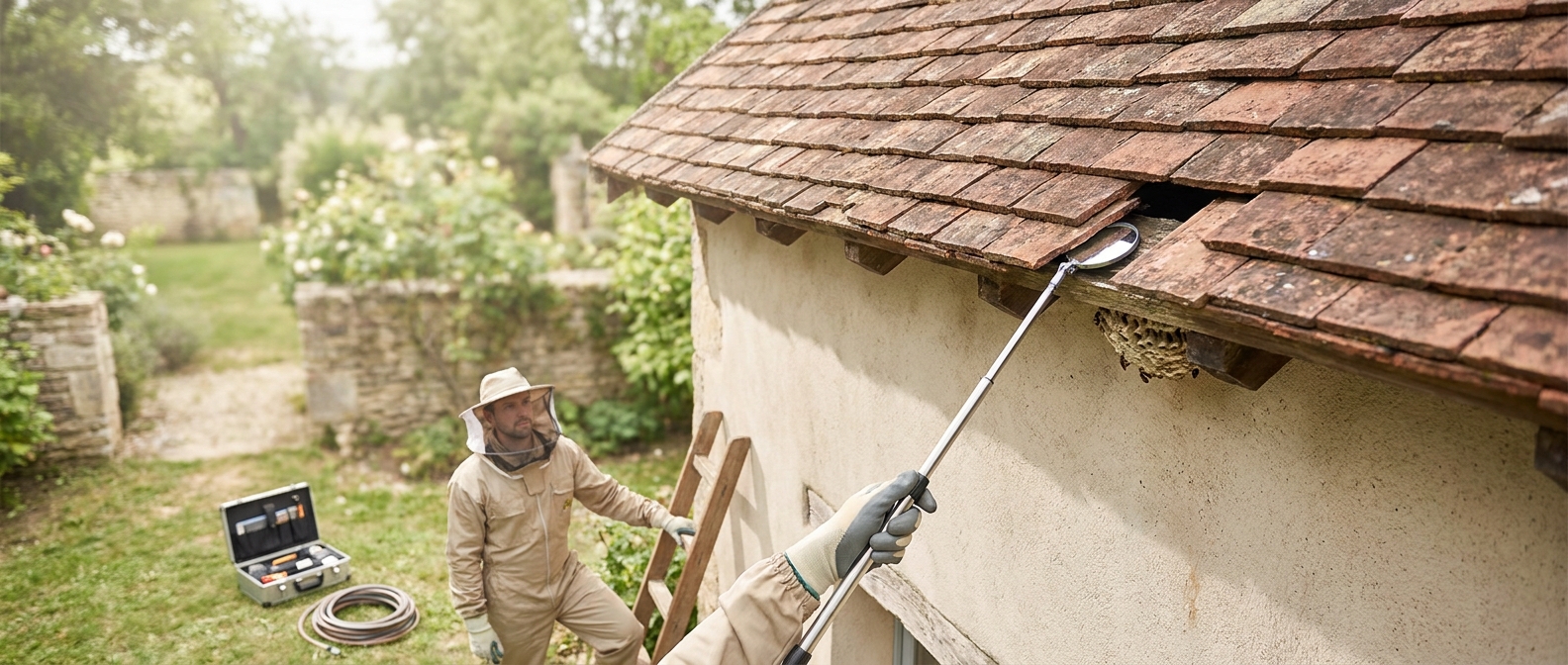
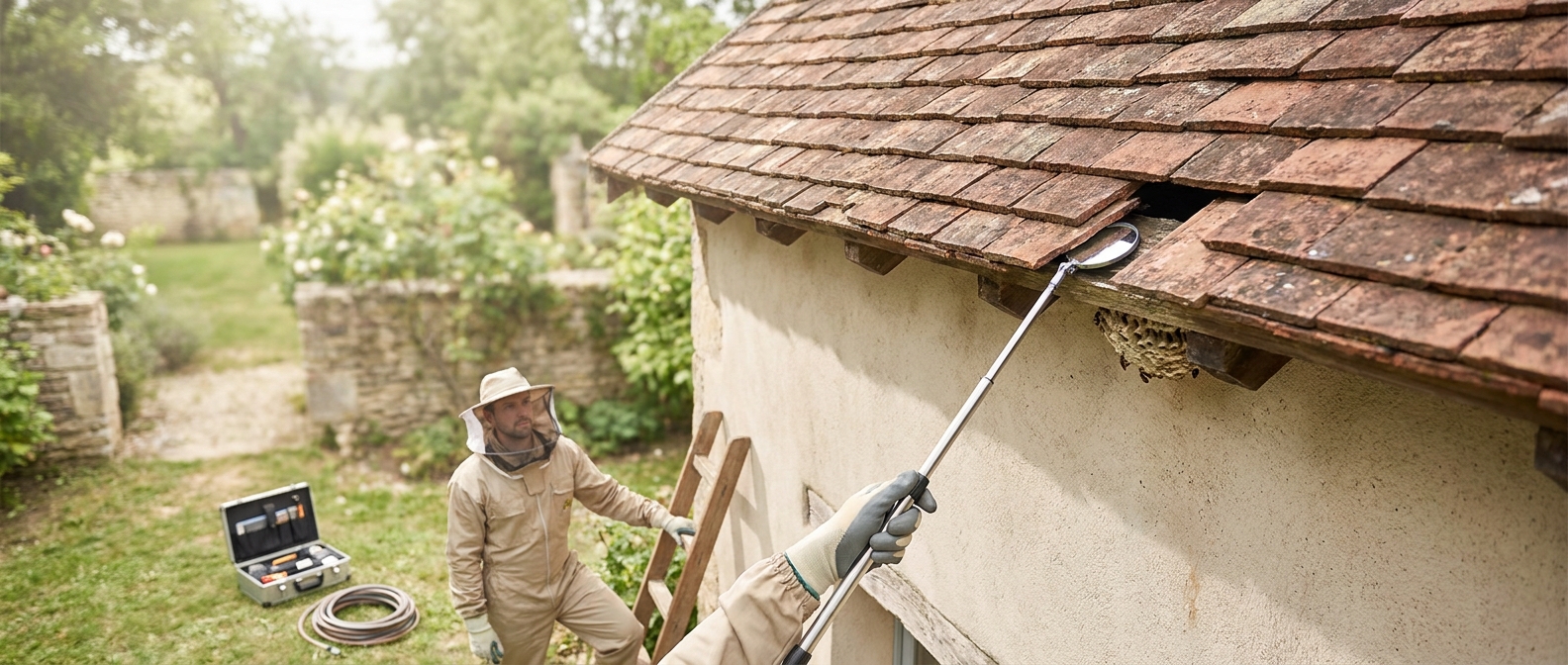
Yes, it’s entirely possible to spot a wasp nest without climbing onto the roof or risking getting stung. The simplest method is to observe from the ground. Stand at a distance—about ten meters—and watch the insects’ activity around your roof. If you see wasps flying back and forth in a steady stream, all converging on the same spot (a loose roof tile, a hole in the underlayment, a ridge joint), you’ve found the culprit.
This continuous flow is the most reliable sign. Wasps that build their nests under roof tiles always follow the same flight path. Observe them at two different times of day: early in the morning when they leave, and late in the afternoon when they return. You’ll quickly see if activity intensifies around a specific spot.
Another sign of a wasp nest is noise—a low, constant humming that can be heard from the attic or a bedroom located directly under the roof. It sounds like a faint humming that never really stops. Some homeowners also notice brownish moisture stains on the ceiling or a distinctive, slightly sweet smell. These are unmistakable signs.
An important point for correctly identifying a wasp nest: don’t confuse it with other insects. A honeybee in the roof, for example, behaves differently. Honeybees are hairier, more golden in color, and pose no comparable risk of aggression. The same goes for a bumblebee nest under the roof, which is rarer and much less of a problem. Wasps, on the other hand, are slender, bright yellow, and have a distinct wasp waist. And they defend their territory without hesitation.
If you’re unsure of the species, or if you suspect there’s a hornet’s nest under the roof tiles, don’t go near it to take a closer look. That’s exactly when accidents happen. Take a zoomed-in photo from the ground, or use binoculars. That’s more than enough for a professional to identify the insect from a distance. Detection is one thing; intervention is another.
The Dangers and Potential Damage Caused by a Nest in Your Roof Structure
People often underestimate the danger of a wasp nest under the roof. Yet a mature colony can number several thousand wasps by late summer. And when these wasps feel threatened, they attack in groups. A single sting is manageable. But a dozen stings—especially for someone with an allergy—can become a medical emergency. Anaphylactic shock, breathing difficulties: this isn’t just theory.
The danger posed by wasps in the roof is amplified by their location. If you accidentally disturb them—while doing repairs or simply by bumping into a beam—you’ll find yourself with a swarm between you and the exit. In a cramped attic, that’s the worst-case scenario.
There’s also damage to the roof structure. Wasps build their nests using a paste made from chewed wood fibers. To make this material, they scrape the wood from your roof structure and beams. A large nest that remains active for several months can weaken wooden structures, especially if the nest grows larger year after year in the same spot. Added to this is the moisture generated by the colony, which can damage insulation and stain ceilings. Damage caused by wasps to a roof structure is generally limited compared to that caused by termites, but it is very real if the nest is left in place for too long.
And then there’s the issue that concerns us most: the Asian hornet in roofs. This invasive species is increasingly settling under roof tiles and in the cavities of buildings. The Asian hornet is a formidable predator of our honeybees, and its nest can grow to an impressive size. A hornet’s nest under roof tiles often goes unnoticed because it’s hidden—until the day the activity becomes too intense to ignore. When dealing with Asian hornets, don’t try to handle it yourself. Call a professional with the right equipment—period.
As for the lifespan of a nest, you should know that a wasp nest does not survive the winter. The workers die in the cold, and only the future queens hibernate elsewhere to return in the spring. An old nest will therefore not be reoccupied. But as long as the colony is active—between spring and fall—the risk remains.
How can you safely remove a wasp nest from under the roof?
The short answer: don’t do it yourself. We know—it can be tempting to buy a can of wasp spray and take care of the problem on a Sunday afternoon. Bad idea. Destroying a wasp nest in your roof is not the same as squashing a wasp on the patio table.
The problem with DIY is access. A nest under the roof tiles is often located in a cavity, in an awkward spot, high up. You’re on a ladder, with angry wasps swarming around your head, and a product that doesn’t kill them all on the first try. The wasp-killing product sold in big-box stores almost never reaches the heart of the nest. The result: you agitate them without eliminating them, and you end up in a dangerous situation. Every year, people end up in the ER or fall off their ladders because of this.
The case of a wasp nest in an inaccessible roof space is even more challenging. When the nest is deeply embedded behind the roof sheathing or between two layers of insulation, specialized equipment is required: a telescopic pole, professional-grade insecticide powder, and full-body protective gear. This is the kind of equipment that a homeowner doesn’t have, and it’s not something you can just improvise using.
The best way to safely remove a wasp nest is through professional pest control. A technician identifies the species, locates the exact entry point, and injects the treatment directly into the center of the nest using the proper equipment. The procedure usually takes less than an hour. The roof is treated cleanly, without breaking your roof tiles, and the nest is eliminated for good.
As for cost, the price of removing a nest varies depending on accessibility and the species. Generally, expect to pay between 80 and 150 euros for a typical wasp nest, and a little more for an Asian hornet nest, which requires greater precautions and sometimes a cherry picker. It’s a reasonable investment compared to the risk of multiple stings or a fall.
To prevent wasps from returning the following year, here are a few simple steps: seal any holes in the roof sheathing after the treatment, check the condition of your roof tiles in the spring, and, if necessary, install insect screens over the ventilation openings. Prevention is always easier than cure.
Conclusion
A wasp nest under the roof is fairly easy to spot from the ground, if you look closely. What makes all the difference is what you do about it next. Trying to destroy a wasp nest on the roof yourself is taking an unnecessary risk, and the results are rarely satisfactory. And with the spread of the Asian hornet, it’s best never to improvise.
Do you suspect there’s a nest under your roof tiles? Don’t let it get any bigger. Contact Frelons.be: we’re available year-round to provide fast and safe service, whether you’re dealing with wasps, hornets, or just need to identify the insects. We’ll take care of the rest, so you can get your peace of mind back.
Frequently asked questions
How can you tell if there's a wasp nest under the roof tiles?
Observe the roof from a distance. Wasps that regularly fly in and out through the same roof tile, crack, or roof joint often indicate the presence of a nest. A buzzing sound in the attic is also a warning sign.
Can wasps get into the house through the roof?
Yes. When a nest is located near insulation or a wall, some wasps may enter through a crack, a conduit, or a vent. Close off the affected rooms and avoid blocking their exterior entrances before treatment.
Can a wasp nest damage the roof?
The damage is generally limited, but a large colony can soil or dampen the insulation and stain a ceiling. Wasps can also exploit and enlarge existing defects. After treatment, an inspection helps identify any necessary repairs.
Can you remove a nest under the roof yourself?
This is strongly discouraged. The height, the risk of falling, and the colony’s defensive reaction make this a dangerous procedure. A household aerosol rarely reaches the center of a nest hidden under the roof tiles.
Do I need to remove the roof tiles to treat the nest?
Not always. A professional can often treat the colony at its point of entry without opening the roof. Removing certain components is only considered when the nest is inaccessible or when the insulation needs to be inspected.
How much does it cost to remove a wasp nest under the roof?
The cost generally ranges from €80 to €150 for a relatively straightforward job. It may increase if the nest is very high up, well hidden, or if a pole or aerial platform is required. The exact price must be confirmed before the job begins.
 French
  English
  Dutch
Dutch
0 Comments