
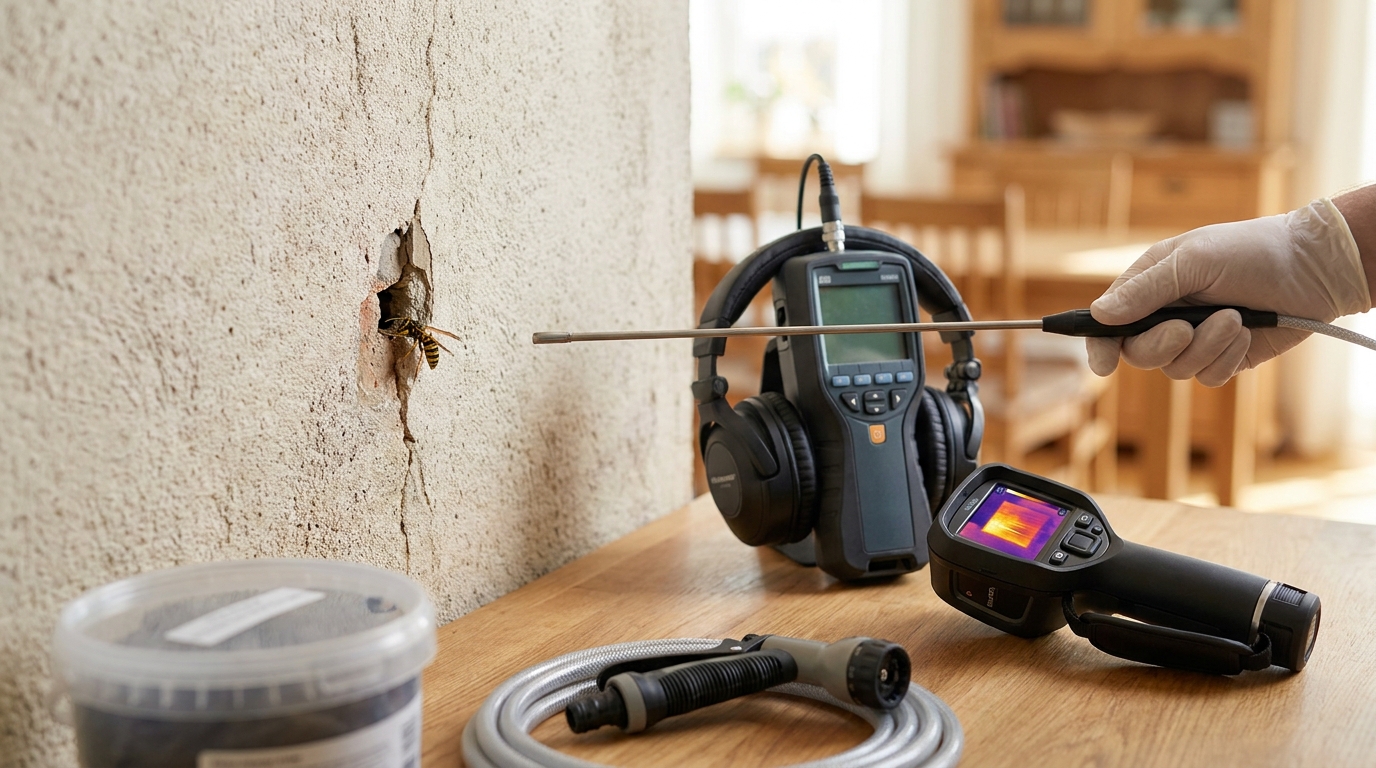
A wasp nest in a wall: Is that possible, and what should you do?
Contents
«That’s impossible—a wall is solid; there’s no room.» We hear that all the time. And yet, every summer, we respond to calls at dozens of homes where a nest has taken up residence deep inside a wall, nice and warm, invisible from the outside. A wall made of brick, cinder block, or stone is by no means a solid, airtight block. There are gaps everywhere—and wasps know this better than you do.
Things to remember
-
This article debunks the myth that it is impossible to build a nest in a solid wall by explaining how wasps make use of cracks
-
We offer two key benefits: a novel acoustic and thermal detection method for the general public, while also warning against the fatal mistake of blocking the entry hole—a detail often overlooked by our competitors
-
Understanding How a Wasp Nest Forms Inside a Wall
-
How to Locate a Wasp Nest Behind a Partition Wall with Precision
The real problem isn’t thinking it’s impossible. It’s reacting the wrong way once you realize there really is a wasp nest in a wall of your house. Almost everyone’s first reaction is to grab some silicone or expanding foam and seal up the hole they’re coming through. Big mistake. We’ll explain why below, because that can literally bring the wasps right back into your living room.
In this article, we’ll look at how a nest manages to take root in a solid wall, how to pinpoint its exact location (using simple methods that few people know about), and, most importantly, how to remove it without putting yourself in danger. At Frelons.be, we do this year-round—for both wasps and Asian hornets.
Understanding How a Wasp Nest Forms Inside a Wall
A queen wasp emerging from hibernation in the spring is looking for one thing: a dark, dry, and wind-protected spot to establish her colony. A cavity in a wall checks all the boxes. She doesn’t need a lot of space at first—just an opening one or two centimeters wide and some empty space behind it.
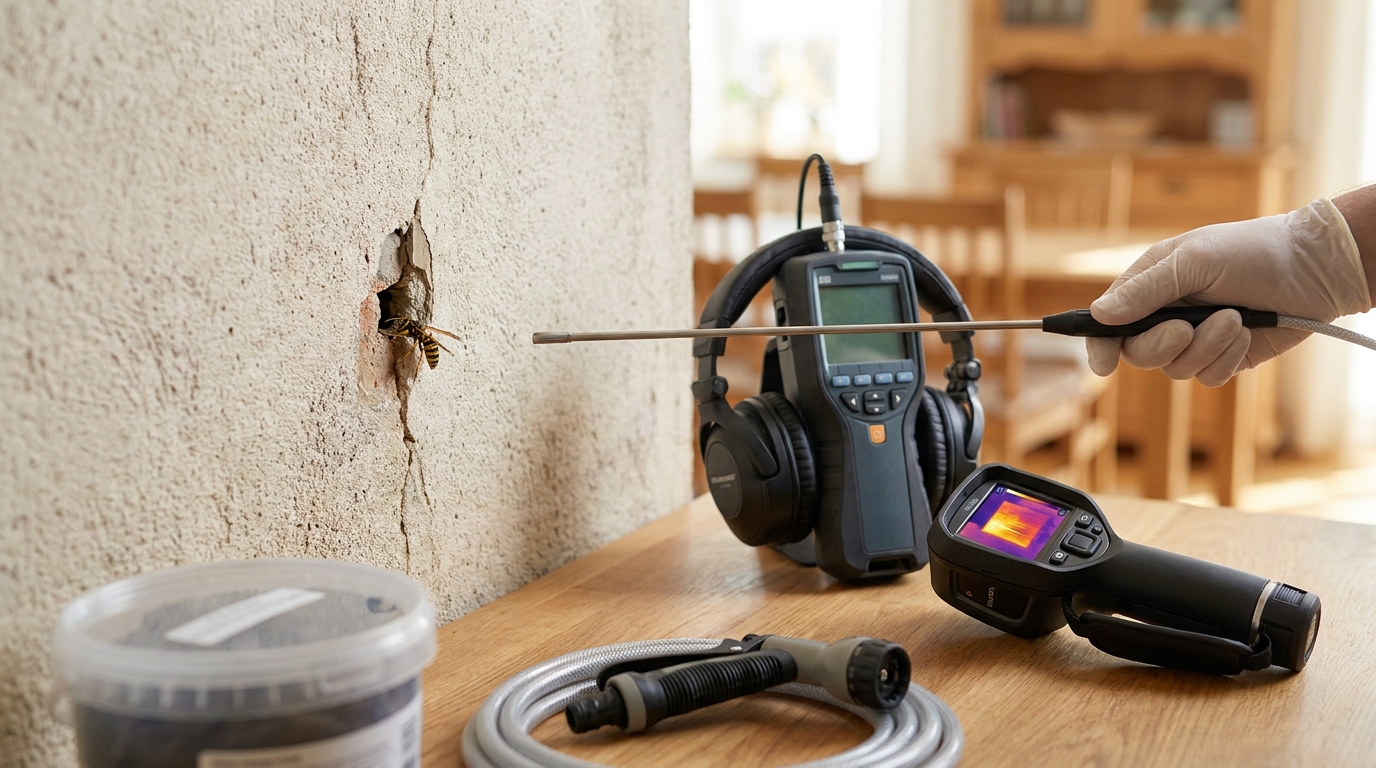
And there are air pockets everywhere in a building. Between two rows of hollow bricks. Behind siding. Inside the box of a roller shutter (a classic example). In the space left between the thermal insulation and the load-bearing wall. In newer homes, exterior insulation creates precisely this kind of ideal air pocket with a stable temperature. In older buildings, it’s more likely to be a hornet’s nest in a stone wall, because the lime mortar joints deteriorate and leave gaping holes.
The most common point of entry? A crack in the facade. A simple flaw in the stucco, a microcrack in a lintel, or an expansion joint that hasn’t been properly sealed. The queen rushes in, climbs up through the gap, and begins building her papier-mâché nest against an interior wall. Over the course of several weeks, the colony grows. A nest that was the size of a golf ball in May can reach the size of a basketball by August, housing several thousand individuals.
For a wasp nest in a cinder block wall, the mechanism is the same: the hollow cavities in the blocks serve as passageways. The same goes for a wasp nest in a brick wall. And if you hear about a bumblebee nest in the wall, keep in mind that bumblebees also love these cavities, even though they’re much less aggressive than wasps.
What makes the situation tricky is precisely that it all happens out of sight. All you see is a constant stream of insects coming and going around a small hole in the exterior wall. Behind it, there could be a huge nest pressed up against your drywall, just a few centimeters from your head while you sleep. That’s why a wasp nest behind drywall is often discovered late, when the noise becomes impossible to ignore.
How to Locate a Wasp Nest Behind a Partition Wall with Precision
Before treating, you need to know exactly where the nest is located. Treating at random is a waste of product and will agitate the colony for no reason. Here’s how to proceed, step by step.
Start by listening. Press your ear against the wall—early in the morning or in the evening when the house is quiet—and listen. An active nest produces a very distinctive scratching sound, a continuous rustling, much like paper being crumpled constantly. The wasps chew away at the wood and constantly expand the nest. Move along the wall: wherever the sound is loudest, the nest is right behind it. This acoustic method of locating the nest is astonishingly accurate, and yet no one ever talks about it.
Next, locate the entrance hole. Stand outside and observe the facade for a few minutes. You’ll see the wasps entering and exiting through the same spot every time. This entrance hole is your outdoor reference point. Note its exact position relative to the windows and corners; this will help you locate the nest in 3D once you’re inside.
The third tool is heat. A nest containing several thousand wasps gives off more heat than the rest of the wall. Using a thermal camera (which you can now rent or buy as an affordable smartphone accessory), scan the surface of the wall in the evening, when the temperature difference is most noticeable. The nest will appear as a clearly defined hot spot. This is the most reliable method for locating a wasp nest in a wall without causing any damage.
Cross-reference the three clues: the loudest spot, the axis of the exit hole, and the warm area. Where all three meet, you’ll find your target. Also look for indirect signs: brownish damp spots appearing on the wallpaper, a slightly sweet smell, or a few wasps flying into a room without you knowing where they came from. This last point is a bad sign: it often means the colony has bored a passage into the house.
Once you've located the nest, do not drill into it, tap on it, or try to scratch at it. You won't see anything more, and you risk triggering a mass attack.
Safe ways to remove a nest from a wall
Now, the one mistake you must absolutely avoid—the one we fix every week for panicked customers—is blocking the entry hole. It seems logical; you might think that by closing off the entrance, they’ll die trapped inside. But the exact opposite happens. Deprived of their usual exit, the wasps look for another way out, and that path almost always leads them into the house—through an electrical outlet, a baseboard seam, or a crack in the drywall. You’ll end up with dozens of angry wasps in your living room. So: never seal a wasp nest in a wall while it’s still active. Only seal it afterward, once the entire colony is dead.
To eliminate a wasp nest embedded in a wall, insecticide powder is the best option. Unlike aerosols, which remain on the surface, the powder is injected directly into the entrance hole. The wasps carry it back on their legs to the heart of the nest and infect the entire colony—including the queen—within 24 to 48 hours. Apply the powder at dusk, when all the workers have returned to the nest, wearing full-body protective gear, gloves, and a protective veil. Then step back and let it take effect. Do not seal the hole until several days have passed with no activity.
I’ll be frank: if a nest is behind drywall or high up, trying to handle it yourself is risky. A wasp can sting multiple times, and a disturbed nest can send hundreds of wasps on the attack in a matter of seconds. If you’re allergic, or if the nest is hard to reach, professional pest control isn’t a luxury—it’s common sense. A professional has the equipment to apply treatment from a distance and locate the nest without breaking through the wall.
The Asian hornet deserves special mention. It rarely nests inside walls (it prefers trees and rooftops), but when it does, it’s no joke. Its sting is more dangerous, and it defends its nest with formidable aggression. Any intervention involving an Asian hornet must be carried out by a properly equipped specialist. It’s also an ecological issue: this invasive species is decimating bee populations, and every nest destroyed makes a difference.
Is it dangerous to leave a nest alone? Yes. A colony doesn’t leave on its own during the season—it keeps growing. The longer you wait, the more difficult it is to remove, and the greater the risk of being stung. The danger of wasps in the house is real, especially with children or pets. Take action early.
Conclusion
A wasp nest in a wall is common, entirely possible, and manageable as long as you do things in the right order. First, locate the nest (using your ear, the entrance hole, or a thermal camera); never block the entrance to an active nest, and treat it with insecticide powder at the right time. If the nest is inaccessible, if you have allergies, or if it’s an Asian hornet nest, don’t hesitate to call in a professional.
At Frelons.be, we’re available year-round, anywhere, with the right equipment to solve the problem quickly and thoroughly. Have a hunch or hear a suspicious buzzing sound in a wall? Contact us before the colony gets too comfortable. Better to give us a call today than get stung tomorrow.
Frequently asked questions
How can you tell if wasps have built a nest in a wall?
Look for regular comings and goings to a crack, a seam, a vent, or the edge of a roof. A buzzing or scraping sound behind a wall may also indicate a nest. A few wasps appearing inside the house are another warning sign.
Should we block the entrance to the nest?
No. If you seal the opening while the nest is active, the wasps will look for another way out. They may then enter the home through an electrical outlet, a baseboard, or a crack inside the house. The hole should not be sealed until the colony has been completely eliminated.
Can wasps get through a wall?
Yes. They can exploit an existing weakness in a lightweight material, a joint, or a sheet of drywall. If the nest is very close to the interior wall, some wasps may eventually make their way into the room. Avoid drilling or hammering the wall.
Do we have to break through the wall to remove the nest?
Not necessarily. In many cases, the nest can be treated through its exterior opening without removing the wall. Cutting an opening in the wall is only considered if access is impossible, if the nest is causing damage, or if activity persists after treatment.
How does a professional deal with a nest hidden in a wall?
The technician identifies the species, locates the colony, and treats the nest from its entry point. A professional-grade product is injected into the cavity so that it gradually reaches the entire colony. Activity must then be monitored before the entry point is sealed off.
How long should I wait before patching the wall?
You must wait until the wasps have completely stopped coming and going—which usually takes several days, depending on the size and location of the nest. Sealing the opening too soon may trap wasps that are still active. Ask the technician to confirm that the cavity can be safely sealed.
 French
  English
  Dutch
Dutch
0 Comments