
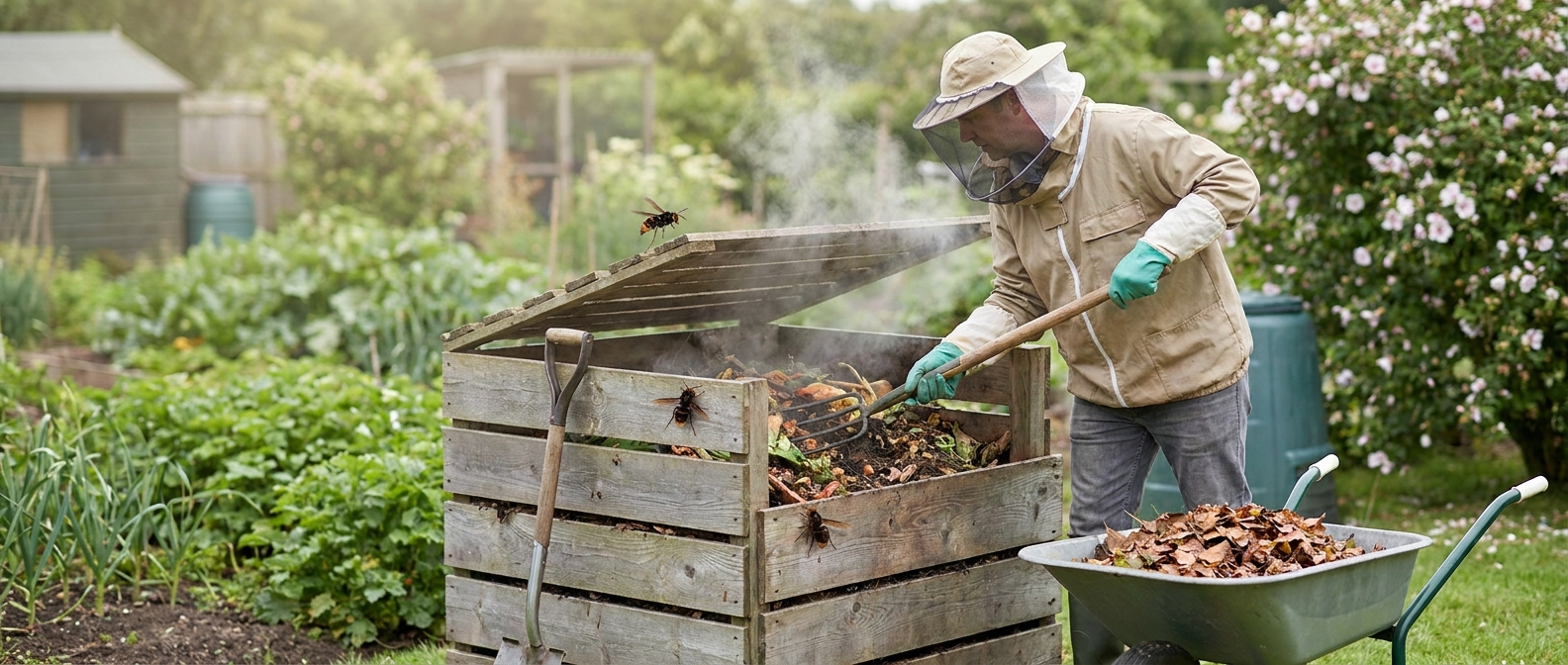
Hornets and Compost: How to Identify a Nest and Protect Yourself?
Contents
-
How can you detect and deal with a hornet's nest in your compost?
-
A Practical Guide to Keeping Your Composting Area Safe All Year Round
Have you noticed a swarm of hornets around your compost bin? This is one of the questions we’re asked most often in the spring and summer. And it makes sense: a compost bin is practically the perfect pantry for these insects. But be careful—there are two very different situations that people often confuse.
Things to remember
-
We are exploring compost not only as a food source, but also as an ideal thermal incubator for nests
-
The article clearly distinguishes between foraging and nesting to provide a safe and proportionate response to gardeners
-
Why does the compost bin attract so many Asian hornets?
-
How can you detect and deal with a hornet's nest in your compost?
On the one hand, there are hornets that just come to feed. On the other, there are those that decide outright to settle in and build a nest. It’s not the same thing at all, and above all, it doesn’t call for the same response. Panicking and destroying everything that moves is the best way to get stung and, in the process, kill off beneficial insects.
In this article, we’ll explore why your compost is a magnet for hornets, how to spot a real nest, and—most importantly—how to keep your garden safe all year round without getting stung. We’re active in the fight against the Asian hornet 12 months a year, and trust us, prevention makes all the difference.
Why does the compost bin attract so many Asian hornets?
Compost is warm, moist, sweet, and teeming with life. In other words, it’s a five-star buffet for a hornet. Compost’s appeal stems from a few very specific factors, and once you understand them, you’ll quickly see why these insects are drawn to it.
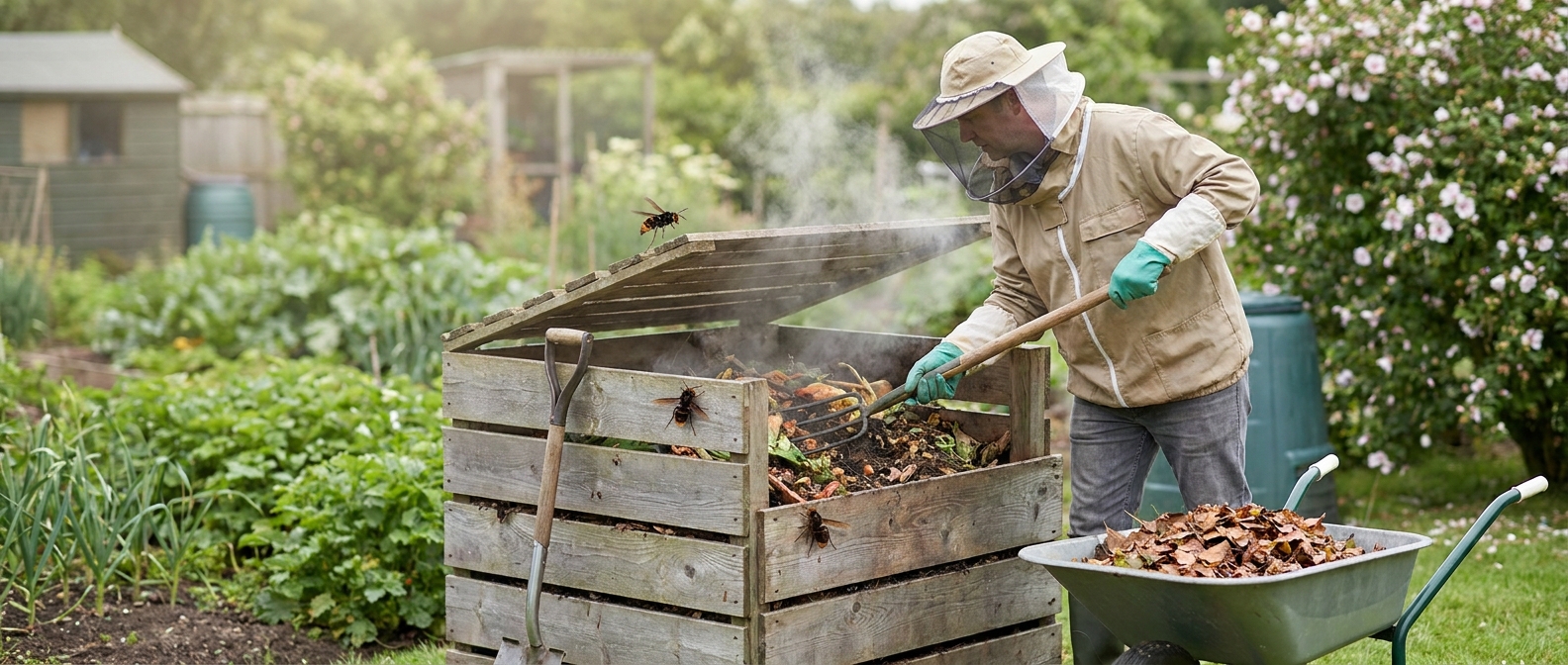
The first factor is food. The fruit waste As they ferment, they give off sweet smells that carry far. An overripe apple, melon peels, the dregs of a jam jar tossed into the compost: for a hornet, this is a signal as strong as a neon sign. The Asian hornet’s diet relies heavily on sugars as an adult, and your organic waste are teeming with them. Add to that the flies and other small insects swarming in the pile: the Vespa velutina It also hunts prey to feed its larvae. Two meals in one place—it doesn't get much better than that.
The second factor—one that’s less often discussed—is heat. A compost pile in the midst of decomposition can reach temperatures of 40 or 50 degrees at its core. This heat is a godsend for a queen bee looking for a warm spot in early spring. The compost pile then becomes much more than just a feeding station: it’s a natural thermal incubator. That’s why some nests end up located in or right next to a compost bin.
Does compost really attract hornets more than anything else? Honestly, yes. Between the moisture, sugar, prey, and heat, it checks all the boxes. And hornets aren’t the only guests: wasps love it too, as do a host of other insects, from rose chafer beetles to woodlice to fruit flies. A healthy compost pile is teeming with life—that’s normal, and it’s actually a good sign.
The key takeaway is that the presence of a few hornets foraging around your trash can does not necessarily mean there’s a nest. Most of the time, they’re just worker hornets out on a foraging trip. They come and go, and they’re not looking for a fight. The real problem starts if a colony decides to set up shop. And we’re going to learn how to spot that.
How can you detect and deal with a hornet's nest in your compost?
The big question: How can you tell if it’s just foraging or a real settlement? Watch the traffic. A few hornets coming and going means they’re foraging. However, a continuous, organized flow—with regular trips back and forth to a specific spot from morning to night—is a sign of a hornet’s nest in the composter or right nearby.
To identify a hornet's nest, look for the structure. In the case of the Asian hornet, the nest resembles a large ball of beige-gray papier-mâché, with an entrance often located on the side or at the bottom. It may be hidden under a pile of branches, in a compost bin that hasn’t been stirred much, or even in the ground right next to it. Because yes, the danger of ground-nesting hornets is very real: some colonies settle in a cavity at ground level, and there you don’t see them until the very last moment, when you stick a pitchfork into it.
That’s exactly what makes the situation dangerous. What should you do if you come across a hornet in the ground—or worse, an entire colony? Rule number one: don’t touch anything. Back away slowly, without making any sudden movements, and move away. A disturbed nest means dozens of hornets will go on the defensive in a matter of seconds. Multiple stings can land someone in the hospital, especially people with allergies.
Don’t count on old wives’ remedies either. Pouring boiling water on them, setting them on fire, or spraying them with insecticide: aside from exposing yourself to a massive attack, it doesn’t solve anything. A well-established Asian hornet nest contains hundreds of individuals, sometimes more than a thousand by the end of the season. You can’t destroy that with a can of insecticide bought at the supermarket.
The right response? Locate and mark the area to warn those around you, then call a professional. At Frelons.be, we specialize in handling exactly this kind of situation, using the right equipment and a technique that neutralizes the colony without putting you in danger. How to recognize a nest, where it’s hiding, and how to approach it—that’s our daily work, all year round. And distinguishing a European hornet—which is larger and less aggressive—from a Vespa velutina Yellow legs—that’s also part of the diagnosis. A European hornet in your yard isn’t quite the same kind of emergency.
A Practical Guide to Keeping Your Composting Area Safe All Year Round
Good news: most problems can be prevented early on with a few simple precautions. Garden safety starts well before summer, as soon as the first warm days of March arrive.
The first strategy is spring trapping. Between February and May, founding queens emerge from hibernation and look for a place to start their colony. Every queen captured during this period potentially prevents an entire nest from forming in the summer. We rely on selective trapping: traps designed to catch the Asian hornet while allowing bees, butterflies, and beneficial insects to fly away. The ideal bait is a sweet-alcoholic mixture (dark beer, syrup, a little white wine) that attracts hornets without luring pollinators. Place the trap a few meters away from the compost pile—not on top of it—so as not to concentrate activity in the wrong place.
Second tip—simple but incredibly effective: cover the compost. A closed compost bin with a secure lid greatly reduces odors. If you’re composting in an open pile, always cover new additions with a layer of dry material: dead leaves, cardboard, dried grass clippings, or shredded plant matter. This layer acts as a barrier against odors and insects. Be sure to bury fruit scraps—they’re the most attractive to pests. A rotten apple left on the surface is an open invitation to all the six-legged neighbors.
To keep hornets away for good, also consider the location. Placing a compost bin right next to the patio or front door is asking for trouble. Keep it away from high-traffic areas and places where children play. Also, be sure to minimize standing water nearby: hornets need to drink, and a saucer full of water right next to the bin will keep them coming back.
One last piece of advice, valid all year round: stay alert. Check your compost bin regularly, especially if you don’t turn it often. A nest in its early stages can be easily removed when it’s about the size of a golf ball. Wait until it reaches the size of a soccer ball, and then you’ll need to call for backup. At Frelons.be, we don’t just work during peak season: prevention in the spring, detection in the summer, and locating nests in the fall—it’s a year-round battle against the Asian hornet. A well-managed compost pile means a safer garden—and helps protect beneficial insects in the process.
Conclusion
A compost bin that attracts hornets is almost inevitable: heat, sugar, and prey—it has it all. But a few hornets foraging here and there doesn’t mean there’s a nest, and that distinction makes all the difference. Cover your compost, bury fruit, trap queens in the spring, and keep an eye on hidden corners: by taking these steps, you can naturally keep the problem at bay without harming biodiversity.
And if you come across a real nest—whether in your compost, in the ground, or in a hedge—don’t try to be a hero. Contact Frelons.be. We’ll respond quickly and safely, and we’re here to help you keep your garden pest-free all year round.
Frequently asked questions
Why are hornets attracted to compost?
Fermenting fruit, sugary waste, and insects in the compost provide food sources. The heat and moisture in the composter can also attract a queen looking for a sheltered spot in the spring
Does the presence of hornets around the compost pile mean there's a nest?
No. A few hornets may simply be coming to forage for food. A nest is more likely if you observe continuous, organized traffic toward a specific spot on the compost bin, the trash pile, or the surrounding ground.
How can you spot a hornet's nest in a compost bin?
The nest resembles a rounded structure made of beige or grayish paper. It may be hidden under branches, inside a compost bin that hasn’t been stirred much, or in a cavity in the ground. Regular comings and goings at the same spot are the main warning sign.
What should I do if I find a nest in my compost?
Stop stirring or opening the compost bin immediately. Calmly step back, keep children and pets away, and cordon off the area. Do not pour water or household insecticide on the nest; instead, contact a professional to identify the species and safely remove the nest.
Can you move a compost bin that's been taken over by hornets?
No. Moving, overturning, or emptying the compost bin can trigger a collective defense response from the colony. The nest must first be located and neutralized by a professional. The compost bin can then be moved or cleaned without risk.
How can you keep hornets from being attracted to your compost?
Use a tightly-fitting lid and cover the fruit waste with fallen leaves, cardboard, or shredded material. Place the composter away from doors, patios, and play areas. Inspect it regularly without touching it if you notice any unusual activity.
 French
  English
  Dutch
Dutch
0 Comments