
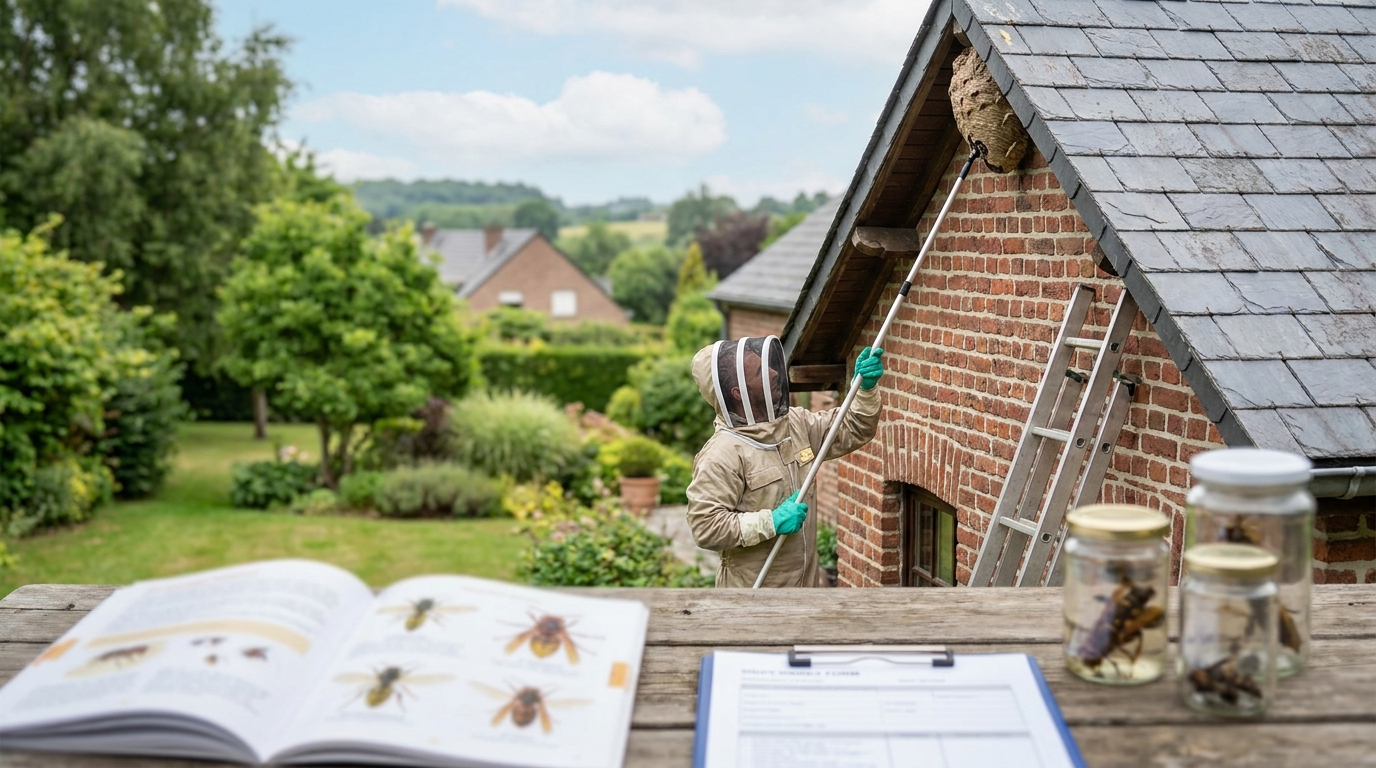
Removal of Wasp and Hornet Nests in Sint-Pieters-Leeuw
Contents
One afternoon in July, a resident of the Negenmanneke neighborhood called us. His patio had become unusable: there was a constant stream of wasps swarming around the grill, and an unsettling buzzing sound coming from under the eaves. He no longer dared let his children play outside. In less than two hours, the nest was treated. This is the kind of situation we encounter every week here.
Things to remember
-
This article offers a local insight into Sint-Pieters-Leeuw, combining a real-life account of a pest control operation with a practical guide to Asian hornets and pest control rates in Zone 1600.
-
wasps and hornets
-
How a Pest Control Treatment Works in Zone 1600
-
Guide to Prices and Steps for Removing a Wasp Nest
Wasps in Sint-Pieters-Leeuw aren’t a seasonal problem you can just ignore and hope will go away. A poorly placed nest—under a roof or in the garden soil—can quickly turn into a nightmare. And in recent years, the Asian hornet has joined the mix, which changes things quite a bit.
In this article, I’ll explain how to identify different pests, what a typical pest control service in Zone 1600 entails, and—most importantly—how much it really costs. No fluff—just practical information to help you take action quickly.
Understanding Pests in Sint-Pieters-Leeuw: Wasps and Hornets
Not all yellow-and-black bugs are the same. Before you panic, you need to know what you're dealing with. It makes all the difference in terms of how to handle the situation and your safety.
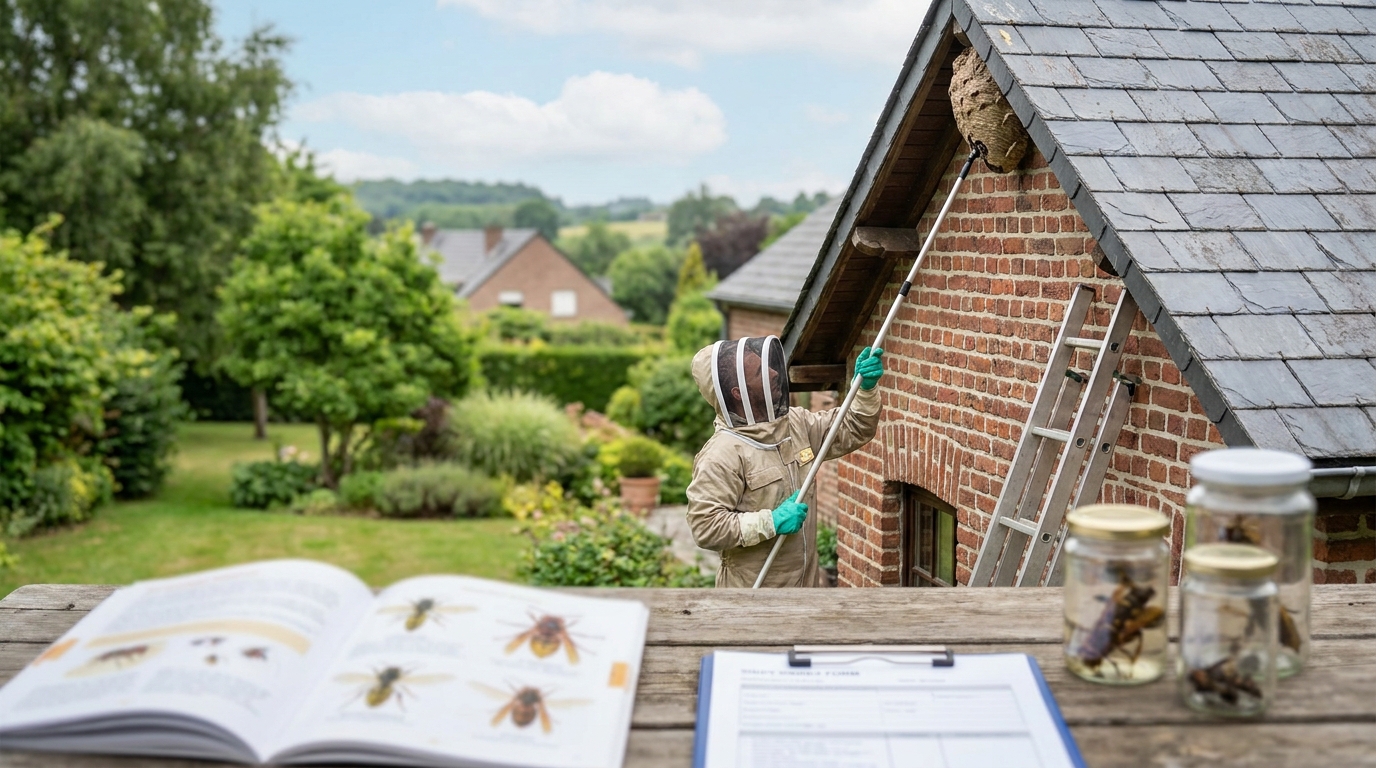
Let’s start with the common wasp—the one that buzzes around you at the dinner table. You see them everywhere in Sint-Pieters-Leeuw as soon as the weather turns nice. They build their nests in sheltered spots: attics, shutter boxes, and wall cavities. One particular type deserves your attention: the ground wasp. Identifying a ground wasp is fairly simple: you’ll see a hole in a lawn or embankment, with a flurry of insects flying in and out of the same spot. And yes, these wasps do sting—and quite aggressively when you approach their entrance. If a lawn mower gets too close, you’ll face a swarm attack. This is often even more dangerous than an above-ground nest, because you don’t see it coming.
Here’s the question that comes up all the time: Which wasp is the least aggressive? The paper wasp—slenderer, with long legs that dangle as it flies—remains fairly peaceful as long as you don’t disturb its nest. But let me be clear: as soon as a nest is near a high-traffic area, whether it’s aggressive or not, you need to take action.
The European hornet, on the other hand, is impressive in size but remains relatively calm. The real concern right now is the Asian hornet in Sint-Pieters-Leeuw. Smaller than its European cousin, with yellow legs and a very dark thorax, it is becoming increasingly established in our region. The Asian hornet has become a serious concern in Belgium, particularly because it is decimating bee populations and building enormous nests high up in trees or under roofs.
Speaking of which, let’s talk about the difference between bees and hornets, because people often confuse the two. Bees are stocky, hairy, and mostly brown, and they quietly gather nectar from flowers. Hornets are slender, hairless, and behave like hunters. Important point: Bees are protected. We don’t exterminate them; we call in a beekeeper to relocate them. Our teams know how to tell the difference in the field, which is why a professional never destroys a nest without first identifying it.
How a Pest Control Treatment Works in Zone 1600
You’ve spotted a nest. Now what? A lot of people try using an insecticide spray from the supermarket. Bad idea. Nine times out of ten, it just agitates the colony without destroying it, and you end up with a swarm of angry wasps. Safety around a wasp nest is no small matter.
A professional intervention begins with an assessment. The technician arrives, pinpoints the exact location of the nest, identifies the species, and evaluates the risks associated with accessing it. A nest inside a shutter box requires a different approach than a hornet’s nest perched eight meters up in a linden tree.
The most effective method for exterminating wasps in Leeuw-Saint-Pierre is to spray an insecticidal powder directly into the nest’s entrance. This is called powder spraying. The idea is simple but incredibly effective: wasps flying in and out become coated with the powder, carry it back into the heart of the nest, and contaminate the entire colony, including the queen. Within a few hours, all activity ceases. This technique works equally well for aerial nests and ground-nesting wasps.
For Asian hornets nesting at heights, we use specialized equipment: telescopic poles that reach high up and specialized sprayers. This is where the expertise of the Vespa Hunter comes into play—a specialized technician trained to handle these hard-to-reach nests. Treating an Asian hornet nest ten meters above the ground isn’t something you can just wing it with a ladder borrowed from a neighbor.
The technician wears a full-body suit, a protective veil, and thick gloves. This gear isn’t just for show. A hornet can sting multiple times, and for someone with an allergy, that’s a guaranteed medical emergency. That’s why I strongly advise against climbing up to a nest on your own.
After treatment, you are generally asked to stay away for a few hours while the product takes effect. Depending on the situation, we may remove the empty nest or leave it in place if it is inaccessible and no longer poses a danger; a treated nest will not be recolonized during the same season. The entire procedure is carried out in accordance with safety regulations, for your protection as well as that of our team and the neighborhood.
Guide to Prices and Steps for Removing a Wasp Nest
The real question—the one everyone asks themselves before picking up the phone—is: How much does it cost to remove a wasp nest? Let’s be transparent. The cost of removing a wasp nest depends mainly on its accessibility and the nature of the nest.
For a typical, easily accessible wasp nest, expect to pay between 80 and 150 euros. As soon as special equipment or a cherry picker is required—or if the nest is an Asian hornet’s nest perched high up—the price goes up, because the job takes longer and is riskier. The cost of removing a ground wasp nest usually falls on the lower end of the price range, since access is straightforward.
How does it work, step by step? First, you call us and describe the situation: where the nest is located, its approximate size, and the type of insect, if you know it. We’ll then give you an estimate. A clear, no-surprise quote for pest control in 1600 is the foundation of a relationship built on trust. Next, we’ll schedule a time slot. And here’s an important point: we handle wasp emergencies 7 days a week. A nest blocking the entrance to your home on a Sunday can’t wait until Monday morning.
On site, the technician confirms the diagnosis, applies the treatment, and explains the precautions you should take in the hours that follow. A standard rapid wasp control service rarely takes more than an hour. You’ll be able to use your patio or garden again the same day.
A quick aside on home remedies, since I’m often asked about scents that keep wasps away. Cloves, lemongrass, burnt coffee grounds, lavender essential oil: yes, they can keep them away from a dining table. But don’t kid yourself—no smell will destroy an established nest. These tips are preventive, never curative. When faced with an established colony, you need professional help.
One last piece of advice: don’t wait. A wasp nest early in the season is small, easy to treat, and less expensive. The same nest in August can be home to several thousand wasps. The sooner you act, the simpler and more cost-effective it is. For any wasps in Sint-Pieters-Leeuw that are making your life miserable, a local professional will solve the problem quickly and thoroughly.
Conclusion
Ground wasps, Asian hornets, nests under the roof: in Sint-Pieters-Leeuw, these situations can be handled effectively when addressed correctly and quickly. The key is to correctly identify the pest, avoid trying to be a hero with an insecticide spray, and call in someone who knows the area and has the right equipment.
We provide services year-round, including Asian hornet removal, with transparent pricing and 24/7 availability. Is a nest causing you concern? Contact us for a quick quote and regain your peace of mind today. Better to make a call now than get stung tomorrow.
Frequently asked questions
How can you spot a wasp nest in Sint-Pieters-Leeuw?
A wasp nest usually looks like a grayish paper-like structure. It can be found under a roof, in a shutter box, in a wall cavity, in a garden shed, or in the ground. Regular comings and goings through the same opening often indicate the presence of an active nest.
Who should I call to remove a wasp nest in Sint-Pieters-Leeuw?
For a common wasp nest, contact a pest control company serving the 1600 area. Provide the location, height, and any observed activity, or send a photo taken from a distance. Frelons.be will then be able to assess the urgency of the situation and bring the appropriate equipment.
How much does it cost to have a wasp nest removed in Sint-Pieters-Leeuw?
Treating an easily accessible wasp nest generally costs between €80 and €150. The price may increase if the nest is high up, requires the use of a telescopic pole, or involves treating an Asian hornet nest. An accurate estimate is provided before the service call.
How long does it take for you to respond in Zone 1600?
The response time depends on the season, the urgency of the situation, and the availability of technicians. Frelons.be responds quickly in Sint-Pieters-Leeuw, particularly in Ruisbroek, Vlezenbeek, Negenmanneke, and Zuun. Nests located near an entrance, a patio, or a high-traffic area are given priority.
What should you do if you encounter an Asian hornet in Sint-Pieters-Leeuw?
Take a photo of the insect or the nest from a safe distance, then submit a report on Vespa-Watch. Never attempt to capture the hornets or destroy the nest yourself. On public property, you can also notify the municipality’s Environmental Department.
Do firefighters respond to wasp nests in Sint-Pieters-Leeuw?
Nests of common wasps and European hornets are generally handled by a private company. For a confirmed Asian hornet nest, a request can be submitted to the emergency response zone through its online portal. Since procedures may change, please check the applicable conditions at the time of reporting.
 French
  English
  Dutch
Dutch
0 Comments