
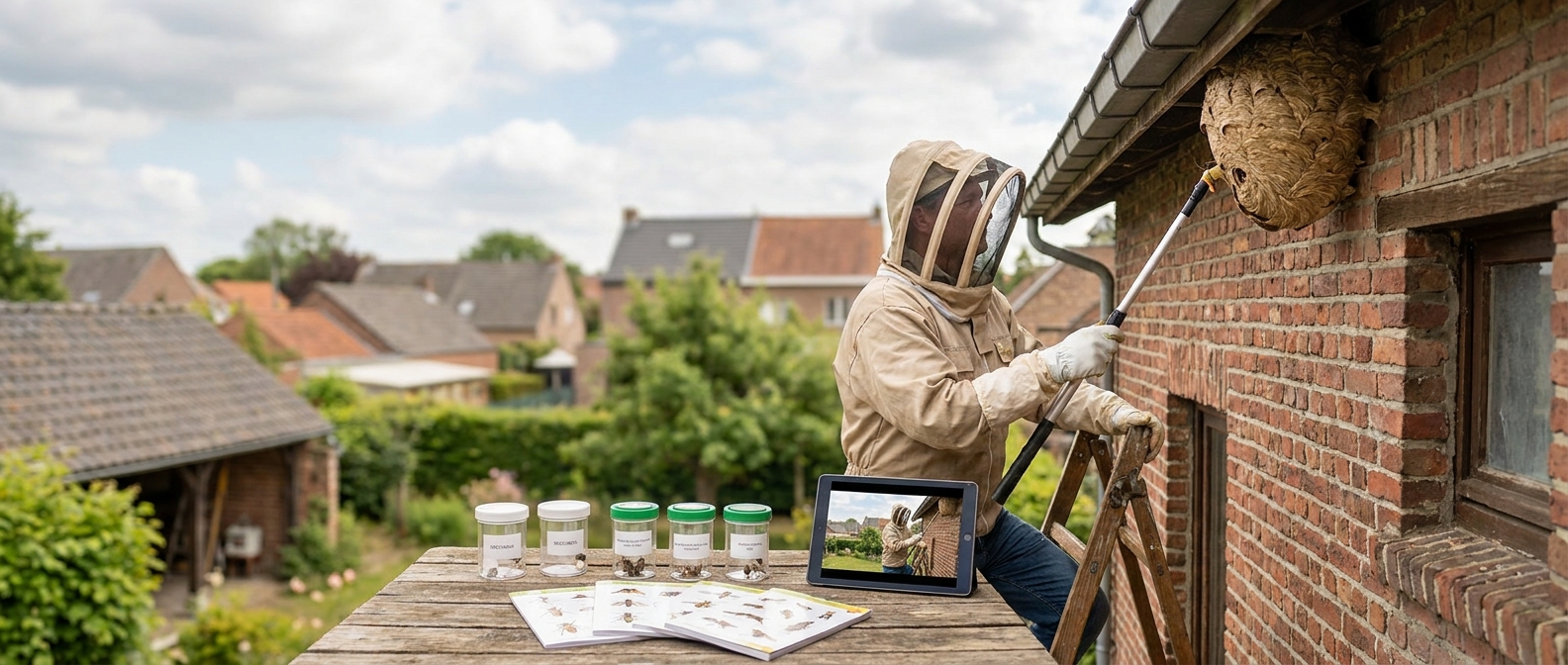
Wasp Nest in Asse: Identification and Rapid Response
Contents
A constant buzzing near the roof, insects darting back and forth under a roof tile—and suddenly doubt sets in. A wasp? A hornet? A bee? In Asse, every summer, the same questions come up. And often in a jumble, somewhere between panic and the urge to handle it yourself with an insecticide spray from the hardware store.
Things to remember
-
This article combines a deep local connection to the town of Asse with educational expertise to identify the species (wasps vs. hornets)
-
It addresses the ambiguity in search results while offering a direct and secure commercial solution for residents
-
Identifying Common Wasp and Hornet Species in Asse
-
Why is the presence of a wasp nest dangerous?
The problem is that you don’t treat a common wasp nest the same way you treat an Asian giant hornet nest. The stakes aren’t the same—neither the danger nor the method. Knowing what you’re dealing with is already half the battle.
At Frelons.be, we provide services year-round in the town of Asse and the surrounding area. We’ve seen just about everything that an attic or a garden can hide. So here’s what you need to know: how to identify the species, why it’s a problem, and how a professional pest control service works.
Identifying Common Wasp and Hornet Species in Asse
Let’s start with the most common one. The common wasp—the one that buzzes around your plate on the patio—is about 1.5 cm long. With a bright yellow body striped with black and a very slender waist, it builds nests out of gray papier-mâché, often in attics, under a roof overhang, or in a hole in the garden. It’s the number one species mentioned in the calls we receive at Asse.
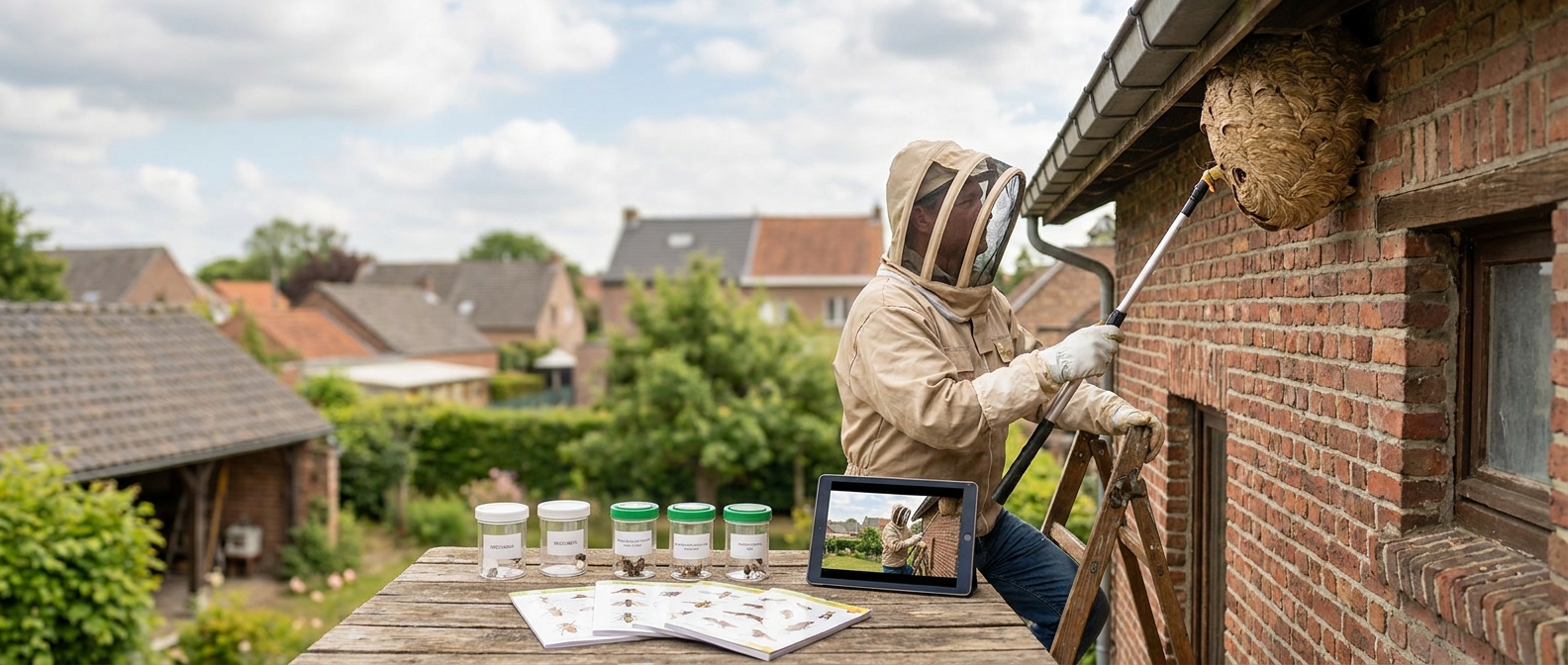
Next comes the paper wasp. More slender and slightly longer, it lets its hind legs dangle while flying, which gives it away immediately. Its nest is different: small, open, shaped like an upside-down umbrella, with no outer shell. It’s often found under a windowsill or in a garden shed. Do paper wasps sting? Yes, but they’re much less aggressive than common wasps. As long as you don’t disturb the nest, they’ll leave you alone.
The hornet is the wasp’s larger cousin. There are two species to be aware of here. First, the European hornet, which is reddish-brown and yellow, impressive in size (up to 3.5 cm) but generally peaceful. It hunts at night and is attracted to light.
And then there’s the Asian hornet in Asse—the one that causes the most concern, and rightly so. Darker than the European hornet, it has an almost entirely black thorax, an orange band on its abdomen, and, most notably, yellow tips on its legs. That’s the telltale sign. Its nests are enormous, shaped like balls or teardrops, often perched high up in a tree, sometimes hidden under a roof or in a hedge. This hornet is a real threat to bees, which it hunts in front of beehives, and its presence is growing every year in our region.
A word about identifying insects in general: don’t rely solely on color. Bees, on the other hand, are stocky, hairy, golden-brown, and only sting as a last resort (they die afterward). A wasp is hairless, shiny, and much more agile. If you’re unsure, take a photo from a distance. This often lets us confirm the species before we even head out, so we can arrive with the right equipment.
Why is the presence of a wasp nest dangerous?
Three stings while clearing away dead leaves. That’s how it usually happens. You’re not looking for trouble—you’re mowing the lawn or gardening—and the nest was right there, hidden from view. That’s what makes an underground wasp nest particularly treacherous: nothing sticks out—just a hole in the ground through which the wasps come and go. One swish of the mower nearby, and it’s a full-scale attack.
Which wasp is the most aggressive? The common wasp, without a doubt, especially in late summer. Starting in August, the colony reaches its peak size, food becomes scarce, and the workers grow agitated. An aggressive wasp gives no warning: it defends its nest as soon as it senses a vibration or a shadow getting too close. Unlike a honeybee, it can sting multiple times in a row without dying.
The danger of a sting depends largely on the individual. For most people, it’s painful, causes swelling, and goes away within a few days. But for someone with an allergy, a single sting can trigger anaphylactic shock within minutes. A tightening throat, difficulty breathing, and feeling unwell: this is a medical emergency—call 112 immediately. And be careful of multiple stings: when an entire nest attacks, the amount of venom can become dangerous even for someone who isn’t allergic.
Which species are the most dangerous? The Asian giant hornet tops the list in terms of the concern it causes—not because its sting is more toxic, but because it attacks in large numbers and in a coordinated manner when you approach its nest. Ten meters from a large nest, you’re already within its defense zone. That’s why we always say the same thing: don’t get close, don’t mess with it, and don’t try to be a hero around a hornet’s nest.
The real risk, in fact, is the instinct of the average person who wants to get rid of them quickly. Insecticide spray, boiling water, fire: every year, this ends in a trip to the emergency room. A nest that’s been disturbed but not destroyed means a furious colony. And then the problem becomes much bigger than it was at the start.
What is the process for a professional service call in Asse?
It all starts with a call. You describe what you see, the nest’s location, its approximate size, and, if possible, the species. A photo would be even better. This step isn’t meant to keep you waiting—it allows us to prepare for the job and assess access. A nest under a roof tile isn’t handled the same way as a nest eight meters up in a cherry tree.
Once on site, our pest control expert begins by identifying the species and pinpointing the exact entrance to the colony. We put on full-body suits—the kind that are resistant to stings—because that’s the only real protection when approaching an active nest. To destroy a wasp nest in Asse, we inject a specialized product directly at the source, where the entire colony will be exposed. The wasps carry the product back into the nest, and the nest is quickly neutralized—often within a few minutes, as far as visible activity is concerned.
For nests located high up, particularly those of the Asian hornet, we use a telescopic pole that allows us to treat the nest from a distance without ever having to climb up and come into direct contact with it. It’s safer and much more effective. Once the colony has been neutralized, the nest is removed whenever possible and accessible, to prevent other insects from reoccupying it.
Removing a nest requires a systematic approach, not improvisation. That’s exactly what our rapid response service in Belgium is all about: we get there quickly—often the very same day—because a nest only gets bigger. Every week you wait means more worker bees, a larger nest, and a more challenging treatment.
One thing that really reassures our customers in Asse is that we work year-round. The Asian hornet never takes a break, and spring nests—those founded by a single queen—are the easiest and most important to destroy. Eliminating a queen in the spring prevents a nest of several thousand hornets from forming in the fall. That’s where we really make a difference.
At Frelons.be, we know the area well—the town of Asse and its unique characteristics, from old farms to residential neighborhoods. No shady subcontracting, no products sold on the fly: a trained, well-equipped professional who comes to your home and leaves with the problem solved.
Conclusion
A wasp flying by is no big deal. A nest in your roof or garden is another matter entirely, especially when you don’t know whether it’s a common wasp, a paper wasp, or an Asian hornet. Identification makes all the difference, and safety comes before the urge to handle it yourself.
Have you spotted a nest in Asse? Don’t disturb it—keep your distance and call us. Frelons.be is available year-round, responding quickly with the right equipment and the necessary expertise. Just give us a call, send a photo, and we’ll take care of the rest.
Frequently asked questions
How can you spot a wasp nest in Asse?
A wasp nest usually looks like a grayish paper-like structure. It can be found under a roof, inside a wall, in an attic, in a hedge, in a garden shed, or in an underground cavity. Wasps regularly coming and going through the same opening often indicate an active nest.
Who should I call to remove a wasp nest in Asse?
For a common wasp nest, contact a professional exterminator such as frelons.be, which serves Asse and Flemish Brabant. Specify the location, height, and observed activity, or send a photo taken from a distance. This information allows Frelons.be to identify the species and determine the necessary equipment.
How much does it cost to have a wasp nest removed in Asse?
The price depends on the species, the height, and the accessibility of the nest. Generally, expect to pay between €80 and €120 for an easily accessible nest, between €120 and €180 when access is difficult, and up to €250 for a high-up hornet’s nest. The exact price is confirmed before the job begins.
How long does it take for you to respond in Asse?
The response time varies depending on the season, the urgency of the situation, and the availability of technicians. During peak periods, Frelons.be can respond quickly in Asse, including on weekends. Nests located near an entrance, a bedroom, a patio, or a frequently used area are given priority.
What should you do if you encounter an Asian hornet in Asse?
Take a photo from a safe distance, then report the insect or nest on Vespa-Watch. Never try to approach the nest or destroy it yourself. Frelons.be can also verify the identification and assess the situation to determine whether intervention is necessary.
Do firefighters respond to wasp nests in Asse?
For common wasps, the town of Asse refers residents to a private exterminator. For a confirmed Asian hornet nest, assistance from the emergency services can be requested through the town’s online portal or by calling 02 451 49 11. The 112 number is reserved for life-threatening emergencies.
 French
  English
  Dutch
Dutch
0 Comments