
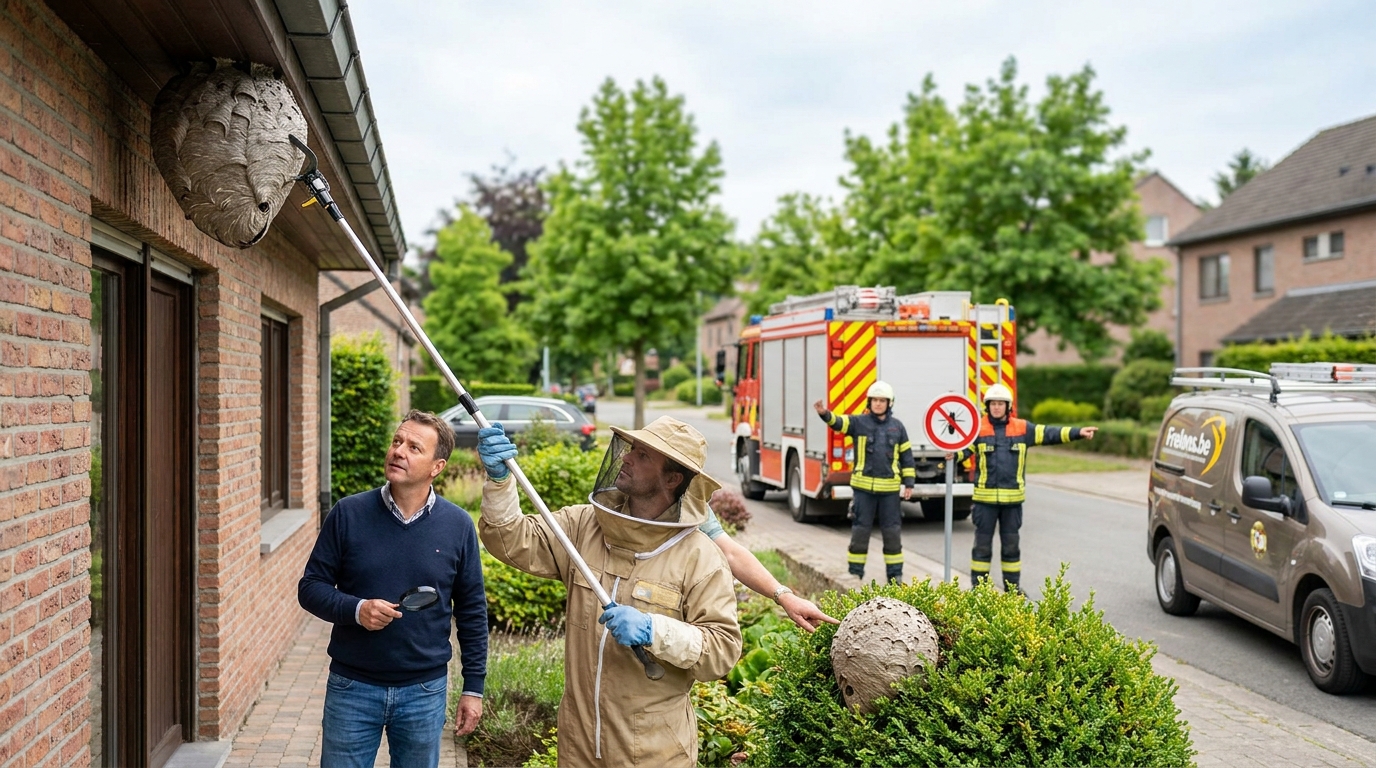
Wasp Nest Removal in Wezembeek-Oppem: Your Expert Since 1970
Contents
-
Why don't firefighters respond to wasp calls in Wezembeek-Oppem anymore?
-
A Guide to Identifying Wasp and Asian Hornet Nests in Your Garden
You spotted a nest under your roof, in the hedge, or against the patio wall, and you did the logical thing: you called the fire department. Except this time, they told you they no longer respond to calls like that. It’s frustrating, especially when you have kids playing in the yard and a swarm of bees buzzing just two meters from the front door.
Things to remember
-
A hyperlocal article explaining that firefighters no longer handle wasp nests in Wezembeek-Oppem
-
be positions itself as the fast and expert alternative, specializing in Asian hornets, and offering a safe solution for families in the 1970 ZIP code
-
Why don't firefighters respond to wasp calls in Wezembeek-Oppem anymore?
-
A Guide to Identifying Wasp and Asian Hornet Nests in Your …
Good news: that’s what we’re here for. Frelons.be provides year-round service in the 1970 ZIP code area, in Wezembeek-Oppem and neighboring municipalities. We specialize in removing wasp nests in Wezembeek-Oppem and, above all, in tracking down the Asian hornet, a pest that has been increasingly establishing itself in our region over the past few years.
Ever since Wezembeek-Oppem became part of its current emergency services district (in 1970, when the municipalities merged), many residents still believe that the fire department handles these types of emergencies. That is no longer the case. Here’s why, and how we’re stepping in.
Why don't firefighters respond to wasp calls in Wezembeek-Oppem anymore?
The question comes up in almost every call we receive. «But don’t firefighters do that anymore?» No, not really. And it’s not because they don’t want to.
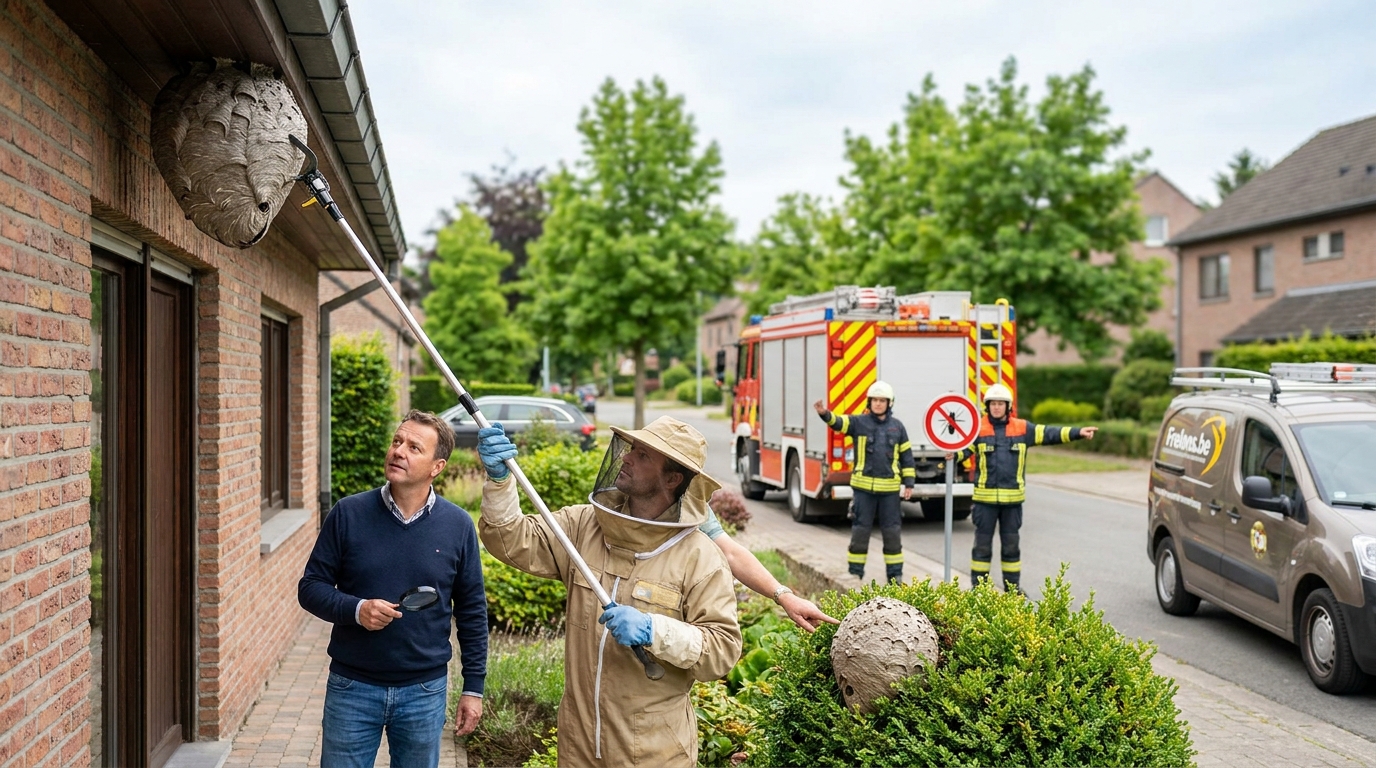
The emergency services district covering Wezembeek-Oppem has refocused its operations on life-threatening emergencies: fires, accidents, and rescues. A wasp nest—unless there is a proven immediate danger (such as a trapped person with an allergy)—is no longer a priority for them. The Wezembeek-Oppem firefighters may still respond in exceptional situations, but for a typical nest in a yard or under a gutter, you will now be referred to a private company. This is the case in almost all of the Brussels suburbs.
Why the change? The number of «wasp» calls skyrocketed every summer. Dispatching a truck and a crew to remove a nest ties up resources that could be saving lives elsewhere. So the authorities made a decision. It makes sense, even if it leaves quite a few people in a bind during the month of August.
So, you find yourself having to find a professional. And that’s when the big question comes up: the price. The cost of removing a wasp nest depends on several factors: the height (a nest at ground level versus one under a third-floor ledge is a very different job), accessibility, the type of insect, and the urgency. Generally, expect to pay between 80 and 150 euros for a standard service call in Wezembeek-Oppem. For a high-up Asian hornet nest that requires a telescopic pole and extra precautions, the cost can go up.
Be wary of prices that seem too good to be true and are prominently displayed on some websites: there are often hidden travel fees or an «emergency» surcharge that pops up at checkout. With us, we clearly state the price before we arrive. You call us, we’ll ask you two or three questions about the nest’s location and size, and we’ll give you a fair price range. No surprises on the bill.
And since we’re on the subject of money: trying to destroy the nest yourself with an insecticide bought at a supermarket rarely saves you money. Most of the time, the nest isn’t completely eliminated, the insects come back, and you end up calling us a few days later anyway. You might as well do it right the first time.
A Guide to Identifying Wasp and Asian Hornet Nests in Your Garden
Not all flying, stinging insects are the same. Before you panic, take two minutes to observe. Knowing how to identify a wasp or hornet nest makes all the difference in how you proceed.
Let’s start with common wasps. Their nests look like gray papier-mâché, shaped like a ball or a pear, and are often hidden in the attic, behind a shutter, in a hole in the wall, or under a wooden deck. They are yellow and black, fairly slender, and become aggressive in late summer when the colony is at its peak. A question I’m often asked: Do we really need to kill them? In theory, wasps play a useful role; they help control other insects. If the nest is far from any foot traffic, you can leave it alone until winter, when it will naturally empty out. But if it’s right by your door or in the kids’ bedroom, the risk of getting stung is real—and in that case, you shouldn’t wait.
The real hot topic right now is the Asian hornet in Wezembeek-Oppem. The Vespa velutina has become firmly established in our regions and is spreading rapidly. It can be recognized by its dark, almost black body, with a single broad orange band on the abdomen and yellow tips on its legs. It is smaller than the European hornet, but far more problematic. Why is it such a cause for concern? Because it is currently the most feared species: it ravages bee hives, and its secondary nest can grow to the size of a basketball, perched high in a tree, sometimes as high as ten meters above the ground.
Which wasps and hornets actually sting? The workers of both species do, and the Asian hornet defends its nest with fierce aggression as soon as anyone comes within five meters. A single sting hurts but is generally harmless for most people. The danger lies in a swarm attack or an allergic reaction in susceptible individuals. Never shake a nest just to «see what’s inside,» and under no circumstances climb a ladder to inspect it up close.
How can you tell the difference safely? Watch the insects’ path from a distance. If they’re flying in and out of a specific spot on a wall or in a cavity, it’s probably a wasp nest on the ground or buried. If they’re swarming toward a large cluster high up in a tree or against a building’s exterior, it’s likely a hornet’s nest. If you’re unsure, take a photo from a distance using your phone’s zoom and send it to us. We’ll identify the species in seconds and prepare the right equipment before we even head out.
How a Professional and Safe Nest Removal Service Works
Many people imagine that we just show up with a spray can and spray everything. If only it were that simple. A proper pest control treatment in Wezembeek-Oppem follows a specific protocol, designed for your safety and to ensure the nest doesn’t return.
It all starts with your call. We note down the address, the suspected type of nest, its height, and its location. For an emergency involving a wasp nest near a living area, we try to come out the same day or the next day. Rapid response in the 1970 area is our specialty: we know the streets, we know where to park, and we don’t waste any time.
When he arrives on site, our technician is equipped with full-body sting-proof coveralls—not just a Sunday gardening jacket. He first identifies the entry and exit points, assesses the colony’s activity, and decides on his approach. For an accessible nest, we inject a professional-grade insecticide directly inside, where the queen lives. That’s what makes all the difference: neutralizing the heart of the colony. If we just kill the workers on the surface, the queen continues to lay eggs and the whole thing starts over.
For Asian hornets nesting high up, we use a telescopic pole that injects the treatment all the way to the top of the tree, without having to climb. Removing a hornet nest requires greater precision, as these insects attack in large numbers. We often work late in the day or early in the morning, when the colony is less active and most of the hornets have returned to the nest.
Once the product has been applied, do not remove the nest immediately. Let it take effect: the insects that return over the next few hours will carry the insecticide back into the nest, causing the colony to collapse. When possible and advisable, remove the empty nest afterward to prevent it from attracting other colonies the following year. For a nest located high up with no residual danger, it is sometimes left to disintegrate naturally—it depends on the specific situation.
Pest control in Wezembeek-Oppem isn’t just a summer issue. The Asian hornet builds its first nests as early as spring, and that’s precisely when you have the best chance of stopping a colony before it grows out of control. That’s why we’re available year-round, not just during the warmer months. A small nest destroyed in May means a disaster averted in September.
Conclusion
A nest on your house isn’t inevitable, and it’s not up to you to risk your life on a ladder either. The fire department doesn’t come out anymore, sure, but you have a local, fast alternative that knows what it’s doing. Whether it’s a simple wasp colony under the gutter or an Asian hornet nest at the top of the linden tree, we’ll take care of it properly—from assessment to nest removal.
Are you in Wezembeek-Oppem or elsewhere in the 1970 area code and have you spotted something buzzing a little too close? Give us a call, send us a photo, and we’ll tell you right away what to do. Better to call us today than get stung tomorrow.
Frequently asked questions
Why don't firefighters destroy wasp nests in Wezembeek-Oppem anymore?
Since the reform of emergency response zones, firefighters in the Brussels suburbs and the 1970 ZIP code area have refocused their response efforts on life-threatening emergencies (fires, accidents). Unless there is an immediate and proven danger to a person (such as a severe allergic reaction), they no longer respond to typical wasp nests and systematically refer residents to private pest control experts.
How much does it cost to remove a wasp nest in the 1970?
The cost of a service call in Wezembeek-Oppem generally ranges from €80 to €150 for a standard, accessible wasp nest. This price depends on the height of the nest (on the ground, under a ledge, or at the top of a tree), its complexity, and the equipment required (such as a telescopic pole for hornets). At Frelons.be, we provide a transparent price quote as soon as you call, with no hidden fees.
Is it necessary to destroy a wasp or hornet nest?
Not always. Wasps play a useful ecological role by controlling other insects. If the nest is located at the far end of the yard, away from walkways and the house, you can leave it until winter, when it will empty naturally. However, if the nest is near a living area (patio, roof, children’s bedroom) or if it belongs to an Asian hornet, removing it is strongly recommended for safety and biodiversity reasons.
How can you identify an Asian hornet in Wezembeek-Oppem?
The Asian hornet (Vespa velutina) is distinguished by its very dark (almost black) body, a single broad orange band on its abdomen, and the bright yellow tips of its legs. It is slightly smaller than the European hornet. Its secondary nests, often perched high in trees, can grow enormous (the size of a basketball) and pose a real threat to local bees.
How long does it take you to respond to a wasp emergency in Wezembeek-Oppem?
With our in-depth knowledge of the town of Wezembeek-Oppem and the surrounding area dating back to the 1970s, our team makes responsiveness its top priority. If a wasp or hornet nest is threatening your living space, we typically respond the same day or within 24 hours of your call.
Can I use a store-bought spray to remove the nest myself?
This is strongly discouraged. Wide-area sprays do not treat the nest thoroughly and rarely reach the queen. Furthermore, attempting to treat a nest without professional protective gear triggers aggression from the worker bees, which greatly increases the risk of being stung by a swarm. Hiring a professional guarantees complete, safe, and permanent eradication.
 French
  English
  Dutch
Dutch
0 Comments