
Wasp Nest in Kraainem: Your Guide to Quick Removal
Contents
-
Everything You Need to Know About Asian Wasp and Hornet Nests in Kraainem
-
Choosing Between the Fire Department and a Private Pest Control Company in Kraainem
You live in Kraainem; your ZIP code starts with 1950; and now, in the middle of summer, you notice some suspicious activity under the eaves or in the hedge. Your heart skips a beat. Is it a regular wasp nest? An Asian hornet? And most importantly: who should you call, how much will it cost, and is it dangerous for the kids playing in the yard?
Things to remember
-
An ultra-local focus on Kraainem (1950) combining on-the-ground expertise on the Asian hornet with a practical guide to choosing between the fire department and private professionals, while providing reassurance regarding safety and cost
-
Everything You Need to Know About Asian Wasp and Hornet Nests in Kraainem
-
Choosing Between the Fire Department and a Private Pest Control Company in Kraainem
-
How a Professional Pest Control Service Works
We get these kinds of calls all year round, even in winter for dormant nests or spring inspections. The Asian hornet, on the other hand, doesn’t take a break and continues to spread throughout Flemish Brabant. But there’s no need to panic. In this article, I’ll explain how to identify what you have on your property, how to decide between calling the fire department and hiring a private professional, and what an actual intervention entails. Practical advice, local insights, and real statistics.
Everything You Need to Know About Asian Wasp and Hornet Nests in Kraainem
The first thing to understand: not all the bugs buzzing around your patio are the same. You’re familiar with the common wasp. Yellow and black, drawn to your soda can and fruit tart, it becomes aggressive in late summer when the colony is at its peak. Its nest looks like gray papier-mâché, often hidden under a roof, in an attic, or in a hole in the wall.
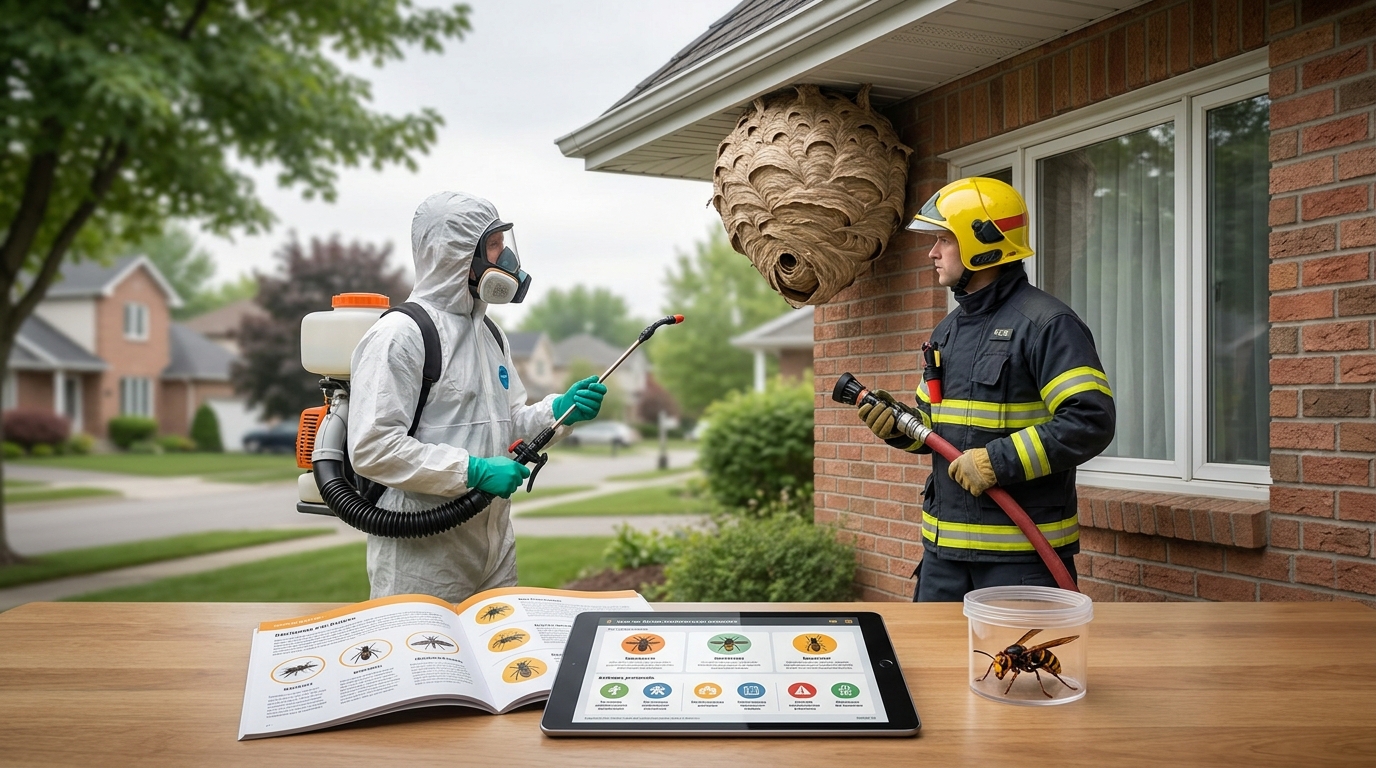
The Asian hornet in Kraainem is a different story. It’s larger, with a dark body, yellow tips on its legs, and an orange band on its abdomen. Its nest can grow as large as a basketball and is often found high up in a tree or sometimes under a shelter. The real problem with this species isn’t so much the sting (even though it hurts), but what it does to our bees. A single nest destroys thousands of bees per season. It’s a disaster for local apiaries and the entire ecological balance of the area.
People often ask me: Why are there so many wasps right now? The answer lies mainly in the mild winters and early springs we’ve been experiencing in recent years. The queens survive better, the colonies get off to an earlier start, and they grow larger. As a result, there are more wasps in Belgium, and the Asian hornet is creeping a little closer to our gardens every year.
How can you identify a wasp nest without putting yourself at risk? Observe it from a distance, without ever getting closer than a few meters. Watch where the wasps are going: they always enter and exit through the same spot. If you see a lot of activity in the morning and late in the day, you’ve found the nest. And by the way, among the other insects in the Kraainem area, you might come across mason wasps (yes, they can sting, but they’re not very aggressive and are solitary) or digger wasps, which paralyze bees to feed their larvae. These species generally pose no problem. It’s really the Asian hornet and large colonies of common wasps that warrant intervention.
My advice: Never try to block an exit hole or spray the nest yourself. You risk triggering a massive attack. Identify the nest, keep your distance, and call for help.
Choosing Between the Fire Department and a Private Pest Control Company in Kraainem
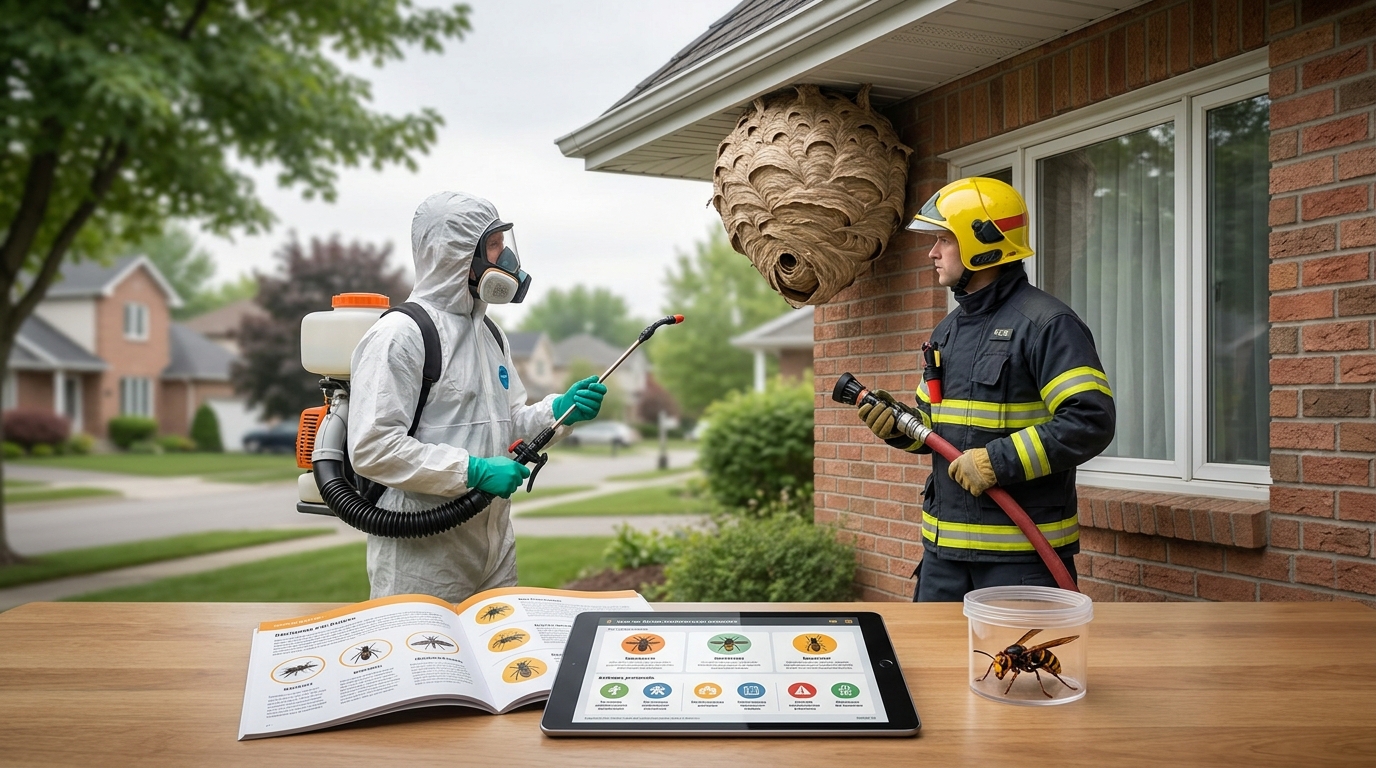
This is THE question that comes up with every call. Should you call the Kraainem fire department for a wasp nest, or go directly to a professional exterminator? Both options are available, and they’re not suitable for the same situations.
Firefighters still respond occasionally, but their guidelines have changed. Today, in many areas of Flemish Brabant, they only respond if there is a genuine danger: a nest at the entrance to a school, a person with allergies, or blocked public access. For a typical nest at the back of the yard, you’ll often be referred to a private service. And even when they do respond, it’s no longer automatically free. You may be asked to pay a flat fee, and wait times can be long during peak season, when calls are flooding in from all over.
A professional exterminator, on the other hand, can get there quickly—often the same day or the next. They have the right equipment, approved products, and the necessary insurance. This is especially essential when dealing with Asian hornets, as their removal requires precise techniques and proper protective gear.
Let's talk about money, because that's what everyone wants to know. The cost of removing a wasp nest depends on several factors: the location (a nest under a roof 8 meters up costs more than an accessible nest), the type of insect, and the urgency. In general, expect to pay between 80 and 150 euros for a standard, accessible wasp nest. The price for removing an Asian hornet nest is a bit higher, often between 120 and 200 euros, due to the height and the time required for the job. Be wary of rates that seem too low when quoted over the phone: they almost always hide travel or height-related fees that are added at the end.
My firm advice? For a wasp problem in Kraainem that isn’t an emergency, call a professional right away. You’ll save time and be guaranteed a successful outcome. Save the Kraainem fire department for cases of immediate danger—that’s their real job. And always ask for a clear price quote before the service, including the call-out fee. A reputable professional will give you a straight answer.
How a Professional Pest Control Service Works
You called, and the appointment is set. So what actually happens when the technician arrives? Many people imagine a big, noisy operation. The reality is much quicker and far more discreet than that.
It all starts with an inspection. The professional locates the nest, identifies the species, assesses the size of the colony, and determines the best approach. This step is crucial: it determines the method and ensures the safety of the operation, both for the professional and for your family. The professional will also ask you to go inside, close the windows, and keep children and pets away during the operation.
Next comes the treatment. To eliminate a wasp nest, an insecticide—in powder or liquid form—is injected directly into the nest, where the worker wasps move about. The wasps carry the insecticide back to the center of the nest, which neutralizes the entire colony, including the queen, within a few hours. The technician wears a full-body suit and uses a telescopic pole for nests located at height. No unnecessary risks are taken.
When it comes to eliminating Asian hornets, the technique is more sophisticated. Since the nest is often perched very high up in a tree, we use long poles—sometimes up to 15 meters—and apply the treatment from a distance. In some cases, the nest is physically removed after treatment to prevent another colony from reusing it. This is what sets professional treatment apart from DIY methods, and it’s also why I strongly advise against attempting this on your own.
One thing people often forget: what to do next? Once the nest has been treated, don’t take it down right away if the professional told you to wait. A few stray wasps may return for a day or two—this is normal; they no longer have a colony and will eventually die. The professional will give you specific instructions based on the situation.
Pest control in Flemish Brabant is carried out year-round. In the summer for active nests, in the fall for late-season colonies, and even in the spring to track down hornet nests before they grow too large. The sooner you treat a hornet’s nest, the simpler, faster, and more cost-effective it is. Never let a situation drag on, hoping it will go away on its own. It never goes away on its own.
Conclusion
A wasp or hornet nest in Kraainem can be dealt with quickly if you go about it the right way. Identify the insect from a distance, don’t touch anything, and contact the right people: the fire department for immediate danger, a professional for everything else—and for anything related to the Asian hornet. Since 1950, the environment in this ZIP code has changed, and the Asian hornet is now part of the landscape. All the more reason to stay vigilant and ready to act.
Have you spotted a nest on your property, or do you have any doubts about the species? Contact us. We respond quickly throughout Flemish Brabant, with a price clearly stated in advance and a team equipped to handle both common wasps and Asian hornets. Your garden should remain a place where the whole family can relax and breathe easy.
Frequently asked questions
Who should I call about a wasp nest in Kraainem (1950)?
If there is a nest on your property in Kraainem, it is recommended that you hire a professional private pest control technician. The local fire department generally only responds if there is an immediate and life-threatening danger (such as a blocked public road, a school, or someone with allergies nearby). For a quick and guaranteed response, a private pest control professional remains the most effective solution.
How much does it cost to remove a wasp or hornet nest in Kraainem?
On average, the cost of removing a standard, accessible wasp nest in Kraainem ranges from €80 to €150. If it’s an Asian hornet nest, the price generally ranges from €120 to €200 due to the height of the nest (often perched in trees) and the complexity of the equipment required. Tip: Always ask for a transparent flat rate that includes travel expenses.
How can you tell the difference between an Asian hornet and a common wasp?
The distinction is primarily visual:
The common wasp: It is smaller, bright yellow and black, and takes a keen interest in your food.
The Asian hornet: Larger in size, it has a mostly dark (black/brown) body, light yellow tips on its legs, and a single orange stripe on its abdomen. Its nest, often located high up, resembles a large sphere about the size of a basketball.
Is it possible to remove a wasp or hornet nest on your own?
No, this is strongly discouraged. Attempting to seal the entrance to a nest or using a wide-area spray can trigger a massive and aggressive attack by the colony. In the case of the Asian hornet, the danger is even greater. Only a certified technician has the full protective suit and long-range injection equipment (telescopic pole) necessary to operate safely.
How long does it take for a nest to be completely destroyed after the removal?
This professional-grade insecticide takes effect extremely quickly. The colony and its queen are usually eliminated within a few hours. However, it is normal to see a few stray wasps lingering around the former entry point for 24 to 48 hours: deprived of their nest, they will eventually disappear on their own.
 French
  English
  Dutch
Dutch
0 Comments