
Wasp and Hornet Nest Removal Service in Beersel
Contents
A wasp nest under the eaves, a swarm of insects near the patio—and suddenly the garden becomes unusable. In Beersel, this scenario plays out every summer, and it’s more common than you might think. Between the wooded areas of Alsemberg, the orchards of Huizingen, and the old buildings of Lot, pests find the perfect place to settle here.
Things to remember
-
This article takes a hyperlocal approach by detailing the specific characteristics of the initiatives in the neighborhoods of Beersel (Alsemberg, Lot, Huizingen)
-
He combines technical expertise on the Asian hornet with business acumen, while educating residents on the specific risks associated with the local topography (wooded areas vs. older homes).
-
Identifying a wasp or Asian hornet nest in Beersel
-
How a Professional Pest Control Service Works
The problem is that people often mistake a simple wasp for something much more serious. The Asian hornet, for example, has been around here for a few years now, and it shows no mercy to bees or the peace and quiet of the neighborhood. Knowing how to identify what you’re dealing with is already half the battle.
At Frelons.be, we provide services year-round in the municipality—not just when it’s hot. Here’s what you need to know to identify the problem, take action, and, most importantly, prevent it from happening again next year.
Identifying a wasp or Asian hornet nest in Beersel
The first question everyone asks is: Is it a wasp or a hornet? The distinction really matters, because the level of danger is not the same. A wasp in Beersel is about 1.5 cm long, bright yellow with black stripes, and its nest looks like gray papier-mâché. It’s often found under roofs, in attics, or behind the shutters of older houses in the town center.
The Asian hornet, on the other hand, is in a league of its own. It is darker, almost black, with a single orange stripe on its abdomen and yellow tips on its legs. Its nest can grow to the size of a basketball, or even larger. It is often found high up in the trees of Alsemberg’s wooded areas, but also under roof overhangs or in thick hedges. The Asian hornet in Beersel is no longer a rarity; it’s a reality we have to deal with every season.
How can you tell if you have a real problem? Watch for them coming and going. If you see a steady stream of insects entering and exiting at the same spot, there’s an active nest nearby. Activity is heaviest early in the morning and late in the day, so that’s the best time to locate the entrance without getting too close.
People often ask me which wasp is the most worrisome. Honestly, it’s not so much the common wasp as the Asian hornet, because of the threat it poses to beehives: a single nest can wipe out entire bee colonies. And for those wondering about the large burrowing wasp that paralyzes bees, we’re talking about the Philanthe—an impressive insect that attacks bees, not you. There are also solitary wasps that almost never sting, such as certain mason wasps: they’re harmless to humans.
You should never try to identify insects by climbing a ladder or tapping on the nest. A wasp in Beersel will defend its colony without hesitation, and a hornet’s nest will react within seconds. If you’re unsure, take a photo from a distance and send it to us. We’ll let you know right away what you’re dealing with and whether intervention is necessary.
How a Professional Pest Control Service Works
«How much does it cost, and when will you come?» That’s the real question, and we’ll answer it clearly. Removing a wasp nest in Beersel isn’t something you can wing, but it almost always follows the same clean and quick procedure.
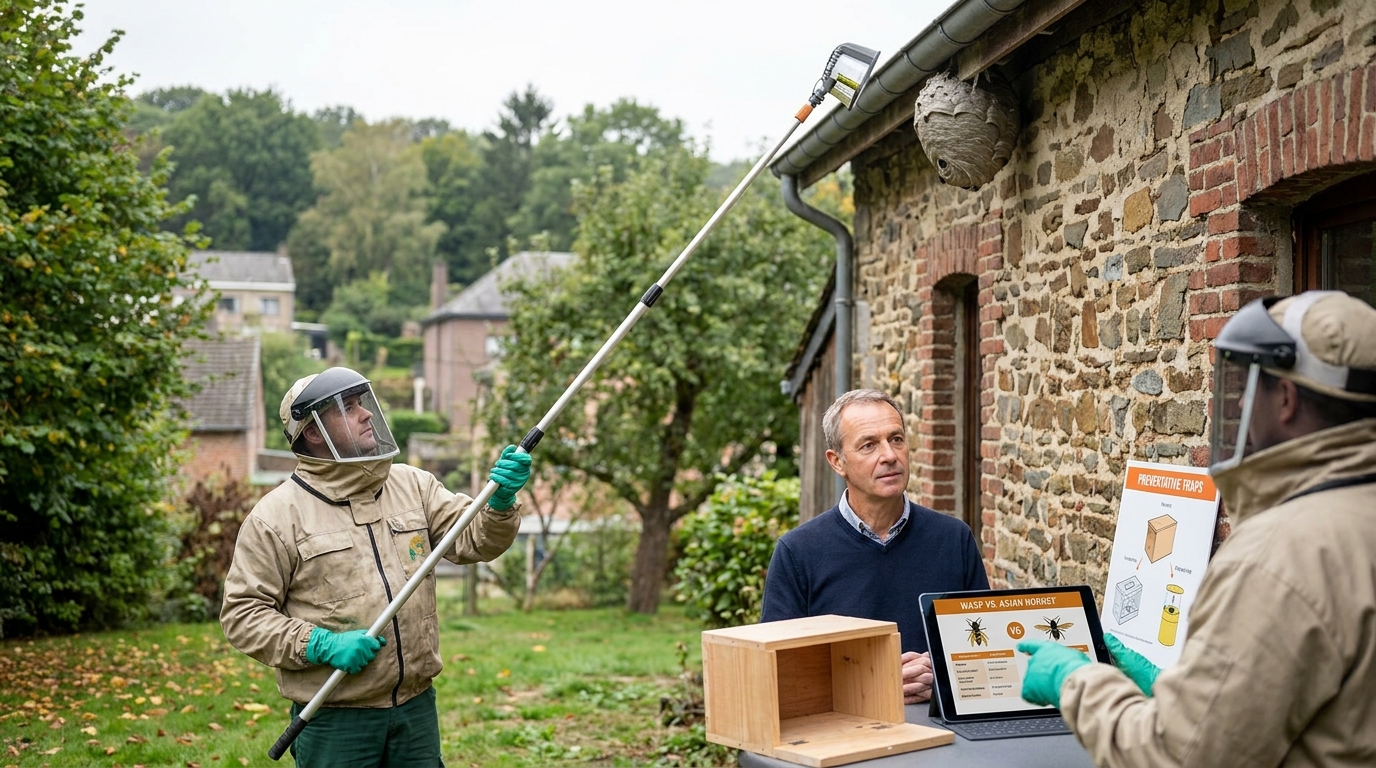
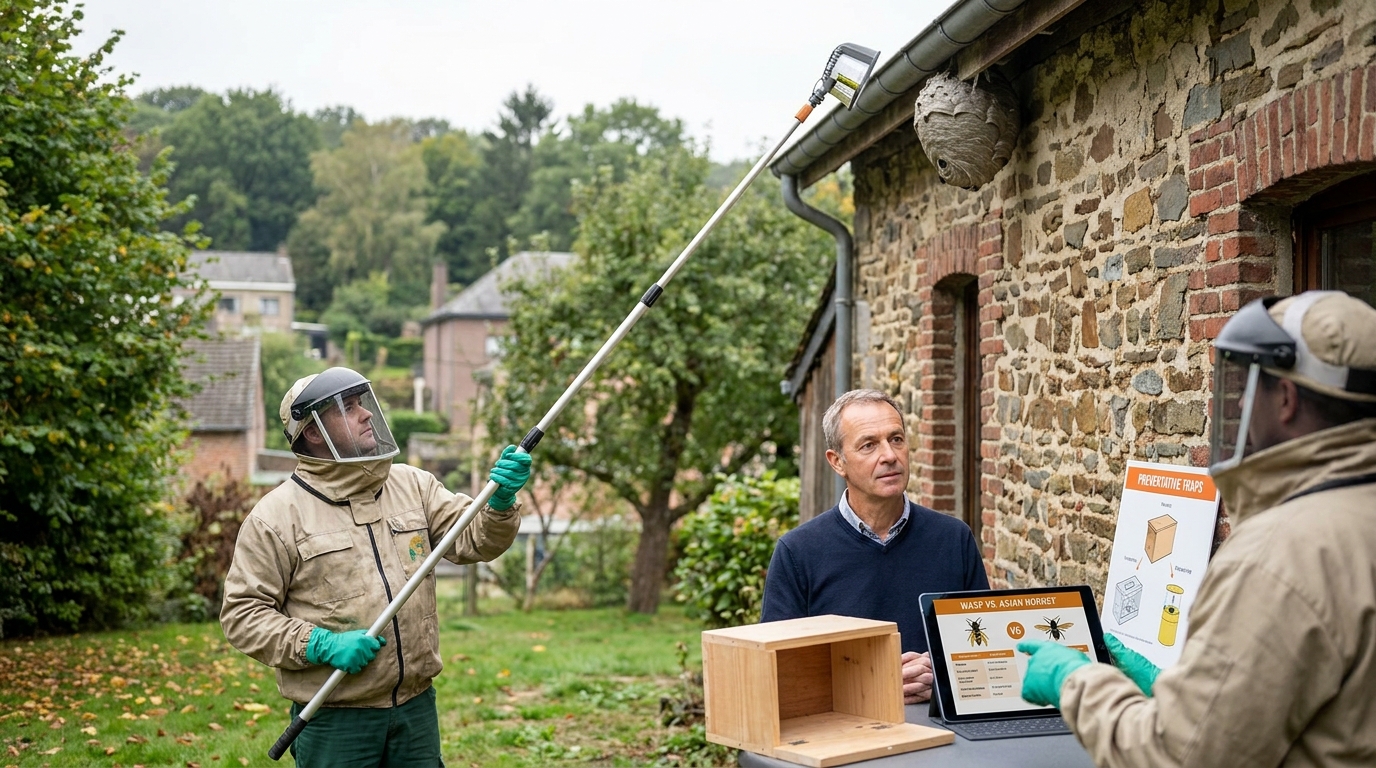
When you call, we start by pinpointing the exact location of the nest with you. Height, access, and type of insect: these three factors determine the method we’ll use. A wasp nest that’s accessible under a ledge takes about twenty minutes to remove. An Asian hornet nest ten meters up in an oak tree in Alsemberg is a different story—we’ll bring out the telescopic pole and the appropriate equipment.
The pest control technician in Beersel arrives equipped with a full-body sting-proof suit, because safety comes first. We treat the nest with a targeted product that takes effect within a few hours, then physically remove the nest when possible. For wasps, we often neutralize them by injecting the treatment directly into the entrance. For hornets, we make sure the entire colony is eliminated, because an improperly treated nest will reform.
As for response times: during peak season, we aim to respond within 24 hours, and we handle true wasp emergencies (known allergies, nests near a child’s bedroom, schools) on the same day. The safety of your yard and home can’t wait.
When it comes to the cost of removing a nest, let’s be honest: it depends on accessibility and height. A wasp nest that’s easy to access remains affordable. A hornet’s nest high up requires more equipment and time, so the price goes up a bit. What we guarantee is a price quoted before the job, with no surprises once we’re on site. No vague estimates, no hidden fees.
Another question that often comes up is: Why shouldn’t you kill wasps yourself? Because store-bought sprays just agitate the colony without destroying it, and you risk getting stung multiple times. A wasp under threat releases pheromones that signal others to attack. It’s better to let a professional handle it with the right product and proper protective gear.
Year-Round Pest Prevention Guide for Beersel
Destroying a nest solves the problem for the day. Preventing it from coming back is better. And there are a few simple steps we can take that make a real difference in our neighborhoods.
In the spring, it’s the founding queens who are looking for a place to start their colony. This is the key moment. Check your attics, garden sheds, eaves, and sheltered nooks and crannies. A small nest the size of a golf ball in April will become a huge nest by August. Spotting it early reduces the cost and danger tenfold.
For everyday wasp prevention: seal cracks in the exterior walls of older homes, install fine-mesh screens over ventilation openings, and empty your outdoor trash cans regularly. Sugar and protein attract wasps. One forgotten soda can on Lot’s patio table, and suddenly you’ve got ten unwelcome visitors.
In Huizingen, given the proximity of the provincial estate and its trees, the risk of Asian hornets is very real. Trapping queens in early spring helps limit the formation of new colonies in the area. In Alsemberg, wooded areas and gardens with trees in particular require extra vigilance: a hornet’s nest can remain hidden until the leaves fall in the fall.
Here are a few useful tips to keep in mind:
-
Check your trees and hedges several times each season, especially at the top
-
Don't let fallen fruit rot on the ground—it attracts insects.
-
Keep your windows fitted with screens if you live near a wooded area
-
Report any suspicious nest as soon as you spot it, without waiting for it to grow larger
At Frelons.be, we don’t just work in the summer. We combat the Asian hornet specifically during the off-season by locating and neutralizing nests before they release their new queens. It’s this year-round work that provides lasting protection for bees and your peace of mind. Do you suspect there might be a nest in Alsemberg, Lot, or Huizingen? It’s better to make a call just to be safe than to end up with a giant nest in September.
Conclusion
A wasp in Beersel can be dealt with quickly and without drama if you go about it the right way. An Asian hornet, on the other hand, requires the expertise and equipment of a professional. In either case, don’t wait until the situation becomes dangerous before taking action. The larger a nest gets, the more expensive it is to remove—and the greater the danger to your family.
Have you spotted something in your home, in your yard, or in your attic? Contact Frelons.be. We’ll identify the problem, respond quickly, and give you a price quote before we start. Whether you’re in Alsemberg, Lot, Huizingen, or elsewhere in the municipality, we’ll take care of everything, all year round.
Frequently asked questions
How can you tell the difference between a wasp nest and an Asian hornet nest in Beersel?
The wasp nest, made of gray papier-mâché, is often hidden in attics, shutters, or eaves of homes in downtown Beersel or Lot. In contrast, the Asian giant hornet’s nest is spherical, can grow as large as a basketball, and is usually built high up in trees in wooded areas such as Alsemberg or Huizingen.
How much does it cost to have a wasp or hornet nest removed in Beersel?
The cost of professional pest control depends mainly on the height of the nest and how difficult it is to access. A standard wasp nest under a roof is very affordable, while an Asian hornet nest requiring a long telescopic pole incurs a slightly higher cost, which is always quoted before the service is performed.
Why should you avoid destroying a wasp nest yourself?
Using a commercial insecticide spray is dangerous because it does not eliminate the entire colony and is harmful to the insects. When feeling threatened, a wasp or hornet releases an alarm pheromone that prompts the entire nest to attack as a group, posing a major risk of multiple stings.
When should you have your home in Beersel inspected to prevent nests?
The ideal time is in early spring, when queen bees emerge from hibernation to start a new colony. Checking your garden sheds, attics, and eaves in April allows you to eliminate a nest the size of a golf ball before it grows into a giant, dangerous nest by August.
 French
  English
  Dutch
Dutch
0 Comments