

Asian Hornet Intervention in Asse: complete guide and report
Contents
Last summer, a resident of Asse discovered an Asian hornet's nest the size of a soccer, suspended under the eaves of his roof. At first, he thought it was a classic wasp nest. His reflex was wrong: he tried to hose it down. The result: three stings and a good scare. Situations like this are becoming increasingly common in Flemish Brabant, and Asse is no exception.
Things to remember
-
This article stands out for its ultra-local focus on real intervention in the commune of Asse
-
Unlike generalist sites, we detail the reporting process specific to the area and the actual costs of professional extermination.
-
Steps for reporting and identifying a nest in Asse
-
Compare options and take action.
The Asian hornet, or Vespa velutina, is taking root in Belgium. It's no longer an isolated phenomenon or one confined to the south of the country. Reports are multiplying every year, including in communes like Asse where it was not expected five years ago. If you've come across this article, it's probably because you've spotted something suspicious in your garden, your attic or a tree at the edge of your property. You've come to the right place: let's take a look at how to identify the Asian hornet, report a nest in Asse and call in a professional without breaking the bank.
At Frelons.be, we take action against the Asian hornet all year round. Not just in summer. Primary nests appear as early as spring, and the founding queens emerge from hibernation well before the warm weather arrives. In other words, vigilance never takes a vacation.
Steps for reporting and identifying a nest in Asse
Before reporting anything, you need to be sure of what you're looking at. Many people confuse the Asian hornet with the European hornet, which is quite different. The European Hornet is bigger, redder and, above all, much less aggressive towards bees. The Asian Hornet, on the other hand, has a dark, almost black body, with an orange stripe on the abdomen and highly recognizable yellow legs. That's why we often talk about the hornet's nest with yellow legs: those legs are the detail that can't be mistaken.
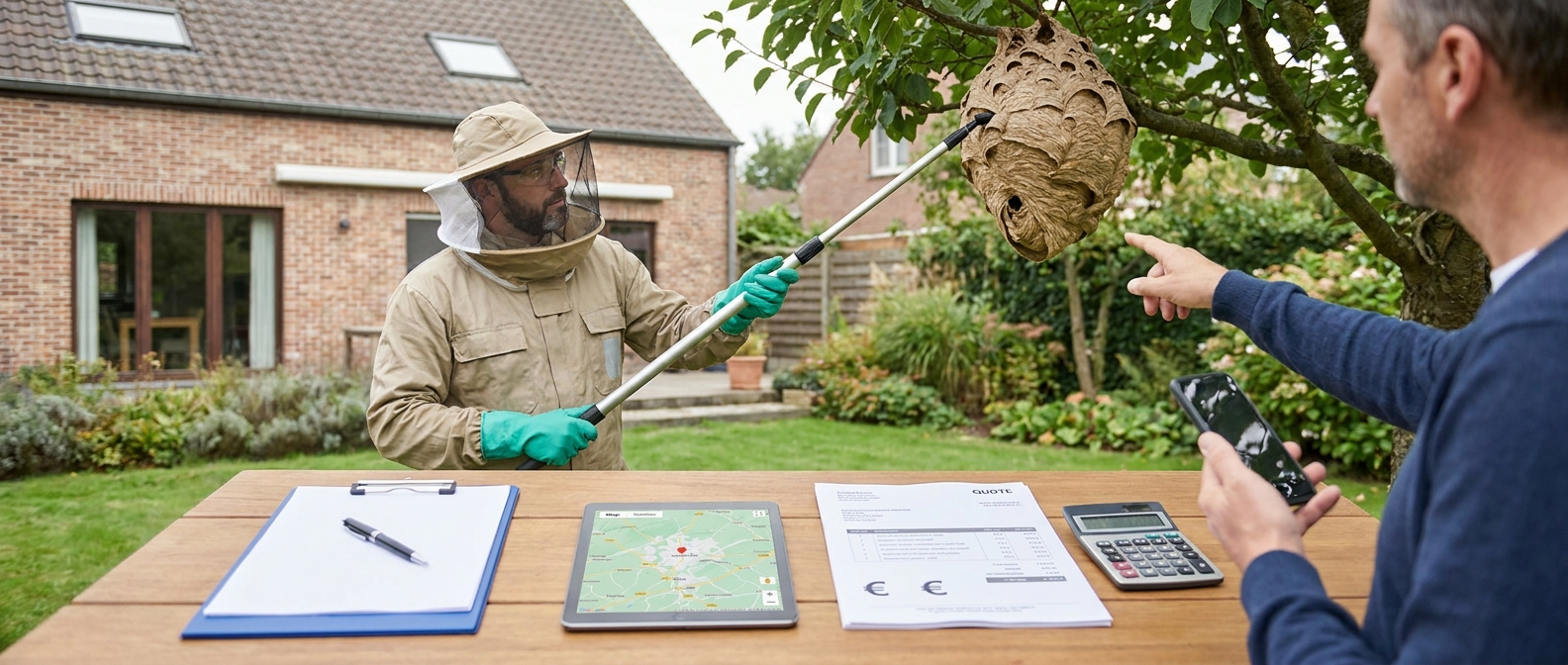
Identifying an Asian hornet in Asse often starts with observing a suspicious movement. Do you see dark insects circling around a fixed point, at the top of a tree, under a cornice, in a cedar hedge? It's a strong signal. The nest of Vespa velutina à Asse looks like a large gray ball, sometimes pear-shaped, with a small lateral opening. It can reach 80 cm in diameter by the end of the season. Impressive, and dangerous if you get too close.
What should I do if I see an Asian hornet? Above all, don't try to destroy the nest yourself. We can't stress this enough. No fire, no water jet, no stick. Asian hornets defend their nests with formidable aggression when they feel threatened, and an Asian hornet sting is painful. For allergy sufferers, it can even become a medical emergency.
To report a hornet's nest in Asse, the procedure is fairly straightforward. You can use the official platform iNaturalist or the vespawatch.be, which centralizes the observations of Vespa velutina in Belgium. A clear photo of the insect or nest is often enough for the experts to validate the identification. You can also contact your local administration in Asse directly, who will relay the information to the relevant services in Flemish Brabant.
A question we're often asked: do the fire department come to Asse for a hornet's nest? The answer has changed. Fire brigades no longer systematically respond to wasp or hornet nests. In practice, the fire department in Asse will direct you to an approved destroyer. This is the norm in Belgium today, and it makes sense: destroying an Asian hornet's nest requires specific equipment and real expertise. It's not just a question of wetsuits and insecticide.
If you're not sure what species it is, just take a photo from a distance (a smartphone zoom lens works very well) and send it to us. We'll tell you within a few hours whether it's an Asian hornet or another hymenoptera. No need to play entomologist.
Prices and rates for hornet nest destruction in Belgium
It's the question that comes up on every call: how much does it cost? The price of destroying a hornet's nest varies according to a number of factors, and there's no single rate set in stone. But we can give some realistic ranges, because nobody likes unpleasant surprises on the bill.
In Belgium, the cost of exterminating a nest of Asian hornets generally ranges between 75 and €200. Why the difference? It all depends on how accessible the nest is. A nest two meters high in a hedge is a quick job, requiring no more than an hour. A nest perched 15 meters up in a poplar tree, on the other hand, requires an aerial platform or lifting equipment, and the price of the hornet intervention rises accordingly.
Here are the main criteria that influence pricing:
-
Nest height The difference between ground and aerial installation is obvious.
-
Accessibility a nest in an attic with a narrow trap door takes longer than a nest visible from the front.
-
Nest size A primary nest in spring (as big as a tennis ball) can be treated quickly. A mature nest in September is a different story.
-
Moving Some service providers charge mileage. At Frelons.be, we cover Asse and the whole of Flemish Brabant without excessive surcharges.
Beware of low offers. A price of €40 for the destruction of a hornet's nest should give you cause for alarm. Either the service provider is using unsuitable products, or is not removing the nest after treatment (which is problematic, as an unremoved nest can attract other pests), or is simply not insured. Hornet extermination in Belgium is regulated, and a serious professional uses approved biocides, wears full protective equipment and secures the area before intervening.
Good news for Asse residents: some Flemish Brabant municipalities offer subsidized or partial reimbursement when it comes to Vespa velutina. The Asian hornet is an invasive alien species, officially recognized as such at European level. Controlling the Asian hornet is therefore considered a biodiversity issue, not just a comfort problem. Check with the Asse local authority to find out if a premium is available. It changes regularly, and can cover a significant part of the cost.
Why shouldn't you kill hornets yourself, beyond the risk of stinging? Because a poorly treated nest can disperse the colony without eliminating it. The surviving hornets rebuild elsewhere, sometimes in an even less accessible location. We've seen cases where a private individual has sprayed a nest with commercial insecticide: three weeks later, a new nest had sprung up ten meters from the first. Professional intervention guarantees that the problem is solved once and for all.
Where to get professional help and how to contact us
Finding a certified destroyer in Asse isn't as complicated as you might think, but there are a few pitfalls to avoid. Many people's first instinct is to type «Asse hornet firefighter» into Google. As we've seen, the fire department is no longer your first port of call in this type of situation. The right thing to do is to contact a specialized service directly.
At Frelons.be, we're active all over Belgium, and Asse is part of our priority intervention zone in Flemish Brabant. We don't just work from April to October. Founding queens start building primary nests as early as March, and we can still intervene on late nests in November. Fighting the Asian hornet is a year-round job.
What happens during an intervention? You contact us by telephone or via our online form. We'll ask you a few questions: where is the nest, how high up, how long ago did you spot it, do allergic people live nearby. If possible, send us a photo. We'll give you a clear estimate, with no surprises, and schedule the job as quickly as possible.
For emergency situations (nest in the immediate vicinity of a house entrance, school or crèche), we prioritize intervention. A hornet emergency in Flemish Brabant can't wait a week. In most cases, we can intervene within 24 to 48 hours.
On the day of the job, our technician arrives equipped with a full-body anti-bite suit, telescopic pole if necessary, and a biocidal product specifically adapted to the application. Vespa velutina. The treatment is applied directly to the nest. We wait for activity to cease, then remove the nest when technically possible. Everything is cleaned up, and you are given instructions for the next few days (a few «late» hornets may still hover around the site for 24 to 48 hours - this is normal).
Is it dangerous to be stung by an Asian hornet? Yes, it hurts a lot, and for around 3 % of the population who are allergic to Hymenoptera venom, it can cause anaphylactic shock. Even without an allergy, several simultaneous stings require medical attention. This is precisely why we insist: don't approach an active nest without professional protection.
One final point for residents of Asse and the surrounding area: the Frelons.be service also includes follow-up. If you've had a nest this year, we can schedule a follow-up visit the following spring to check that a new colony hasn't set up in the same place. Asian hornets tend to return to favorable areas, especially when there are apiaries or orchards nearby.
To contact us, go to hornets.be. You'll find our phone number, a quick contact form and all the information you need about our coverage area. We respond quickly, because we know that when you have a hornet's nest above your terrace, every day counts.
Conclusion
The Asian hornet in Asse is no longer a hypothesis, it's a reality. Reports are increasing, nests are multiplying, and the only effective response is rapid professional intervention. Correctly identifying the insect, reporting the nest via official channels or directly to a specialist, and calling in a certified destroyer: these are the three steps that make the difference between a managed problem and a situation that degenerates.
If you've spotted a suspicious nest in Asse or Flemish Brabant, don't leave it lying around. Contact Frelons.be today. That's what we're here for, summer and winter alike.
Frequently asked questions
How can you tell an Asian Hornet from a European Hornet?
The Asian hornet (Vespa velutina) is darker than its European cousin. It has an almost black body, an abdomen with a single orange stripe at the tip, and characteristic yellow legs. It is also slightly smaller and much more aggressive towards bees.
How do I report an Asian hornet nest in Asse?
To report a nest in Asse, use the official vespawatch.be or iNaturalist platform, and attach a photo for validation. You can also notify the Asse local authority, which will pass on the information to the relevant services in Flemish Brabant.
Do Asse firefighters destroy hornet nests?
No, no longer systematically. Emergency services and fire departments in Asse no longer deal with pest nests except in cases of immediate and vital danger. They will direct you to an approved and professional destroyer like Frelons.be, equipped with the specific equipment for this invasive species.
How much does it cost to destroy a hornet's nest in Belgium?
In Belgium, the cost of exterminating a hornet's nest generally varies between €75 and €200. The price depends mainly on the height of the nest (requiring a cherry picker or large pole), its accessibility (attic, hedge, treetop) and its size.
Is there a bonus or refund in Asse for eradicating a nest?
Yes, as the Asian hornet is classified as an invasive alien species in Europe, some communes in Flemish Brabant offer subsidies or partial reimbursements for professional intervention. Contact the commune of Asse to find out about the current terms and conditions of this biodiversity bonus.
Is the Yellow-legged Hornet's sting dangerous?
The sting is very painful, but no more deadly than that of a wasp for a non-allergic person. On the other hand, it becomes very dangerous (anaphylactic shock) for the 3 % of the population allergic to hymenoptera venom, or in the event of multiple stings. If in doubt, consult a doctor immediately.
Can I destroy a hornet's nest myself using insecticide?
This is highly inadvisable and dangerous. Using a water jet or commercial insecticide will stress the colony, provoking a highly aggressive group attack. What's more, a poorly treated nest causes the surviving hornets to flee and rebuild a new nest a few meters away.
 French
  English
  Dutch
Dutch
0 Comments