
Asian hornet in Dilbeek: Complete guide to intervention and reporting
Contents
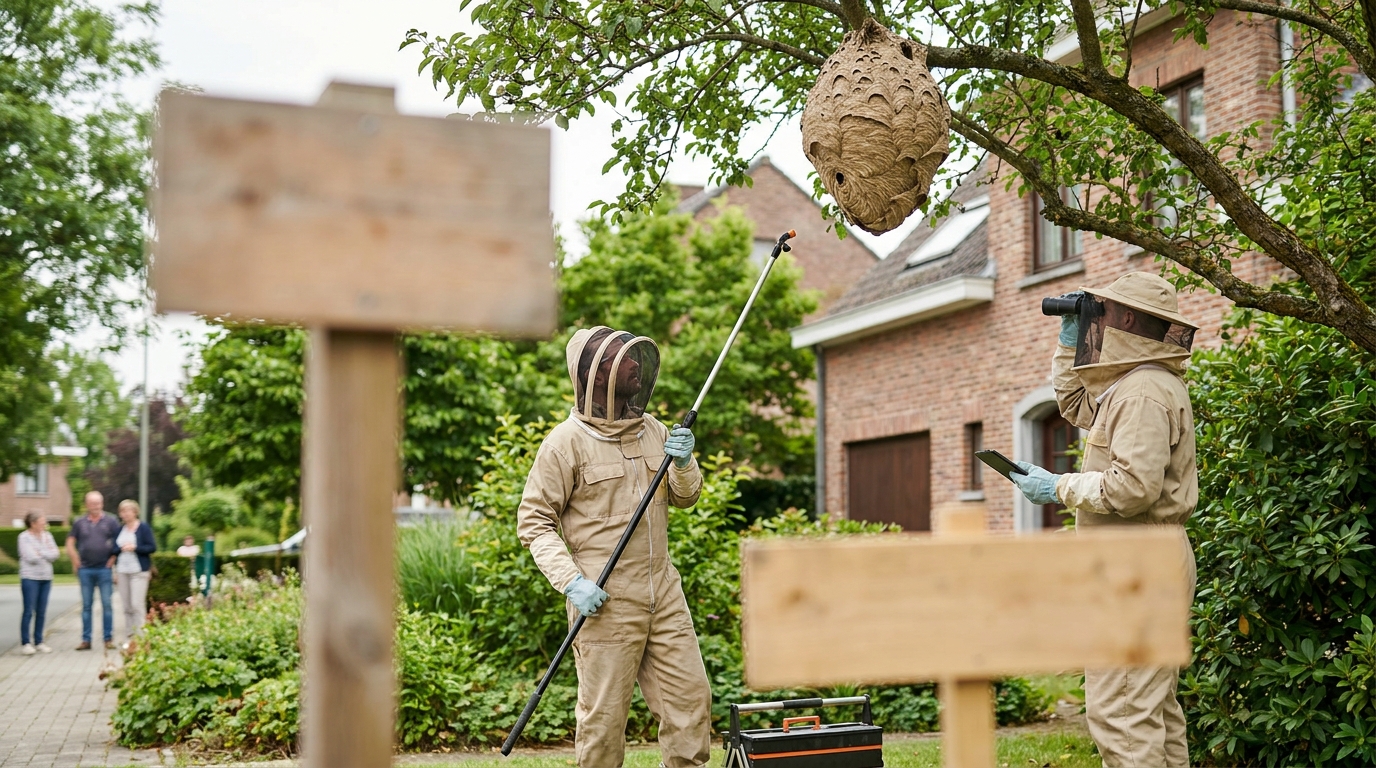
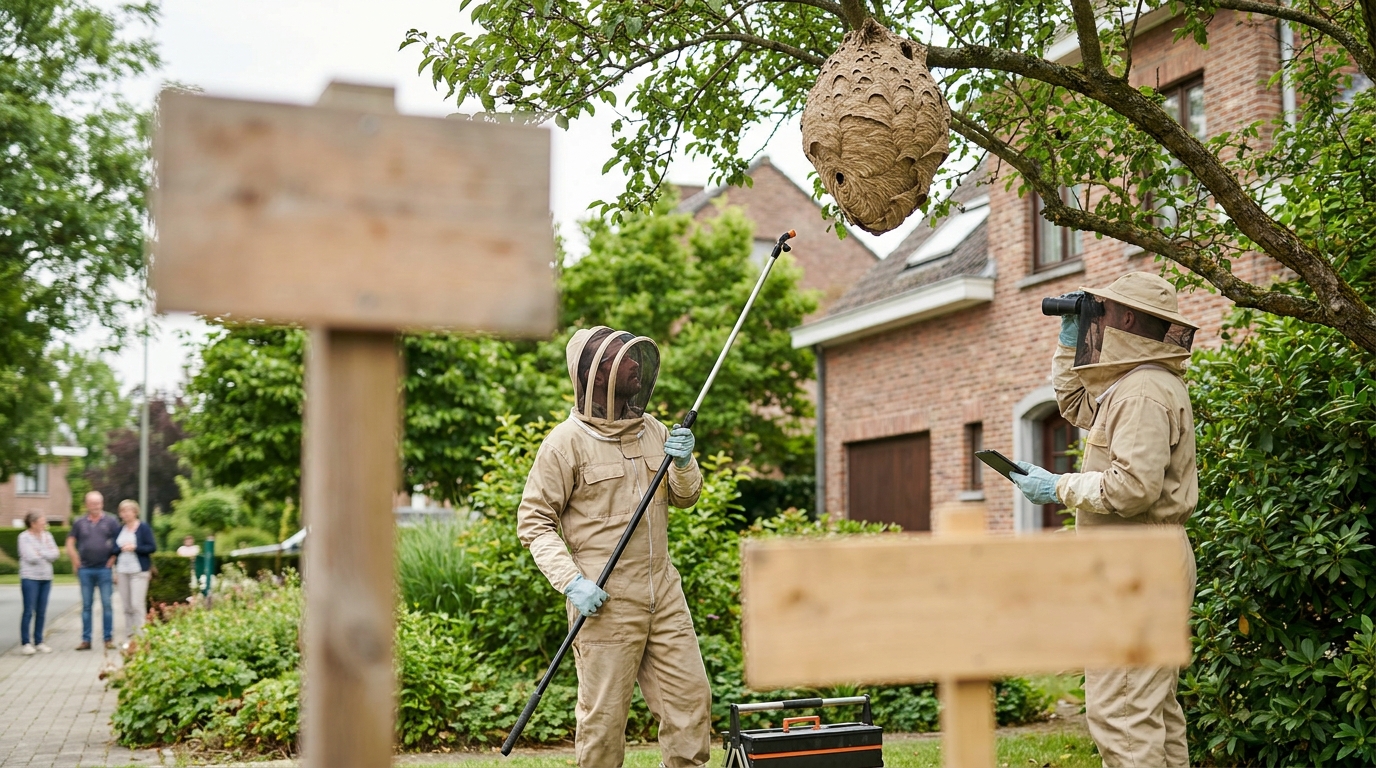
Last summer, a resident of the Ninoofsesteenweg in Dilbeek spotted a suspicious coming and going under the overhang of his roof. Dark insects, larger than normal wasps, were swarming in and out. At first, he thought it was a wasp swarm. When our team arrived on the scene, the Asian hornet's nest was already the size of a basketball. Another two weeks and it would have doubled in size.
Things to remember
-
A pedagogical article with ultra-local roots, reporting on a typical intervention in Dilbeek
-
Unlike cold directories, we immerse the reader in the reality of the field in the heart of the commune to explain the identification, the danger and the professional destruction process.
-
Identifying and reporting the Asian hornet in Dilbeek
-
Procedure for a nest destruction operation in Dilbeek
This kind of situation is becoming increasingly common in Dilbeek and throughout Flemish Brabant. The Asian hornet, or Vespa velutina, has become firmly established in Belgium in recent years. And suburban communities like Dilbeek, with their tree-lined gardens, orchards and proximity to Brussels, are particularly exposed areas. If you live in 1700 or 1701 and have any doubts about a nest, this article explains exactly what to do, step by step.
At Frelons.be, we take action against the Asian hornet all year round. Not just in summer. Not just when it's «urgent». We know the terrain, we know Dilbeek, and we'll show you how it's done.
Identifying and reporting the Asian hornet in Dilbeek
Before you panic, you need to know what you're looking at. Not all large, buzzing insects are Asian hornets. In Dilbeek, we also come across the European hornet (bigger, redder and generally less aggressive) and, of course, common wasps. Confusion is common, and it's normal.
Visit Vespa velutina is quite easy to recognize once you know what to look for. Its body is predominantly black, with a single, clearly visible orange abdominal segment. Its legs are yellow at the tips, earning it the nickname «Yellow-legged Hornet». Workers are around 2.5 to 3 cm in size. The queen can reach 3.5 cm. Compared to the European Hornet, it is smaller and considerably darker.
Where can you find them in Dilbeek? Everywhere, frankly. We've dealt with nests in hedges in Groot-Bijgaarden, under roofs in Itterbeek, in tall trees along the canal. The Asian hornet in the 1700 is no longer an exception: it has become a recurring reality. Primary nests (in spring, often small, in low shelters) are easily overlooked. It's when the colony migrates to a secondary nest high up, sometimes 10 or 15 meters away in a tree, that people start to worry.
What to do when you see an Asian hornet? First rule: don't try to destroy the nest yourself. Never. A mature nest can contain several hundred individuals, and these hornets defend their colony in a coordinated fashion. An isolated sting is generally no more dangerous than that of a wasp, but grouped attacks can cause serious reactions, even in non-allergic people.
To report a hornet nest in Dilbeek, you have two main options. You can use the Vespawatch platform, which maps Asian hornet nests in Belgium and forwards reports to authorized operators. Or you can contact us directly at Frelons.be. In either case, try to take a photo of the nest or insect if you can do so without getting too close. This helps us to confirm the species before we move.
An important point: we're often asked why you shouldn't kill hornets yourself. The reason is twofold. Firstly, killing a few individuals solves nothing if the nest remains active: the queen continues to lay eggs. Secondly, crushing or trapping hornets near the nest releases warning pheromones that make the rest of the colony much more aggressive. You turn a manageable problem into a dangerous situation.
If you spot a Vespa velutina in Dilbeek, report it. It's the most useful thing you can do for yourself and your neighbors.
Procedure for a nest destruction operation in Dilbeek
A typical call looks like this: «I've got a nest in my garden, I don't know if it's wasps or hornets, my kids are playing outside, can you come quickly?» The answer is yes. Here's how a hornet's nest removal in Dilbeek works, from the first contact to the end of the job.
When you call us, we start with a quick diagnosis. We ask you a few questions: where is the nest, how high up is it, how long have you noticed it, and have you been able to observe the insects up close? If you have a photo, that's even better. In general, we can confirm within a few minutes whether it's an Asian hornet or another hymenoptera.
The actual intervention is usually carried out within 24 to 48 hours, sometimes the same day in an emergency (nest in the immediate vicinity of a high-traffic area, school or public space). Our technician arrives equipped with a full-body anti-sting suit, a biocide injection system and, if necessary, a telescopic pole for nests at height.
The protocol is well established. First, the perimeter is secured: occupants are asked to stay indoors, with their windows closed. We assess the size of the nest and its accessibility. For an accessible nest (under an awning, in a hedge, in a shed), the product is injected directly into the nest entrance. The biocide takes effect in just a few minutes. Hornets inside the nest are neutralized, and those returning from foraging are in turn contaminated as they enter the nest.
For nests perched 10 or 15 meters up in a tree, which is common in Dilbeek's residential areas with their large gardens, we use a telescopic pole to reach the nest without a gondola. It's faster, cheaper and just as effective.
A question that often comes up is: do you physically remove the nest? It depends. If the nest is accessible and its removal poses no structural problem, yes, we remove it after treatment. If it's high up in a tree, we leave it in place after neutralization. A treated nest will never be recolonized: hornets do not reuse an old nest. It will degrade naturally within a few months.
Insect control in Flemish Brabant follows strict standards. The products used are approved, targeted at Hymenoptera, and applied in such a way as to limit the impact on the immediate environment. We don't spray blindly. Eliminating a wasp or hornet nest is a precise technical gesture, not a general spraying.
The whole procedure takes between 30 minutes and an hour, depending on complexity. After the treatment, you'll be given instructions for the following days: a few «late» hornets may hover around the nest site for 24 to 48 hours - this is normal, they'll disperse. If activity persists beyond that time, we'll call again, free of charge.
Safety and local solutions for Dilbeek residents
350 euros for a nest destruction: that's the figure you see circulating on some forums. The reality is more nuanced. The price of destroying a hornet's nest depends on several factors: the height of the nest, its accessibility, the type of insect (Asian hornet, European hornet, wasp), and the timing of the intervention (an emergency Sunday evening does not cost the same as a scheduled appointment during the week).
At Frelons.be, we announce the price before we come. No surprises at the end. We tell you what's included, and if there are any extra costs (difficult access, need for special equipment), we say so up front. That's the basics, but obviously not everyone in the industry operates like that.
Another point of concern for the residents of Dilbeek: is it dangerous to be stung by an Asian hornet? The sting itself is painful, more so than a wasp sting, but for a non-allergic person, a single sting is not life-threatening. The real risk is multiple stings. When a nest feels threatened, hornets attack in groups. Ten, twenty or even thirty simultaneous stings can cause toxic shock, even without pre-existing allergies. Children, the elderly and pets are particularly vulnerable. That's why we insist: don't approach a nest, and don't try anything alone.
For hornet emergencies in Dilbeek, our line remains open seven days a week. We know that discovering an active nest above your terrace on a Saturday afternoon can't wait until Monday. We also intervene in the evening if necessary, when the hornets have returned to the nest and the treatment is most effective.
Why choose a specialist company rather than a general pest control service in Dilbeek? Because the Asian hornet requires specific expertise. The techniques, the dosages, the insect's behavior: everything is different from a classic wasp treatment. A technician who deals with cockroaches all year round doesn't necessarily have experience of hornet nests in high places. At Frelons.be, that's our specialty. It's all we do.
Here are a few things to remember if you live in Dilbeek or the surrounding area:
-
Inspect your roof, eaves and garden sheds in early spring. Primary nests are small (golf-ball size) and easy to spot at this stage.
-
If you regularly see yellow-legged hornets in your garden, there's probably a nest within 500 meters. Report it.
-
Protect your hives if you're a beekeeper. The Asian hornet is decimating bee colonies. The beekeepers of Flemish Brabant are well aware of this.
-
Don't let ripe fruit fall to the ground without picking it up: it's a hornet magnet in late summer.
The municipality of Dilbeek collaborates with reporting platforms and approved operators. Check with your local authority to find out whether a premium or partial reimbursement is available for the destruction of an Asian hornet nest. Some communes in Flemish Brabant offer financial assistance, so it's worth checking.
We're active all year round. In winter, we spot empty nests to map areas at risk the following spring. In spring, we track down foundresses and primary nests. Summer and autumn are the peak season for intervention. The Asian hornet doesn't take vacations, and neither do we.
Conclusion
The Asian hornet in Dilbeek is not a theoretical threat. It's a reality that more and more residents of 1700 and 1701 are experiencing on a daily basis. Knowing how to identify the insect, reporting a nest quickly and calling in trained professionals: these are the three steps that make the difference between a situation that's under control and a real safety problem.
If you've spotted a nest or have any doubts, contact Frelons.be. We'll assess the situation, give you a clear price and get to work quickly. No jargon, no unnecessary waiting. Just a team that knows the terrain and gets the job done right.
Frequently asked questions
How to recognize an Asian hornet from a European hornet in Dilbeek?
The Asian hornet (Vespa velutina) can be distinguished by its predominantly black body and distinctive yellow-tipped legs. It is slightly smaller and noticeably darker than the European hornet, which has russet hues and a striped yellow abdomen. If you see a dark insect 2.5 to 3 cm long in the 1700 or 1701, it's probably the Asian species.
Where do Asian hornet nests usually hide in Dilbeek?
In Dilbeek, primary nests are found in spring in low, sheltered places such as garden sheds, hedges or roof overhangs in Itterbeek or Groot-Bijgaarden. In summer, the colony often migrates to a secondary nest, invisible to the naked eye, perched more than 10 meters high in the tops of tall trees. Remember to inspect your outdoor structures regularly as soon as the weather turns warm.
What should you do if you discover a hornet's nest in your home in Dilbeek?
The golden rule is to never attempt to destroy the nest yourself, as Asian hornets attack in a coordinated and aggressive manner when they feel threatened. Take a secure remote photo to confirm the species, then report it immediately on the Vespawatch platform or contact a specialized team like Frelons.be. Keep children and pets away from the area while you wait for action.
How does a professional nest destruction operation work?
After a telephone or photo diagnosis, a technician equipped with a full-body sting-proof suit intervenes within 24 to 48 hours to secure the perimeter. He injects a targeted biocide directly into the nest, at ground level or using a telescopic pole for tall trees. Any hornets present are neutralized instantly, while foragers returning to the nest are contaminated and eliminated within hours.
How much does it cost to remove an Asian hornet nest in Flemish Brabant?
The cost of pest control varies according to the height of the nest, its accessibility and the urgency of the job. At Frelons.be, we provide you with a transparent, personalized price quote before any work is carried out, to avoid any unpleasant surprises. What's more, we advise you to check with your local Dilbeek administration, as some localities offer bonuses or partial reimbursements for this procedure.
 French
  English
  Dutch
Dutch
0 Comments