
Asian hornet in Zaventem: complete intervention guide
Contents
-
Report and destroy a hornet's nest in Zaventem: quick access
-
Identify the Asian hornet and prevent its return all year round
Last summer, a shopkeeper in Hector Henneaulaan discovered a nest of Asian hornets the size of a football, wedged under the eaves of his warehouse. At first he thought it was wasps. When he saw the size of the insects and their distinctive yellow legs, he realized that the problem was something quite different. In Zaventem, this kind of situation has been multiplying in recent years, and most residents don't know exactly what to do or who to call.
Things to remember
-
This article immerses you in a real-life intervention at Zaventem, combining local storytelling and a practical guide.
-
Unlike generic lists, it details the specific geographical features of the municipality and provides direct access to destruction and reporting solutions.
-
quick access
-
Story of a pest control operation in the heart of Zaventem
This article isn't a generic list of tips you'll find everywhere. We're going to talk specifically about what happens when you spot a hornet in Zaventem: how to report it, who intervenes, how long it takes, and above all, how to prevent it from happening again. Whether you're a local resident, a shopkeeper or just passing through, you'll have all the information you need to react quickly and effectively.
Report and destroy a hornet's nest in Zaventem: quick access
First thing to know: don't touch anything yourself. No water jets, no sticks, no smoke. An Asian hornet nest can contain several thousand individuals, and a group attack is a medical emergency. The danger of a hornet sting is real, especially for allergy sufferers, children and pets. An Asian hornet is less aggressive than a European hornet when foraging alone, but once you get close to the nest, it's a different story.
The most effective way to report a hornet in Zaventem is via the Vespa-Watch Belgium. It's the official tool. You take a photo of the insect or nest (from a reasonable distance, we agree), fill in the online form with the precise location, and experts validate your observation. If it's Vespa velutina, The information is passed on to the relevant authorities and to a network of approved insect killers.
You can also contact the municipality of Zaventem directly. The environment department has a dedicated number and can direct you to a local exterminator. Many people think of the fire department first. The fire department in Zaventem will intervene to deal with hornets in certain emergencies, notably when the nest is on the public highway or represents an immediate danger to the safety of the neighborhood. For nests located on private property, they generally refer to a professional.
The destruction of a hornet's nest in Zaventem must be carried out by a certified insect killer. Why certified? Because the products used are regulated, because the operation requires specific protective equipment, and because a poorly treated nest can cause hornets to spread throughout the neighborhood. We've seen cases where individuals have tried to block the entrance to a nest: as a result, the hornets have made a new exit inside the house.
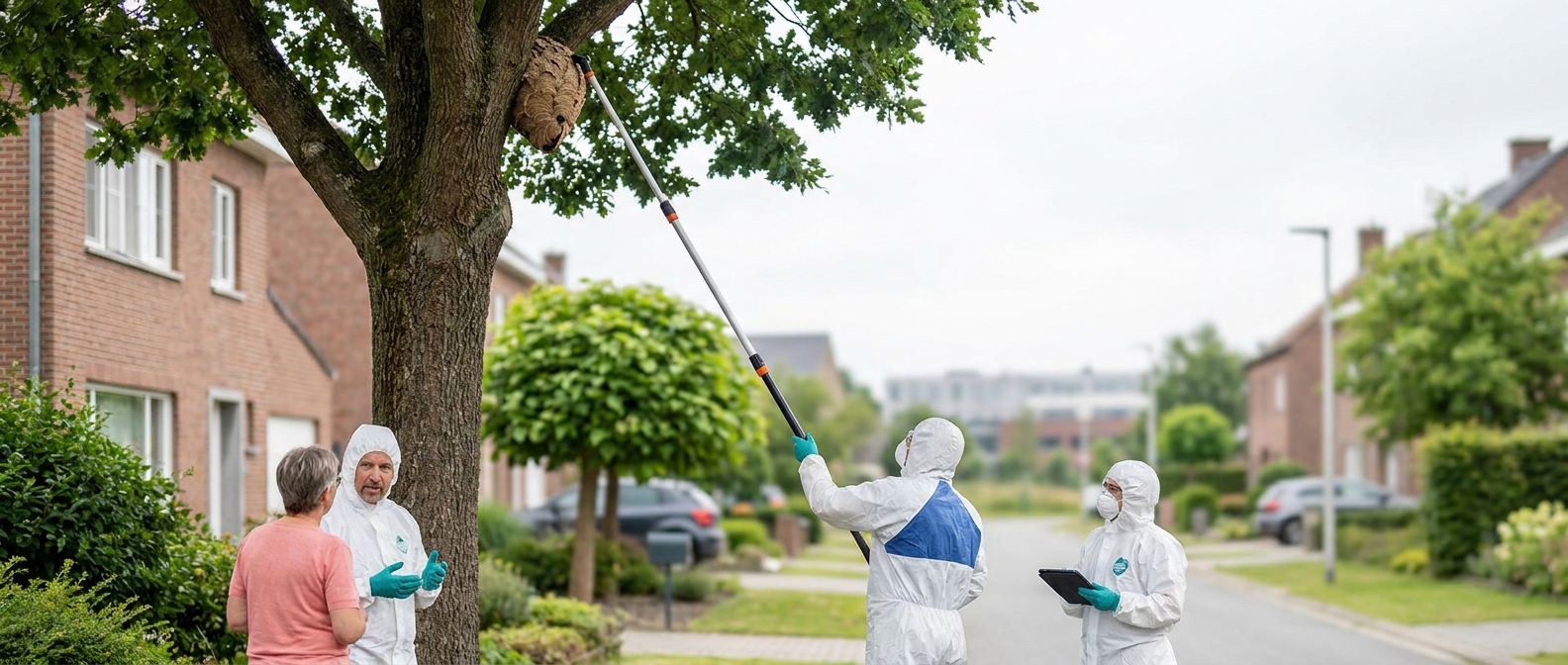
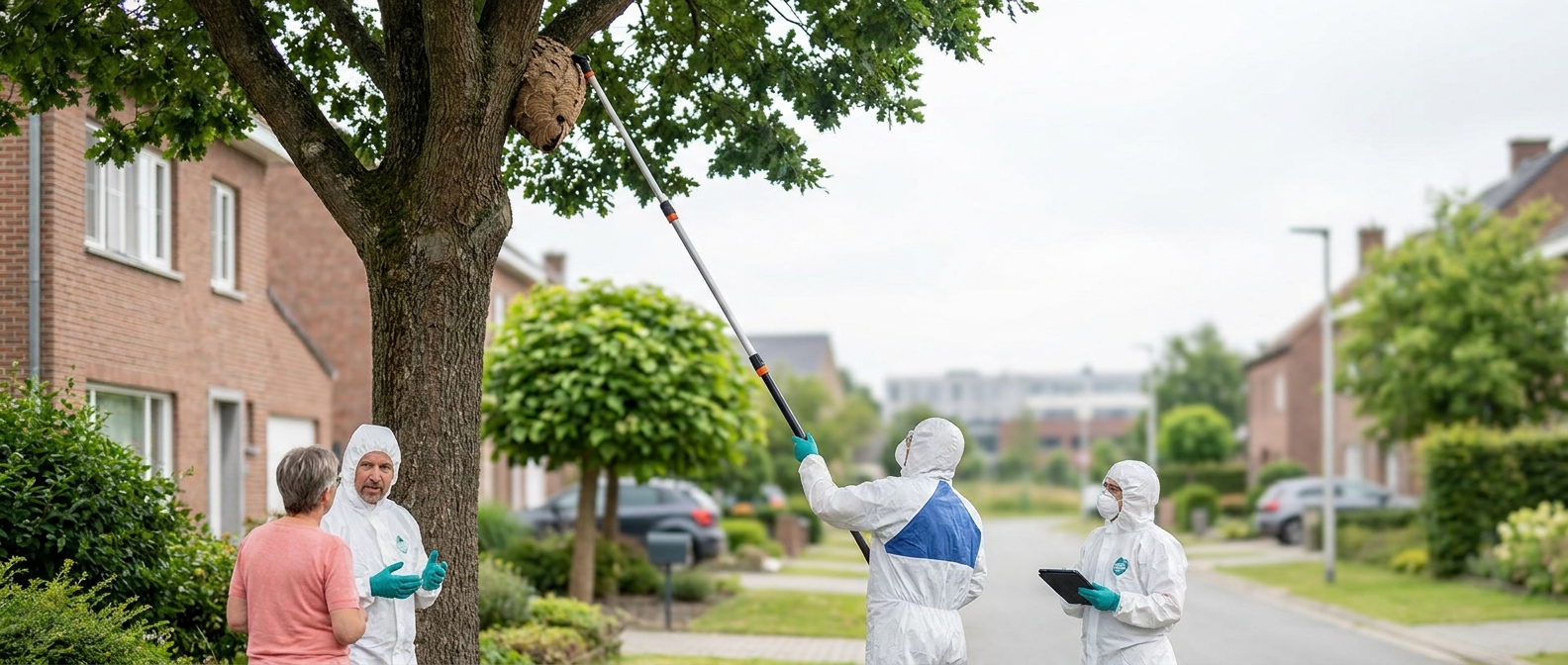
If you're also looking for wasp nest removal in Zaventem, the procedure is similar, but wasps and Asian hornets are not treated in exactly the same way. Asian hornets often build their nests at great heights (treetops, under roofs), sometimes requiring a cherry picker or telescopic pole system. Wasps, on the other hand, nest more often in cavities in the ground or walls.
For a hornet emergency, the reflex is: secure the area (keep children and animals away), don't provoke the nest, and call a professional. At Frelons.be, we work all year round in Zaventem and the surrounding communes. Yes, all year round: because founding queens emerge from hibernation as early as February-March, and secondary nests develop until November. The best strategy is not to wait until summer to take action.
Story of a pest control operation in the heart of Zaventem
On a Tuesday morning in September, a resident of the Sterrebeek-Zaventem neighborhood called. She had been hearing a dull buzzing in her attic for several days. She thought it was a swarm of bees. Her neighbor, who had already had to deal with hornets the previous year, told her not to open the attic hatch and to call in an Asian hornet exterminator.
We arrived on site in the late morning. Local intervention is one of our strengths: we know the streets, the types of buildings, the accesses. In Zaventem, many houses have tiled roofs with ventilation spaces under the eaves. This is exactly where Asian hornets love to settle. The nest was hanging from an attic beam, about 40 centimetres from the ceiling. Size: a good 35 centimetres in diameter. Not the biggest we've seen, but big enough to house several hundred workers.
First and foremost, we secure the perimeter. Neighborhood safety is our top priority. We warn the immediate neighbors, asking them to close their windows and keep their children indoors during the operation. It takes five minutes, but it prevents accidents. An Asian hornet that feels threatened can sting several times, unlike a bee. And its venom, while no more toxic than that of a wasp, is injected in greater quantities. Is it dangerous to be stung by an Asian hornet? For most people, it's very painful, but not fatal. For an allergic person, it can trigger anaphylactic shock. We don't take that risk.
The exterminator puts on his full-body suit, checks the joints, and climbs up to the attic with the injection equipment. An approved insecticide is injected directly into the nest via a boom. The product takes effect in just a few minutes. Hornets returning from outside are captured or neutralized within hours. The nest is always left in place for 24 to 48 hours after treatment, to ensure that all workers returning from foraging pass through the contaminated nest.
The next day, we returned to the site to remove the nest and check that it was no longer active. The resident told us she hadn't slept all night, not because of the noise, but because she realized she'd been living for weeks with an active nest right above her bedroom. This kind of situation is a regular occurrence in Zaventem. People only become aware of the problem when the nest has already grown.
An important point: after intervention, always check the surrounding area. An Asian hornet's range can reach several kilometers around the nest. If a nest is destroyed, it's possible that others exist in the vicinity. Local residents are systematically advised to remain vigilant and report any suspicious activity.
Identify the Asian hornet and prevent its return all year round
Many people still confuse the Asian hornet with the European hornet, or even with certain large wasps. So how do you recognize an Asian hornet? It's easier than you might think. Visit Vespa velutina is smaller than the European hornet (approx. 3 cm vs. 3.5 cm), with a completely brownish-black thorax, a dark abdomen with a single orange segment, and yellow-tipped legs. It's this last detail that gives it away. The European hornet, on the other hand, has a yellow abdomen with black stripes, a bit like a wasp, only stronger.
At Zaventem, the presence of Vespa velutina has been confirmed for several seasons. The commune is located in an area where the species is actively expanding in Belgium. Gardens, orchards and wooded areas along the canal are all favorable biotopes. If you see an insect matching this description, don't kill it just yet. Why shouldn't I kill single Asian hornets? Because a single individual doesn't represent a major threat, and above all because killing it doesn't solve anything if the nest is still active. What you need to do is follow the nest with your eyes to find out where it's heading, then report it via Vespa-Wacth Belgium.
What should you do if you see an Asian hornet in your garden? Observe, photograph, report. If you see several in the same place (around a watering hole, a fruit tree, a beehive), there's probably a nest within a radius of 500 meters to one kilometer.
For prevention, selective trapping is an effective method, provided it's done correctly. These are hornet traps designed to capture founding queens in spring, between February and May. This is the period when they emerge from hibernation and look for a place to build their primary nest. A well-placed trap at this time can prevent the creation of several nests in your neighborhood. Caution: a non-selective trap will also capture bees, butterflies and other beneficial insects. Use traps with calibrated openings (9 mm diameter) that let small insects through.
At Frelons.be, we're active all year round against the Asian hornet. The insect's cycle doesn't end in September. Fertilized queens leave the nest in autumn to find hibernation shelter in woodpiles, attics and wall cracks. At the end of winter, they return to found new colonies. Keeping an eye on your home in winter, checking attics and plugging potential access points: it's common sense that makes all the difference.
A final word of advice for Zaventem residents: tell your neighbors. The fight against the Asian hornet works best when it's a collective effort. Destroying a nest on your property is a good thing. But if you don't keep an eye on the surrounding gardens, new colonies will set up the following season. The commune sometimes organizes information sessions, so ask the environment department for details. And if you have the slightest doubt about an insect or a nest, contact an approved insect killer rather than attempting anything yourself.
Conclusion
The Asian hornet in Zaventem is no longer an isolated phenomenon. Every year, the number of reports increases, and nests are appearing in ever more varied locations: attics, hedges, garden sheds, even under terraces. The good news is that solutions exist and are readily available. Report via Vespa-Wacth, call a professional, don't improvise: three simple reflexes to protect your family and your neighborhood.
Have you spotted a hornet or a suspicious nest? Contact Frelons.be. We intervene in Zaventem and the surrounding area, summer and winter alike, so that you can regain your peace of mind without taking unnecessary risks.
Frequently asked questions
How to recognize an Asian hornet in Zaventem?
The Asian hornet (Vespa velutina) is easily distinguished by its entirely brownish-black thorax and two-tone, yellow-tipped legs. It is slightly smaller than the European Hornet, which has a yellow abdomen with black stripes and red legs.
How do I report an Asian hornet nest in Zaventem?
The most effective method is to take a photo from a safe distance and submit it to the official Vespa-Watch Belgium platform. You can also contact the environment department of the Zaventem municipality, which will direct you to an approved exterminator.
Who should I call to destroy a hornet's nest in Zaventem: the fire department or a professional?
The Zaventem fire department generally only intervenes in the case of nests in public spaces, or where there is an immediate safety hazard. For private property, you'll need to call in a certified pest control operator like Frelons.be, equipped with specific injection equipment.
Is it dangerous to be stung by an Asian hornet?
The sting is very painful, and the hornet injects a larger quantity of venom than a wasp, stinging several times. While not fatal for most people, it represents an absolute medical emergency for allergy sufferers in the event of anaphylactic shock.
What should you do if you discover a hornet's nest in your garden or attic in Zaventem?
Never attempt to destroy, block or approach the nest yourself, as hornets will launch fearsome group attacks if they feel threatened. Immediately remove children and pets, secure the area and contact a licensed professional.
How can I prevent Asian hornets in Zaventem?
In spring (from February to May), you can install selective traps calibrated to capture the founding queens as soon as they emerge from hibernation. In winter, be sure to inspect your garden sheds, attics and loft spaces to plug cracks and potential access points.
 French
  English
  Dutch
Dutch
0 Comments