
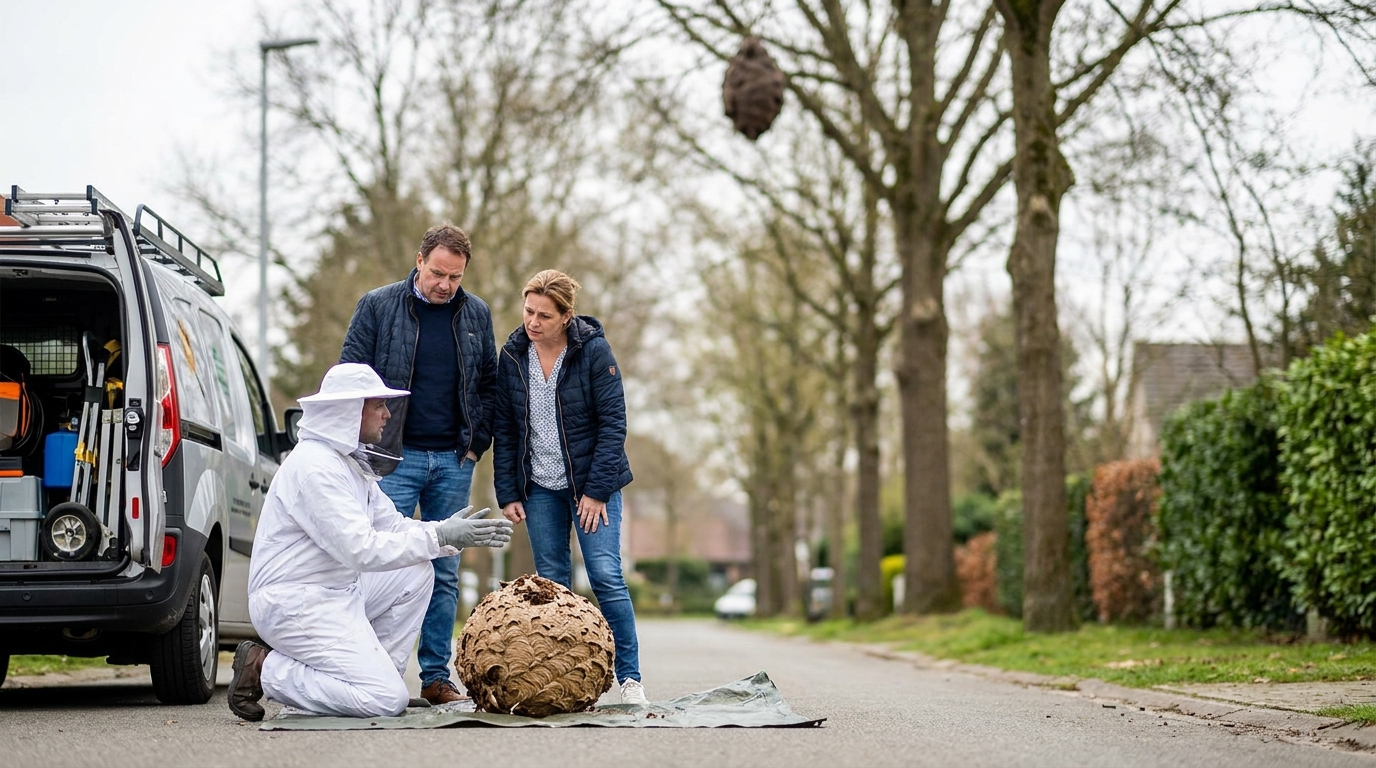
Hornet nest in Hoeilaart: Identification and intervention
Contents
-
How do I identify and report an Asian hornet nest in Hoeilaart?
-
Account of a hornet's nest destruction operation in Hoeilaart
-
Professional solutions and prevention against the Hornet all year round
Last summer, a resident of Waversesteenweg called us on a Sunday morning. He had noticed an incessant ballet of dark insects around his cherry tree. Not wasps, no. Asian hornets. A nest the size of a basketball, hanging from a branch four meters high, just above the terrace where his children had been playing the day before.
Things to remember
-
This article offers an ultra-local immersion by detailing a real intervention in Hoeilaart.
-
It combines precise identification tips with an account of a nest destruction situation, while clarifying the reporting procedures specific to the municipality to reassure residents.
-
How do I identify and report an Asian hornet nest in Hoeilaart?
-
Account of a hornet's nest destruction operation in Hoeilaart
This kind of situation is becoming increasingly common in Hoeilaart. The municipality, with its wooded areas and orchards, offers an ideal breeding ground for Vespa velutina. And every year, the number of reports increases. The problem is that many people hesitate: they don't know if it's really an Asian hornet, they don't know who to contact, and above all, they don't always appreciate the urgency of the situation.
That's exactly what this article is about. Together, we'll look at how to recognize a nest, how to report a hornet nest in Hoeilaart properly, and what actually happens when we intervene to destroy a hornet nest in Hoeilaart. No abstract theory, just practical advice and the right addresses.
How do I identify and report an Asian hornet nest in Hoeilaart?
First thing's first: don't confuse the Asian hornet with the European hornet. It's a common mistake, and it changes everything. The European Hornet is larger, lighter, with pronounced yellow-orange hues. The Vespa velutina, on the other hand, is smaller (around 3 cm for a worker), darker, with a black thorax and dark brown abdomen adorned with a thin orange stripe. Legs? The tips are yellow. That's the detail that can't be mistaken.
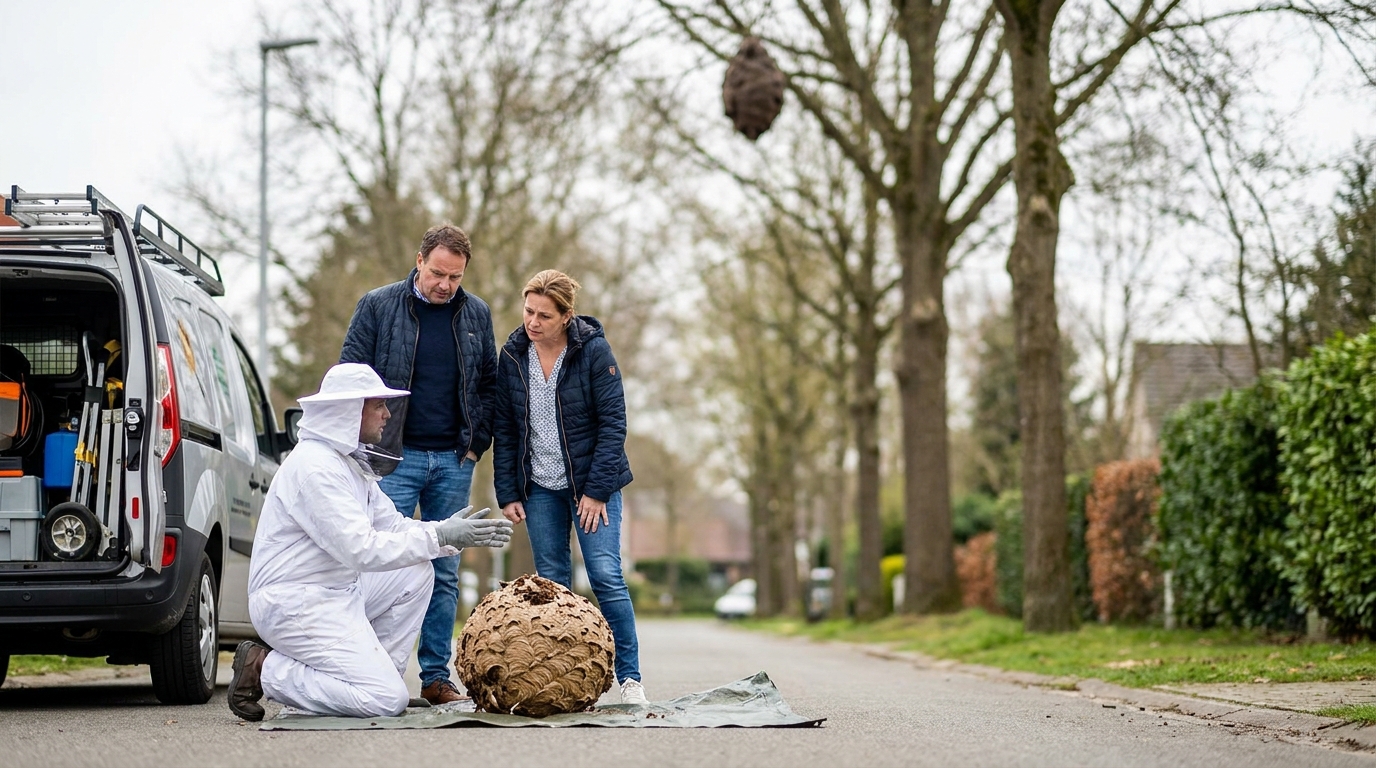
To identify a hornet, observe its behavior. The Asian hornet often hovers in front of hives or watering holes. They are less aggressive towards humans than the European Hornet, unless you approach their nest. That's another story.
Let's talk about the nest. In spring, the foundress builds a primary nest, often small, in a sheltered spot: under an awning, in a garden shed, sometimes in a low hedge. The nest is the size of a tennis ball, or even an orange. Many people pass by without seeing it. From summer onwards, the colony sometimes moves to a secondary, much larger nest, often high up in the trees. This one can be up to 80 cm in diameter and shelter several thousand individuals.
In Hoeilaart, secondary nests are regularly found in tall trees along the Forêt de Soignes, in wooded gardens in the center, and sometimes on buildings. If you spot a nest or even a single suspect hornet, don't try anything yourself. Seriously: no water jets, no sticks, no fire. You risk a mass attack, and an Asian hornet sting can cause severe allergic reactions, even anaphylactic shock in sensitive individuals.
What to do? Reporting hornets in Hoeilaart follows a simple procedure. You can use the iNaturalist platform or the website vespawatch.be, which centralizes Vespa velutina sightings in postal code 1560 and throughout Flemish Brabant. A photo is all it takes to start the process. Experts validate the identification, and if confirmed, the information is passed on to the relevant authorities.
You can also contact the commune of Hoeilaart directly, who will direct you to the appropriate services. Some local residents call us first, and that's perfectly normal: when you have an active nest two meters from your window, you don't want to wait three days for a form to be processed. We intervene, and report the situation at the same time.
An important point: why shouldn't you kill a lone Asian hornet you come across in your garden? Because crushing an individual doesn't solve anything. You need to locate the nest. A single hornet is a clue. Note the location, observe the direction of flight and report it. It's a lot more useful than getting out the swatter.
Account of a hornet's nest destruction operation in Hoeilaart
September 2023. We receive a call around 2pm. A family from the residential neighborhood near the train station. The mother was stung while pruning her laurel hedge. Her arm doubled in size within an hour. The doctor confirmed: Asian hornet. Her husband spotted the nest in a lime tree at the bottom of the garden, about six meters from the ground.
We're there in less than two hours. Rapid intervention is our top priority when there's already been a sting. Because an active nest in September is a colony at its peak: between 1,500 and 3,000 nervous individuals, ready to defend their territory.
On site, the first step is to secure the perimeter. Ask the neighbors to come inside, close the windows on the garden side and keep the pets away. The safety of the garden and the neighborhood comes first. A colleague stays on the ground to keep an eye on things, while I don the reinforced full-body suit. The Asian hornet's sting penetrates conventional beekeeping suits, so we use special, thicker, ventilated equipment, with anti-perforation gloves.
The nest is clearly visible once you know where to look. Drop-shaped, grayish-beige, with a side opening. Hornets enter and exit continuously. A telescopic pole fitted with an injector is used to introduce a biocide directly into the nest. No remote spraying, no commercial bombs: a targeted injection that neutralizes the colony without dispersing the insects throughout the neighborhood.
The operation itself takes around twenty minutes. Hornets returning from foraging hover around the nest for a few hours, disorientated, before dying. We return the next day to remove the nest and check that there is no further activity. This hornet nest destruction in Hoeilaart took place without incident. The family was able to use their garden again the following day.
What struck me in this particular case was the delay. The nest had been there for at least two months. Neighbors had noticed «big wasps» but no one had made the connection. It's often like that. You only realize there's a nest when someone gets stung, or when it gets so big you can't ignore it.
What should you do if you come across a Hornet? Stay calm. Don't make any sudden movements, and don't breathe towards the insect. Move away slowly. The Asian hornet doesn't spontaneously attack far from its nest. But at less than five meters from the nest, it's a different dynamic: the colony senses the vibration and sends out guards. That's when it gets dangerous.
Professional solutions and prevention against the Hornet all year round
Many people think that the Asian Hornet is a summer problem. False. The Vespa velutina cycle is year-round, and so is prevention.
In spring, from March to May, the founding queens emerge from hibernation and look for a site for their primary nest. This is the ideal time for trapping hornets. Selective traps, placed in high-risk areas, enable foundresses to be captured before they establish a colony. A well-placed trap at the right time can prevent the formation of hundreds or even thousands of hornets later in the season. We install these devices at our customers' sites in Hoeilaart from the end of February, depending on temperatures.
Summer and autumn are the time for heavy intervention. Secondary nests are active, colonies are at full capacity, and the risk of stings is at its highest. As a hornet exterminator in Flemish Brabant, we cover Hoeilaart and all neighboring municipalities: Overijse, Tervuren, La Hulpe, Rixensart. We know the terrain, the tree species where nests are most likely to be found, and the wetlands that attract hornets.
In winter, the nest is abandoned. The colony dies, except for the young, fertilized queens who hibernate in the ground, under tree bark or in the nooks and crannies of buildings. This is the time to take stock: inspect the structures, locate old nests (a nest is never reused, but its presence indicates that the area is favorable), and plan the trapping strategy for the following spring.
Is it dangerous to be stung by an Asian hornet? The sting is painful, comparable to that of a wasp but more intense. For most people, it remains local: pain, swelling, redness for a few days. The real danger lies with people allergic to hymenoptera venom (around 3% of the population) and multiple stings. Beyond ten simultaneous stings, even a non-allergic person can develop a severe toxic reaction. With an active nest in your garden, the risk of multiple stings is real.
Our approach at Frelons.be is one of continuous monitoring. We don't just destroy a nest and disappear. We propose a prevention plan tailored to your property: spring trapping, regular inspections, advice on reducing attractants (stagnant water, fallen fruit, open compost). The Asian hornet in Hoeilaart is not a passing phenomenon. The species has established itself permanently in Belgium, and the only effective response is proactive management.
If you have the slightest doubt about the presence of hornets in your home, don't wait. A nest detected in April is a quick and easy operation. A nest discovered in August, on the other hand, is a major operation with much higher risks. The difference between the two? A few weeks' attention.
Conclusion
The Asian hornet is now part of the landscape in Hoeilaart. That doesn't mean you have to live with a nest in your garden. Identification is simple when you know what to look for, reporting takes five minutes, and professional intervention solves the problem within a few hours.
At Frelons.be, we're active all year round in Flemish Brabant. Trapping in spring, nest destruction in season, prevention in winter. If you've spotted a hornet or a suspicious nest in Hoeilaart, contact us. We'd rather come to you for nothing than intervene too late.
Frequently asked questions
How can you tell the difference between the Asian Hornet and the European Hornet?
The Asian hornet (Vespa velutina) can be recognized by its very dark body, black thorax and characteristic bright yellow leg tips. The European Hornet, on the other hand, is larger and has much lighter reddish and yellow-orange hues.
Where do Asian hornets usually set up their nests in Hoeilaart?
In spring, they build a small primary nest (the size of an orange) in the shelter of a low hedge or garden shed. In summer, the colony often migrates to an imposing secondary nest, up to 80 cm in diameter, usually hidden in the tops of tall trees, particularly near the Forêt de Soignes.
What is the procedure for reporting a hornet or suspicious nest in the commune of Hoeilaart?
You need to take a photo from a safe distance and upload it to the vespawatch.be website or via the iNaturalist platform to map the 1560 zip code. In case of emergency or of an active nest in the immediate vicinity of your home, contact the commune of Hoeilaart or a local extermination company directly to plan a rapid response.
How does a professional intervention in Hoeilaart actually work?
The technician first secures the area around the nest, then dons a thick, anti-perforation, reinforced full-body suit. Using a telescopic pole, he injects a targeted biocidal product directly into the nest, instantly neutralizing the colony without dispersing the insects.
What should you do if you come across a lone Asian hornet in your garden in Hoeilaart?
Stay calm, avoid sudden movements or blowing towards it, and move away slowly, as a lone hornet is not aggressive. Try to spot its flight direction to locate the nest, and signal its presence rather than trying to crush it.
 French
  English
  Dutch
Dutch
0 Comments