
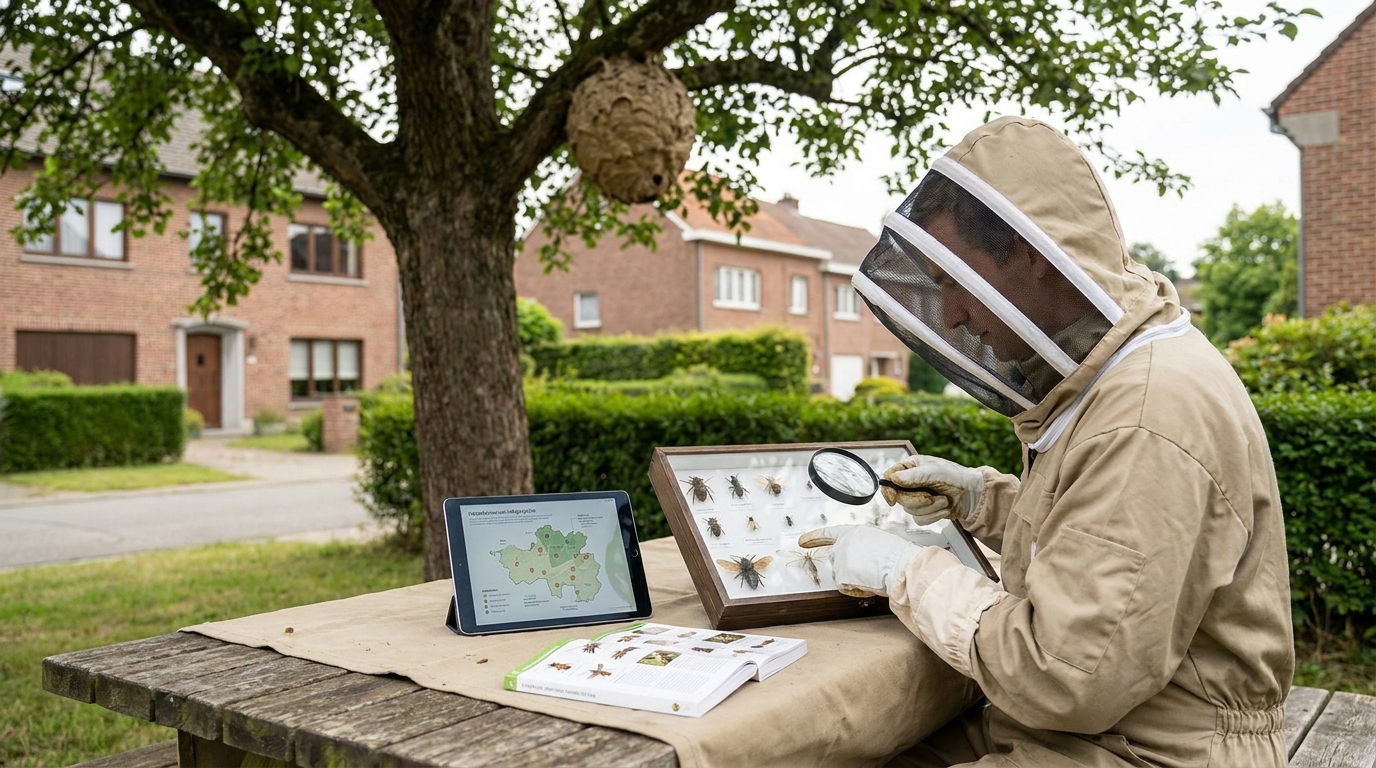
Hornet in Drogenbos: identify, report and destroy a nest
Contents
-
Recognizing the Asian Hornet in Drogenbos: criteria and identification
-
The impact of the Asian hornet on the ecosystem and safety at Drogenbos
Last summer, a resident of Grote Baan street in Drogenbos called us on a Sunday morning. He had spotted a suspicious movement under the overhang of his roof. Dark insects, bigger than wasps, were flying in and out all the time. When we arrived on the scene, it was immediately clear: an Asian hornet's nest, already the size of a football, about six meters high. This kind of situation is becoming increasingly common in the commune.
Things to remember
-
This article transforms a real-life story of intervention in the Drogenbos neighborhoods into a pedagogical guide.
-
It uses a strong local base to explain how to differentiate species and what specific steps to take in the commune, while promoting the expertise available all year round.
-
criteria and identification
-
The impact of the Asian hornet on the ecosystem and safety at Drogenbos
Drogenbos is not immune to the spread of Vespa velutina in Belgium. The proximity of green areas, gardens and the canal create a favorable environment for colonies. And every year, the number of reports increases. The problem is that many people are still hesitant. They don't know if it's really an Asian hornet, they don't know what to do, or worse, they try to take care of it themselves. We're going to set the record straight.
This article is the guide I'd like to give to everyone who contacts us at Drogenbos. How to recognize the beast, why it's a real problem, and above all: what to do when you discover a nest in your home or neighborhood.
Recognizing the Asian Hornet in Drogenbos: criteria and identification
First thing to know: not all the large insects flying around your terrace are Asian hornets. In Drogenbos as elsewhere, the most frequent confusion is with the European hornet (Vespa crabro). Yet the two species are quite different when you know where to look.
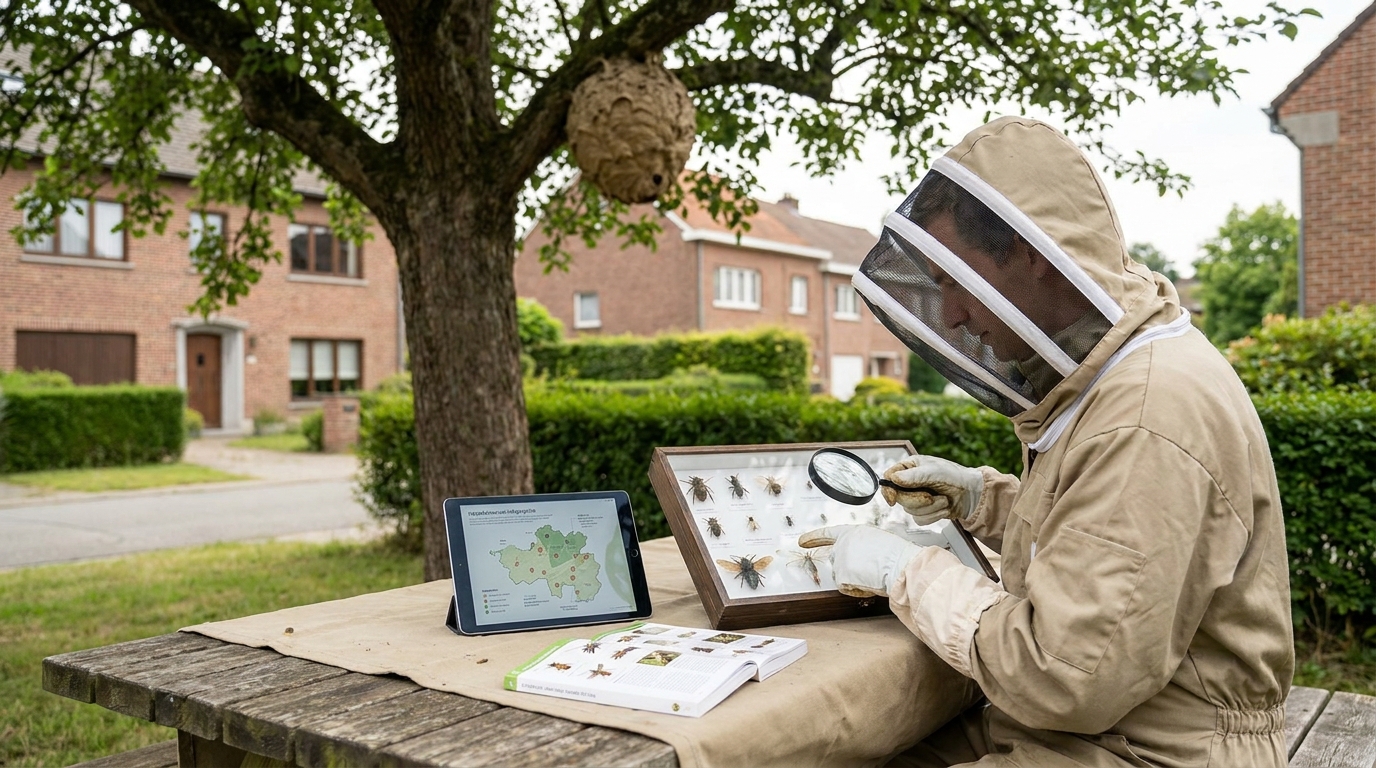
The Asian hornet, or Vespa velutina, It has a predominantly black body. This is its most distinctive feature. Its legs are yellow at the tips, giving it a two-tone appearance that is quite recognizable in flight. The face is orange, with an orange stripe running down the back of the abdomen. It measures between 2.5 and 3 centimetres for workers, slightly more for queens. This is smaller than the European Hornet, contrary to what many people think.
The European Hornet, on the other hand, is a lighter shade of red. Its abdomen has pronounced yellow streaks on a brown background. It looks more like a large wasp. Above all, they are active at night, attracted by light. The Asian Hornet is strictly diurnal.
To identify an Asian hornet in Drogenbos, observe its behavior. Is the insect hovering in front of a hive or watering hole? Is it actively hunting other insects in flight? Vespa velutina is a formidable predator. It hovers in front of hives and captures bees one by one. If you see this in your garden, there's little doubt.
The nest is another good indicator. At the start of the season, in spring, the founding queen builds a small primary nest, often in a shelter: under an awning, in a garage, sometimes in a hedge. The nest is the size of a tennis ball. Many people pass by without seeing it. As the colony grows, it sometimes moves to a secondary, larger nest, often high up in a tree. These nests can reach 80 centimetres in diameter by late summer. They are pear-shaped with a side entrance, not the underside as in the European hornet.
An important detail: in Drogenbos, nests can be found both in residential areas and near wooded areas along the canal. Gardens with fruit trees or water features are particularly attractive. If you have an open composter or fruit falling to the ground, keep a close eye on it. The Asian hornet loves sources of sugar at the end of the season.
When in doubt, take a photo. Even a blurry one can help a professional to confirm the species. Don't get too close to the nest, especially if the insects start to show signs of agitation. We'll come back to this later, but the golden rule is: observe from a distance, never intervene alone.
The impact of the Asian hornet on the ecosystem and safety at Drogenbos
A single Asian hornet colony can eliminate up to 11 kilograms of insects per season. Bees account for between 30 and 80 % of this diet, depending on studies and the availability of prey. For beekeepers in Drogenbos and neighbouring towns, this is a disaster.
The danger of the Asian hornet is not limited to beehives. It attacks a whole range of pollinators: bumblebees, hoverflies, butterflies. Biodiversity in Drogenbos takes a direct hit. Fewer pollinators means less fruit in the orchards, fewer wild flowers, and a gradual impoverishment of the entire local ecological fabric. The commune's gardens, the green spaces along the Drève de Linkebeek and the communal park all depend on a fragile balance that Vespa velutina is seriously disturbing.
In terms of safety, let's be clear: the Asian Hornet is no more aggressive than the European Hornet when left alone. But the situation changes completely when you're near a nest. The defense zone can extend to several meters. A person trimming a hedge, a child climbing a tree, a gardener passing the lawnmower too close: it's enough to trigger a collective attack. And we're talking about dozens of bites in a matter of seconds.
For a person allergic to hymenoptera venom, a single sting can cause anaphylactic shock. This is a life-threatening emergency. But even without allergy, multiple stings represent a real risk. Asian Hornet venom contains tissue-destroying substances that cause intense pain. Beyond a dozen stings, medical consultation is essential, allergy or not.
In Drogenbos, we regularly intervene in situations where the nest is located right next to a playground, a terrace or a busy passageway. People sometimes live with a nest for weeks without knowing it, until an incident occurs. One of our customers had a nest in a cedar tree, two meters from his front door. He walked past it morning and night. The day he trimmed the hedge, he was stung seven times in the face and arms. Seven. He ended up in the emergency room.
There's also a less visible aspect: stress. When you know that a hornet's nest is active in your garden, you don't dare let the children play outside, you close the windows in midsummer, you avoid certain areas. It's not a trivial matter. Peace of mind at home counts, and the Asian hornet in Drogenbos poses a direct threat to this day-to-day safety.
Without intervention, a colony produces between 200 and 500 future founding queens in autumn. Each of these can potentially create a new colony the following year. Leaving a nest in place means multiplying the problem for the whole community. Rapid destruction is not just a matter of personal comfort, it's an act of collective responsibility towards the biodiversity of Drogenbos and the safety of the neighborhood.
Guide to reporting and safely destroying Drogenbos nests
Have you spotted a suspicious hornet nest or hornets in your garden in Drogenbos? Here's exactly what to do, step by step.
Step 1: Don't touch anything. No water jets, no sticks, no fire. Every year, we see people end up in hospital because they tried to deal with the problem themselves. An Asian hornet nest can contain several thousand individuals at the height of the season. Disturbing the colony without the proper equipment means exposing yourself to a massive attack. We can't stress this enough.
Step 2: Report the hornet's nest. In Belgium, the official platform for reporting an Asian hornet nest is the site iNaturalist or the portal vespawatch.be. You can upload a photo and pinpoint the exact location of the nest. This information is fed into a national database, enabling us to monitor the expansion of Vespa velutina in France. The commune of Drogenbos can also relay the information via its environmental services.
Step 3: Contact a professional for nest destruction. That's where we come in. At Frelons.be, we work all year round in Drogenbos and the surrounding municipalities. All year round, because the Asian hornet has a cycle that begins in spring with the founding queens and continues until the first frost. Waiting until winter, hoping that the problem will resolve itself, means taking the risk of allowing hundreds of future queens to disperse.
Destroying a hornet's nest in Drogenbos follows a precise protocol. We start by assessing the situation: nest size, height, accessibility, proximity to dwellings or transit areas. Each intervention is different. A nest in a hedge two meters above the ground is not the same as one perched fifteen meters up in a poplar tree.
For accessible nests, insecticide is injected directly into the nest, using full-body suits and full protective equipment. For high-altitude nests, we use telescopic poles or, when necessary, gondolas. The aim is always the same: to neutralize the colony quickly and safely, without dispersing the hornets into the surrounding area.
A question we're often asked: does the commune cover the costs? Policies vary in the Brussels region and outlying areas. Some communes partially subsidize the destruction of Vespa velutina nests. Contact the Drogenbos environmental department to find out whether financial assistance is available. In all cases, rapid intervention remains the priority. A nest destroyed in May, when it's still small, costs less and poses fewer risks than one treated in September.
Here are a few practical tips to make the procedure easier:
-
Note the exact location of the nest and take photos if possible.
-
Keep pets away from the area
-
Warn your neighbors, especially if the nest is on the property line.
-
Keep windows closed on the nest side on the day of the operation
-
Don't try to trap hornets yourself with homemade traps: they mainly catch other useful species and have no effect on an established colony.
After destroying the nest, we systematically check for any residual activity in the days that follow. Workers in flight at the time of treatment may return to the site. This is normal, and can be managed. We remain available for follow-up if necessary.
Reporting and rapidly destroying nests is the only effective lever against the expansion of the Asian hornet in Drogenbos. Each nest treated means potentially hundreds fewer queens for the following season. And that makes a real difference to the whole commune.
Conclusion
The Asian hornet is taking up permanent residence in Drogenbos. It's no longer a distant threat or an isolated phenomenon: it's a local reality that concerns every resident, every garden, every neighborhood. Knowing how to identify the insect, understand the risks it poses and react quickly when a nest is discovered changes everything.
At Frelons.be, we're active all year round to destroy hornet nests in Drogenbos. Spring, summer, autumn: each period has its own challenges and requires an appropriate response. If you have the slightest doubt about the presence of a nest in your home or neighborhood, contact us. We'll assess the situation, intervene quickly and secure your surroundings. Don't let the problem grow.
Frequently asked questions
How can you tell the difference between Asian and European hornets in Drogenbos?
The Asian hornet ($Vespa$ $velutina$) is smaller, has a predominantly black body with a single orange stripe on the abdomen and bright yellow leg tips. Unlike the European hornet, which is lighter and more yellow-striped like a large wasp, the Asian hornet never flies at night, and actively hunts bees by hovering.
What are the safety risks of an Asian hornet nest?
Although not naturally aggressive in isolated flight, the Asian hornet fiercely defends its nest within a radius of several meters. A simple noise from a lawnmower or the trimming of a hedge can trigger a collective attack by dozens of specimens. Their multiple stings are extremely painful and represent a life-threatening risk of anaphylactic shock.
Where do hornet nests usually hide in Drogenbos?
In spring, the queens build a primary nest the size of a tennis ball in sheltered places (garden sheds, awnings, cedars). In summer, the colony often moves to a pear-shaped secondary nest, up to 80 cm in diameter, nested in the treetops, particularly in wooded areas near the canal or the Drève de Linkebeek.
How do I report a suspect nest in Drogenbos?
If you spot a nest or suspicious movement, never try to destroy it yourself with a water jet or stick. Take a photo from a safe distance and record your sighting on the official Vespawatch.be portal or the iNaturalist app to alert regional environmental and scientific authorities.
Why is it essential to call on Frelons.be for extermination?
Our team has the full protective suits and injection equipment (telescopic booms) required to neutralize the colony at height without dispersing it into the neighborhood. We operate all year round in Drogenbos, destroying nests at every stage of development and stopping the proliferation of future queens in the autumn.
 French
  English
  Dutch
Dutch
0 Comments