
Asian Hornet in Linkebeek: Complete guide and local intervention
Contents
Last summer, a resident of Rue des Hêtres in Linkebeek noticed an incessant ballet of insects around her garden shed. She thought they were wasps. It turned out to be Asian hornets, Vespa velutina, The nest had already grown to the size of a football. The nest was already the size of a soccer. We're seeing this kind of situation more and more often in the commune, and it's not going to stop.
The Asian hornet in Linkebeek is no longer a curiosity. It's an annual reality. The municipality has reacted by installing selective traps, collaborating with the Vespawatch platform and raising awareness among residents. But you still need to know what to do when you come face to face with a nest. Who do I call? How much does it cost? Does the municipality intervene? This article answers all these questions, step by step, based on a real intervention carried out in the field.
Things to remember
-
An informative report based on a local intervention in Linkebeek
-
The article combines the story of a nest neutralization with a practical guide to communal services (selective traps) and Vespawatch reporting procedures to offer a comprehensive and reassuring local resource.
-
Steps to take in Linkebeek
-
Destroying a nest in the commune
Whether you've spotted a nest in your garden, on your roof or in a tree at the edge of your property, you'll find practical information here on how to act quickly and safely.
Report a nest and get a trap: Steps to take in Linkebeek
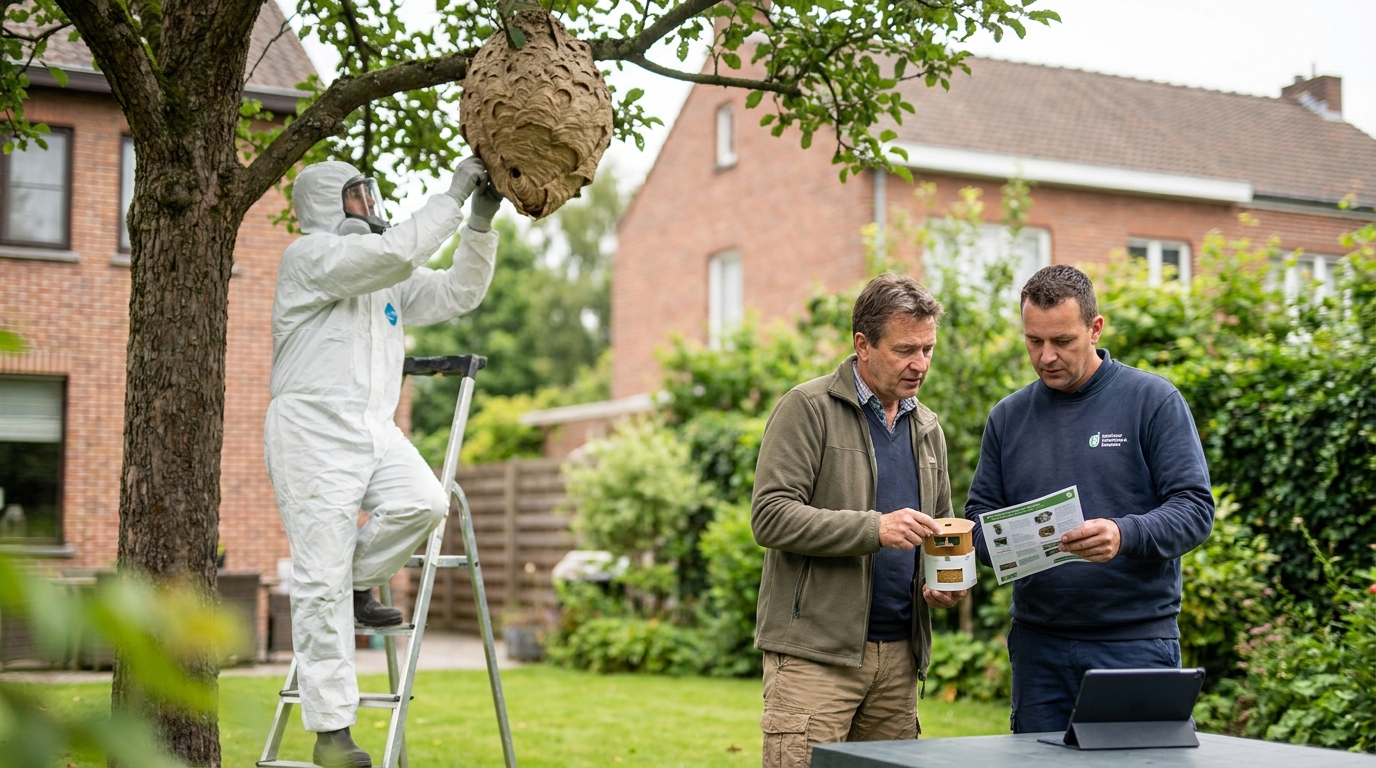
Thirty. This is the number of selective traps that Linkebeek has installed on its territory to combat the Asian hornet. Thirty traps in strategic locations, designed to catch the foundresses in spring without decimating other insects. If you live in the commune, you can obtain one free of charge from the local administration. Just drop by the Linkebeek commune or give them a call to find out how to collect your selective trap.
But before the trap, there's the report. And here, many people hesitate. They don't know if it's really an Asian hornet, they're afraid of disturbing someone, or they simply don't know the procedure. So here's how it works.
Step 1: Identify the insect. The Asian hornet (Vespa velutina) is quite easy to recognize. Dark, almost black body, with an orange band on the abdomen and yellow legs at the tips. It is smaller than the European Hornet. If in doubt, take a photo. Even if it's blurry, it'll be useful.
Step 2: Report via the Vespawatch platform. This is the official channel in Belgium for reporting an Asian hornet nest. Vespawatch reporting is simple: you go to the site, fill in a form with the location of the nest, add your photo if possible, and off you go. This system works well, centralizing data at national level and making it possible to track the progress of Vespa velutina in Belgium.
Step 3: Notify the commune. Alongside the report, contact the Linkebeek local authority. The commune is involved in the fight against the hornet and can speed up the process, especially if the nest is located in a public space or on a roadside. The municipal services know where to direct you and can confirm whether selective traps in Linkebeek are available for your neighborhood.
One important point: never attempt to destroy a nest yourself. We'll come back to this later, but it's the kind of thing that can go very wrong. The citizen's role is to spot and report. The rest is up to the professionals.
For landowners with large plots or orchards, vigilance is even more necessary. Asian hornets love to settle high up in trees, sometimes more than ten meters away. A nest can go unnoticed for months. If you notice a steady flow of dark insects in a particular direction, follow them with your eyes. You'll probably find the nest at the end of the trajectory.
A final word of advice: don't wait until autumn. The earlier a nest is reported, the simpler the intervention, and the less time the colony has had to produce new queens. A report in June means a nest the size of a tennis ball. By September, we're talking 60 centimetres in diameter, with several thousand individuals.
A typical intervention: Destroying a nest in the commune
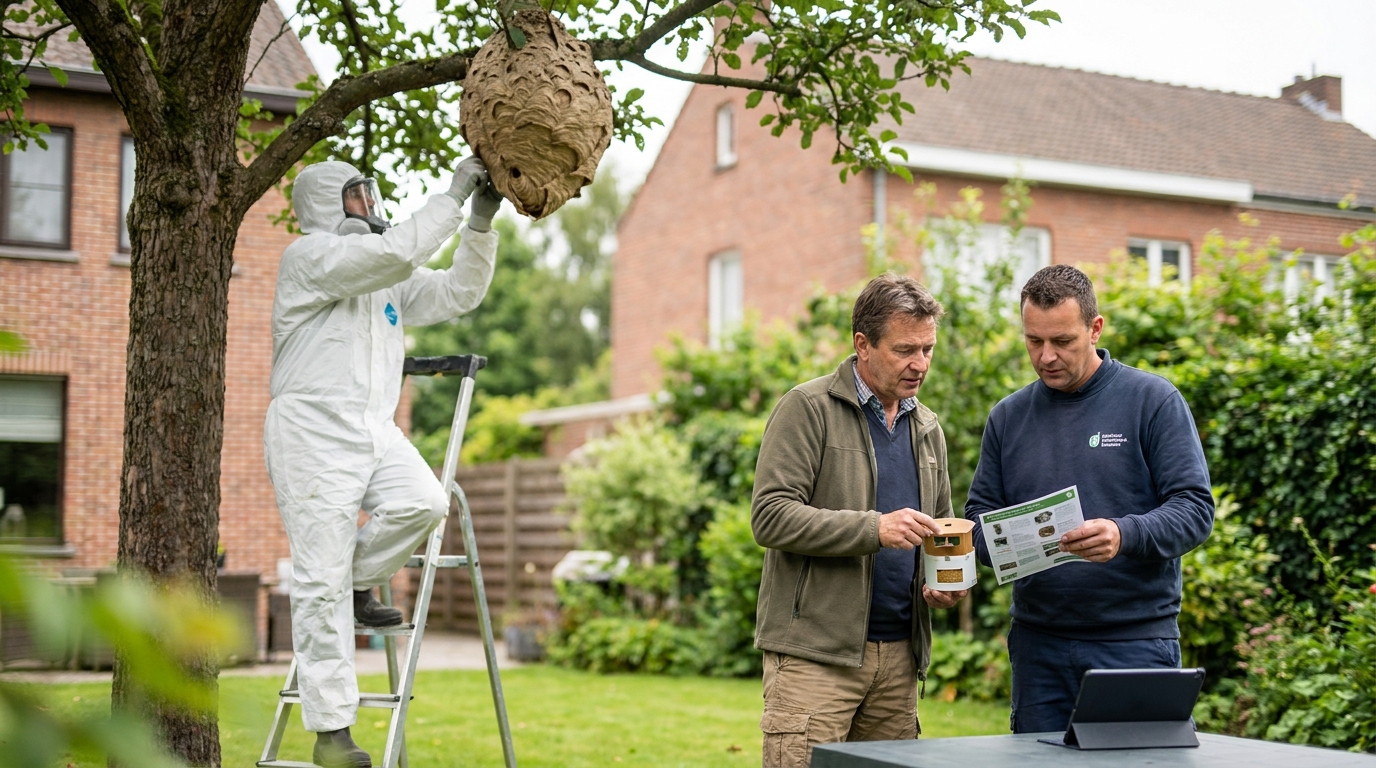
It was a Tuesday morning, early September. The call came from a private individual on Chaussée d'Alsemberg, on the Linkebeek side. A nest of Asian hornets had been spotted in a lime tree, some eight meters high. The owner had noticed it while trimming his hedge: dozens of hornets were flying in and out of a grayish mass hanging between two main branches.
The report had already been made via Vespawatch a few days earlier. The identification was confirmed: Vespa velutina, without a doubt. The destruction of the hornet's nest in Linkebeek could now begin.
Asian hornet control follows a precise protocol. The technician arrives equipped with a full-body anti-sting suit, a telescopic pole and a suitable biocide product. Improvisation is out of the question. The first thing he does is secure the perimeter. Residents are asked to stay indoors, with their windows closed. Neighbors are notified. Pets have gone inside.
The telescopic boom makes it possible to reach the nest without the need for a gondola, which is a huge advantage in residential environments. The technician injects the product directly into the nest through the main entrance. It's fast: a few seconds are all it takes. The hornets inside are neutralized within minutes. Those flying outside return to the nest within hours, and are also eliminated by contact with the product.
Hornet control doesn't stop there. The technician usually returns 24 to 48 hours later to remove the nest and check that there is no further activity. It's a step that some service providers overlook, but it's an essential one. A nest left in place, even if treated, can attract other insects or worry local residents.
That day in Linkebeek, everything went off without a hitch. The nest was around 40 centimetres in diameter, corresponding to a well-established colony, probably active since late June. Inside, between 1,500 and 2,000 individuals were estimated. The owner couldn't believe it: he passed under this tree every day without suspecting anything.
What's striking about this type of intervention is its speed. From start to finish, the on-site operation takes between 30 and 45 minutes. The longest part is often the preparation and securing. The destruction itself is almost surgical.
A detail that often comes up in questions from residents: is the product used dangerous for the environment? The biocides used by authorized professionals are targeted. They act on the insects in the nest, not on the surrounding fauna. The technician uses calibrated doses, not massive spraying. This is very different from what we sometimes see on the Internet, where people spray a nest with supermarket insecticide. That's dangerous for everyone, hornets included (they become aggressive without being neutralized).
Emergency and safety: A practical guide for Linkebeek residents
The first question everyone asks: how much does it cost? The price of destroying a wasp or hornet's nest in Linkebeek varies according to several factors. The height of the nest, its accessibility, the type of insect. For an Asian hornet's nest, you should expect to pay between 100 and 150 euros. Some service providers charge more if the nest is very high or in a difficult-to-reach location (roof, chimney, large tree). Check with your local council: in some cases, part of the costs may be covered, or a special rate may be negotiated with a hornet expert in Linkebeek.
Now, let's talk about safety. The Asian hornet is not spontaneously aggressive towards humans. They won't attack you if you pass within ten meters of their nest. The problem is when you get too close, vibrate a branch or use a lawnmower or hedge trimmer nearby. The colony perceives a threat and responds collectively. Several dozen hornets can emerge in a matter of seconds. And unlike bees, hornets can sting several times.
For people allergic to hymenoptera venom, this is a potential medical emergency. If you know you're allergic, keep your adrenaline kit handy during the season (May to November). And let the emergency services know if a nest is to be destroyed near you.
A few practical safety rules:
-
Never approach within five metres of an active nest.
-
Don't throw anything at it. No water, no stones, no sticks. Never throw anything at it.
-
Don't try to burn it. It's the best way to start a fire AND an attack.
-
If hornets are circling you, stay calm, don't make any sudden movements and move away slowly.
-
In the event of multiple bites (more than five in an adult), call 112.
Families with children should be extra vigilant in their gardens between August and October. This is the period when nests are the largest and colonies the most populous. Asian hornets are also attracted by ripe fruit: if you have an apple, pear or grapevine tree, pick up any fruit that has fallen to the ground.
Calling in a hornet expert in Linkebeek is the only sensible option when faced with a nest. The fire department no longer systematically intervenes to remove hornets' nests in Belgium, except in the case of an immediate emergency (e.g. a nest in a school or hospital). For private homes, the operation is carried out by a licensed professional. At Frelons.be, we intervene all year round, even outside the high season, because the founding queens start building as early as spring.
A final point on the safety of the Asian Hornet that deserves to be emphasized: the threat is not just to humans. Vespa velutina is a formidable predator of bees. A single colony can decimate an entire hive in a matter of weeks. If you are a beekeeper in the Linkebeek area, rapid reporting and destruction of nests near your apiaries is an absolute priority. The survival of your colonies depends on it.
Conclusion
The Asian hornet has settled in Linkebeek, and it's here to stay. The good news is that the municipality is mobilized, that the tools exist (selective traps, Vespawatch platform, trained professionals) and that every resident can play a part by quickly reporting what they observe.
Have you spotted a nest or a suspicious hornet? Don't waste any time. Report it on Vespawatch, contact the Linkebeek commune, and call in a professional to destroy it. At Frelons.be, we're available all year round to intervene quickly and safely. One call is all it takes.
Frequently asked questions
How can I get a free selective trap in Linkebeek?
The Linkebeek local authority distributes selective traps free of charge to residents to catch queen bees in spring. To obtain one, simply contact the commune directly by telephone or visit the town hall to arrange collection.
What is the official procedure for reporting a hornet's nest in Linkebeek?
If you discover a nest, you must first register it on the official Vespawatch platform, adding a photo for scientific validation. At the same time, notify Linkebeek's municipal services to coordinate the intervention, especially if the nest threatens a public space or the neighborhood.
What is the average cost of destroying an Asian hornet nest?
The cost of an intervention by a certified professional in Linkebeek generally varies between 100 and 150 euros. The cost may vary according to the height of the tree, the accessibility of the roof and the urgency of the situation, but some interventions benefit from co-payments or agreed rates.
Do the local fire department respond to a hornet's nest in a private home?
In Belgium, fire departments no longer routinely destroy hornet nests on private property. Except in the case of an immediate life-threatening emergency, such as a nest in a school or crèche, you must call on the services of a private, licensed pest control company.
Why does the Asian hornet pose a threat to Linkebeek's bees?
This insect is a formidable predator, hovering in front of hives to capture worker bees as they return from foraging. A single uncontrolled colony of Asian hornets can stress, starve and decimate an entire apiary in just a few weeks.
 French
  English
  Dutch
Dutch
0 Comments