
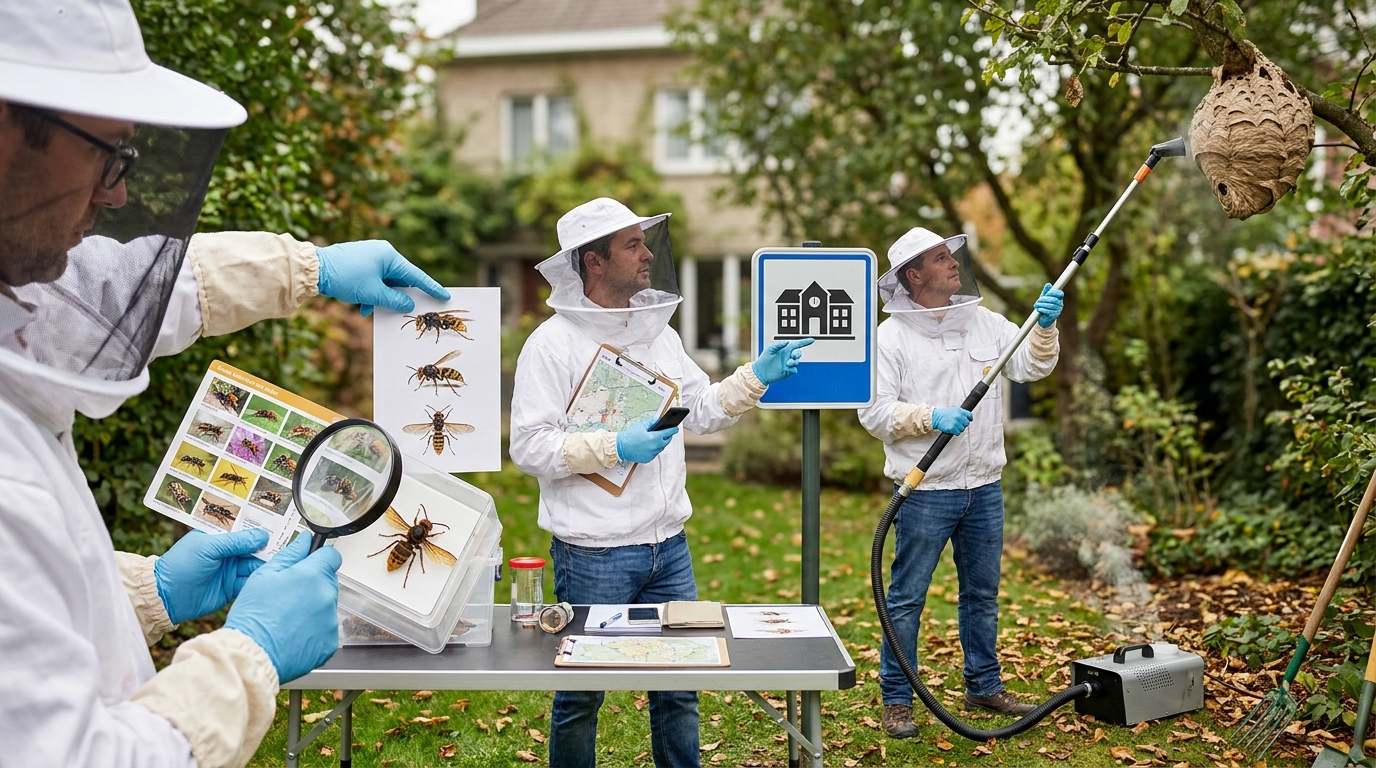
Asian Hornet in Rhode-Saint-Genèse: how to react and intervene?
Contents
A few weeks ago, a resident of Rhode-Saint-Genèse contacted us in a panic. A dull buzzing in the back garden, a grayish ball hanging from an oak tree, hovering insects he'd never seen before. When we arrived on the scene, we immediately confirmed that it was indeed a nest of Vespa velutina, the Asian hornet. Not an isolated case. Since 2016, the species has been on the rise in Belgium, and postal code 1640 has not been spared.
What strikes us every time we intervene is the lack of concrete information available to local residents. You know there's a problem, you see articles in the press, but when the nest is in your tree or under your roof, you need precise answers. Who do I call? Does the commune reimburse? Is it dangerous to stay nearby while waiting for the intervention?
Things to remember
-
An informative story based on a real-life intervention in the heart of Rhode-Saint-Genèse
-
We combine identification advice, local procedures specific to the 1640 zip code and technical expertise to reassure residents and protect local biodiversity all year round.
-
Identifying the Asian hornet and the risks in Rhode-Saint-Genèse
-
Notification procedure and municipal aid in 1640
This article answers all these questions. It explains how to recognize the Asian hornet, how to report a nest in Rhode-Saint-Genèse, and what happens when an expert comes to your home to neutralize a nest. Whether you have a doubt or an emergency, you'll find the steps to follow here.
Identifying the Asian hornet and the risks in Rhode-Saint-Genèse
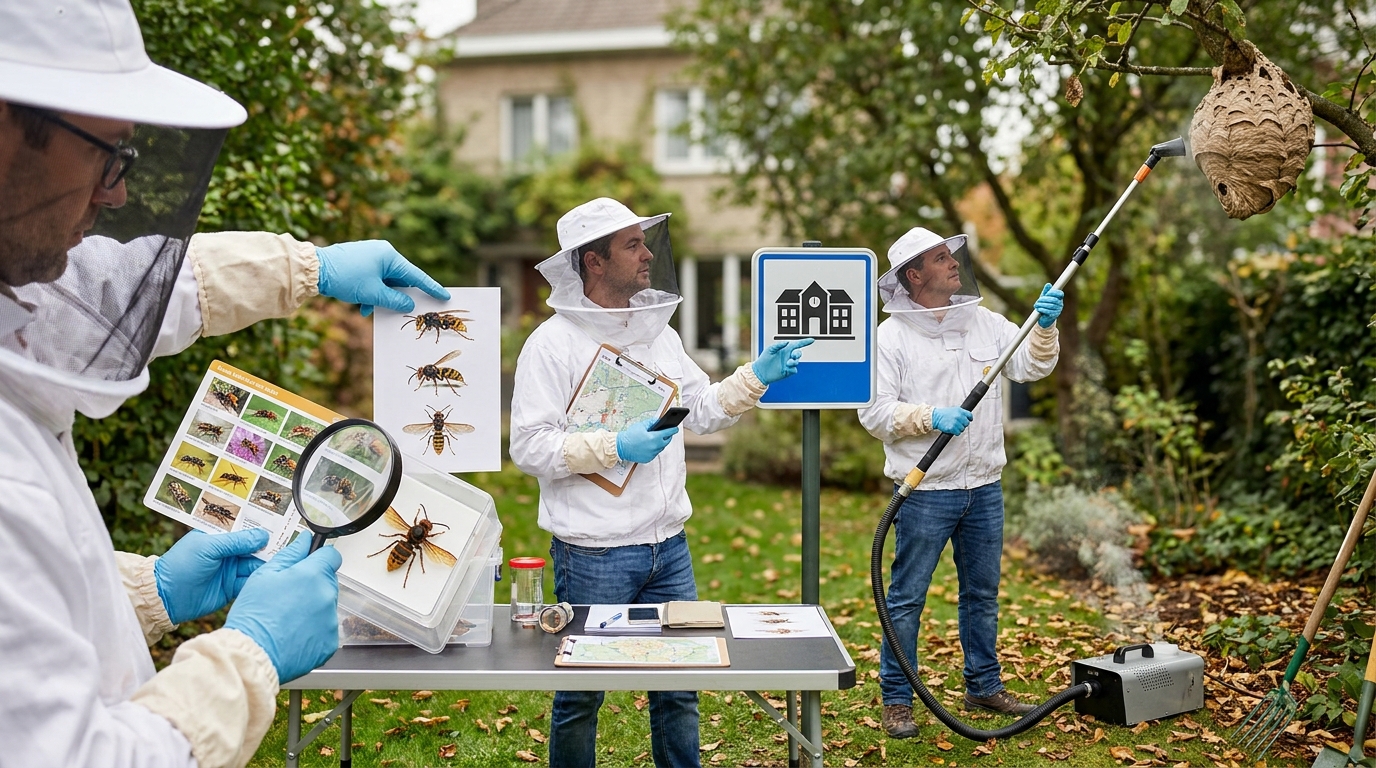
Recognizing the Asian Hornet is the first step, and it's not as easy as you might think. Many people confuse Vespa velutina with the European hornet (Vespa crabro), which has been with us since time immemorial and doesn't pose the same problems. The main difference lies in color: the Asian hornet is predominantly black, with an orange stripe on the abdomen and yellow legs at the tips. The European hornet, on the other hand, is reddish-brown with a striped yellow abdomen. If the insect you observe is dark, almost black, and hovers in front of a hive or watering hole, chances are it's the right one (well, the wrong one).
Size can also help. The Asian hornet's workers measure between 2.5 and 3 cm, slightly less than the European hornet. Another clue is its nest. At the start of the season, in spring, the founding queen builds a small primary nest, often under a shelter (awning, shed, dense hedge). It's discreet, about the size of a tennis ball. If no one spots it at this stage, the colony moves on in summer to build a much larger secondary nest, sometimes high up in a tree, sometimes in an attic. These secondary nests can reach 80 cm in diameter and house several thousand individuals.
Why is this a problem specific to Rhode-Saint-Genèse? The commune combines wooded residential areas, mature gardens and semi-rural spaces. This is exactly the type of environment that Vespa velutina affectionate. Tall trees provide ideal nesting sites, and the many flowering gardens attract the pollinators on which the Hornet feeds. Rhode-Saint-Genèse is rich in biodiversity: wild bees, bumblebees, hoverflies. And it's precisely this richness that's under threat.
A single Asian hornet nest can decimate 30 to 40 % bee colonies within a radius of several kilometers. The workers hover in front of the hives and capture the bees one by one. For local beekeepers, this is a nightmare. For the local ecosystem too: fewer pollinators means less fruit, fewer wildflowers, a cascade of impoverishment.
As far as human health is concerned, the Asian hornet is no more dangerous than a classic wasp for a non-allergic person. A sting is painful, but nothing more. The real risk comes from unknowingly disturbing a nest, by trimming a hedge for example, or climbing a ladder near a hidden nest. Hornets defend their colony collectively and aggressively. Several dozen simultaneous stings can provoke a serious toxic reaction, even in someone who is not allergic. That's why we insist: never touch a nest yourself. Ever.
If you have any doubts about identification, take a photo from a distance (a smartphone with a zoom lens will do) and send it to hornets.be or to your local reporting platform. We'd rather receive ten false alarms than miss an active nest.
Notification procedure and municipal aid in 1640
You've spotted a suspicious nest in your own or your neighbor's garden. What should you do now? First thing: don't improvise. Second: report the hornet in Rhode-Saint-Genèse via official channels. It's quick, and triggers an effective chain of reaction.
The municipal administration of Rhode-Saint-Genèse has set up a reporting system accessible to all residents of the 1640. You can report a hornet's nest in several ways: by telephone to the municipal environment department, via the online form available on the municipal website, or directly on the national platform. vespawatch.be. This last option is particularly useful because it centralizes data and enables scientists to track the species' progress in Belgium.
When reporting, try to provide as much information as possible: precise location (address, position in the garden or on the building), approximate nest height, photo if possible, and estimated activity (many insects coming and going, or nest that seems quiet). These details will enable the operator in charge of your case to prepare his intervention correctly.
The question on everyone's lips: does the commune cover the costs? The answer is yes, in part. The Walloon Region and the Brussels-Capital Region have set up subsidy systems, and Rhode-Saint-Genèse, although located in the Flemish Region but with a special status, benefits from its own framework. The commune collaborates with approved operators, notably via the Vespa Hunter network in 1640, which ensures the destruction of confirmed Asian hornet nests. In most cases, the intervention is free of charge for the citizen when it involves Vespa velutina and that the report is made through official channels. Please note: if the nest turns out to be that of a classic wasp or a European hornet, the local authority will not usually pay for the removal.
For the 2026 campaign, the commune has stepped up its communications. Posters in the neighborhoods, publications on social networks, information sessions in schools. The objective is clear: to identify primary nests in spring, before they become massive colonies in summer. One primary nest destroyed in April means potentially 5,000 fewer hornets at the end of the summer. The calculation is simple.
A few important details. The Rhode-Saint-Genèse fire department can intervene in the event of an absolute emergency (nest in a busy thoroughfare, immediate risk to children or vulnerable persons), but this is not their primary mission for this type of pest. The normal procedure is to report the problem to the local authority, then send in a specialist operator. How long does it take? At the height of the season, allow between 48 hours and a week. Out of season, it's often quicker.
One final point that's often overlooked: even if the nest is on your neighbor's property, it's worth reporting it. If your neighbor is away, on vacation, or simply unaware of the situation, you can alert the commune. The fight against the Asian hornet in Rhode-Saint-Genèse is a matter for the whole neighborhood, not just the owner of the property concerned.
Procedure for a home nest-killing operation
Let's return to the intervention we mentioned in the introduction. The owner had sent us a clear photo of a secondary nest hanging about 8 metres high in an oak tree, on the edge of his terrace. Intense activity: dozens of hornets constantly coming and going. Her children regularly played in the garden. We had to act fast.
When a hornet expert comes to Rhode-Saint-Genèse for nest destruction, the first step is always an on-site assessment. We look at the type of nest, its size, height and accessibility. A nest in a hedge 2 meters above the ground is not the same operation as a nest 15 meters up a poplar tree. The environment also counts: are there any close neighbors? Any pets? A nearby swimming pool or watering hole that attracts hornets?
The work itself is carried out in a full protective suit, with special anti-sting equipment. We use a telescopic pole or, for very high nests, a gondola. The product used is an authorized biocide, injected directly into the nest. The effect is rapid: within a few minutes, hornet activity drops drastically. We then wait for the hornets in flight to return to the nest (they are programmed to do so) before removing the entire structure. It's out of the question to leave a treated nest in place without unhooking it: other insects could nest there, and biocide residues would end up in the environment.
The safety of the operation is our obsession. We systematically ask residents to stay indoors, with their windows closed, for the duration of the operation. Pets must be brought inside. We mark out the area. It's not just an act: a nest of 3,000 hornets that feels threatened can become very aggressive within a radius of 5 to 10 metres around the nest.
Wasp nest destruction in Rhode-Saint-Genèse follows a similar protocol, but with a few differences. Wasps often build their nests in cavities (under roofs, roller shutter boxes, holes in walls), making access difficult. The Asian hornet, on the other hand, tends to build in the open, suspended. This makes neutralization easier in most cases, provided you have the right equipment for working at height.
How long does the operation take? For a standard nest, between 30 minutes and an hour, including securing time. For a very high nest or one in a complicated position (chimney, under a sloping roof), it can take two hours. We never botch things up. Incomplete neutralization means the nest is rebuilt within a few weeks.
After the operation, a report is given to the owner and, if the operation was coordinated via the commune, the data is transmitted to the monitoring network. Each nest destroyed is fed into the regional mapping system. This enables us to anticipate areas at risk for the following year.
At hornets.be, we work all year round in Rhode-Saint-Genèse and throughout the 1640 region. In winter, the nests are empty (the workers die, only the new queens survive in hibernation), but this is precisely the right time to spot abandoned nests in leafless trees. This gives us an idea of the areas that have been colonized, and enables us to set traps for founding queens in early spring.
Conclusion
The Asian hornet in Rhode-Saint-Genèse is not a fatality. It's a serious problem, yes, but with the right reflexes, it can be managed. Learn to recognize the insect, quickly report any suspicious nests to the commune or to vespawatch.be, and let a professional take care of it. Don't take any risks yourself.
If you live in the 1640 and suspect the presence of a nest, contact frelons.be. We'll assess the situation, intervene as quickly as possible and coordinate with the Rhode-Saint-Genèse local authority to take care of the problem. Every nest destroyed means thousands of pollinators saved. It's worth picking up the phone.
Frequently asked questions
How can you tell an Asian Hornet from a European Hornet?
The Asian hornet (Vespa velutina) is darker than its European cousin, with a predominantly black body, an orange stripe on the abdomen and yellow-tipped legs. The European Hornet is larger, with a russet body and black-striped yellow abdomen.
What should I do if I find a hornet's nest in my garden in Rhode-Saint-Genèse?
Never approach closer than 5 meters and do not attempt to destroy it yourself. Immediately report the presence of the nest to the environmental department of the commune of Rhode-Saint-Genèse or via the Vespawatch.be platform to trigger a safe intervention.
Does the commune of Rhode-Saint-Genèse cover the cost of destruction?
Yes, for the 2026 season, the local authority generally offers to pay for the destruction of confirmed Asian hornet nests, provided you use the official reporting channels. Please note that this assistance does not apply to common wasp or European hornet nests.
Why is the Asian hornet a threat to our local biodiversity?
It is a formidable predator, hovering in front of hives to capture bees. A single nest can destroy a large part of Rhode-Saint-Genèse's bee and pollinator colonies, damaging the reproduction of the region's flowers and orchards.
When to report a nest for maximum effectiveness?
The best time to spot primary nests is in spring (April-May), when they are the size of tennis balls and often hidden under garden sheds. Destroying a nest at this time prevents the birth of thousands of hornets and the creation of giant secondary nests in summer.
 French
  English
  Dutch
Dutch
0 Comments