
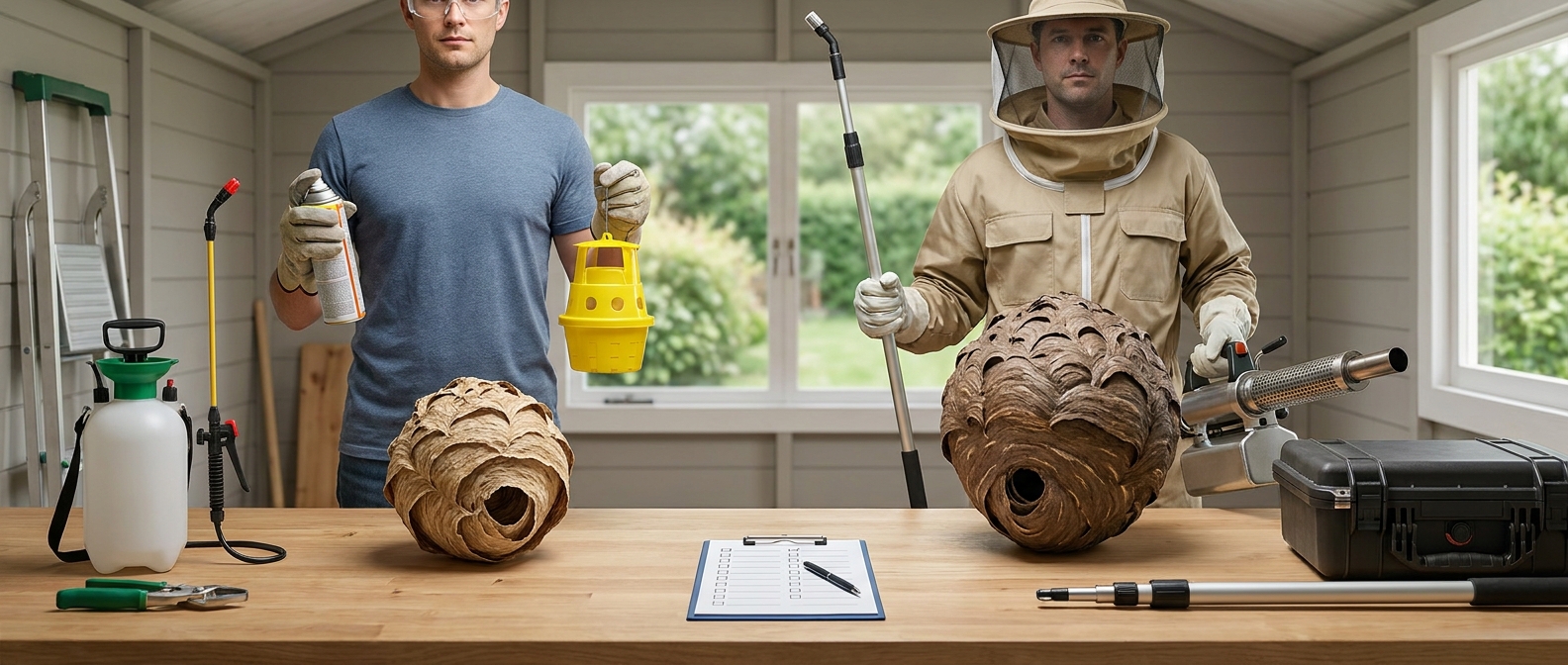
A guide to getting rid of hornets in your garden shed
Contents
-
European vs. Asian hornet: criteria for identifying the nest in your shelter
-
Destroy the nest yourself or call a pro: benefits, risks and costs
-
Commercial traps vs. pest control services: our recommendations before you buy
You open your garden shed door to grab the hedge trimmer, and there it is: a dull buzzing, insects flying back and forth overhead, a grayish ball hanging in a dark corner. It's a classic scenario, seen every year in dozens of private homes in Belgium. A hornet's nest in a garden shed is one of the most frequent cases we deal with at Frelons.be, from spring to autumn.
Things to remember
-
This article analyses why garden sheds are ideal hornet nests.
-
We compare the risks of the Asian hornet with those of the European hornet and propose a complete decision-making grid between autonomous intervention and the use of a hornet expert.
-
be for total safety
-
Compare the different options before deciding.
The problem is that many people hesitate. They don't know whether it's a European or an Asian hornet. They wonder whether the nest is dangerous, whether they can remove it themselves or whether they should call someone. Above all, they waste time, allowing the colony to grow. This article is here to give you a clear decision-making grid: identify what you have in front of you, assess the real risk, and choose the right solution without putting yourself at risk.
European vs. Asian hornet: criteria for identifying the nest in your shelter
First thing to do before touching anything: know what you're dealing with. Because a European hornet and an Asian hornet are not the same animal, they don't behave in the same way, and above all they don't pose the same level of risk.
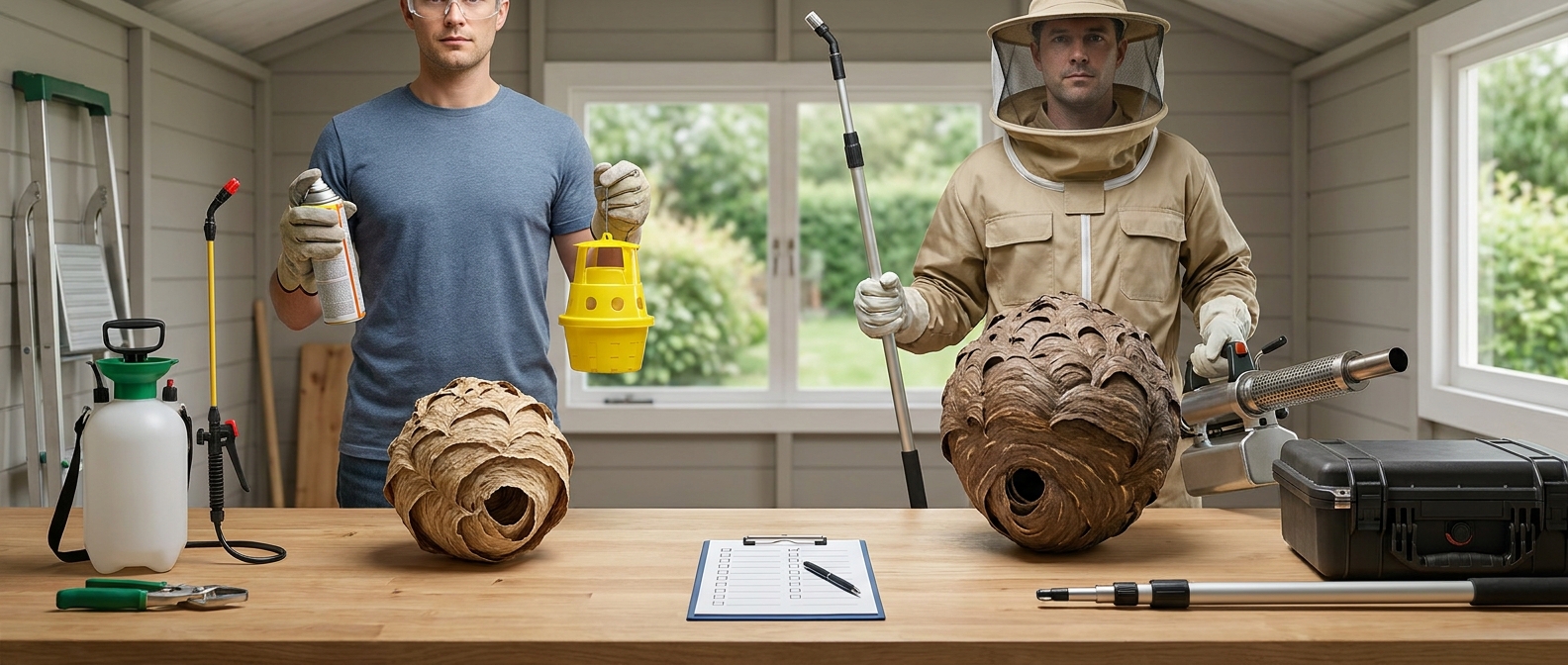
The European hornet (Vespa crabro), it's the big red-orange one your grandparents already knew. It measures between 25 and 35 mm, has a yellow abdomen streaked with black, and frankly, is rather quiet. It will only attack you if you shake its nest directly. Its nest, in fact, is often open at the bottom, with a texture resembling light-brown papier-mâché. They are regularly found in sheds, attics and hollow tree trunks.
The Asian hornet (Vespa velutina), it's a different story. Smaller (around 25 mm for the workers), it's best recognized by its very dark, almost black body, with an orange stripe on the abdomen and yellow legs at the tips. If you see a dark insect with bright yellow leg tips circling your garden shed, you've probably got your answer.
To identify an Asian hornet with certainty, look at the nest too. In spring, the Queen Hornet first builds a primary nest, often no bigger than a tennis ball. It's this famous primary nest in a shed that can be found hanging from a beam, in the corner of a wall, sometimes even behind a tool resting against the wall. At this stage, the colony numbers no more than a dozen individuals. The nest is light, discreet and easy to miss.
As summer progresses, hornet nests can explode in size. Secondary nests of the Asian hornet regularly reach 40 to 60 cm in diameter, sometimes more. They become spherical, with a side entrance (not underneath, as with the European). Their color tends toward gray-beige. And the colony can number several hundred workers. At this point, aggressiveness goes up a notch: Asian hornets defend a perimeter of 5 meters around the nest, sometimes more.
Why do hornets come to your garden and your shed? The answer is simple: a garden shed offers everything a queen seeks in spring. A space sheltered from wind and rain, dark and quiet, with wood within reach of her mandibles to make the pulp for her nest. Add a nearby orchard, compost, garbage cans that aren't always closed, and you've got the perfect cocktail. The Asian hornet in a garden is no accident: it's a logical choice for the colony.
A trick that helps a lot: take a photo of the insect and the nest with your phone. Zoom in. Compare with reference images available on official websites. If in doubt, send us the photo via Frelons.be and we'll tell you what it is within a few hours. It's better to waste ten minutes checking than to rush headlong into an Asian hornet's nest.
Destroy the nest yourself or call a pro: benefits, risks and costs
Let's get straight to the point: in 90 % of cases, we advise against destroying a hornet's nest yourself. Not to sell you an intervention, but because the accidents we see every season are avoidable.
The danger of a hornet sting is real. An isolated European hornet sting is very painful, but rarely serious for a non-allergic person. The Asian hornet, on the other hand, often stings in groups when it feels threatened. Three, five, ten stings at a time: it happens fast if you disturb the nest without proper protection. And even without a known allergy, the quantity of venom injected can cause shock. For allergy sufferers, a single sting is enough to trigger an anaphylactic reaction. This is a life-threatening emergency.
So, when is autonomous intervention an option? Only in a very specific case: a primary nest, in early spring, the size of a golf ball, with very little activity (one or two visible workers). If you wear thick clothing and gloves, intervene at dusk when the hornets have retreated and are less reactive, and quickly remove the nest and place it in an airtight bag, the risk remains limited. Limited, not zero.
As soon as the nest exceeds the size of a grapefruit, or there are more than five or six hornets circulating, we go into the «call a professional» category. This is non-negotiable. Professional anti-sting suits, approved biocides, remote injection techniques: all these exist for a reason. Because a mature Asian hornet nest in a garden shed is potentially 200 to 300 individuals ready to swoop down on you.
In terms of cost, the price of hornet nest destruction varies according to size, accessibility and region. In general, you should expect to pay between 80 and 150 euros for a standard professional job in Belgium. Some communes subsidize the destruction of Asian hornet nests in whole or in part, so check with your local administration. At Frelons.be, we intervene all year round, and give you a clear estimate before we start.
A point that's often overlooked: why not simply kill a lone Asian hornet that happens to be passing by? Because crushing one worker releases an alarm pheromone that can attract others. And, above all, killing a worker doesn't solve anything if the nest is still active three meters away. It's the nest that needs to be treated, not the individual workers.
Professional insect control also offers a guarantee that DIY does not: verification that the nest has been neutralized, and complete removal to prevent larvae from continuing to develop. A poorly treated nest is a nest that can be reactivated. We've seen it happen more than once.
Commercial traps vs. pest control services: our recommendations before you buy
Garden center shelves are full of anti-frisson solutions. Bait traps, repellent sprays, citronella candles, ultrasonic diffusers... Some products are useful. Many are pure marketing.
Let's start with traps. There is such a thing as an effective hornet trap, but you need to understand what it does and what it doesn't do. A well-designed selective trap (with grids calibrated to let out bees and small insects) and suitable bait (a mixture of dark beer, blackcurrant syrup and a little white wine) can capture dozens of Asian hornets. This is useful in spring to intercept the founding queens before they establish a nest. Selective trapping in spring, between February and May, is the real window of opportunity for preventive action.
But be careful: a trap placed next to an active nest in summer will not eliminate the colony. You'll capture a few workers, the colony will compensate by producing more, and the nest will continue to grow. The trap is not a substitute for destroying the nest. It's an Asian Hornet prevention tool, not a treatment tool.
Hornet repellents in the garden? Let's be honest: no repellent has been proven to have any lasting effectiveness against Asian hornets. Citronella, clove essential oils, burnt coffee: you read about it all over the internet, and in reality, hornets couldn't care less. Repellent may bother classic wasps during a barbecue, but dealing with a hornet colony in your garden shed is like blowing on a fire.
Long-range insecticide sprays sold in supermarkets? They can kill a few individuals on contact, yes. The problem is the safety distance. These sprays have a range of 3-4 meters, and an Asian hornet nest defends a much wider perimeter. You spray, you miss the queen, the workers come out en masse, and you find yourself running around your garden with a spray can in your hand. Hardly a caricature.
Our recommendation is crystal-clear. For prevention: set selective traps at the end of winter, keep an eye on the nooks and crannies of your garden shed in March-April (this is the primary nesting period), and remove obvious sources of attraction (fallen fruit, open garbage cans, pet bowls). To treat a nest that has already been installed: call in a professional pest control service. The ratio between the cost of the intervention (often less than 150 euros) and the health risk of a home treatment is not even debatable.
At Frelons.be, we work on primary nests spotted early, as well as on large summer and autumn colonies. We're active all year round, because the Asian hornet doesn't take vacations. If you have any doubts about what's going on in your garden shed, all it takes is a phone call or a message with a photo for us to assess the situation.
Conclusion
A hornet in your garden shed is never harmless. First, identify the species: European or Asian, the level of risk is not the same. Assess the size of the nest: a primary nest in spring is manageable with care. A mature nest in summer is a professional matter, period.
Don't waste money on gadgets that won't solve the problem. Instead, invest in good selective traps in spring for prevention, and keep the Hornets.be issue handy for the rest. It's always better to intervene on a small nest in April than on a colony of 300 hornets in August. You too can trust us.
Frequently asked questions
How can you tell a European Hornet from an Asian Hornet?
The European Hornet is large, reddish and yellow. The Asian Hornet is smaller, with a very dark (almost black) body, an orange stripe on the abdomen and, as a major distinguishing feature, bright yellow tips on the legs.
Is it dangerous to have a hornet's nest in my garden shed?
Yes, because the garden shed is a frequent place of passage. While the European hornet is rather calm, the Asian hornet is very aggressive if it feels threatened, and can attack in groups as soon as you get within 5 meters of the nest.
Can I destroy a hornet's nest myself?
Autonomous intervention is strongly discouraged, except for a primary nest (the size of a golf ball) in early spring. As soon as the nest grows, the risk of multiple stings and anaphylactic shock calls for the intervention of an expert.
Why do hornets choose my garden shed?
Your shed offers the ideal conditions for a founding queen: a dark, dry, wind-protected location, with wood nearby to build the nest. The presence of fruit, compost or water nearby enhances the attractiveness of the site.
Are commercial hornet traps effective?
They are useful as a preventive measure in spring to capture queens, but totally inadequate to eliminate a colony established in summer. Traps are never a substitute for professional nest destruction, but only serve to reduce predation pressure.
How much does it cost to remove a hornet's nest in Belgium?
A standard professional job usually costs between €80 and €150. This price guarantees total and safe eradication. Note that some communes offer assistance or reimbursement for Asian hornet nest destruction.
 French
  English
  Dutch
Dutch
0 Comments