
Hornets in your trees: Why are they there and what to do about it?
Contents
-
Understanding the attraction: Why do hornets invade your trees?
-
The hidden hornet's nest: How to detect an invisible danger in the canopy?
-
Safety and intervention guide: How to deal with a hornet in your tree?
Have you noticed an incessant ballet of large insects around your apple or cherry tree? That dull buzzing, that to-and-fro between the branches, that feeling that «something» is going on up there in the foliage? You're probably not dreaming. Hornets, especially the Asian hornet, love your trees. Not by chance, not on a whim: for very specific biological reasons.
Things to remember
-
We analyze why hornets specifically choose your trees for feeding or nesting, by combining insect biology and plant architecture.
-
The article explains the difference between a ‘larder’ tree and a ‘shelter’ tree, while providing a safety protocol based on expert recommendations for identifying nests camouflaged in the foliage.
-
Why are hornets invading your trees?
-
How do you detect an invisible danger in the canopy?
The thing is, a hornet in a tree can mean two radically different things. Either he's come to feed (your tree is a larder), or he's set up his colony (your tree has become a shelter). The distinction is crucial, because your reaction will be completely different in both cases. A hornet foraging on the sap of an oak tree is not the same story as a hornet's nest in a tree six meters high, camouflaged in the dense foliage of a weeping willow.
In this article, we'll take a look at what really attracts these insects to your trees, how to spot a hidden nest before it becomes a serious problem, and above all what to do about it. With solid scientific data, not old-fashioned recipes.
Understanding the attraction: Why do hornets invade your trees?
A figure to set the scene: a colony of Vespa velutina (the Asian hornet) consumes an average of 11 kg of insects per season, according to research by the Muséum national d'Histoire naturelle. That's a colossal amount. To support this metabolism, workers need two types of resources: proteins (from the insects they hunt) and sugars. And guess where they find both? In your trees.
Let's start with sugar. Fruit trees are the number one target. Apple trees, pear trees, cherry trees, fig trees, vines: as soon as the fruit ripens and starts to split or fall, it's an open-air feast. The Asian hornet on a fruit tree is a late-summer classic. Damaged fruit releases concentrated fructose, just what the adults need for their own nourishment. The workers, on the other hand, eat almost exclusively sugar. It's the larvae that consume the animal proteins.
Sweet sap is another major source. Some tree species produce particularly attractive exudates. Oak, lime, ivy in autumn: these hornet-attracting trees don't do it on purpose, but their biology makes them irresistible. Sap oozing from a bark wound or poorly healed pruning is like an energy drink dispenser for hornets. A study published in Journal of Pest Science (Monceau et al., 2014) showed that Vespa velutina adapts its hunting zones according to the seasonal availability of sugar resources.
So which tree attracts hornets? The answer depends on the season. In spring, it's mostly flowering trees (where hornets hunt pollinators). In summer, trees with accessible sap. In late summer and autumn, fruit trees laden with ripe fruit. A hornet on an apple tree in September is almost systematic in the orchards of south-west France, where Vespa velutina has been firmly established since 2004.
But there's a second angle that's often overlooked: the tree as a hunting ground. Asian hornets are formidable predators of bees and other flying insects. A tree in bloom or a lime tree buzzing with activity is a protein supermarket. The workers hover in front of the flowers and intercept the foragers. It's documented, filmed and measured. According to CNRS observations, a single hornet can capture between 25 and 50 bees a day.
Let's summarize the nutritional requirements that drive hornets to your trees: sugars for adults, proteins for larvae, water for nest thermoregulation. A mature tree often ticks all three boxes. Fruit trees are particularly attractive because they concentrate pollinating insects, sweet fruit and moist shady areas. From a hornet's point of view, your orchard is a five-star resort.
The hidden hornet's nest: How to detect an invisible danger in the canopy?
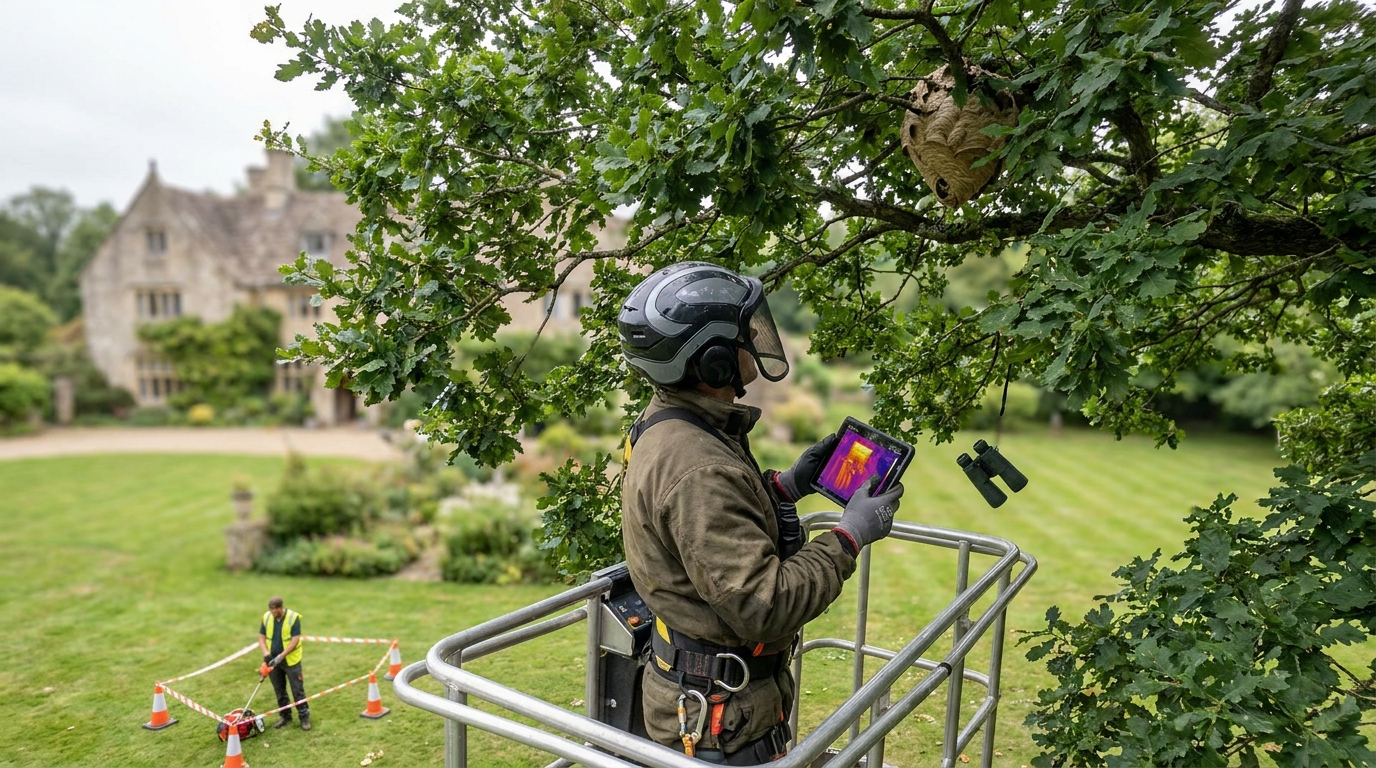
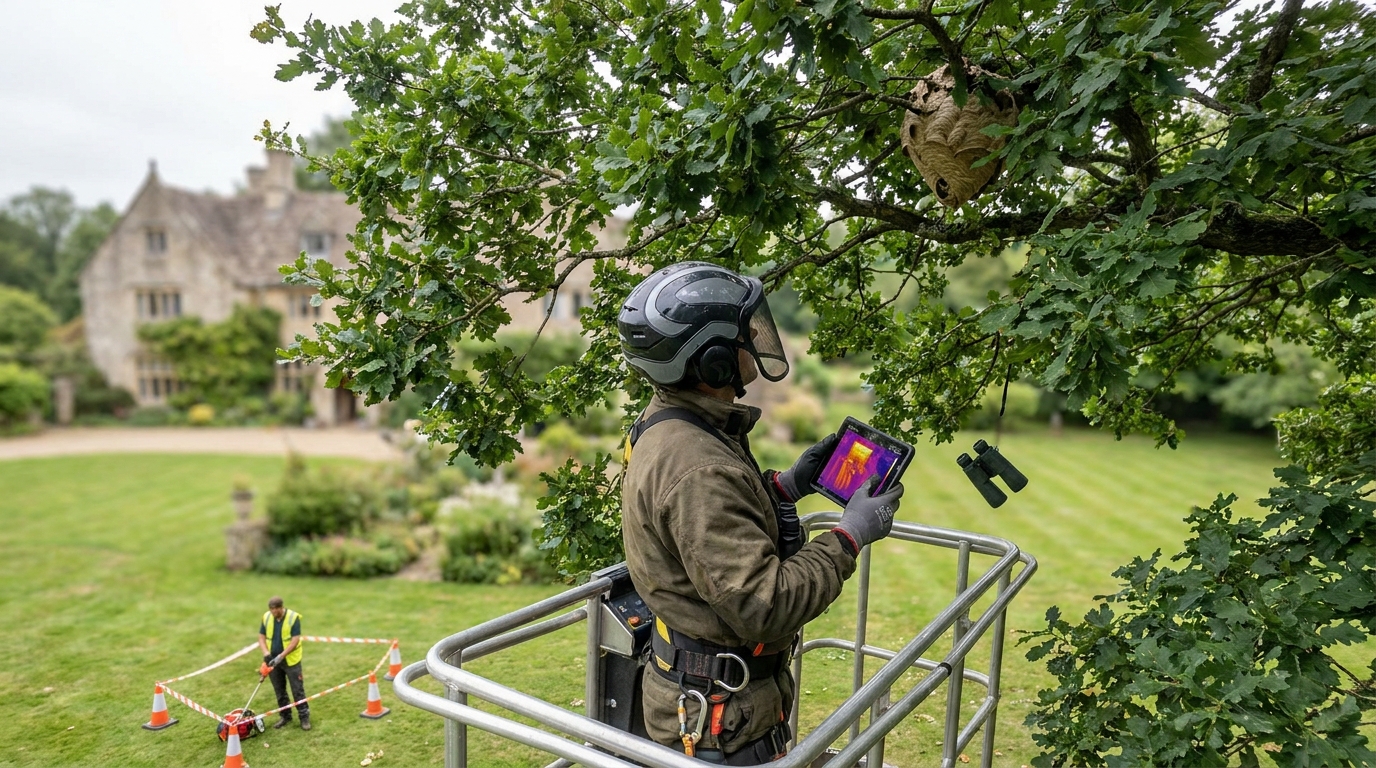
Yes, hornets do nest in trees. It's even their preferred location for secondary nests, which colonies build from June-July onwards when the population explodes. And the problem is that these nests are often completely invisible from the ground.
A hornet's nest in a tree in full leaf is a nightmare to spot. The structure, made of chewed wood fibers, has a brown-gray color that blends into the branches. Yet its size can reach 80 cm in diameter and shelter over 2,000 individuals in autumn. Studies by Fredon (Fédération régionale de défense contre les organismes nuisibles) show that 70 % of Asian hornet nests in trees are only discovered after leaf fall, in November or December. Too late to intervene effectively on the active colony.
The height of the nest further complicates matters. The secondary nests of Vespa velutina are generally installed between 10 and 25 metres high. Sometimes higher. Nests up to 30 meters have been documented in tall poplars. At this distance, even a nest the size of a basketball goes completely unnoticed in the canopy. A hornet's nest in a tree trunk is rarer, but it does happen, especially when the trunk is hollow or has a natural cavity.
How can you spot a hornet's nest in a tree before it becomes huge? The most reliable technique is to observe flight paths. Workers follow fairly regular routes between their hunting grounds and the nest. If you see hornets passing over and over again in the same place, always in the same direction, follow the flight line with binoculars. Do this in the late afternoon, when traffic is heaviest. You'll eventually locate the convergence point in the tree.
Here are a few concrete warning signs to watch out for:
-
A regular flow of hornets to the same tree, especially in the morning and at the end of the day.
-
Droppings (small dark droppings) at the foot of a tree, a sign of activity above the tree.
-
A continuous dull hum from the top, audible in calm weather
-
Fragments of papier-mâché (nest material) fallen to the ground after a gust of wind
Camouflage is all the more effective in certain species. A hornet in a weeping willow, for example, benefits from a curtain of drooping branches that completely conceals the nest. Plane trees, oaks with dense foliage and tall laurel trees all provide ideal cover. Conversely, a nest in a birch or a tree with light foliage will be easier to detect.
And don't confuse a hornet's nest with other structures. A wasp's nest in a tree is generally smaller (rarely more than 25 cm) and often located lower down. The nests of oak processionary caterpillars look like white silken cocoons, nothing like the grey-brown honeycomb structure of hornets. If in doubt, take a photo with a good zoom lens and contact a professional for identification.
An important point: never climb a tree to check for a nest. An Asian hornet nest in a tree, even a small one, can trigger a mass attack if the insects perceive a vibration or threat from less than 5 meters away. Multiple stings of Vespa velutina require medical attention in around 2 % of cases, according to Anses, and severe allergic reactions do occur.
Safety and intervention guide: How to deal with a hornet in your tree?
The first rule is non-negotiable: never try to destroy a hornet's nest in a tree yourself. Not with a garden hose, not with smoke, not with commercial insecticide sprays. Every year, hospital emergency departments receive people who have tried to play hero with a hornet's nest high up in the air. Falls from ladders combined with bites are the classic disaster scenario.
Safety in the garden against hornets is based on a simple three-step protocol.
Step 1: Assess the situation. Do you see isolated hornets on your fruit or flowers? This is normal predation, not an emergency. They come to feed and then leave. Keep your distance, avoid sudden movements, wear light-colored clothing (hornets are attracted by dark colors) and pick up fallen fruit to reduce its attractiveness. The occasional hornet on a fruit tree is not the same as an established nest.
Step 2: Confirm the presence of a nest. If the clues converge (regular traffic, buzzing, oriented flight paths), try to locate the nest visually with binoculars, without approaching closer than 10 meters. Note the approximate height, tree species and apparent diameter of the nest. This information will be invaluable to the professional.
Step 3: Call in a professional exterminator. This is the only reasonable option for destroying a hornet's nest in a tree. Specialized companies use telescopic poles (up to 25 meters), ventilated full-body suits and professional pyrethroid-based insecticides, applied directly into the nest entrance. The intervention generally lasts between 30 minutes and an hour. The average cost is between €80 and €200, depending on height and accessibility, although some local authorities will pay part of the cost (ask your local council for details).
What about trapping? Hornet traps can be useful in the spring, between February and May, to capture founding queens before they create their colony. The classic trap is a bottle containing a mixture of dark beer, white wine and blackcurrant syrup. The white wine repels the bees, limiting by-catch. Warning: trapping in summer is not recommended by the Muséum national d'Histoire naturelle, as it captures too many non-target insects and has no significant impact on an already established colony. Trapping does not replace professional intervention on an existing nest.
What about pruning? If you have to prune a tree between April and November, carefully inspect the foliage before you start. Professional pruners know: discovering a hornet's nest with a chainsaw, perched 15 meters up in a harness, is a situation no one wants to experience. If you have the slightest doubt, have the tree inspected by a specialist before any pruning. The vibrations of the cut can trigger a massive defensive reaction.
Why shouldn't hornets be systematically killed? A legitimate question. The European hornet (Vespa crabro) is a protected species in several European countries, and plays a role in regulating insect pests. The Asian hornet, on the other hand, has been classified as an invasive alien species in France since 2012, and its destruction is encouraged. Make the distinction: the European Hornet is larger, redder and less aggressive. The Asian Hornet is darker, with an orange face and yellow-tipped legs. If you're not sure, photograph the insect and submit the image on the iNaturalist platform or on the frelonasiatique.mnhn.fr website for identification.
To protect your garden for the long term, a few complementary measures work well: install protective netting on the most attractive fruit trees during the ripening period, maintain strict hygiene (picking up fruit from the ground, closed garbage cans), and systematically report nests to the local authorities to help monitor the species. Each reported nest feeds the databases that map the progression of the species. Vespa velutina and to adapt control strategies on a national scale.
Conclusion
A hornet in a tree doesn't have to spell disaster. It could be a simple visit to a restaurant, or it could be the sign of a nest of Asian hornets in a tree in your garden, with all that that implies in terms of risk. The key is observation. Look for flight paths, listen, inspect your trees before pruning, and above all, don't play the role of insect killer.
If you suspect the presence of a nest, contact a pest control professional without delay. The earlier in the season you take action, the more effective it is, and the less it costs. And if you want to act upstream, trapping foundresses in spring remains your best preventive lever. Your garden deserves to be a safe space, both for you and for the pollinators that work there every day.
Frequently asked questions
Why are hornets attracted to my trees?
Your trees are vital sources of food: they provide sugar via ripe fruit and sap, and protein via the pollinating insects that hornets hunt. A mature fruit or oak tree is a veritable «five-star resort» for a colony.
How do I know if a hornet's nest is hidden in my tree?
Observe flight paths at the end of the day: a regular back-and-forth movement towards a specific point in the canopy often indicates a nest. Other signs include a constant low hum or the presence of dark droppings at the base of the trunk.
What's the difference between a feeding hornet and an established nest?
A lone hornet foraging on fruit or sap is simply looking for food and is not aggressive if left alone. A nest, on the other hand, is home to hundreds of individuals ready to launch a collective attack if you approach within 5 meters or vibrate the tree.
Is it dangerous to prune a tree if hornets are circling?
Yes, it's extremely risky. The vibrations of a chainsaw or pruning shears can trigger a massive defensive attack by the colony camouflaged in the foliage. Always inspect the canopy carefully before pruning between June and November.
What should I do if I discover a hornet's nest high up in a tree?
Never try to destroy it yourself with a water jet or insecticide spray, as the risk of falling and multiple bites is too high. Contact a professional equipped with telescopic poles for safe, total eradication.
 French
  English
  Dutch
Dutch
0 Comments