
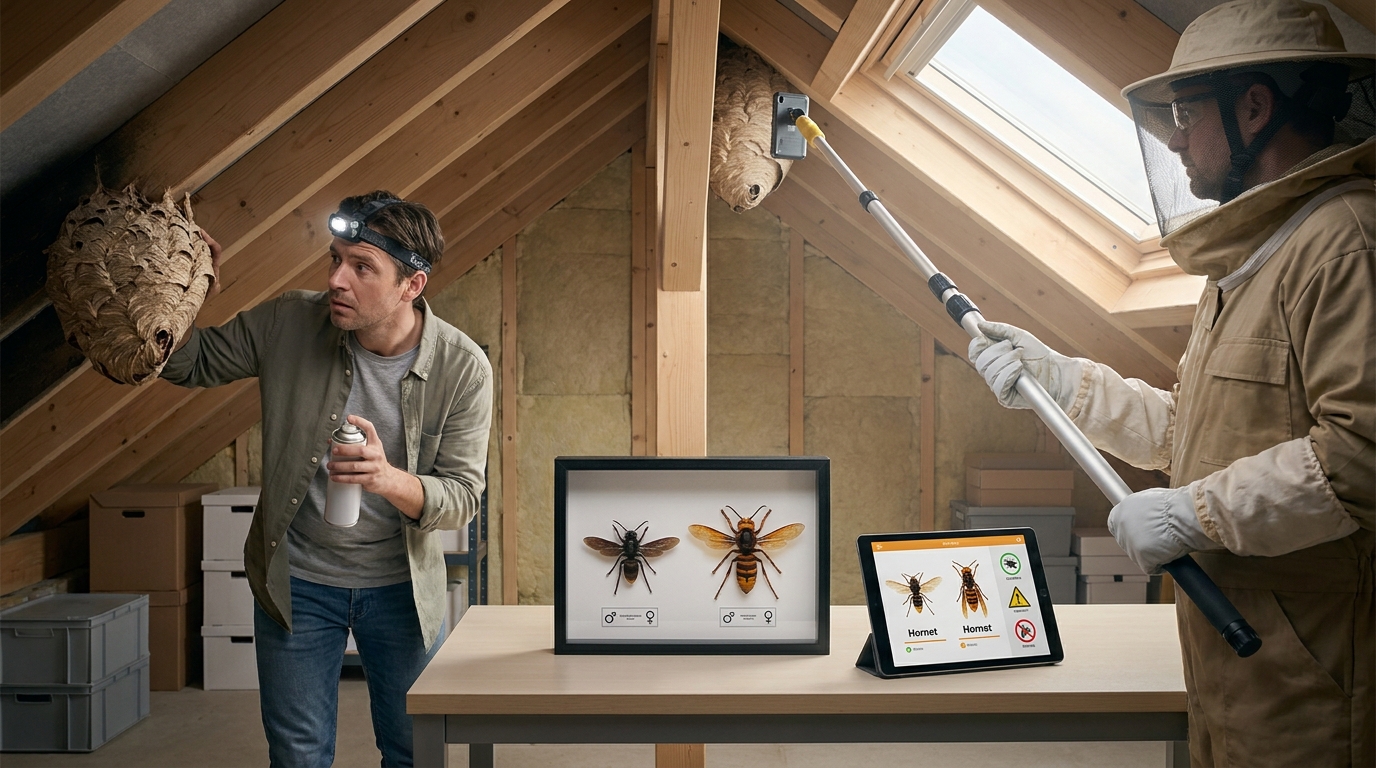
Hornet nest in the attic: identification, dangers and solutions
Contents
-
Identifying your attic occupant: Asian hornet vs. European hornet
-
Accessing your attic with a nest: Immediate risks vs. professional intervention
-
Choosing the right destruction solution: Pre-intervention recommendations
You go up to the attic to fetch the Christmas decorations, and there: a dull humming, insects buzzing back and forth near the rafters, perhaps even a grayish mass clinging to a beam. The heart races. It's to be expected. A hornet's nest in the attic is scary, and rightly so.
Things to remember
-
This article lifts the veil on the presence of hornets in the attic, providing a direct answer to the anguish felt by homeowners: why are they there, and is it safe to enter?
-
We compare the behavior of the species and offer a decision grid between dangerous inaction and the professional expertise of Hornets.
-
Asian hornet vs. European hornet
-
Immediate risks vs. professional intervention
What we see most often at Frelons.be is exactly this scenario. Homeowners who discover a hornet's nest in their attic in midsummer, sometimes in autumn, and don't know what to do. Go up anyway? Close the trapdoor and forget about it? Call someone? The answer depends on what's living up there, and how big the problem is. We'll untangle it all together.
Identifying your attic occupant: Asian hornet vs. European hornet
First thing to do before making any decisions: know who you're dealing with. Because the difference between a European hornet and an Asian hornet in your attic is a bit like the difference between a stray cat and a fox in your henhouse. Both are a problem, but not in the same way.
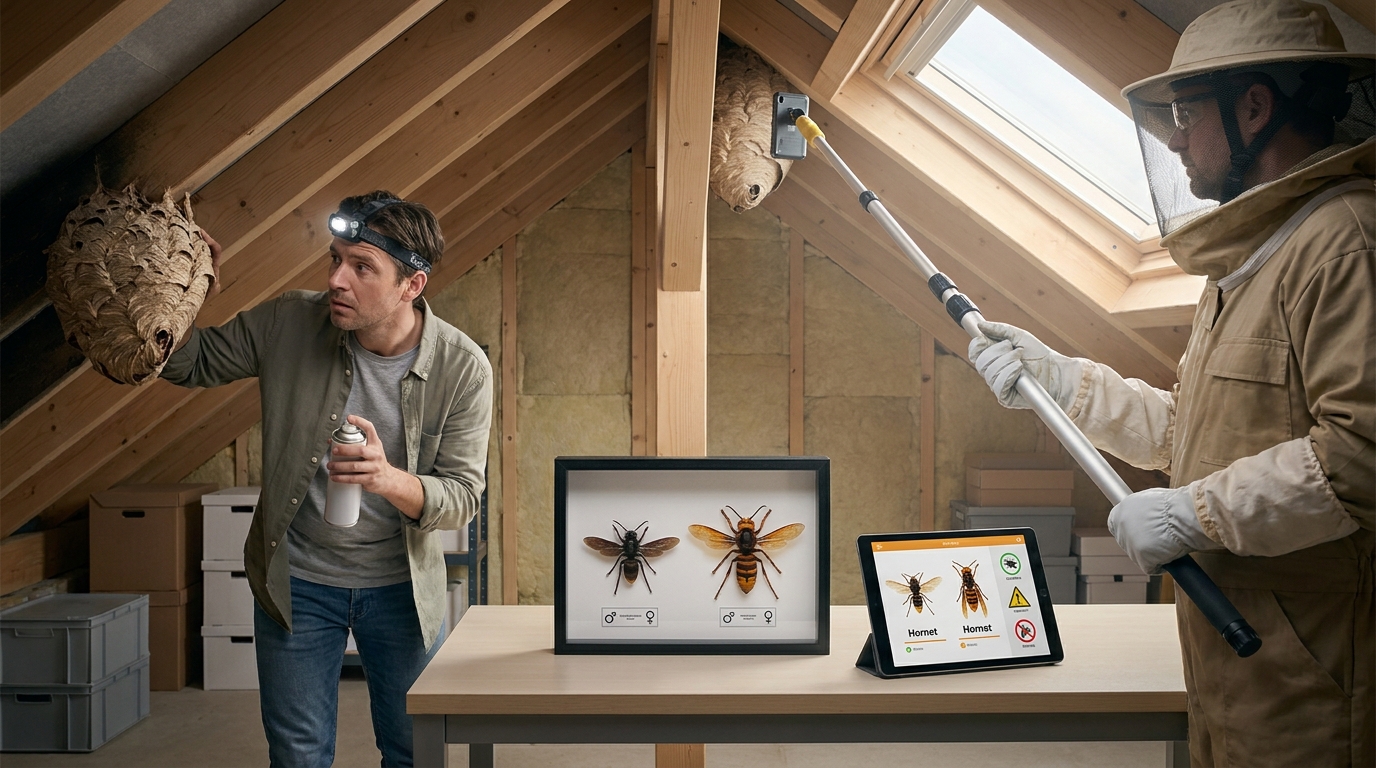
The European hornet (Vespa crabro), it's the big redhead. Reddish-brown body, brown legs, imposing size (up to 35 mm for queens). It's been around forever in Belgium. Its nest resembles a large papier-mâché balloon, often open at the bottom, with a texture reminiscent of beige-orange corrugated cardboard. It likes to nest in attics, old hollow trees and sometimes walls. Noisy, impressive, but relatively predictable. It won't attack you if you don't shake its nest.
The Asian hornet (Vespa velutina), it's a different story. Smaller than its European cousin (around 25 mm for the workers), it is best recognized by its dark, almost black body, with a prominent orange ring on the abdomen and yellow-tipped legs. Its nest? Often in the shape of a closed sphere, sometimes enormous (up to 80 cm in diameter at the end of the season), with a small lateral opening. It's increasingly found under roofs in Belgium, and it's a real problem.
The signs of a hornet's nest in your attic are quite clear:
-
Regular comings and goings of insects near a roof opening, ventilation hole or space under the tiles
-
A hum audible from the floor below, especially in hot weather
-
Pieces of papier-mâché (nest construction waste) falling between the boards
-
The presence of dead hornets on the attic floor or near windows
How can you tell if there's a hornet's nest in your attic without climbing in? Observe the outside of your house, especially at the end of the day when the workers are returning. If you see hornets systematically entering the same spot under the roof, it's almost certain. The Asian hornet often chooses high, well-protected areas under the roof, which makes attics particularly attractive.
Be careful not to confuse them with other occupants. A wasp in the attic is also common, but wasps are much smaller and their nests have a different, more «layered» structure. A weasel's nest in the attic doesn't buzz: it scratches, runs and leaves droppings. Confusion is rare once you know what to look for.
If the insect is dark with yellow legs, you're probably dealing with Vespa velutina. And there's no time to dawdle.
Accessing your attic with a nest: Immediate risks vs. professional intervention
We'll be blunt: no, you shouldn't go up into your attic if you suspect the presence of an active nest. Not «maybe», not «with caution». No.
The danger of a hornet in the attic is real and often underestimated. When a nest is disturbed, hornets don't think. They defend. An Asian hornet nest at the height of its season can contain between 1,500 and 6,000 individuals. Imagine yourself in a confined space, under a low roof, with thousands of insects who see you as a threat. The exit is behind you, through a narrow trapdoor. You understand the problem.
The Asian hornet's sting is more painful than that of a wasp. The venom contains substances that cause intense pain, local swelling and, in some cases, severe allergic reactions. A single sting is enough to trigger anaphylactic shock in sensitized individuals. Several simultaneous stings can cause distress even in someone who is not allergic: kidney failure, destruction of red blood cells. There are documented cases of 20 to 30 bites. In a cramped attic, this threshold is quickly reached.
And the European hornet? Less aggressive, it's true. They rarely attack far from their nest. But «less aggressive» doesn't mean «harmless». In a confined space like an attic, proximity is inevitable. You're less than a metre from the nest without even meaning to be. You're in the defense zone.
What we see all too often at Frelons.be:
-
People who go up «just to see» and come running back down with several injections
-
Smoking attempts make hornets even more aggressive
-
Commercial insecticide sprays on a 40 cm nest, which is like tickling a bear.
Where does a hornet hide in a house outside the nest? Scouts and disoriented workers are often found in living rooms, attracted by light. They pass through floor gaps, electrical ducts and recessed spotlights. Closing the attic hatch is not always enough to guarantee the safety of the attic and lower floors.
The only sensible approach when an active nest is confirmed: don't touch it, close off access as much as possible, and call a professional. Your family's safety comes before curiosity or the desire to deal with the problem yourself on a Sunday afternoon.
Choosing the right destruction solution: Pre-intervention recommendations
A neighbor told you he'd taken care of the problem himself with a garbage bag and a ladder. Good for him. Statistically, this is the kind of story that ends up in the emergency room one time out of five. To get rid of a hornet under a roof, especially if it's a Vespa velutina, In order to do this, you need equipment, experience and a precise knowledge of the insect's behavior.
What a pest control expert does in practice :
-
Species identification and nest size assessment (sometimes with a thermal camera for nests hidden in insulation)
-
Choice of appropriate protocol: injection of insecticide directly into the nest using a telescopic boom, or treatment by powdering, depending on the configuration.
-
Work in full-body suit with respiratory protection
-
Nest removal once the colony has been neutralized (generally 24 to 48 hours after treatment)
-
Check that there are no secondary nests nearby
The question of price always comes up. In Belgium, the cost of destroying a hornet's nest varies between 80 and 200 euros, depending on accessibility, height and the species concerned. A nest in an accessible attic costs less than one wedged between two layers of insulation six meters up under a cathedral roof. At Frelons.be, we announce the price before we intervene, so there are no surprises.
Why not kill an isolated Asian hornet rather than treat the nest? Because crushing a worker is useless. The queen produces hundreds of eggs a day. You can kill ten a day for a month, and the colony will continue to grow. It's the nest that needs to be neutralized, not the individuals.
An important point: the period of intervention counts enormously. A nest discovered in May-June is small, with few workers. Intervention is quicker, less risky and less expensive. A nest discovered in September is potentially a 60 cm monster with thousands of occupants and future queens ready to swarm. The longer you wait, the more complicated it becomes.
When it comes to attic pest control, don't just call in anyone. Check that the contractor uses approved products, has professional insurance and is familiar with local regulations. In Belgium, the Asian hornet is a notifiable invasive species. A serious professional will report it to the relevant authorities after it has been destroyed.
What about the «natural» solutions you see all over the Internet? Beer traps, vinegar, essential oils? They might catch a few marauding workers. They'll never get rid of a nest in your attic. You might as well empty the sea with a spoon.
Conclusion
A hornet's nest in the attic is a problem that can't be solved on its own, and gets worse over time. Identify the species from a distance (color, size, shape of nest), don't go up into your attic while the nest is active, and call in a professional without delay.
At Frelons.be, we work all year round on Asian and European hornet nests in Belgium. One call is all it takes to get a diagnosis and a clear price quote. Your attic belongs to you, not to the hornets.
Frequently asked questions
How can I tell a European hornet from an Asian hornet in my attic?
The European Hornet is imposing, with a reddish body and brown legs. The Asian Hornet is smaller, with a very dark (almost black) body, an orange face and, above all, yellow-tipped legs.
Is it dangerous to enter an attic where there is a nest?
Yes, it's extremely risky. In an enclosed, confined space like an attic, proximity to the nest triggers the colony's defense instinct, which can lead to multiple stings and the risk of anaphylactic shock.
Can I destroy a hornet's nest myself using a commercial insecticide?
We strongly advise against this. Conventional sprays don't reach the heart of a large nest and only irritate the colony, radically increasing the aggressiveness of the thousands of individuals present without eradicating the queen.
How much does it cost to remove a hornet's nest in Belgium?
On average, professional intervention costs between €80 and €200. Rates vary according to the accessibility of the nest (under the roof, in the insulation) and the size of the colony at the time of removal.
What should I do if I see hornets coming out of my ceiling or spotlights?
This means that the nest is probably located in your attic insulation. Don't plug the holes (as this will encourage them to seek an exit inside your living spaces) and contact an expert immediately for targeted treatment.
 French
  English
  Dutch
Dutch
0 Comments