
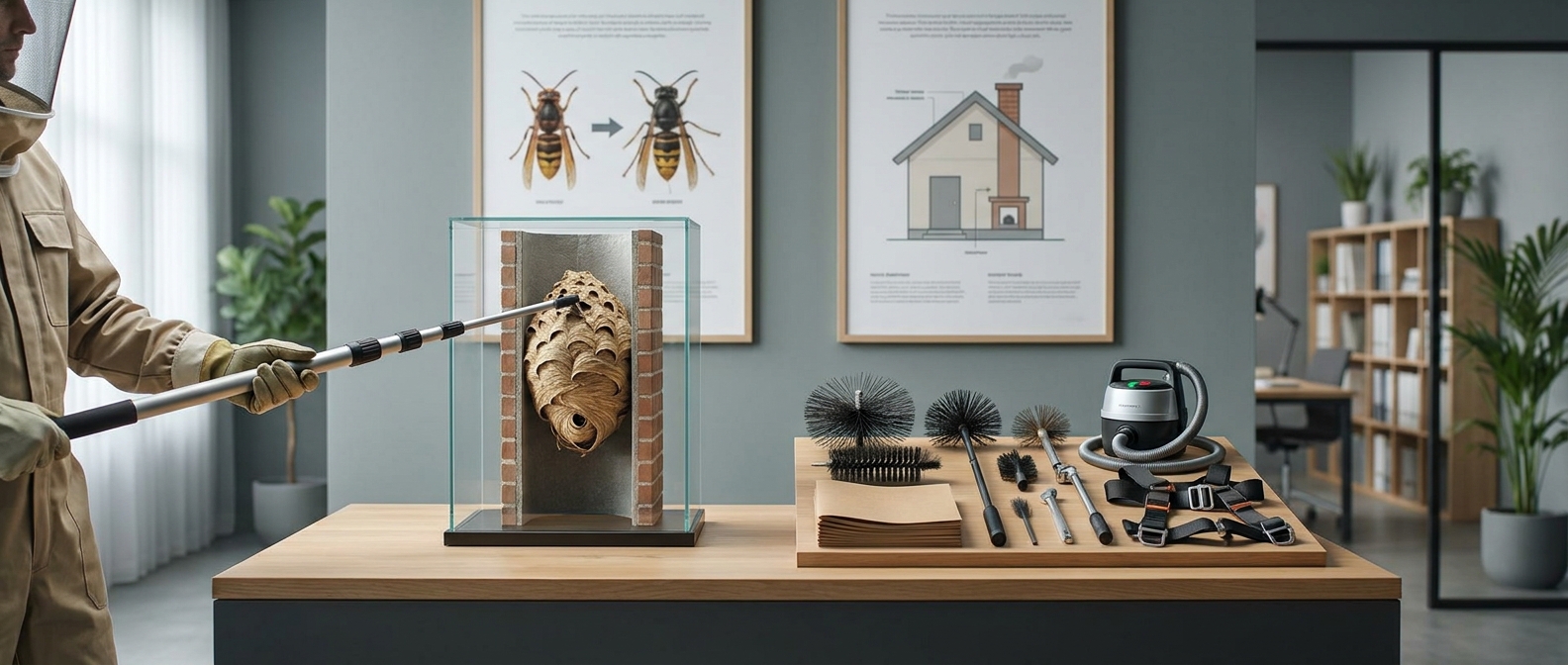
Hornet nest in the chimney: identification and solutions
Contents
-
European hornet vs. Asian hornet: identifying the danger in the chimney
-
Professional intervention vs. in-house methods: advantages and disadvantages
-
Selection criteria and recommendations for long-term pipe safety
A dull hum from the fireplace. Insects flying back and forth around the chimney cap. You're not crazy, and no, it's not «just a wasp passing by». When hornets take up residence in a chimney flue, they're quick to notice, and can't be solved by lighting a fire.
Things to remember
-
We explore why hornets, particularly the Asian species, prefer your chimney flues
-
Unlike conventional guides, we analyze seasonal behavior and offer a rigorous comparison between expert intervention and DIY solutions, while integrating the crucial step of post-treatment chimney sweeping for total home safety all year round.
-
identifying hazards in the chimney
-
advantages and disadvantages
Every year, at hornets.be, we deal with dozens of cases of hornets in the chimney. The scenario is often the same: the homeowner hears the noise, hesitates for a few days, tries something he's found on the Internet, then ends up making an emergency call. We'll save you the trouble. In this article, we take a look at how to identify the species squatting in your chimney, why chimneys are so attractive to hornets, and above all, how to get rid of them cleanly and permanently, without endangering your family.
We're also going to talk about something that almost no one mentions: what's going on after destroying the nest. Because a flue blocked by the remains of a nest means a risk of carbon monoxide poisoning. Treatment doesn't stop with insect control.
European hornet vs. Asian hornet: identifying the danger in the chimney
First thing to do when you suspect a hornet in the chimney: observe. Not too closely, of course. But identifying the nest and the species changes the situation completely, both in terms of the level of danger and the method of intervention.
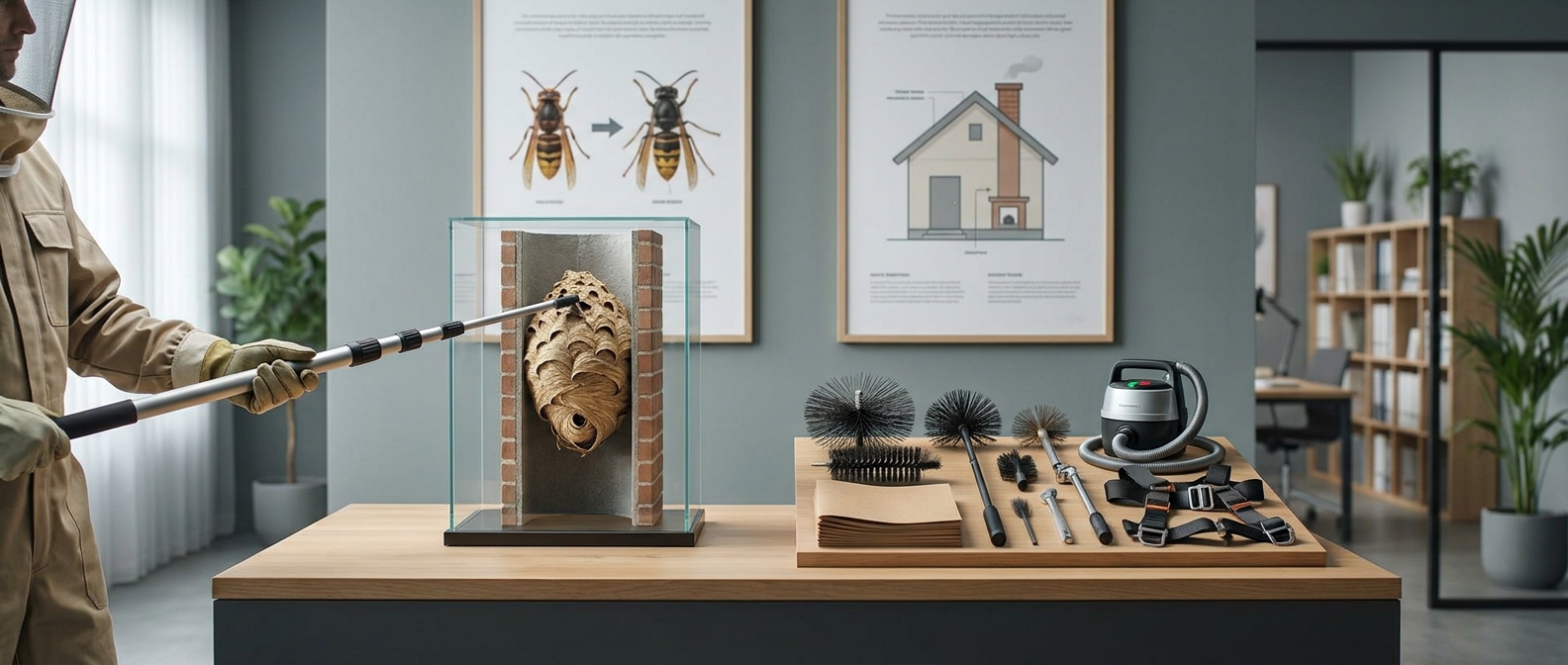
The European hornet (Vespa crabro) is the most common in our regions. Reddish-brown body, brown legs, imposing size (up to 3.5 cm for queens). They are nocturnal, attracted by light. If you see insects circling around your lamps at night and hear a noise in the flue, it's probably him. He's impressive but relatively unaggressive, unless you approach the nest.
The Asian hornet (Vespa velutina), it's a different story. Smaller (2.5 to 3 cm), it can be recognized by its black thorax, yellow-tipped legs and orange face. It is diurnal, very active and, above all, much more defensive around its nest. An Asian hornet in your chimney is a serious problem. This invasive species is steadily expanding in Belgium and France, and loves protected cavities like chimney flues.
Why the chimney? What attracts hornets to a house? Three main factors:
-
Residual heat Even an unused chimney maintains a more stable temperature than the outside, ideal for starting up a colony in spring.
-
Darkness and protection The duct provides perfect shelter from wind, rain and predators.
-
Easy access A missing or damaged chimney cap means the door is wide open.
How can you tell if you've got a hornet's nest in your chimney? There are several reliable clues. Firstly, a continuous buzzing sound: not a one-off noise, but a regular humming, especially audible in the morning or at the end of the day. Then there's the coming and going of insects around the roof. And sometimes hornets, who end up entering the room through the fireplace, especially if the damper is poorly closed or non-existent.
An important detail for nest identification: the European hornet often builds its nest inside the duct, sometimes quite low down, visible if you shine a light on the fireplace. The Asian hornet, on the other hand, may set up a primary nest (small, about the size of a tennis ball) in the duct in spring, then migrate to a larger secondary nest outside in summer. If you find a wasp in your chimney flue, don't be confused: wasps build smaller, open umbrella-shaped nests. Hornets' nests are round, closed, with a single opening.
One last thing about danger. A European hornet sting is painful but rarely serious (except for allergies). A group attack by Asian hornets defending their nest in a confined space such as a chimney flue is potentially fatal. It's no joke. If you have the slightest doubt about the species, don't try anything yourself.
Professional intervention vs. in-house methods: advantages and disadvantages
Let's get straight to the point: in 90 % cases of hornets in chimney flues, professional intervention is the only reasonable option. We know this isn't what everyone wants to hear, especially when you type «hornet nest destruction» into Google hoping to find a miracle trick. Let's take an honest look at both approaches.
The homemade methods you see everywhere:
Is smoke effective in getting rid of hornets? The first thought that comes to mind is «I'll light a fire, that'll scare them off». Not a good idea. Smoke can indeed disorient hornets, but in a chimney flue, you run the risk of making them aggressive and pushing them into the house rather than out. What's more, if the nest partially obstructs the flue, the smoke will back up into your living room. Carbon monoxide poisoning, angry hornets in the room: the perfect combo for a trip to the emergency room.
Commercial insecticide sprays? Insufficient range to reach a nest several meters up the chimney. And you can imagine the risk of spraying a flammable product into a chimney.
Plugging the pipe to «suffocate» them? This won't work. The hornets will find another way out, often inside the house, through cracks or faulty joints. We've seen entire colonies swarm into a bedroom after the owner had sealed the chimney cap. Not the kind of wake-up call you'd wish on anyone.
Professional intervention :
A professional pest control technician has the right equipment: full-body anti-sting suit, telescopic pole to inject the product directly into the nest, professional residual insecticide (which continues to act for several days to eliminate hornets absent at the time of treatment). Treatment generally takes between 30 minutes and an hour.
When it comes to the price of insect removal, you should expect to pay between 80 and 200 euros on average for the destruction of a hornet's nest in a duct. Prices vary according to the height of the nest, accessibility, species (the Asian hornet sometimes requires extra precautions) and your region. Some municipalities in Belgium offer bonuses or free interventions for Asian hornets. Check with your local authority for details.
The question of safety is the key issue. A chimney flue is a vertical space, narrow and difficult to access. You're in a vulnerable position: you can't step back, you can't see the actual size of the nest, and there's a risk of falling if you climb onto the roof. A professional knows how to assess the situation before taking action. They also know how to recognize a wasp nest in a chimney from a hornet's nest, which changes the protocol.
And why shouldn't you just kill the hornets yourself? Beyond the immediate danger, a partially destroyed nest is worse than an intact one. The survivors become hyperaggressive, and the queen can restart a colony if she is not eliminated. The job has to be done properly or not at all.
At hornets.be, we work all year round. Yes, even in winter. Because an abandoned nest in a duct remains a problem (obstruction, debris, risk of reinfestation the following spring). We don't just kill the insects: we make sure the duct is cleared, so you can safely move on to the next stage.
Selection criteria and recommendations for long-term pipe safety
The nest is treated, the hornets are dead. You think it's over? Not quite. The post-treatment phase is the one that most people neglect, and it's often here that problems start up again the following year.
Chimney sweeping after a nest: non-negotiable.
A hornet's nest in a duct, however small, leaves a residue. Nest fragments (a mixture of chewed wood fibers), insect corpses and droppings. All this partially obstructs the flue and can cause smoke to back up or, worse still, a build-up of carbon monoxide if you use your chimney. Chimney sweeping after a nest is a compulsory step before relighting any fire. Call in a professional chimney sweep, who will also check the integrity of the flue: hornets can damage joints and linings over time.
Prevention: stop it from happening again.
The best protection for your chimney is an anti-braking grid. This is a fine-mesh screen (6 to 8 mm maximum) installed on the chimney cap. The mesh must be small enough to block hornets and wasps, but large enough to let smoke through without draught problems. Beware of DIY solutions: a mesh that's too tight will quickly clog up with soot and reduce draught. A screen that's too wide won't block anything at all.
A few criteria to help you make the right choice:
-
Material Stainless steel is preferred. Galvanized steel rusts with acid condensation in the flue. Stainless steel lasts for years without maintenance.
-
Mounting The following points should be borne in mind: the grille must be securely fastened, not simply laid. Wind and weather will tear it off otherwise.
-
Maintenance Cleaning the grate: the grate should be cleaned annually, ideally when the chimney is swept. Soot and cobwebs will eventually clog the mesh.
If your chimney doesn't have a cap at all, now's the time to install one. A cap with integrated grid costs between 40 and 150 euros, depending on the diameter of the flue. This is a derisory investment compared to the cost and stress of a new infestation.
The right timing for action.
Prevention is more effective if you anticipate it. Founding queens look for a nesting site between March and May. If your screen is in place before then, you're on the safe side. In autumn, after the annual chimney sweep, check that everything is in order. This is also a good time to inspect other potential entry points: air vents, roller shutter boxes, under roofs.
A point often overlooked: unused chimneys are the most vulnerable. No fire, no smoke, no disturbance. It's the perfect place for a colony. If you no longer use your chimney, seal it properly or install a vented flue cap. This prevents insects from gaining access and avoids moisture problems.
The safety of your home depends on these details. A well-maintained flue, an installed grate and regular chimney sweeping are the combination that keeps you safe. And not just from hornets. Wasps in the chimney, birds nesting in the flue, bats: all these unwelcome visitors are stopped by the same flue protection measures.
Conclusion
A hornet in the chimney is never trivial. Whether it's a European or an Asian hornet, the proximity to your living space makes the situation urgent. Identify the species if you can, but don't take any unnecessary risks. Call in a professional, have the chimney swept after treatment, and install lasting protection.
At frelons.be, we're active all year round to get rid of hornets in your chimneys, roofs and gardens. Any doubts or suspicious noises in the flue? Just contact us. We'll assess the situation quickly and take action as soon as possible. One call too many is better than one sting too many.
Frequently asked questions
How do I know if I have a hornet's nest in my chimney?
The most common sign is a continuous dull buzzing from the flue, coupled with insects coming and going around the chimney cap. In summer, you may also find disoriented hornets falling directly into your fireplace.
Can I light a fire to scare away hornets?
Don't smoke. The smoke can make the hornets extremely aggressive, causing them to invade the interior of your home. What's more, if the nest blocks the flue, you run the risk of carbon monoxide poisoning.
What's the difference between a European hornet and an Asian hornet?
The European hornet has a reddish-brown body and is most active in the evening. The Asian hornet is smaller, with a black thorax and yellow legs; it is more aggressive and represents a real danger if it feels threatened near its nest.
Why is it necessary to sweep the chimney after destroying the nest?
This is a vital safety step: nest residues and insect corpses can clog the flue. A professional chimney sweep eliminates the risk of smoke back-up and fire the next time you use your chimney.
How can I prevent hornets from returning to my duct?
The most durable solution is to install a stainless steel anti-braking grid on the chimney cap. The mesh should be fine enough (around 6-8 mm) to block insects while still allowing combustion fumes to pass through.
How much does it cost to have a professional remove a hornet's nest?
In Belgium, the price of a disinsection generally varies between €80 and €200. The price depends on the height of the chimney, the difficulty of access and the species of hornet to be treated.
 French
  English
  Dutch
Dutch
0 Comments