
Asian hornet: who to notify if a nest is reported?
Contents
-
A hornet's nest in a public or private space: who should you call first?
-
Destroying a hornet's nest: choosing the right authorized service provider
You've spotted a large, dark insect prowling around your fruit trees or terrace. It's stockier than a wasp, with conspicuous yellow legs. First reaction: panic. Second reaction: «What do I do, who do I call? This is exactly the question that thousands of private individuals ask themselves every year, and the answer is not the same depending on whether you observe an isolated individual, a nest on a communal lamppost or a colony installed under your roof.
Things to remember
-
We distinguish three critical cases: the simple scientific reporting of an individual, the management of a nest in a public versus private space, and the use of professional destruction.
-
The article highlights the importance of active vigilance all year round, including spring trapping.
-
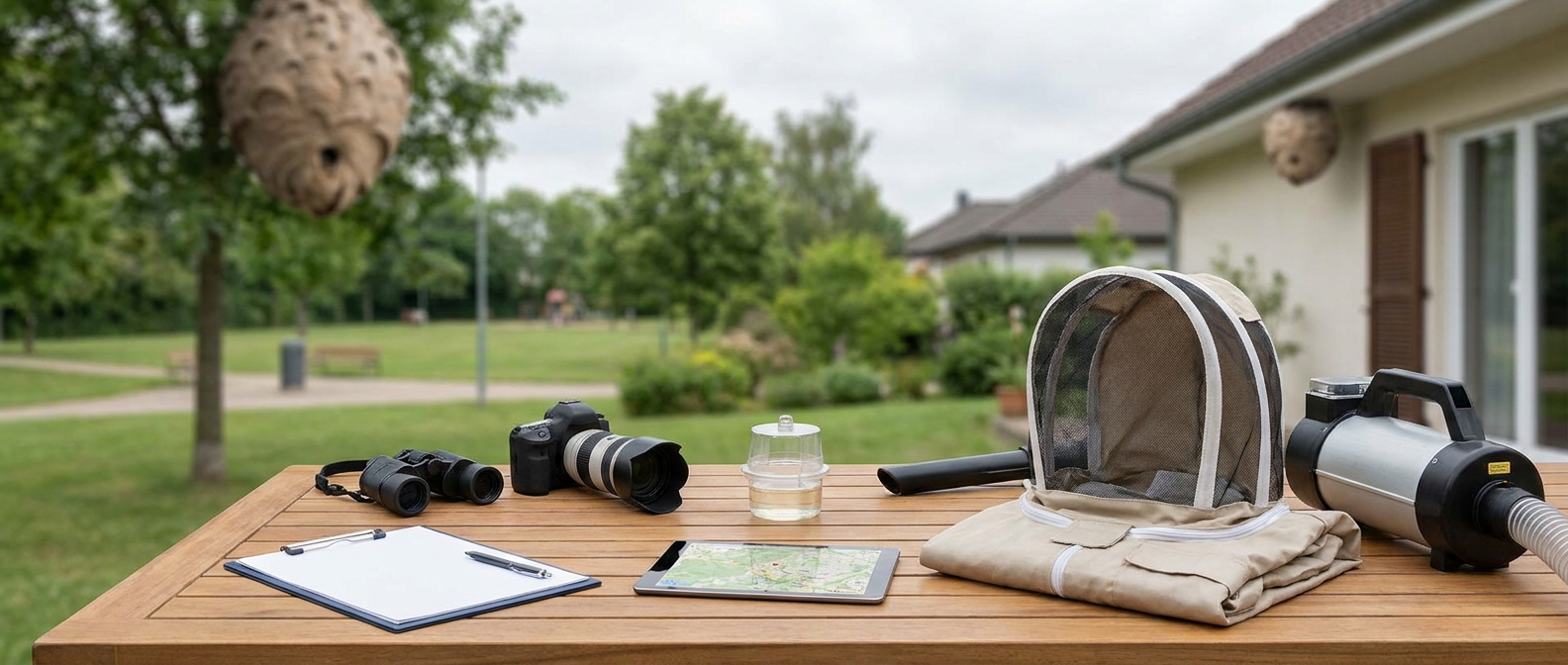
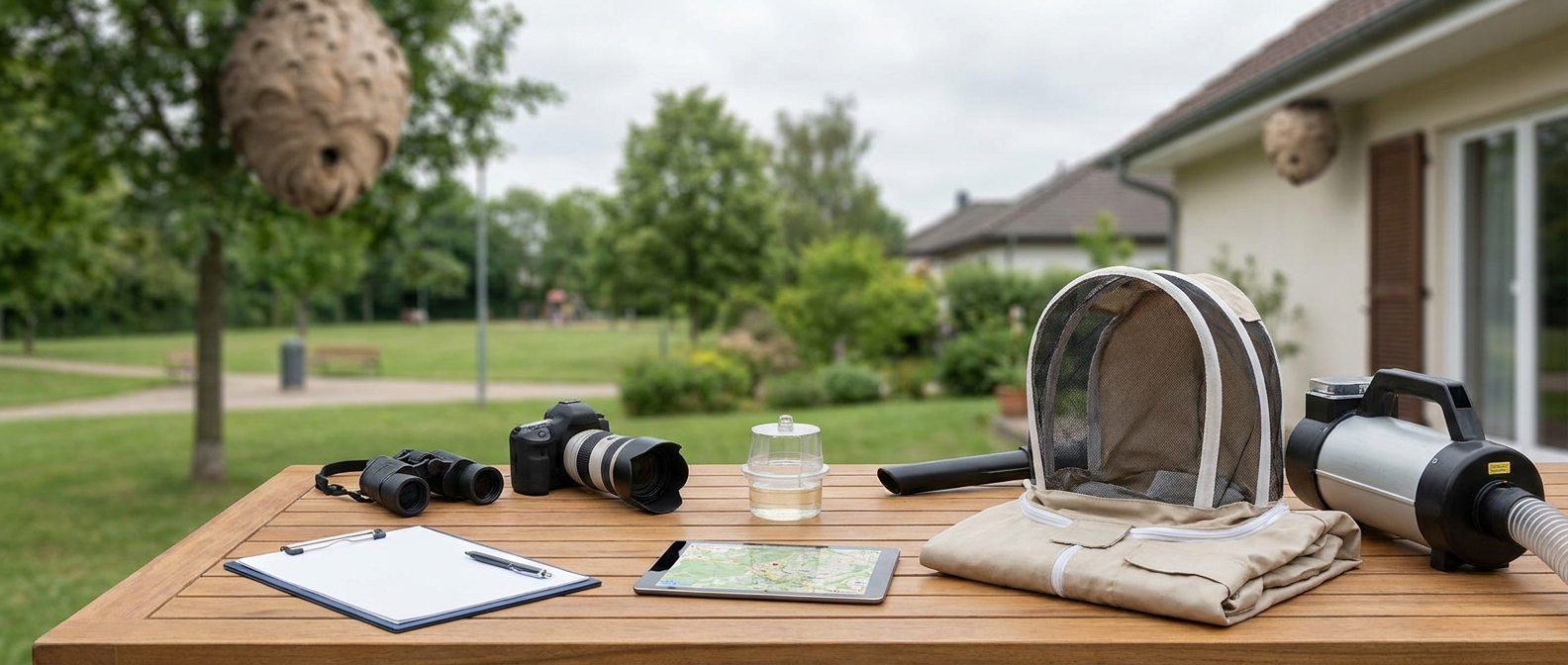
monitoring tools
-
who to call first?
The problem is that the people to contact vary. Commune, fire department, prefecture, private exterminator: each has a precise role to play, and going through the wrong door can waste precious time. An Asian hornet nest can grow to the size of a basketball in just a few weeks. In other words, every day counts.
At Frelons.be, we take action against the Asian hornet all year round. What we see in the field is that many people hesitate too long before taking action, because they don't know who to warn. This article gives you the right reflexes in three concrete situations: reporting an individual, managing a nest whether it's on public or private property, and choosing a professional to destroy it.
Reporting the presence of Asian hornets: monitoring tools
An Asian hornet sitting on an ivy flower in September may seem harmless. But it isn't. Each individual sighting, even without a visible nest, feeds into a surveillance network that enables scientists and authorities to track the progress of the Vespa velutina on the territory. Reporting an Asian hornet isn't just about «making a report»: it's about making a direct contribution to the inventory of biodiversity and the protection of bee colonies.
Where can I report the presence of Asian hornets? There are several options, all free of charge.
-
Online reporting platforms In Belgium, the comments.be (managed by Natagora) lets you encode a sighting with photo and geolocation. There are also: Inaturatis, Fixmystreet and Vespawatch. These tools centralize data and make it accessible to researchers. A clear photo of the specimen (from the front if possible, to see the characteristic orange head) is all that's needed for your report to be validated.
-
Your municipality Invasive species: many people don't know it, but the commune is an official contact point. Some communes even have an «invasive species» contact or a dedicated form on their website. When you report the presence of hornets to the commune, your alert is often passed on to the relevant environmental services.
-
Local beekeeping associations Beekeepers are on the front line. They know the areas at risk and can quickly confirm an identification. If you're in doubt as to whether you're dealing with a European or an Asian hornet, this is often the quickest way to get a reliable answer.
An important point: don't kill the specimen before you've photographed it. A crushed hornet is difficult to identify. And identification is the basis of the whole reporting process. Vespa velutina.
What should you do if you see large numbers of Asian hornets, but can't locate the nest? This is a frequent occurrence, especially in summer when the workers are busy working on food sources (ripe fruit, beehives, garbage cans). In this case, report it anyway. Several sightings in the same neighborhood can be used to triangulate the probable position of the nest. Reporting platforms cross-reference these geolocated data to guide searches.
Spring trapping is another aspect of active monitoring. Between February and April, the founding queens emerge from hibernation and look for a site to build a primary nest. Setting selective traps at this time significantly reduces the number of colonies that will develop over the summer. We recommend traps with a mixture of dark beer and syrup, fitted with an anti-capture system for other insects. It's a preventive action that any individual can take in his or her own garden, and it makes a real difference on a neighbourhood scale.
Remember the essentials: reporting an Asian hornet takes five minutes. It feeds a crucial scientific inventory and sometimes triggers rapid intervention. Never underestimate the value of a simple observation.
A hornet's nest in a public or private space: who should you call first?
72 % of the calls we receive start with the same phrase: «We've got a nest, we don't know who to warn.» The answer depends on a single criterion: where the nest is located.
On the public domain (a tree in a park, a lamppost, a communal building), the commune is responsible. Call your commune. Some communes cover the entire cost of tree removal, while others hire a service provider and cover the costs. Response times vary from one locality to another, but in general, when there's a risk to the safety of passers-by, things go pretty quickly. Remember to specify the exact location and approximate size of the nest: a nest the size of a tennis ball (primary nest in spring) does not trigger the same urgency as a nest 60 cm in diameter three metres above a sidewalk.
On your private property, the situation is different. As a homeowner, you are responsible for the destruction. Neither the local authority nor the fire department is obliged to intervene free of charge. It's a common misconception that «firemen come to remove hornets» nests". In reality, in the vast majority of cases, fire departments no longer intervene to remove hornet or wasp nests, unless there is an immediate danger to human life (stung allergic person, nest in a school, etc.). And when they do, they often charge for it.
So who should you notify if there's a hornet's nest on your property? There are two main options:
-
Contact your local authority first to check whether any assistance is available. Some communes partially subsidize the destruction of Asian hornet nests in private homes, as part of local control plans. It's always worth asking.
-
Call in a pest control professional (more on this in the next section). This is the most direct and safest route.
A word on safety. We can't stress this enough: don't try to destroy a hornet's nest yourself. Not with a water jet. Not with fire. Not with commercial insecticide sprays. An active nest may contain several hundred or even several thousand individuals. The Asian hornet is less aggressive than the European hornet when encountered alone, but it defends its nest with formidable violence. Multiple stings can cause anaphylactic shock, even in non-allergic individuals.
What to do while waiting for the intervention? Mark out the area. Keep children and pets away. Don't make excessive noise or vibrations near the nest (lawnmowers, drills). Keep your windows closed if the nest is close to the house. These simple measures considerably reduce the risk of stings.
And last but not least, you are a tenant. Who should you contact in the event of a wasp or hornet's nest? It's up to the owner of the dwelling to take charge of the destruction, since it's a problem linked to the building or the land. Notify the owner immediately, and report the nest to the local authority at the same time to speed things up.
Destroying a hornet's nest: choosing the right authorized service provider
When you type «hornet's nest destruction» on the Internet, you come across a jungle of advertisements. Prices ranging from 50 to 300 euros, promises of intervention in 30 minutes, and labels you've never seen elsewhere. How do you sort?
The first criterion is registration. A professional hornet nest killer must be registered for the use of biocidal products (biocide circuit restreint). Without this, he or she has no legal right to use the necessary insecticides. A certified company is also an insured company: if the intervention causes damage (nest falling on a car, damage to the roof), you're covered.
The cost of destroying a hornet's nest varies according to several factors:
-
Nest height A nest 2 metres away in a hedge is not the same as a nest 15 metres away in an oak tree. The use of a cherry picker or rope access techniques increases the cost.
-
Accessibility Nesting: in an attic, behind siding, in a chimney. The more complicated the access, the more it costs.
-
The period In the height of summer, demand explodes. Some service providers apply higher rates in high season.
On average, you should expect to pay between 80 and 200 euros for a standard job. Beware of abnormally low prices: they sometimes conceal a botched intervention (simple spraying without removing the nest, unsuitable product) or the absence of a guarantee of results. Conversely, if you pay more than 250 euros for an accessible nest, ask questions.
What a good pest control professional does in practice: he inspects the nest, assesses the situation, chooses the appropriate method (injection of insecticide using a telescopic pole, treatment by powdering, vacuuming in certain cases), neutralizes the colony, then removes the nest if technically possible. He may return a few days later to check that there is no residual activity.
Beware of self-proclaimed «emergencies». If the nest doesn't represent an immediate danger (it's high up, away from traffic areas), you can take 24 to 48 hours to compare estimates. Always ask:
-
Biocide registration number
-
A certificate of professional liability insurance
-
A written estimate prior to intervention
-
The method and product used
At Frelons.be, we intervene all year round, including in winter to remove abandoned nests (an old nest is never recolonized, but removing it allows us to inspect the building structure and spot any damage). We provide a clear estimate before each job, and explain exactly what we're going to do and why.
A final point that's often overlooked: after destruction, think about prevention. Set up selective traps the following spring, keep an eye on places where a primary nest could become established (roof overhangs, garden sheds, dense hedges) and report any new sightings. The fight against the Asian hornet is an ongoing process, not a one-off intervention.
Conclusion
To recap. You observe an isolated Asian hornet: report it on a dedicated platform or to your local authority, with a photo. If you spot a nest on public land: contact your local authority, as it is their responsibility. If the nest is in your home, on your private property: check for possible municipal aid, then call in a certified company for professional and safe insect control.
Never try to deal with a nest on your own. Don't waste time finding out whether the fire department will intervene: in 90 % of cases, it's no longer their job. Above all, don't wait for the nest to grow. The earlier you intervene, the less risky and less costly it is.
Do you have a doubt, a question, a suspicious nest? Contact Frelons.be. That's what we're here for, twelve months a year.
Frequently asked questions
Where and how to report an Asian hornet?
To contribute to scientific monitoring, use platforms such as Observations.be or Vespawatch and attach a clear photo of the insect. You can also contact your local authority or beekeeping association to confirm identification.
Who should I call if I find a hornet's nest on public property?
If the nest is located in a park, on a light fitting or on a municipal building, contact your local council or local authority directly. They are responsible for public safety and will commission a service provider to carry out the work, which is often paid for by the local authority.
Do the fire department respond to a hornet's nest in a private home?
As a general rule, no. The fire department no longer intervenes on private property, except in cases of immediate mortal danger (school, stung allergic person). If you have a nest in your garden or roof, you need to call in a licensed professional insect killer.
How much does it cost to destroy an Asian hornet nest?
Rates generally vary from €80 to €200, depending on the height and accessibility of the nest (use of a gondola or pole). Check with your local authority, as some offer bonuses or subsidies to reduce the cost.
How to recognize a reliable pest control professional?
A serious expert must be registered to use biocides (restricted circuit) and have professional liability insurance. Beware of abnormally low prices, and always demand a written estimate specifying the method of destruction used.
 French
  English
  Dutch
Dutch
0 Comments