
Can you scare away or move wasps from your home?
Contents
A wasps« nest under the roof overhang, an incessant comings and goings near the kitchen window, and the question that comes up every summer: can we get them to leave without destroying everything? The short answer is »it depends". The long answer is this article.
Things to remember
-
Beyond simple table tips, this article answers the crucial question: is it possible to move a colony that has already been set up?
-
We combine natural methods for ‘pushing out’ with expert advice on the actual feasibility of moving a nest, while distinguishing between wasps, bees and Asian hornets.
-
The basics for scaring away wasps and understanding their habits
-
A guide to the best natural wasp repellents.
Between table tricks to keep wasps away during a barbecue and the real problem of a colony installed in a wall or under a shutter, we're not talking about the same thing at all. Natural repellents can help in one case. In the other, we have to be honest: some situations require professional intervention. Together, we'll sort out what really works, what's a myth, and when it's best to call someone.
And because confusion is common, we'll also be talking about bees (which are not treated in the same way) and the Asian hornet, whose management is a subject in its own right.
The basics for scaring away wasps and understanding their habits
Before looking for a miracle recipe, it's important to understand why they're there. A wasp doesn't settle in your home by chance. They're looking for three things: shelter from the wind and rain, a nearby food source, and a quiet spot. Your garden shed, the underside of your terrace, a roller shutter box - they all tick the boxes.
In spring, a founding queen locates the site and starts building on her own. At this stage, the nest is the size of a golf ball. This is the time when scaring away the wasps is most likely to work. The queen hasn't yet invested weeks of work, so the colony doesn't really exist yet. If you disturb her enough, she may decide to go elsewhere.
Once summer has set in, it's a different story. A mature nest can house several thousand workers. They won't «move» because you burn coffee next door. The nest is their infrastructure: cells, larvae, reserves. They'll defend it.
What is the scent that scares wasps away? We'll come back to this in detail in the next section, but remember this: wasps use their sense of smell to locate food. Certain strong odors can confuse them, prompting them to look elsewhere. Cloves, citronella, white vinegar, burnt coffee grounds: these substances create an «unpleasant» zone for them. This works well to keep them away from a table or terrace. To scare wasps away from an established nest, it's far less effective.
An important point that's often overlooked: wasps are useful. They regulate pest populations and contribute to pollination. If the nest is in a remote corner of the garden and doesn't bother anyone, sometimes the best option is to leave it alone. The colony dies naturally in autumn, with only the young queens surviving to found new colonies the following year.
Another thing to know: don't confuse wasps and bees. Bees build permanent, protected hives, and you can scare bees away without killing them by hiring a beekeeper to collect the swarm. In most cases, this is free of charge. If you see a compact swarm clinging to a branch, it's almost certainly bees in transit: they'll leave on their own in 24 to 48 hours.
For outdoor wasps, the strategy is based on two pillars. First, remove what attracts them: no sweet food in the open air, tightly closed garbage cans, fallen fruit picked up quickly. Secondly, use repellents to make the area unpleasant. If you combine the two, you can scare wasps away from the garden or terrace quite effectively without chemicals.
A guide to the best natural wasp repellents.
9 out of 10 people who type «wasp repellent» into Google are looking for a solution for eating out in peace. Good news: for this very purpose, natural repellents work quite well. Here's what works, ranked by actual effectiveness and not by popularity on social networks.
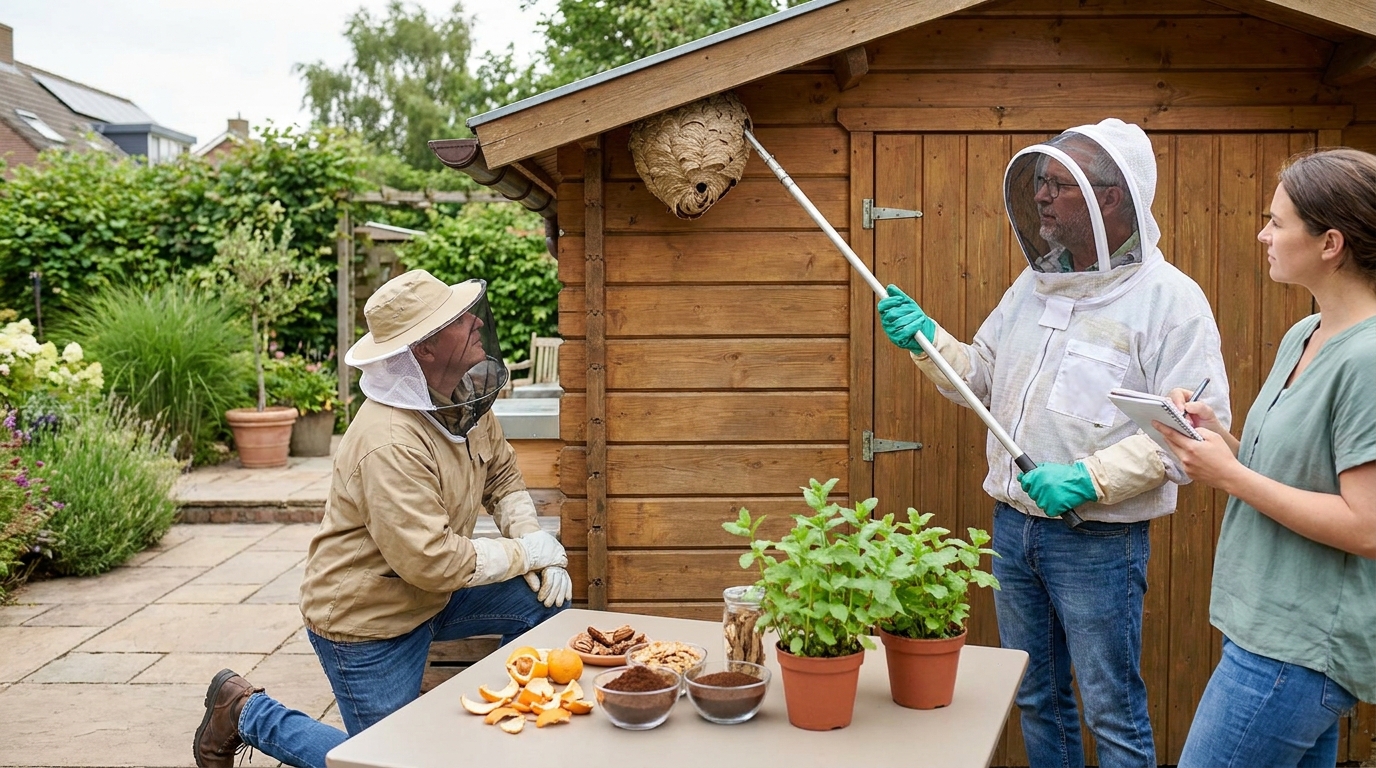
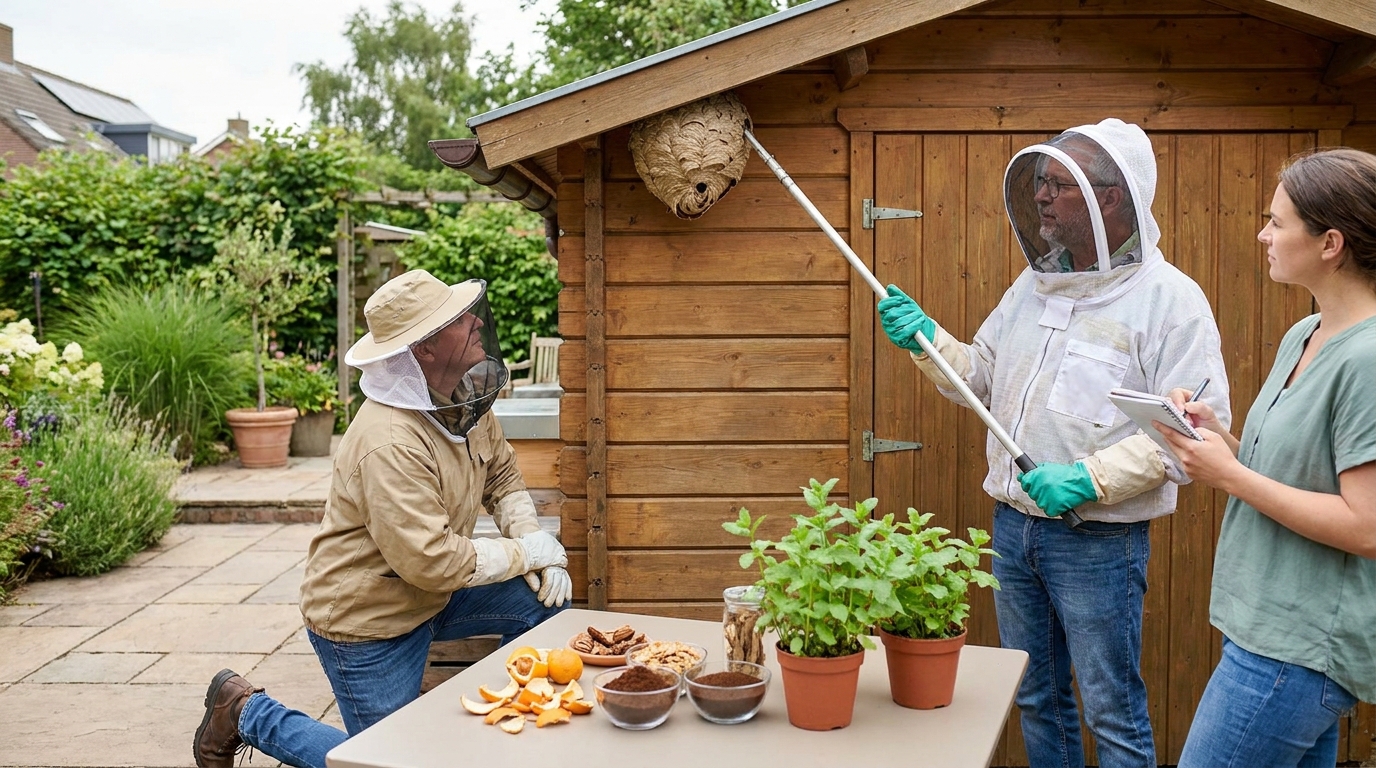
Burnt ground coffee. This is probably the most effective natural wasp repellent for quickly removing wasps from a specific area. Put dry coffee grounds in a bowl and light them with a lighter or match. It burns slowly, giving off a thick, fragrant smoke that wasps hate. The effect is almost immediate within a radius of two to three meters. Repeat every hour if necessary. It's simple, costs nothing and works against hornets too.
Cloves. Squeeze a dozen or so into half a lemon or orange and place on the table. The combined scent of citrus and clove creates an effective olfactory barrier. Not spectacular, but sufficient for a terrace meal. You can also prepare a concentrated infusion of cloves and spray it around the area to be protected.
Citronella essential oil. When diffused or sprayed diluted (a few drops in water), it repels wasps on the terrace. Combine with lavender or peppermint essential oil for an even more deterrent cocktail. Beware, however: essential oils evaporate quickly in direct sunlight, so reapply regularly.
White vinegar. Sprayed undiluted or slightly diluted on window sills, door frames and pergola posts, it discourages wasps from approaching. The smell is strong for us too, so it's better suited to high-traffic areas than to the dinner table.
False nests. Wasps are territorial. They avoid settling close to an existing colony. A crumpled kraft paper bag, hung under the roof overhang in early spring, can deter a founding queen from building there. It's preventive, not curative: it won't make an existing nest go away.
What doesn't work, or work very badly: conventional citronella candles (concentration too low), ultrasound (no scientific proof), beer or jam traps (they attract more wasps than they eliminate if you place them too close to your living space). If you use a trap, place it 10-15 meters from your terrace, not on the table.
To scare wasps away naturally and sustainably, the real key is the combination. Burnt coffee during meals, cloves all the time, vinegar on entry points, and above all: no accessible food source. A glass of syrup left on the table is a call to all the wasps in the neighborhood. Cover dishes, rinse cans, clean up quickly.
What about the wasps in the pool? They simply come to drink. Install an alternative watering place a few meters away (a bowl with water and pebbles for them to rest on). This is quite effective in keeping them away. Add a few drops of citronella to the water in the cup if you want to keep them away from the pool without killing them.
Moving or removing a nest: when and how to act safely
Let's be clear from the outset: moving an active wasp nest is not like moving a flowerpot. It's dangerous, and in 90% of cases, unrealistic without professional equipment. Wasps defend their nest with an aggressiveness proportional to the size of the colony, and unlike bees, they can sting several times.
So, when can you take action yourself? Only in a very specific case: an emerging nest, in spring, built by a queen alone or accompanied by a few workers. We're talking about a nest no bigger than a tennis ball. At this stage, you can try to remove it in the evening (when the wasps are less active), with covering clothes, thick gloves and an airtight bag. But even then, if you're uncomfortable, don't take any chances.
To move a bees' nest, the approach is completely different. Contact a local beekeeper. In the vast majority of cases, they will collect swarms free of charge, and this is the only responsible approach. Bees are essential pollinators, and their destruction is to be avoided at all costs.
When should I call a professional? As soon as the nest is larger than a fist. As soon as it's in a hard-to-reach place (attic, double wall, under the roof). As soon as you're allergic to the stings, of course. And always if it's an Asian hornet.
The Asian hornet deserves a closer look. Their nests can reach the size of a washing machine by the end of the season. They are more aggressive than the common wasp when approached, and their stings are more painful. Destroying its nests is a public health priority in many regions. At Frelons.be, we take action against the Asian hornet all year round, even outside the summer period, because primary nests appear as early as February-March.
How do you get rid of wasps when the nest has really taken hold? A professional usually uses an insecticide powder or aerosol injected directly into the nest, often at the end of the day. The operation takes 15 to 30 minutes. The nest is then removed or left in place (it will degrade naturally). The cost varies between 80 and 150 euros, depending on accessibility.
Here are a few mistakes not to be made:
-
Block the nest entrance. The wasps will find another exit, potentially inside your home.
-
Use fire. Real fire hazard, especially under a roof or in the attic. Nests are made of cellulose, which burns very well.
-
Spray the nest with water or a consumer insecticide from a «safe» distance. You'll infuriate them without eliminating them.
-
Intervene in the middle of the day. This is when the majority of workers are in the nest and on the alert.
If you wait until autumn, the colony naturally dies out with the first cold spells. The workers and the old queen die. The nest will not be reused the following year (contrary to popular belief). You can then remove it without any risk. This «patient» approach is the most environmentally friendly, provided the nest doesn't pose an immediate safety problem.
To scare away an emerging wasp nest without destroying it, some testimonials report success with smoke (incense, burnt coffee) directed at the nest entrance for several consecutive days. The idea is to make the environment sufficiently inhospitable for the queen to give up and set up her colony elsewhere. This can work on a very small spring nest. On a summer nest with hundreds of workers, forget it.
Conclusion
Scaring a wasp away from your plate is easy. Scaring wasps away from a mature nest is another matter. Natural repellents such as burnt ground coffee, cloves or citronella are real allies in protecting your terrace and garden on a daily basis. For an established nest, the window of «soft» action is limited to the very early spring, when the colony is not yet one.
Beyond that, safety comes first. An accessible nest, an Asian hornet spotted, a situation that's beyond your control: call in the professionals. At Frelons.be, we're on hand all year round to help you manage these situations, from simple advice to on-site intervention. Don't wait for a small nest to become a big problem.
Frequently asked questions
Is it possible to remove an existing wasp nest?
It is very difficult, if not impossible, to move a mature colony, as the wasps will defend their structure to the bitter end. Relocation is only possible in early spring, on a nest the size of a golf ball, before the queen has laid her first workers.
What's the most effective scent for scaring away wasps naturally?
The smell of burnt coffee grounds is the most radical way of creating an immediate exclusion zone around a table or terrace. Cloves stuck in a lemon and citronella essential oil are also excellent additions to disrupt their sense of smell and encourage them to look elsewhere for food.
Can you move a wasp nest without killing them?
Unlike bees, which a beekeeper can recover by moving the swarm, wasps can't be «transferred» from point A to point B. If the nest is badly placed and dangerous, the only viable solution is often to destroy it by a professional. If the nest is badly placed and dangerous, the only viable solution is often to destroy it by a professional, unless you can wait until winter, when the colony naturally dies.
How can you tell the difference between a wasp nest and a bee swarm?
A swarm of bees often forms a compact and impressive cluster of thousands of individuals uncovered on a branch, while a wasp nest looks like a grayish ball of paper hidden in a shelter. If you see bees, don't do anything: they're protected and a beekeeper will usually come and collect them free of charge.
Why should you never block the entrance to a wasp nest?
Blocking the entrance to a nest is a dangerous mistake, as wasps will systematically look for another way out, which often leads them to break into your home. What's more, this makes them extremely aggressive, considerably increasing the risk of multiple stings for occupants.
 French
  English
  Dutch
Dutch
0 Comments