
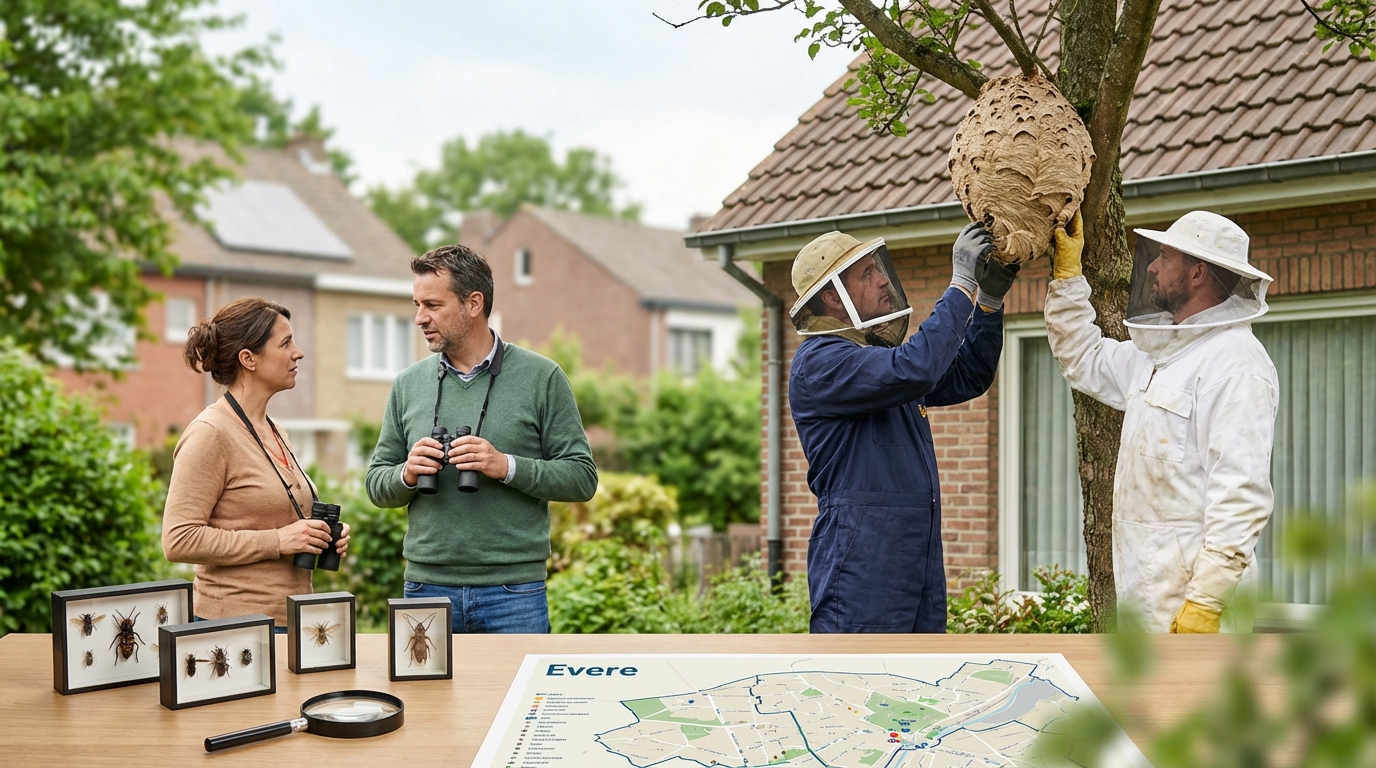
Wasp nest in Evere: intervention story and local solutions
Contents
-
Understanding the invasion of wasps and hornets in the commune of Evere
-
Identify the Asian hornet in Evere and protect your environment
Last Tuesday, 2.30pm, a call from a family in the Paduwa district. The father had just discovered a wasp nest the size of a football, trapped under the roof overhang just above the children's bedroom window. The kids hadn't been able to open their window for three days. Total stress.
Things to remember
-
This article takes an ultra-local approach, recounting a typical intervention in Evere's neighborhoods (such as Moeraske or Paduwa).
-
Unlike competitors who only list prices, we humanize the service with an educational narrative, while emphasizing the growing threat of the Asian hornet in the commune to justify year-round vigilance.
-
Understanding the invasion of wasps and hornets in the commune of Evere
-
A step-by-step guide to nest destruction in Evere
This kind of situation is experienced several times a week in Evere between May and October. And increasingly so the rest of the year, as mild winters allow some colonies to survive well beyond normal levels. Wasps in Evere are not a new phenomenon, but their presence is intensifying, and the Asian hornet is beginning to show its antennae in the municipality. Add to this the gardens, parks like the Moeraske and the many houses with wooden roofs or cladding, and it's easy to see why the 1140 zip code is an ideal playground for hymenoptera.
This article is a concrete account of a typical intervention at a resident's home in Evere. Not just a price list. We're going to break down what really happens when we come to destroy a nest, what we observe in the field, and why the Asian hornet is a game-changer for everyone, including those who thought that «wasps go away by themselves in winter».
Understanding the invasion of wasps and hornets in the commune of Evere
Evere is a semi-residential municipality with a rather unusual mix of housing estates with gardens, apartment blocks and green areas such as the Moeraske nature reserve. This cocktail creates perfect conditions for wasps and hornets. Gardens provide food (fruit, garbage cans, barbecues), roofs and shutter boxes provide shelter, and green spaces guarantee a supply of insects to feed the larvae.
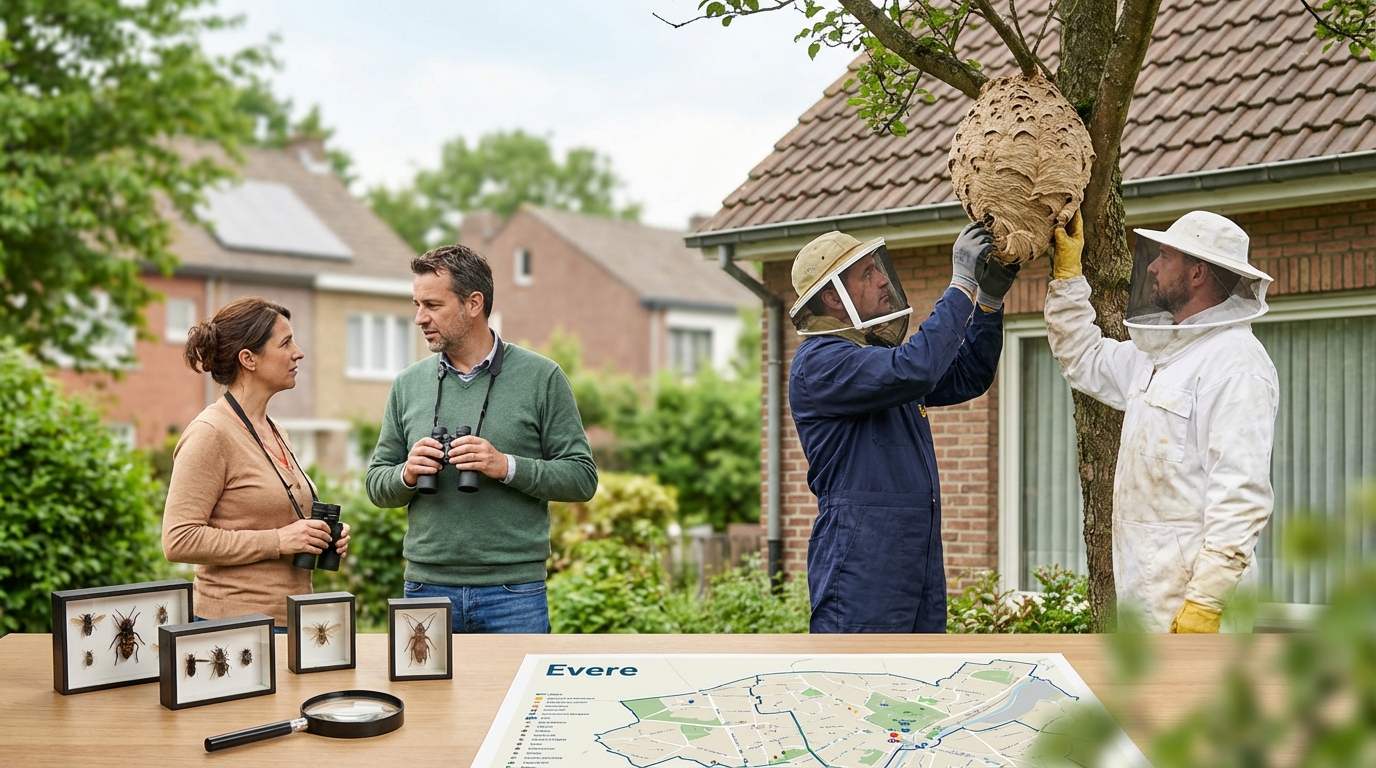
We're often asked why we shouldn't kill wasps. The answer is nuanced. Wasps play a real role in the ecosystem: they regulate populations of flies, caterpillars and aphids. A colony of common wasps can eliminate several thousand insects a day. The problem is when the nest is 50 centimetres from your front door or in the trunk of your awning. Then we're no longer talking about cohabitation, we're talking about a health risk. Especially with children or people allergic to venom.
Pests in 1140 aren't just a summer affair. We take action as early as March, when the founding queens emerge from hibernation and start to build their first nests. These primary nests are small, about the size of a golf ball, and often hang under a windowsill, in a garden shed or behind a shutter. This is the best time to act: a lone queen, a tiny nest, rapid intervention. But most people don't spot them until July or August, when the nest has grown and the workers become aggressive.
Hornets in Evere pose an additional problem. The European hornet, which has been around for a long time, is impressive in its size, but is relatively non-aggressive unless you get too close to its nest. The Asian hornet, on the other hand, is a different story. We'll come back to this in more detail below, but you should know that it has been reported on several occasions in the Brussels-Capital Region in recent years, and Evere has not been spared.
Something that surprises many people: ground wasps. Yes, some species build their nests directly in the ground, often in abandoned burrows or areas of loose soil at the bottom of the garden. Do ground wasps sting? Yes, they do. In fact, they are particularly reactive when their nest is stepped on without being seen. We had the case of an amateur gardener on the rue du Tilleul who was stung seven times while turning over a flowerbed. Seven stings at once is potentially dangerous, even without a known allergy.
For building managers, the challenge is different. Nests are found in common areas: stairwells, service shafts, flat roofs. Access is sometimes complicated, and the building manager is liable if a tenant is stung in the common areas. We regularly receive urgent requests from condominium owners in Evere who have let the problem linger for weeks before calling us.
A step-by-step guide to nest destruction in Evere
Back to our family in the Paduwa district. The call comes in at 2.30pm. The first thing we do is ask a few questions: where exactly is the nest? How high up? Are there any allergy sufferers in the household? Is the nest accessible from the outside, or does it have to be accessed from the inside? This information determines the equipment we take on board and the protocol we follow.
For this job, the nest was under the roof overhang, at a height of around 4 meters. Accessible with a ladder, no need for a cherry picker. We arrived on site at 4.15pm, less than two hours after the call. That's what 7/7 intervention means: no appointments in three weeks, no long waits.
Step 1: On-site assessment. Never rush in headlong. You observe the nest, spot the wasps« flight paths (they have »aerial highways" which they systematically use) and identify the species. In this case, it was common wasps, Vespula vulgaris. No hornets. The nest was about 30 centimetres in diameter, corresponding to a colony of 2,000 to 3,000 individuals.
Step 2: Securing the perimeter. Residents are asked to close their windows and stay indoors. We set up a safety zone. If neighbors are in their garden, we warn them. Safety is non-negotiable. A disturbed wasp can alert the whole colony in a matter of seconds, thanks to alarm pheromones.
Step 3: Treatment. A professional insecticide in powder or aerosol form is used, depending on the configuration. For a nest under a roof overhang like this one, the product is injected directly into the nest entrance using a telescopic pole. The product acts within a few minutes on any wasps present, and remains active for several days to eliminate those returning from their foraging flight. No flames, no rubbish bags over the nest (yes, we've seen that before), no dangerous DIY.
Step 4: Nest removal. Once the colony has been neutralized, the nest is physically removed. This is important, not just for aesthetic reasons. An abandoned nest can attract other insects, and above all, the inhabitants need to see that it's over. The father of a family in Paduwa breathed a sigh of relief when he saw the nest in the bag. His children could reopen their window that evening.
When it comes to the price of destroying a wasp nest, we're very transparent. A standard intervention in Evere, for a nest accessible without special equipment, costs between 80 and 150 euros. If the nest is high up (over 8 meters), in a chimney or in a place requiring special equipment, the price can go up. We always announce the price before we intervene, so there are never any surprises at the end.
A word about homemade extermination attempts. Every summer, emergency rooms in Brussels receive patients who have tried to take care of a wasp nest themselves. Slippery ladder, multiple stings, allergic reaction: the scenarios are always the same. Wasp extermination is a profession. You wear a full-body suit, reinforced gloves and a protective veil. And we know the behavior of each species. That big black and yellow wasp that prowls around your terrace without ever stinging? It's probably a mason wasp, Sceliphron. It is solitary and totally harmless. No need for intervention. Knowing the difference saves unnecessary expense and preserves useful insects.
Identify the Asian hornet in Evere and protect your environment
In 2016, the first confirmed Asian hornet nest in Belgium was discovered in Tournai. Since then, the species has been making its way towards Brussels at a steady pace. Reports have been recorded in several Brussels municipalities, and the Asian hornet in Evere is no longer a remote hypothesis: it's a reality to be monitored very closely.
How to recognize it The Asian hornet (Vespa velutina) is smaller than the European Hornet. Its body is predominantly black, with an orange stripe on the abdomen and yellow-tipped legs. The European Hornet, on the other hand, is larger, yellower and has a striped abdomen. If you see a dark, stocky insect hovering in front of a beehive or watering hole, chances are it's an Asian hornet.
Why is it a major problem? Because it decimates bee colonies. A single Asian hornet can capture between 25 and 50 bees a day. Multiply that by a colony of several thousand individuals, and you understand the impact on biodiversity in Brussels. Beekeepers in the region have been sounding the alarm for several years. European bees have no natural defense mechanism against this predator, unlike Asian bees, which know how to form a «heat ball» to suffocate it.
Nest prevention starts with vigilance. In spring, the founding queens of the Asian hornet build a primary nest, often in a covered shelter such as a roof overhang, garden shed or dense hedge. This primary nest looks like a small papier-mâché ball, no bigger than an orange. If you spot one at this stage, it's the ideal time to intervene. A single queen, no colony, no danger. You can neutralize the nest in just a few minutes.
In summer and autumn, the colony often moves to a much larger secondary nest, sometimes perched in the top of a tree 15 or 20 meters high. These nests can reach 80 centimetres in diameter and house over 6,000 individuals. In these cases, intervention is far more complex, sometimes requiring the use of a cherry picker. Around the Moeraske and in Evere's wooded gardens, these nests are easily overlooked until the leaves fall in November.
What to do if you think you've spotted an Asian hornet? Take a photo if possible (without coming within 5 meters of the nest) and contact us. You can also report the sighting on the iNaturalist platform or via the Brussels Environment website. Every report helps us to map the progress of the species and organize trapping campaigns.
At Frelons.be, we're active all year round against the Asian hornet. Not just in summer. Trapping the founding queens in spring is one of the most effective ways of limiting the number of colonies. Selective traps are set up in high-risk areas, local residents are trained to recognize the species, and emergency action is taken as soon as a nest is confirmed. Because waiting until «the right season» to take action means letting a colony produce 200 to 300 future queens who will go on to found new colonies the following year.
Protecting your environment in Evere also means accepting that not all wasps are enemies. Polistes, solitary wasps, bark beetles: these species are gardeners' allies. They pollinate and regulate pests. Nest destruction should only be carried out in situations where there is a real risk to people. Our role is also to tell you when not to do anything.
Conclusion
A wasp nest in Evere is never a trivial matter, but it's not a catastrophe either when you call in the right people. The intervention is fast, the price is clear, and the result is immediate. For Paduwa's family, everything was sorted out in 45 minutes.
The real issue for the coming years is the Asian hornet. Its progress towards Brussels has been documented, and Evere, with its green spaces and gardens, is a breeding ground for it. Remaining vigilant all year round, reporting suspicious nests as early as spring, and not waiting for the colony to become unmanageable: this is what will make the difference.
Have you spotted a nest in your home or condominium? Call Frelons.be. We intervene 7 days a week in Evere and throughout the Brussels region. One phone call, an honest assessment, and if it's just a harmless mason wasp, we'll tell you that too.
Frequently asked questions
When should I call a professional for a wasp nest in Evere?
As soon as the nest represents a health risk, particularly if it is close to a high-traffic area, a child's bedroom or an allergic person. Early intervention, as soon as the primary nests appear in March, makes destruction easier and less costly.
How much does it cost to remove a wasp nest in the 1140?
In Evere, a standard intervention for an accessible nest generally costs between 80 and 150 euros. The cost may vary depending on the height of the nest (over 8 meters), or whether a cherry picker is required to reach a roof or tree.
Do Evere firefighters still deal with wasp nests?
Firefighters now focus on life-saving emergencies, and often charge more for their services than private companies. Calling in a local expert like Frelons.be guarantees a 2-hour response and a comprehensive educational service.
Is it dangerous to have an earth wasp nest in your garden?
Yes, because they are very aggressive if you accidentally step on their underground nests. The vibrations of a lawnmower can trigger a mass attack, making these nests particularly treacherous for Evere gardeners.
What should I do if I find a hornet's nest near the Moeraske reserve?
Never try to destroy it yourself, especially in wooded areas. Take a photo from a safe distance and report it on platforms like iNaturalist or contact us for a quick assessment to protect local biodiversity.
 French
  English
  Dutch
Dutch
0 Comments