
Wasp nest in Ganshoren: what happens during an intervention?
Contents
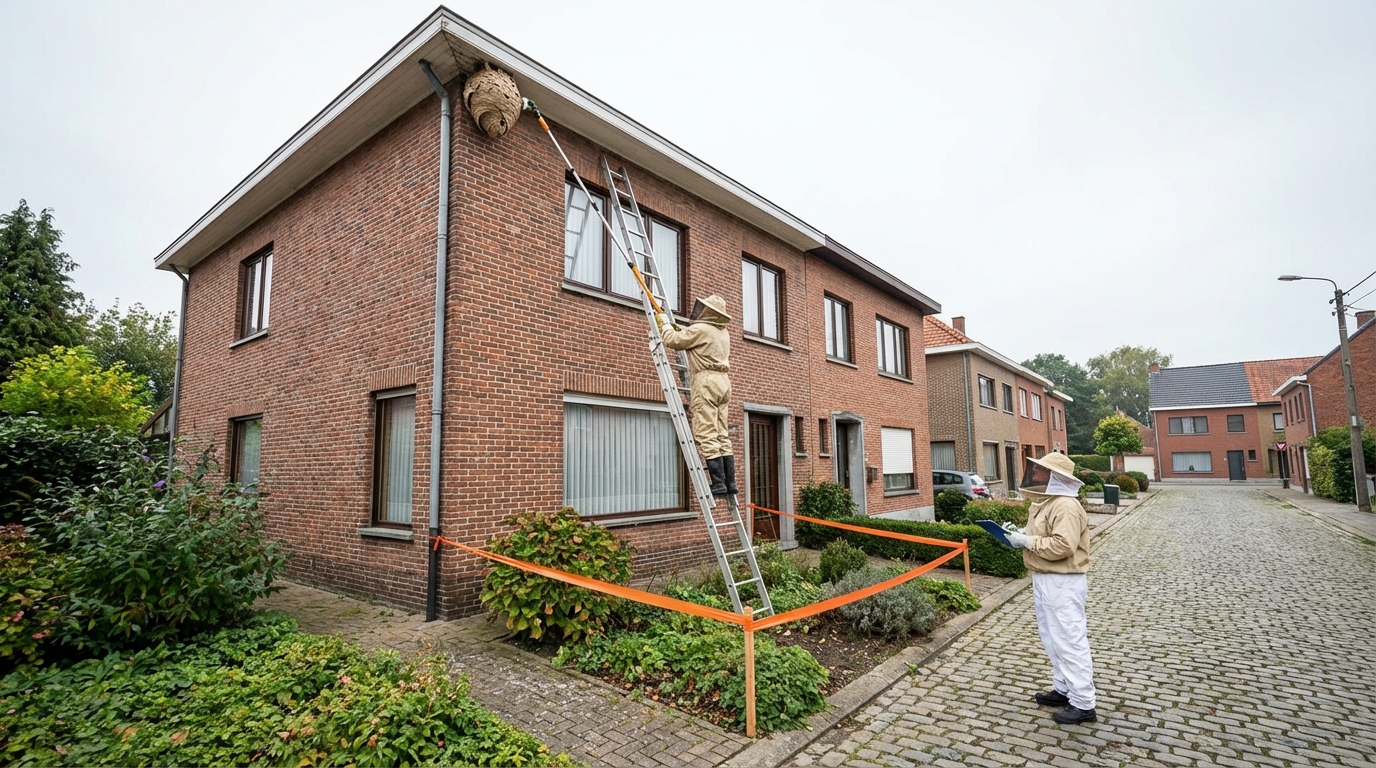
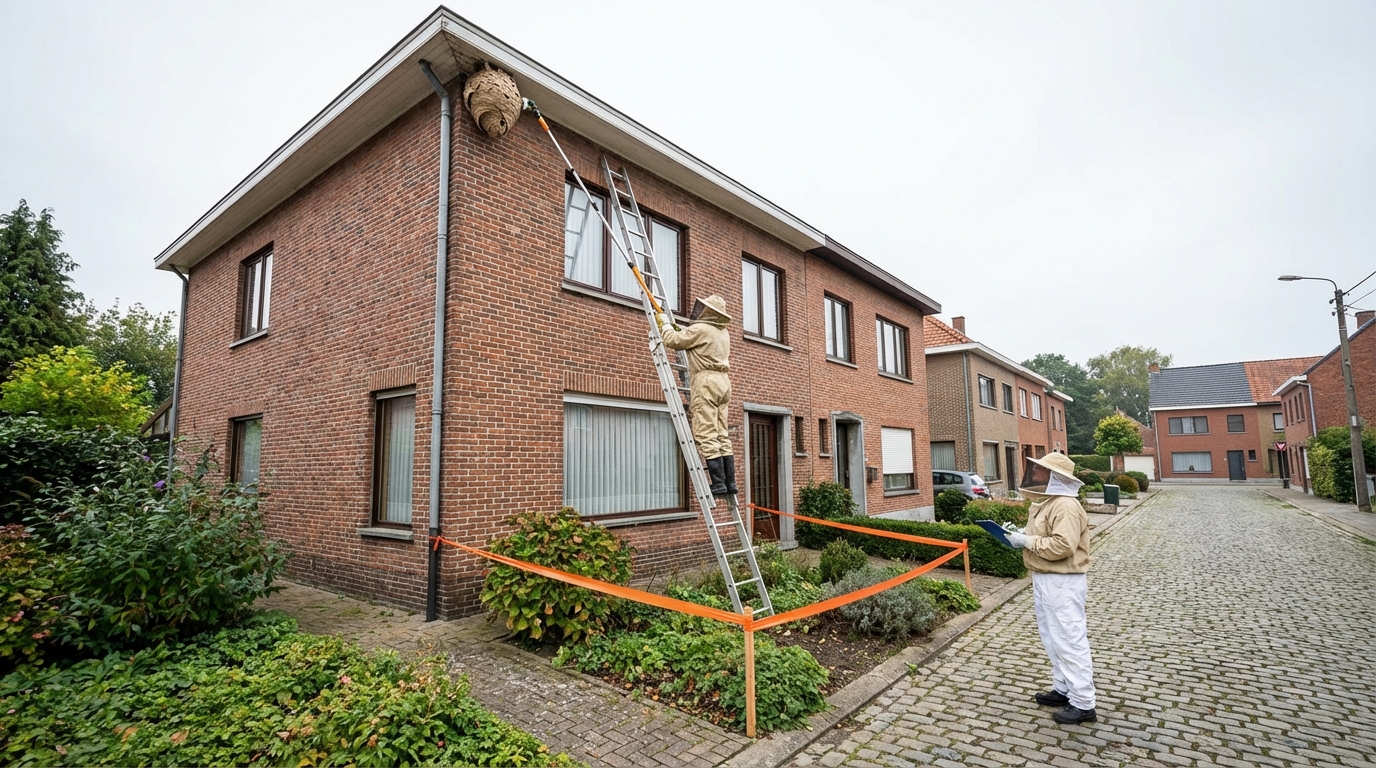
Saturday morning, 9:30 a.m., a call from a resident of Rue au Bois in Ganshoren. «There's something as big as a football under my cornice, and it's buzzing loudly.» Classic. Every summer, we receive dozens of similar requests in 1083. And every time, the same concern: is it dangerous? How much does it cost? Is it really necessary to intervene?
Things to remember
-
An informational article with ultra-local anchoring simulating the story of an intervention in Ganshoren (1083)
-
The aim is to reassure residents by explaining the professional process and differentiating between wasps and Asian hornets, for which we remain active all year round.
-
Identifying a wasp or hornet nest in Ganshoren
-
The course of a professional intervention in 1083
The short answer: yes, we have to intervene. A wasp nest in Ganshoren can't be dealt with with a can of supermarket insecticide. We'll tell you how it's done, from the identification of the nest to the departure of our team. And we'll also talk about the Asian hornet, because in Ganshoren as elsewhere in the Brussels Region, it's starting to take hold, and that's another story.
Whether you live near King Baudouin Park or near the Basilica, this article is designed to help you make the right decision, quickly and stress-free.
Identifying a wasp or hornet nest in Ganshoren
First thing to do before panicking: observe. A wasp's nest is not what we often imagine. Forget the image of the big gray ball hanging from a branch. It can take that shape, yes, but in 60 % of cases in Ganshoren, nests are found in much more discreet places: under a roof tile, in a roller shutter box, behind siding, even in the ground.
To recognize a wasp nest, you first need to spot a regular flow of insects in the same place. If you see five or six wasps going in and out of the same hole every minute, there's a nest. The nest itself is made of chewed cellulose, a kind of greyish paper that's quite fragile to the touch (but don't touch it). Its size varies with the season: in June, it can be the size of a tennis ball. In August, some are as big as basketballs.
The question we get asked all the time: what's the difference between a wasp and a hornet? Visually, it's quite distinct. The common wasp measures 1 to 2 cm, with contrasting bright yellow and black stripes. The European hornet is considerably larger, between 2 and 3.5 cm, with a more orange hue on the abdomen. It makes an impressive noise in flight, but is actually less aggressive than the wasp. In fact, it's this large wasp that doesn't sting easily: the European Hornet only attacks if it feels directly threatened.
The Asian Hornet is a different story. Smaller than the European Hornet (around 2.5 cm), it has a dark, almost black body, with an orange stripe on the abdomen and yellow legs at the tips. It can also be recognized by its nest: a teardrop-shaped structure, often perched high up in trees, sometimes 15 or 20 meters away. The Asian hornet is on the increase in Ganshoren. Reports in 1083 have increased over the last two years, and this is a trend we're seeing throughout the Brussels Region.
Why is it important to make the distinction? Because the treatment is not the same. Wasps are most active from May to October. The Asian hornet, on the other hand, requires year-round vigilance: founding queens emerge from hibernation as early as February-March, and secondary nests can persist well into autumn. At Frelons.be, we remain active year-round against the Asian hornet, precisely because the problem doesn't end with summer.
One last point: we're sometimes asked why you shouldn't kill wasps yourself. The reason is twofold. Firstly, a crushed wasp releases an alarm pheromone that attracts and angers its fellow wasps, which can trigger a group attack. Secondly, wasps play a role in the ecosystem: they regulate populations of flies, caterpillars and aphids. The aim is not to exterminate the species, but to remove the nest when it represents a danger to the inhabitants.
The course of a professional intervention in 1083
One call, and we're usually on site within 24 hours. For urgent situations (nest at child height, allergic person in the home), we do our utmost to intervene the same day. Here's how it works, step by step, when we come to destroy a wasp nest in Ganshoren.
On-site assessment. Our pest control expert always starts with a visual diagnosis. Where exactly is the nest? What species? What size? Does it have complicated access (roof, attic, wall cavity)? This step takes five to ten minutes, but it's essential. A wasp nest in a shutter box cannot be treated in the same way as a hornet's nest perched ten meters up in a lime tree.
Safety. Residents are asked to stay indoors, with their windows closed. If the operation takes place in a shared garden or near a public space (and in Ganshoren, with its parks and gardens, this often happens), we secure a perimeter. Our technician wears a full-body anti-sting suit, reinforced gloves and a mask. Safety is non-negotiable: not for us, not for you.
Treatment. We use a professional insecticide in powder or aerosol form, injected directly into the nest or at its entrance. The product takes effect within a few minutes on the insects present. For accessible nests, the physical structure is then removed. For those in cavities (walls, roofs), the product is sufficient: wasps returning to the nest are in turn contaminated, and the colony is extinguished within 24 to 48 hours.
For the Asian hornet, the technique differs. High-level nests sometimes require a telescopic pole or the intervention of a nacellist. We adapt the protocol to each situation. What remains the same is rigor: we never leave a nest half-treated.
Follow-up. After treatment, we check that the activity has ceased. We also give advice to local residents, such as filling in access holes and keeping an eye on the surrounding area in the days that follow. If there is ever a resumption of activity (it's rare, but it can happen), we come back at no extra charge.
The whole operation takes between 30 minutes and an hour and a half, depending on complexity. A nest under an accessible ledge can be dealt with in 30 minutes. A nest in the attic, with access through a narrow trapdoor, is bound to take longer. In any case, when we leave your home in Ganshoren, the problem is solved.
An important clarification: are common wasps venomous? Technically, we're talking about venom, not poison. Their sting injects a venom that causes pain, redness and local swelling. For the vast majority of people, this is unpleasant but harmless. The real risk is for allergy sufferers: a single sting can cause anaphylactic shock. That's why we insist: never try to destroy a nest yourself, especially if you don't know your reaction to wasp stings.
Rates and precautions for Ganshoren residents
How much does it cost to remove a wasp nest? That's the first question we get on the phone, and rightly so. The price of wasp nest removal depends on several factors: the location of the nest, its size, the species involved and accessibility. For a standard wasp nest, accessible without special equipment, expect to pay between 80 and 150 euros in the Brussels region. A nest high up or in a difficult-to-reach area can push the bill up to between 150 and 250 euros.
For Asian hornets, the cost of disinsectisation in Brussels is generally a little higher, due to technical constraints (height of nests, specific equipment). Expect to pay between 100 and 300 euros, depending on the situation. Some communes contribute to the cost of eliminating Asian hornets, as they are an invasive species classified as a threat to biodiversity. For more information, contact the local authority in Ganshoren: assistance is available.
What we always include in our rates: travel, diagnosis, treatment, nest removal where possible, and guaranteed results. No surprises, no hidden extras. We announce the price before intervening, and the customer validates. Period.
When it comes to pest prevention, a few simple steps can reduce the risk of a nest taking up residence. In early spring (March-April), inspect typical locations: under roofs, garden sheds, shutter boxes, gutters. Founding queens look for discreet, protected shelter to start their colony. If you spot a small nest the size of a golf ball with a single wasp, it's the ideal time to take action: at this stage, intervention is quick and easy.
Other practical precautions: don't leave food or sweet drinks outside without a lid. Open garbage cans are a wasp magnet. If you have fruit trees in your garden (and there are plenty in Ganshoren), pick up fruit that has fallen to the ground. These sources of sugar attract wasps in late summer, when colonies are at their peak.
For local services in Ganshoren, Frelons.be is active throughout 1083 and the neighboring communes of Jette, Berchem-Sainte-Agathe, Koekelberg and Molenbeek. We know the terrain, the types of buildings and the wooded areas around the Parc Roi Baudouin where hornets like to settle. Our local roots make all the difference: we know where to look, we can get there quickly, and we know the particular features of the buildings in the area.
A final reminder: for wasps, the critical season runs from May to October. For the Asian hornet, we remain mobilized all year round. If you spot a suspicious insect in the middle of winter, don't think it's impossible. Asian hornet queens hibernate in sheltered nooks and crannies, and can be spotted as early as the first warm days of February. Early detection means one less nest in summer.
Conclusion
A wasp nest in Ganshoren can be dealt with quickly and efficiently by a professional. Identification, safe treatment, guaranteed results: the intervention rarely takes more than an hour, and you're back in peace the same day. For the Asian hornet, vigilance is permanent, and our team remains available twelve months a year.
Have you spotted a nest or suspicious comings and goings around your home? Contact Frelons.be. We intervene quickly in Ganshoren and all neighboring municipalities. One call is all it takes for us to assess the situation and give you a clear price before we intervene.
Frequently asked questions
How do I know if I have a wasp nest in my home in Ganshoren?
The main clue is the incessant coming and going of insects towards a specific point, such as a shutter box, a cornice or a hole in the ground. In Ganshoren, nests are often hidden in the cavities of Brussels houses or in the gardens near the Parc Roi Baudouin.
How much does it cost to destroy a wasp nest in Brussels?
For a standard intervention in Ganshoren, the price generally varies between €80 and €150, including travel and guaranteed results. If the nest is difficult to access, or if Asian hornets require a telescopic pole, the price can rise to €250 or €300).
Do the fire department still respond to wasp nests in 1083?
The Brussels fire department always intervenes, but their service is not free and often more expensive than a private expert, with delays that can be lengthy in hot weather. Calling in a local specialist like Frelons.be guarantees a 24-hour response and a targeted treatment to protect your environment.
What's the difference between a wasp nest and an Asian hornet nest?
A wasp's nest looks like a hidden ball of grayish paper, while the Asian hornet's nest is often a large blob suspended high in the trees. The Asian hornet is darker with yellow legs, and its destruction requires specific expertise, as it remains a threat to biodiversity all year round.
Is it dangerous to destroy a wasp nest yourself?
This is extremely risky, as a threatened wasp releases pheromones that alert the entire colony, triggering cluster attacks. Without full protective equipment and professional products, you expose yourself to multiple stings that can cause anaphylactic shock, even without a known allergy.
 French
  English
  Dutch
Dutch
0 Comments