
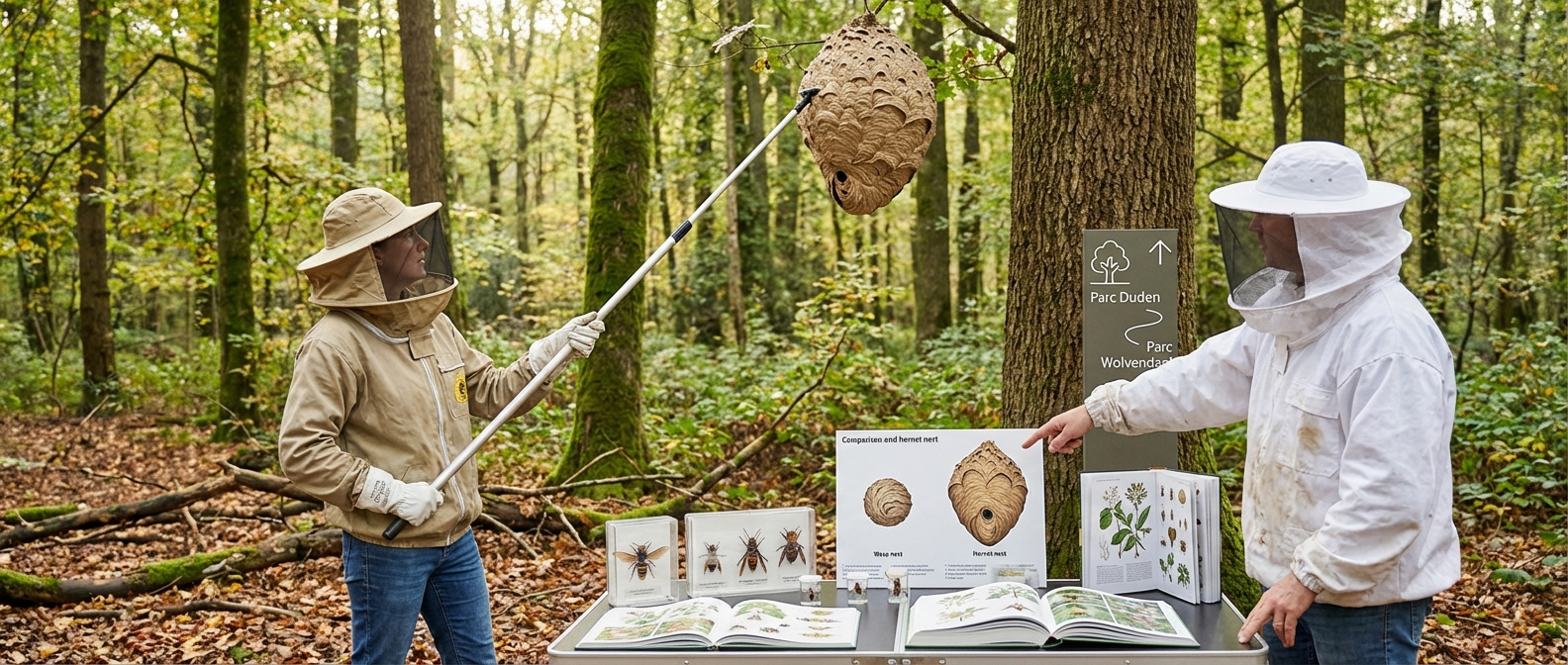
Wasps at Forest: identification and destruction guide
Contents
-
The basics: understanding wasp species in Forest and their role
-
Practical guide: how to identify a wasp nest in a wooded area
It's the same story every summer. Forest residents enjoying Duden Park or their terraces see squadrons of wasps arrive, and panic sets in. Except that not all wasps are created equal. Some are harmless, others downright problematic, and confusing them can cost you dearly, both in stings and in lost biodiversity.
Things to remember
-
A unique blend of story of local intervention in Forest's wooded neighborhoods (Parc Duden, Wolvendael) and teaching guide
-
We explain how to differentiate between useful and harmful forest species for the safety of local residents, while highlighting our hornet expertise.
-
Understanding the wasp species at Forest and their role
-
How to identify a wasp nest in a wooded area
We regularly intervene in the commune of Forest (1190) for nests installed in unlikely places: under the roofs of terraced houses on Avenue Jupiter, in the soft ground of Wolvendael Park, or hanging from the branches of beech trees in Duden Park. What we notice every time is that people don't really know what they're looking at. Common wasp? Forest wasp? Asian hornet? The answer changes everything: the level of danger, the method of intervention, and even whether to intervene at all.
This article is the guide we wish we had to hand out to local residents before each season. We'll take a look at the species you really come across in Forest, teach you how to recognize a nest by its location, and explain in concrete terms how a nest is destroyed when necessary.
The basics: understanding wasp species in Forest and their role
In Forest, the proximity of large wooded areas such as Duden Park and Wolvendael Park creates a special ecosystem. We're not in a mineral city center. The gardens are mature, the trees are centuries old, and the fauna is rich. As a result, you'll come across species of wasp here that you wouldn't necessarily see in other parts of Brussels.
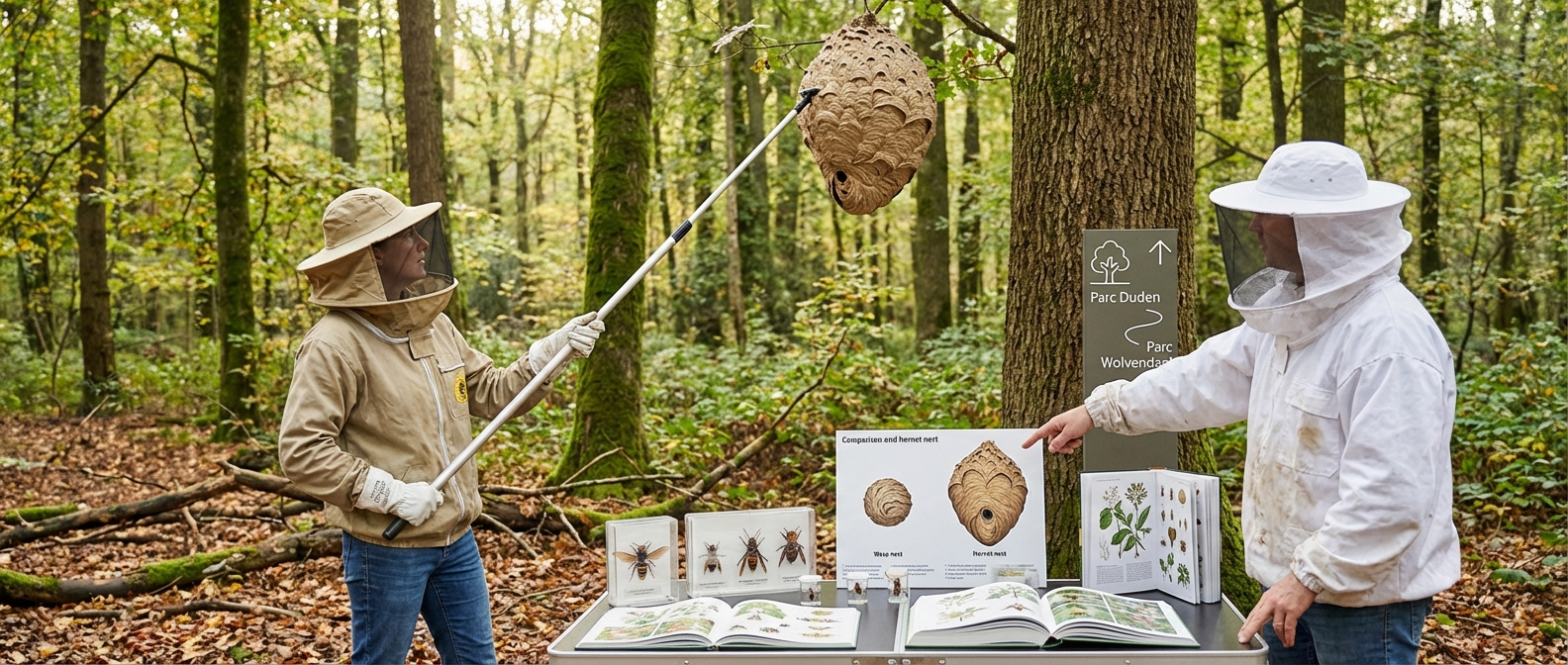
The unsung star is the forest wasp, or Vespula sylvestris for Latin lovers. It looks a lot like the common wasp (yellow and black, classic stripes), but its behavior is radically different. Vespula sylvestris builds its nests high up, often in trees or under eaves, and is much less aggressive than its cousin. Vespula vulgaris. You can pass within a metre of its nest without it reacting. This is not at all the case with the common wasp, which defends its territory with formidable aggression as soon as you get within three or four meters.
Why is it important to make a difference? Because the forest wasp plays a real role in biodiversity at Forest. It hunts down harmful insects (flies, caterpillars, aphids) and even contributes to pollination. Systematically destroying every nest we see is like shooting ourselves in the foot. We lose the natural allies that regulate pest populations in our gardens.
So why shouldn't we kill all the wasps? Quite simply because the majority of the species present in the wooded areas of Forest pose no problem whatsoever. Of the dozens of species of social and solitary wasps found in Belgium, only two or three are a real nuisance to humans: the common wasp and the German wasp, which love our plates and soda cans. The others, including Vespula sylvestris, live their lives with no interest in your barbecue.
There are also mason wasps, often seen on the brick walls of forest homes. Do mason wasps sting? Technically, they can, but in practice it's extremely rare. They're solitary, not at all territorial, and their venom is far less potent. Crushing them or plugging their little nesting holes is pointless and counter-productive.
The real problem, the one that mobilizes us all year round at Frelons.be, is the Asian hornet. In recent years, it has become increasingly common in Forest. It can be recognized by its dark (almost black) body with an orange stripe on the abdomen and yellow-tipped legs. Unlike local wasps, the Asian hornet is a formidable predator of bees, and a real danger when its nest is close to homes. We don't leave them alone.
Practical guide: how to identify a wasp nest in a wooded area
A neighbor called me last year, convinced he had a hornet's nest in his garden near Avenue Kersbeek. He could see insects flying in and out of a hole in the ground at the foot of an old oak tree. When he arrived on the scene: ground wasps. No hornets, no immediate danger. This kind of confusion happens at least once a week.
Recognizing a wasp nest starts with observing its location. This is the first and often the most reliable clue.
In the ground. A wasp nest in the ground can be identified by the regular comings and goings of insects around a hole, often no larger than a two-euro coin. Common and German wasps love underground cavities: former rodent burrows, spaces under patio slabs, loose embankments. In Forest, with all the gardens sloping down to the Duden valley floor, these underground nests are very common. Do ground wasps sting? Yes, and rather violently. They defend their nests fiercely if you step on them, or if a lawnmower passes too close. In fact, this is the most common situation that triggers a call from us.
In trees and shrubs. The forest wasp (Vespula sylvestris) and some hornet species build aerial nests. The nest looks like a gray ball, sometimes the size of a soccer ball, sometimes much larger. The texture is that of papier-mâché, because that's exactly what it is: wood fiber chewed and mixed with saliva. In the trees of Duden Park, you can regularly find them five or six meters high. As long as they're high up and away from traffic, they're not a problem.
Under roofs and in attics. That's another matter. A nest in a roller shutter box, under tiles, or in an uninsulated attic, becomes a problem of cohabitation. The nest can grow throughout the summer to the size of a basketball, with thousands of individuals. Warning signs: a muffled buzzing behind a wall, wasps entering through a crack or vent, nibbling marks on wood or plaster.
How can you tell the difference between a solitary burrowing wasp and a ground-dwelling colony? The burrowing wasp (like species of the genus Ectemnius or Cerceris) digs small individual holes, often in sand or compacted earth. You'll see an insect go in and out on its own, without the heavy traffic that characterizes a colony of social wasps. These burrowing wasps are harmless: they hunt other insects to feed their larvae and do not seek confrontation. In Forest, they can be found mainly in sandy park paths and sunny flowerbeds.
A simple trick to assess the situation before calling us: observe the nest (or entry point) for five minutes, from a respectable distance, say at least five meters. Count the number of insects entering and leaving per minute. Less than five, it's probably a small nest or a solitary species. More than twenty means you're dealing with a well-established colony, and in that case it's best not to play the hero.
How a nest destruction operation works in Forest
70% of our work at Forest is carried out between June and September. The peak is August. The nests have reached their maximum size, the wasps are nervous because the colony is starting to produce future queens, and it's just the time when everyone wants to enjoy their garden. Timing is rarely in our favor.
When you contact us to have a wasp nest destroyed in Forest, here's what happens. First, we ask you a few questions over the phone: where is the nest, what is its approximate size, has anyone been stung, are there any allergy sufferers in the household. This information determines the degree of urgency. An allergic person in the house with a nest in the shutter box? We come within a few hours.
On site, the technician always starts by identifying the species. This is non-negotiable. If it's a forest wasp nest high up in a tree at the bottom of the garden, we tell you straight out: leave it. The nest dies naturally in autumn, and these wasps are doing you a favor. On the other hand, a nest of common wasps in the ground next to the children's playground, or an Asian hornet's nest in Forest, is a no-brainer. We take action.
The method depends on the location. For an underground nest, insecticide powder is injected directly into the nest entrance. As the wasps move in and out, they carry the product inside, and the colony is eliminated within 24 to 48 hours. If the nest is accessible from the air, it can be treated and removed immediately. For nests high up or in complicated places (chimneys, double walls), we adapt: telescopic poles, inspection cameras, sometimes a gondola for very large Asian hornet nests in treetops.
The case of the Asian hornet in Forest is well worth investigating. These nests can exceed 80 cm in diameter and contain several thousand individuals. They are often located high up, at 15 or 20 meters. Intervention requires specific equipment and real expertise. At Frelons.be, this is our speciality: we are active all year round against the Asian hornet, including in winter to locate and destroy nests that have become visible after the leaves have fallen.
The question of the cost of destroying a wasp nest always comes up. Let's be clear: count between 80 and 150 euros for a classic wasp nest, depending on accessibility. A high Asian hornet's nest is more expensive, often costing between 150 and 250 euros, because of the equipment required. These prices cover travel, intervention and follow-up. Beware of the abnormally low prices we sometimes see online: an exterminator in 1190 who advertises 50 euros all-inclusive is often a sign of shoddy workmanship or hidden charges.
One last point we repeat to every customer: don't try to destroy a nest yourself. Not with boiling water, not with a garbage bag, not with insecticide spray from the supermarket. Every year, we see people in the emergency room because of homemade attempts gone wrong. Wasps attack in groups when their nest is threatened, and a dozen simultaneous stings can send anyone to hospital, even those with no known allergy.
Conclusion
Living in Forest means enjoying an exceptional setting, with Duden Park and Wolvendael just around the corner. Wasps are part of this ecosystem. Most of them pose no problem and contribute to the natural balance of the community. Those that become dangerous, because of their location or species, deserve rapid and professional intervention.
If you spot a suspicious nest in your garden or near your home in Forest, take a photo from a distance and contact us. We'll tell you in all honesty whether or not to intervene. And if it's an Asian hornet, don't delay: the bigger the nest, the more complex the intervention. Call Frelons.be, we know every corner of the town.
Frequently asked questions
Which wasp species are most common in Forest?
In Forest, forest wasps are common in wooded areas such as Duden Park, as are common wasps and Asian hornets. While the forest wasp is peaceful and useful for biodiversity, common wasps and hornets represent a real risk for local residents and require increased surveillance.
How do you know if a wasp nest is dangerous?
Danger depends on species and location: a nest in the ground (ground wasps) or under a roof on Jupiter Avenue is critical, as it provokes defensive attacks. On the other hand, a forest wasp nest high up in a tree in Wolvendael Park is generally harmless if kept away from frequent passageways.
How is a wasp nest destroyed in Forest (1190)?
The process begins with precise identification of the species, to avoid destroying useful pollinating insects. Our technicians then use targeted insecticide powders or telescopic booms to eradicate the colony safely, guaranteeing total elimination within 24 to 48 hours.
How much does it cost to remove a wasp or hornet nest?
In Forest, the cost of a standard wasp nest removal varies between €80 and €150, depending on accessibility. For a high-rise Asian hornet's nest, you'll need to budget between €150 and €250, including specific equipment (gondola or pole) and travel costs.
Why shouldn't I destroy a wasp nest myself?
Attempting to eliminate a nest with household products or water causes a massive, coordinated attack on the colony, multiplying the risk of multiple stings. Without professional equipment, you expose yourself to serious accidents, particularly if the nest is in a confined area such as a shutter box or attic.
 French
  English
  Dutch
Dutch
0 Comments