
All you need to know about wasp nest destruction in Auderghem
Contents
A family barbecue, a quiet afternoon on the terrace, and suddenly: the hum. Not one or two stray insects, no. A regular, organized comings and goings, pointing towards a corner of your roof or the back of your garden shed. If you live in Auderghem, there's nothing unusual about this scenario. The commune is one of the most exposed in Brussels to wasp and hornet nests, and that's no accident.
Things to remember
-
This article takes an ultra-local approach, linking the presence of wasps to the geography of Auderghem (near Forêt de Soignes).
-
He describes a typical intervention in the commune to humanize the service while educating people about the risks of the Asian hornet, which is present all year round.
-
Why is Auderghem a preferred area for wasp nests and f...
-
Step-by-step guide
At Frelons.be, we work all year round in the 1160 area. We know the streets, the types of buildings and the gardens that border the Forêt de Soignes. We also know that many people hesitate before calling: is it really dangerous? How much will it cost? Can we wait? This article answers all these questions.
We're going to talk about what makes Auderghem such a good breeding ground for wasps and Asian hornets, what happens in practice when we intervene at your home, and how to react to these insects, whatever the season. No unnecessary jargon, just what you need to know to protect your home.
Why is Auderghem a prime area for wasp and hornet nests?
Take a look at a map of Brussels. Auderghem literally backs onto the Forêt de Soignes, one of Europe's largest urban forests. Over 4,000 hectares of woods, clearings and damp undergrowth. For wasps and hornets, it's a giant larder: insects in abundance, plant material to build nests, nearby watering holes.
But the forest alone doesn't explain everything. It's the combination of forest and residential habitat that creates the ideal conditions. Wasps seek out protected nesting cavities: under roofs, in shutter boxes, behind cladding, in attics. Auderghem, with its terraced houses, garden villas and old, sometimes poorly insulated buildings, offers exactly this type of refuge. Auderghem's environment combines dense vegetation and residential buildings: a perfect cocktail for colonies.
There's also a factor that people underestimate: urban biodiversity. The greener and livelier a neighborhood, the more it attracts pollinating insects, and the more it attracts their predators. Wasps aren't just «pests» in the strict sense, they're part of an ecosystem. Except that when a colony of 5,000 individuals settles just two meters from your terrace, ecological balance takes a back seat. The safety of your children and pets comes first.
Why are there so many wasps in some years? Mild winters play a huge role. A queen that survives the winter means one more colony in the spring. And in Brussels, really cold winters are rare. As a result, populations are increasing, and areas like Auderghem, close to the Forêt de Soignes, are the first to be affected.
We regularly work in the streets near Rouge-Cloître, around Parc Tenreuken and in the residential areas between Boulevard du Souverain and Chaussée de Wavre. These areas combine mature gardens, old trees and buildings with numerous crevices. A playground for common wasps, German wasps and, increasingly, the Asian hornet.
The Asian hornet deserves a closer look. First spotted in Belgium a few years ago, it's making rapid progress. Its presence in 1160 is no longer anecdotal. It builds primary nests in spring (small ones, often in hedges or under awnings), then secondary nests high up in summer, sometimes 15 or 20 meters up in trees. The proximity of the forest facilitates this migration between nests. Auderghem is in the front line.
A step-by-step guide to nest destruction in Auderghem
You've spotted a nest. Or maybe just some suspicious insect traffic around a particular spot on your facade. First thing's first: don't try to deal with it yourself. Every year, we see people who've tried it with a commercial insecticide spray. The result? Multiple bites, sometimes severe allergic reactions, and a nest that's still active but with very angry insects. Safe intervention requires professional equipment and a real understanding of the behavior of these insects.
Here's how it works when you call us.
1. First contact. You can reach us by phone or via our contact form. We're available 24 hours a day, including weekends. We'll ask you a few questions: where the nest is (or where the insects have been), how long you've noticed it, has anyone been bitten? If you have a photo, that's even better. It allows us to assess the species and size of the colony before we even move.
2. Displacement and diagnosis. A technician will visit you in Auderghem, often within hours of your call. He locates the nest precisely, identifies the species (common wasp, German wasp, European hornet, Asian hornet) and assesses accessibility. A nest under a roof tile is not the same as a nest in the top of a tree.
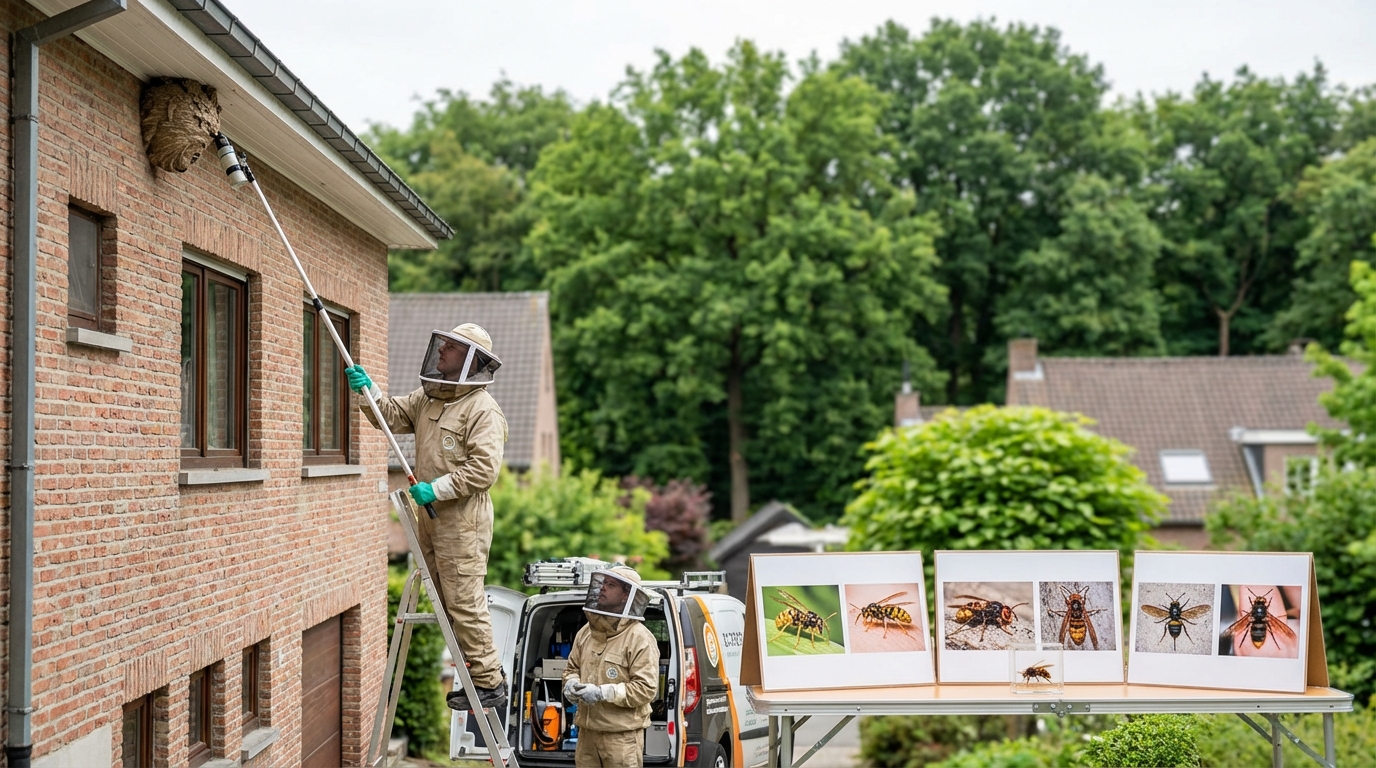
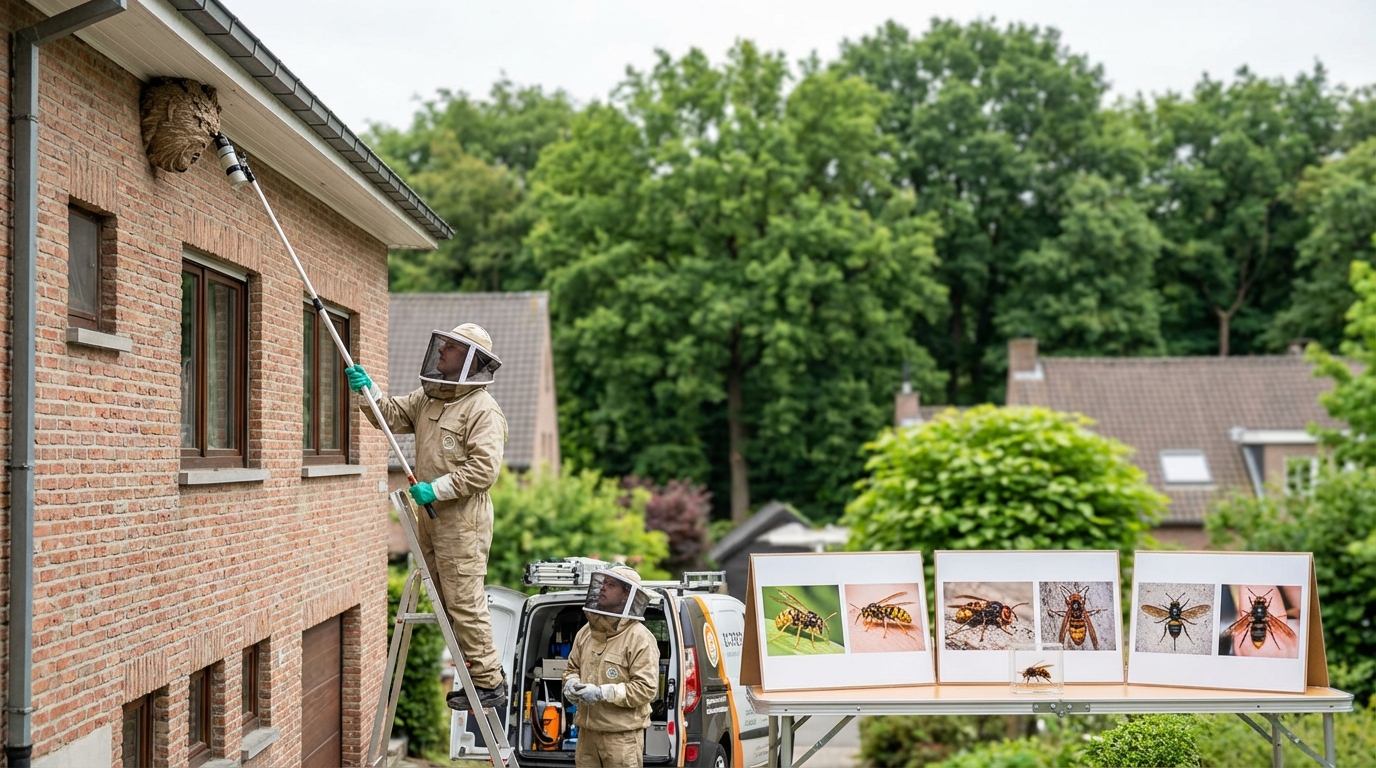
3. The intervention itself. The technician puts on his full protective suit and uses an appropriate biocidal product, injected directly into the nest or at its entrance. The effect is rapid: insects inside the nest are neutralized in just a few minutes. Those returning from outside come into contact with the product and are eliminated within hours. For high nests, telescopic poles or, in some cases, a gondola are used.
4. Nest removal. Whenever possible and appropriate, we physically remove the nest. This prevents another insect from moving in, and reassures the occupants. Sometimes, the nest is inaccessible (in a cavity wall, for example): in this case, treatment is sufficient, the colony dies and the nest decomposes naturally.
5. Post-procedure advice. We'll tell you what to look out for in the days ahead. It's normal for a few insects to remain in flight for 24 to 48 hours. We also tell you which areas of your home to look out for in the coming season.
A question we're always asked: how much does it cost to remove a wasp nest? At Frelons.be, we charge a fixed price for the destruction of wasp and hornet nests. No surprises at the end, no hidden extras. You know the amount before we start. It's a choice we take on board: people who have a nest in their home are already stressed, so they don't need to worry about how much it's going to cost them.
Rapid intervention in Brussels is our business. We don't make you wait three days. When a family with small children calls us because there's an active nest above the front door, we understand that every hour counts. The safety of children and pets is what drives most calls, and it's what drives our responsiveness.
Identify and react to Asian hornets and wasps all year round in zone 1160
Many people think that wasps are a summer problem. You see them around tables in July and August, and then it's all over. The reality is different, especially since the arrival of the Asian hornet in Auderghem.
Let's look at the calendar again. From February-March, the founding queens emerge from hibernation and look for a place to build a primary nest. At this stage, the nest is small, about the size of a golf ball, often in a sheltered spot: a shutter box, a bush, a garden shed. This is the best time to act. A primary nest with a single queen is a quick and easy operation. If you wait until summer, the colony can number several thousand individuals.
How to recognize an Asian hornet nest? The primary nest looks like a small gray ball, with a papier-mâché texture. The secondary nest, the summer nest, is much larger (sometimes 80 cm in diameter), pear-shaped and with a side entrance. It is often installed high up in trees, making it difficult to spot from the ground. If you see Asian hornets in your garden in Auderghem, there's probably a nest within 300 to 500 meters.
And the Asian Hornet itself, what does it look like? Smaller than the European hornet (around 3 cm vs. 3.5 cm), it is best recognized by its dark abdomen with a single orange segment, and its yellow-tipped legs. The European Hornet, on the other hand, has a yellow abdomen with black stripes, closer to that of a large wasp. The Asian Hornet is more aggressive in defending its nest, and poses a serious threat to local bees.
What to do if you see a hornet? Don't make any sudden moves. If it's an isolated individual, it probably won't attack you. Back away calmly. If you see several in the same place, or if you see them coming and going towards a fixed point, it's a sign of a nearby nest. Call a professional. Don't try anything alone, especially with the Asian hornet: group attacks can cause dozens of stings in a matter of seconds.
A word about the mason wasp, which is also regularly reported to us. It's a solitary insect that builds small nests in earth or mud, often on exterior walls or in window frames. Do mason wasps sting? Very rarely. They are not aggressive and do not defend their nests like social wasps. If you spot one, there's usually nothing to worry about. You can still intervene if their presence bothers you, but it's far from an emergency.
Pest extermination in Auderghem isn't limited to the summer months. We also work in autumn and winter. Why do we do this? Because abandoned nests can pose a problem (some people mistakenly believe that an old nest will attract new colonies), and because the Asian hornet, with increasingly mild winters, remains active for longer than before. We treated Asian hornet nests in November in 1160 last year. The problem doesn't stop on September 30.
Our advice: inspect your home in early spring. Check shutter boxes, under roofs, garden sheds and dense hedges. If you spot a nest early, it's easier, less costly and, above all, less risky for everyone involved.
Conclusion
Living in Auderghem means enjoying an exceptional living environment at the gateway to the Forêt de Soignes. The other side of the coin is that wasps and hornets are also happy here. Rather than put up with the situation, or try DIY solutions that put your family at risk, call on professionals who know your area and can intervene quickly, at a fixed rate, all year round.
Do you have any doubts about a nest? Have you spotted Asian hornets in your garden? Contact Frelons.be. We're on call 24 hours a day, and we'll come to your home in Auderghem quickly to make it safe.
Frequently asked questions
Why are there so many wasp nests in Auderghem?
The immediate proximity of the Forêt de Soignes provides an ideal reservoir of food and water for the colonies. Combined with the residential structures of 1160 (roofs, shutters, garden sheds), this creates a perfect nesting environment.
How is a wasp nest destroyed?
A certified technician identifies the species and injects a professional biocide directly into the nest to neutralize the colony within minutes. We provide 24-hour emergency service in Auderghem, and physically remove the nest where access is possible.
How much does it cost to remove a wasp nest in 1160?
At Frelons.be, we apply a fixed, transparent price for any intervention in Auderghem, with no hidden extras. You'll know the exact amount right from the start, so there are no surprises.
Can wasp or hornet nests be found all year round?
While activity peaks in summer, queens seek shelter from February-March onwards for their primary nests. With mild winters in Brussels, some Asian hornet nests remain active until November, requiring constant vigilance.
 French
  English
  Dutch
Dutch
0 Comments