
Wasp nest destruction in Woluwe-Saint-Pierre : Complete guide
Contents
Last summer, a resident of Avenue de Tervueren called us on a Sunday morning. Tense voice. He'd opened his skylight to air his daughter's bedroom, and there was a surprise: a wasp's nest the size of a football, hanging just below the cornice. The little girl was sleeping two meters away. This kind of situation is encountered dozens of times a season in Woluwe-Saint-Pierre, and each time, the same urgency, the same stress.
Things to remember
-
An informative story based on a real-life intervention in Woluwe-Saint-Pierre, combining identification tips and a practical guide to local services (private vs. communal) to reassure the inhabitants of 1150 against Asian wasps and hornets.
-
Identifying wasp and hornet nests in Woluwe-Saint-Pierre
-
A professional intervention in an urban area
-
Tariffs and municipal assistance for residents over 1150
This guide is exactly what we'd like the resident of 1150 to have on hand before panicking. We're going to talk about identification, concrete procedures, real rates and municipal aid. No generic blah, blah, blah: just information that reflects the reality of Woluwe-Saint-Pierre, with its old houses, slate roofs and tree-lined gardens that attract this flying little world.
Identifying wasp and hornet nests in Woluwe-Saint-Pierre
Before you pick up the phone, you need to know what you're dealing with. Because a common wasp nest, a mason wasp nest and an Asian hornet nest are not treated in the same way. And confusion is common.
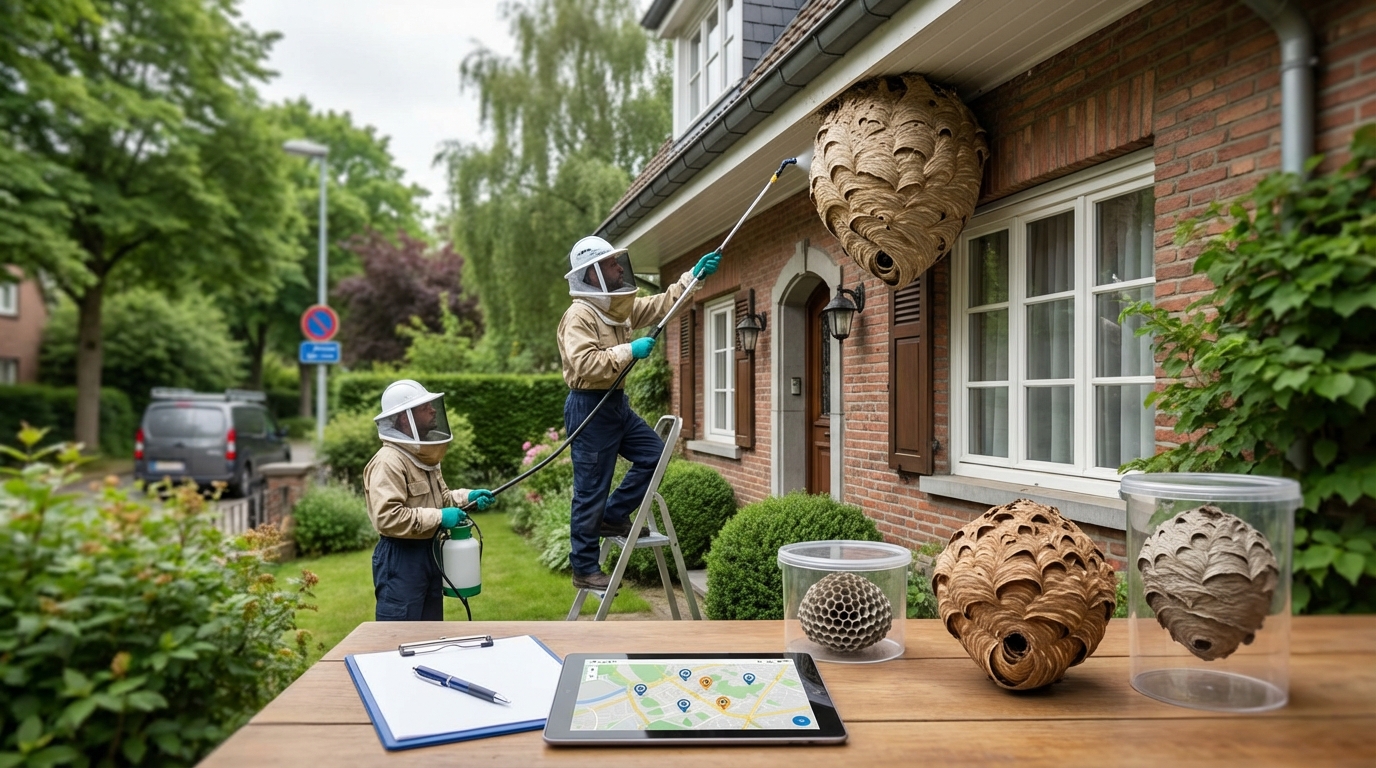
The common wasp (Vespula vulgaris), this is the species most often found in 1150, building grayish, papier-mâché nests that are often hidden: under a roof, in a roller shutter box, sometimes even in the ground. In Woluwe-Saint-Pierre, old houses with their many nooks and crannies are a perfect playground for them. The nest starts small in spring, about the size of a golf ball, and can reach 40 cm in diameter by midsummer. This is precisely why many people wonder why there are so many wasps at any given time: the wasp season stretches from May to October, with a peak between July and September when the colony is at its peak, sometimes 5,000 individuals.
The mason wasp is another story altogether. You can recognize them by their little earthen nests, often stuck to an exterior wall or window frame. The good news is that the mason wasp is solitary and hardly ever stings. If you find one in your home, don't panic. They pose no real danger and disappear on their own at the end of the season. There's no need to pay for an intervention.
The Asian hornet, on the other hand, is the real cause for concern. Reported in Brussels since 2016, the Asian hornet has taken up permanent residence in the region. In Woluwe-Saint-Pierre, they are detected every year, particularly in areas close to the Woluwe Park and private gardens bordering the Forêt de Soignes. Its nest is characteristically teardrop-shaped, often perched high up in a tree, sometimes over 15 meters. The entrance is on the side, not underneath as in the common wasp. Its color is dark brown. If you spot a nest of this type, don't go near it. The Asian hornet is aggressive when threatened, and its stings are particularly painful.
To identify a wasp or hornet's nest, here are a few simple pointers: observe the insects' comings and goings, especially at the end of the day when they return to the nest. Note the size of the insects (the Asian hornet measures around 3 cm, compared with 1.5 cm for a common wasp). Above all, keep your distance. A zoom shot from 5-6 meters away is all it takes for a professional to identify the species.
An often overlooked detail: in spring, the founding queens of Asian hornets are looking for a place to start their colony. This is where spring trapping comes into its own. We'll come back to this in the section on municipal aid, but remember that capturing a queen in April means potentially preventing the formation of an entire nest of several thousand individuals.
A professional intervention in an urban area
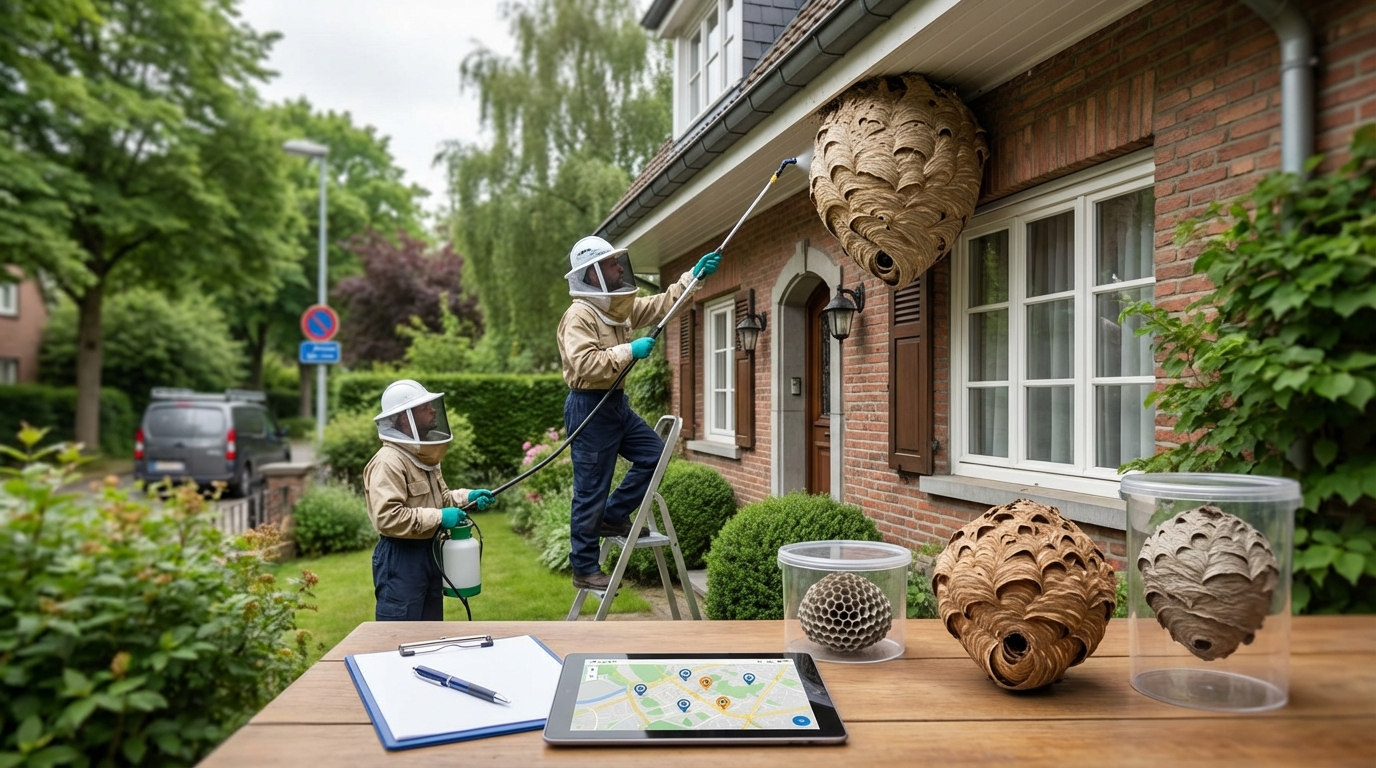
Back to our resident on Avenue de Tervueren. Sunday morning, nest under the cornice, child sleeping next door. What happens when he calls a pest control professional in Woluwe-Saint-Pierre?
First step: remote diagnosis. The technician asks a few questions over the phone. Where is the nest? Approximately how big is it? Are there allergic people in the household? Any pets? Is there easy access to the area? We often ask for a photo. This confirms whether the nest is in fact a wasp, a European hornet or an Asian hornet, and enables us to adapt our equipment accordingly. To destroy a nest under the roof, for example, you'll need a telescopic ladder, or even a nacelle if the nest is really high up.
Second step: removal. Companies specializing in wasp extermination in Woluwe-Saint-Pierre generally intervene within 2 to 4 hours during peak activity periods (July-August). Some offer 24-hour intervention, which is reassuring when the nest is in a bedroom or near an entrance. The technician arrives in a fully-equipped vehicle, with full-body suit, reinforced gloves and injection equipment.
Third step: securing the perimeter. This is a point that people underestimate. In urban areas like Woluwe-Saint-Pierre, houses are often terraced or close together. The safety of the work doesn't just concern the customer: you also have to think about neighbors, passers-by and children playing in the next-door garden. The technician marks out a safety zone, closes nearby windows if possible, and warns the occupants of adjacent houses if necessary.
Fourth step: treatment. For a classic wasp nest, a powdered insecticide is injected directly into the nest entrance using a telescopic pole. The product diffuses inside, and the insects die within a few hours. The nest is then removed the same day or the following day, once all activity has ceased. For a high-altitude Asian hornet nest, the technique is similar but requires greater care: the Asian hornet is more reactive and attacks in groups when the nest is disturbed.
An important point: hornet extermination in Woluwe-Saint-Pierre (and everywhere else in Belgium) is regulated. The products used are authorized biocides, and the technician must be certified. Never call on someone who can't show this certification. There are still too many DIY enthusiasts offering their services on social networks, without any training or insurance.
Fifth step: the post-intervention check. A good professional comes back or calls within 48 hours to check that the nest is inactive. If wasps return (this sometimes happens, especially when workers were in flight at the time of treatment), a second visit is generally included in the initial fee.
For our resident of Avenue de Tervueren, the intervention lasted 45 minutes. The nest was treated and removed the next day, and his daughter was able to return to her room that very evening. No drama, no rubble, just a professional who knows what he's doing.
Tariffs and municipal assistance for residents over 1150
How much does it cost to remove a wasp nest? That's the question we're asked most often, and the answer depends on a number of factors. Let's be concrete.
The price of a wasp nest removal in Woluwe-Saint-Pierre generally varies between 80 and 180 euros, all taxes included. Prices vary according to: the height of the nest (a nest on the ground or at ground level costs less than a nest 10 meters away under a roof), accessibility (you may have to go inside the house, move furniture, or intervene from the neighbor's garden), and the type of insect. A nest of Asian hornets often costs a little more, around 120 to 200 euros, because the intervention requires more time and equipment. The price of a wasp intervention normally includes travel, treatment and removal of the nest.
Beware of opaque quotes. A serious professional will announce a fixed price or a clear price range before coming to your premises. If you're told «we'll see on site», don't trust them. Always ask for a price including all taxes and travel expenses.
In terms of municipal aid, Woluwe-Saint-Pierre has set up an interesting scheme, especially for the Asian hornet. The municipality distributes trap lids for spring trapping of founding queens. The principle is simple: a special lid is attached to a jar containing a sweet bait (dark beer and syrup, for example). Asian hornet queens are attracted to the jar in spring, between March and May, when they are looking for a nesting site. The trap lids are available from the Woluwe-Saint-Pierre town hall, usually from March onwards.
For the destruction of Asian hornet nests specifically, the Brussels-Capital Region covers part of the cost via the surveillance network. If you spot a suspicious nest, report it on the vespawatch.be. An expert will confirm the identification, and if it is indeed an Asian hornet, the destruction is coordinated (and often subsidized) by the regional authorities. Common wasps, on the other hand, are the responsibility of the owner or tenant.
Here are a few tips to reduce your bill. First, act early. A nest treated in May or June, when it's still small, costs less and is easier to remove than a mature nest in August. Secondly, group your requests together: if your neighbor also has a problem, some companies offer a reduced rate for two interventions on the same street. It's worth talking to your neighbors.
A word about emergency interventions. Nights, weekends, public holidays: yes, it's possible, and yes, it's more expensive. Generally speaking, you'll have to pay an extra 30 to 50 euros. But when a nest is in a child's bedroom or blocking access to your front door, we're not going to wait until Monday morning. Companies offering 24-hour service in the 1150 area can be reached even on Sundays, as in the case of our resident on Avenue de Tervueren.
Last but not least: your home insurance. Few people know it, but some insurance policies include a «pest» clause that reimburses all or part of the cost of the operation. Check your terms and conditions before you pay - it could save you the whole cost of destroying the wasp nest. It only takes five minutes, and it's well worth it.
Conclusion
A wasp or hornet's nest in Woluwe-Saint-Pierre can be dealt with. Not by tinkering with insecticide spray from the supermarket (that's the best way to get stung and make the situation worse), but by calling in a licensed professional who knows the terrain. First identify what you have in front of you, don't take any chances, and call it in. In 2 to 4 hours, you're done.
If you're looking for prevention, think about spring trapping as early as March, with the trap covers distributed by the commune. And if you spot an Asian hornet nest in Brussels, report it immediately to vespawatch.be You're doing the whole neighborhood a favor.
At Frelons.be, we're active all year round against the Asian hornet and we intervene quickly in Woluwe-Saint-Pierre. In doubt or in a hurry? Just contact us. We'd rather come to you for nothing than leave you to deal with it on your own.
Frequently asked questions
How much does it cost to destroy a wasp nest in Woluwe-Saint-Pierre?
The average cost varies between €80 and €180, depending on the accessibility and height of the nest. Intervention for Asian hornets can be slightly more expensive (up to €200) due to the specific protective equipment required.
Does Woluwe-Saint-Pierre offer any assistance?
Yes, the commune distributes free trap covers in the spring to capture queen hornets. For the destruction of an Asian hornet nest, a report on VespaWatch can enable the Region to coordinate the cost.
Who pays for extermination: the landlord or the tenant?
In Belgium, the cost of destroying a wasp nest is generally the responsibility of the tenant, as it's a routine maintenance expense. However, check your home insurance policy: some policies include a «pest» clause that fully reimburses the cost.
How can you tell a wasp nest from an Asian hornet nest?
Wasp nests are gray and often hidden (ledges, shutters), while Asian hornet nests are brown, teardrop-shaped and perched high in trees. If in doubt, take a photo from a distance and send it to a certified 1150 professional.
 French
  English
  Dutch
Dutch
0 Comments