
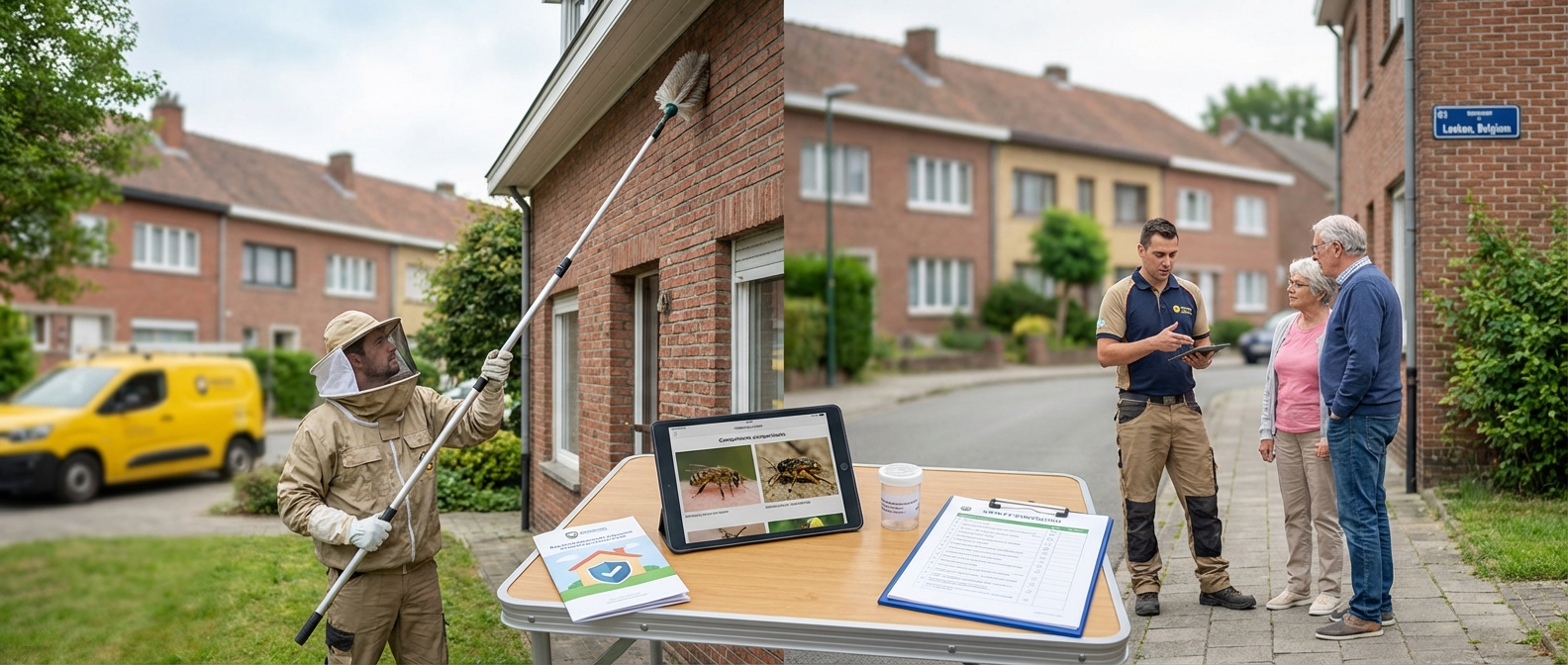
Destroying a wasp nest in Laeken: a comprehensive guide for residents
Contents
-
Identifying pests in Laeken: a guide to wasps and Asian hornets
-
The course of a pest control operation in 1020: from diagnosis to eradication
-
Rates, safety and responsibilities: dealing with a wasp emergency in Laeken
Last summer, a resident of De Wand called us on a Sunday morning. His children were playing in the garden when they noticed a suspicious movement under the garage ledge. A wasp nest, as big as a football, had been there for several weeks without anyone noticing. We see this kind of situation every year in Laeken, in the houses of Mutsaard, along the Parc Royal, or in the buildings of 1020. And every time, the same question comes up: what do we do now?
Things to remember
-
This article takes an ultra-local approach, describing a typical intervention in the Laeken neighborhoods (De Wand, Mutsaard).
-
It combines technical expertise and practical advice to reassure residents, while highlighting the constant presence of hornets.
-
A guide to controlling the Asian hornet, even outside the summer season
-
Guide to differentiating between Asian wasps and hornets
That's what this guide is all about. We're going to talk about identification, intervention, rates, and above all the right reflexes to have when you discover a nest in your home. At Frelons.be, we intervene all year round in Brussels, including against the Asian hornet which is beginning to settle in the region. Whether it's the middle of July or November, we're always ready to help.
Don't panic, and don't make any hasty moves. Read on, and you'll know exactly what to do.
Identifying pests in Laeken: a guide to wasps and Asian hornets
Before you pick up the phone, you need to know what you're dealing with. Because not all striped bugs are the same, and the answer won't be the same depending on the species.
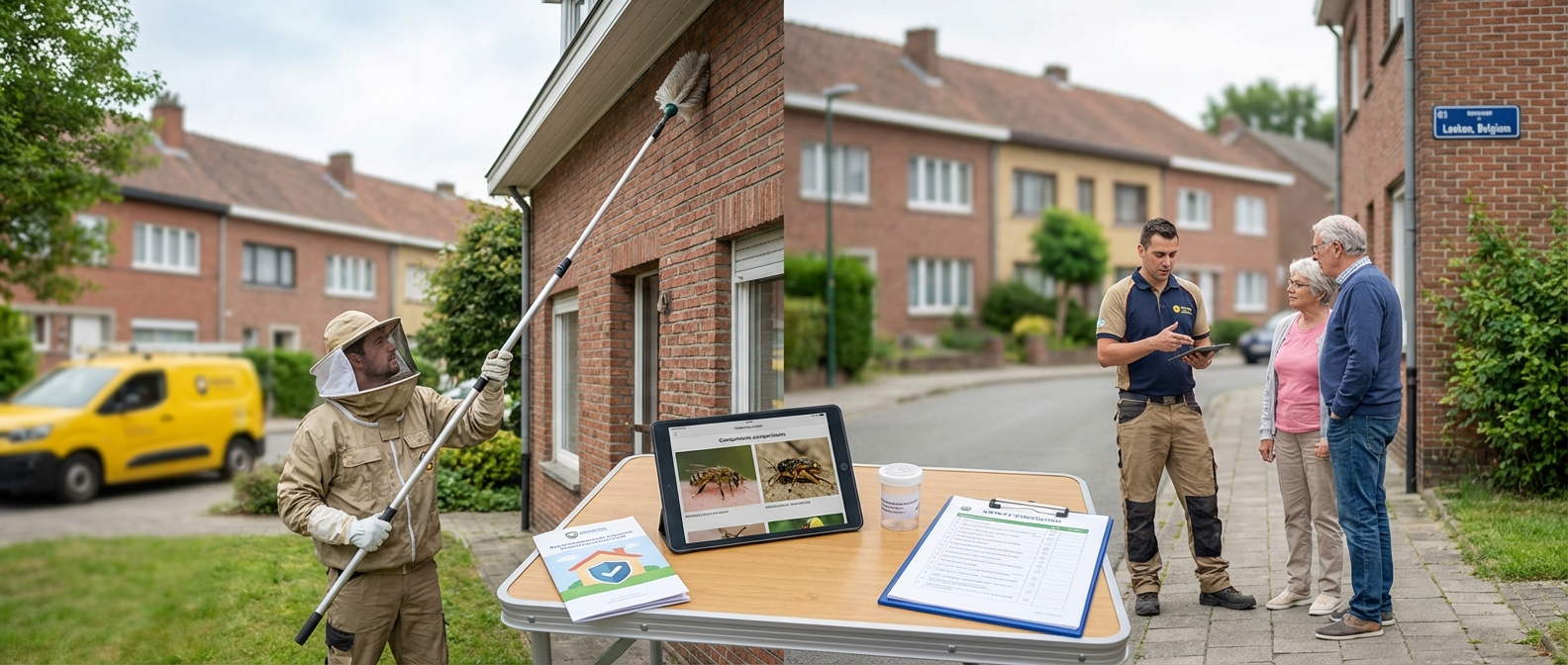
The common wasp (Vespula vulgaris), it's the one we all know. Yellow and black, around 15 mm long, it loves your terrace when you're getting out the jam. Its nest looks like grayish papier-mâché, often hidden in a sheltered spot: under a roof, in a shed, sometimes even in the ground. In Laeken, they are regularly found in the old buildings of the Mutsaard district, where attics and false ceilings offer ideal hiding places.
The European hornet, on the other hand, is considerably larger (up to 35 mm). Impressive, but rather quiet. In fact, many people ask us what that big wasp is that doesn't sting: it's usually him. He's not interested in your food, and only becomes aggressive if you get too close to his nest. Its silhouette is browner, with reddish highlights on the thorax.
The Asian hornet (Vespa velutina), it's a different story. Darker than its European cousin, almost black with an orange stripe on the abdomen and yellow legs at the tips. It arrived in Belgium a few years ago and is making progress every season. Identifying the Asian hornet in Laeken is becoming a real issue: we've dealt with several cases in 1020 over the past two years, notably near Heysel and in the gardens bordering the royal estate.
Why is it important to make the distinction? Because the Asian hornet in Brussels represents a serious ecological threat. It decimates bee colonies, with direct consequences for pollination. Its presence must be reported, and its nest destroyed by trained professionals. This is no ordinary pest.
To summarize wasp/frelon identification in a few visual cues:
-
Common wasp : small (15 mm), bright yellow and black, gray papier-mâché nest
-
European hornet : large (25-35 mm), reddish-brown, not very aggressive
-
Asian hornet : medium-sized (25-30 mm), very dark, yellow legs, often nests high up in trees
In doubt? Take a photo from a distance (no closer than 3 meters) and send it to Frelons.be. We'll tell you what it is in just a few minutes. No need to play amateur entomologist when there's a risk of stinging.
The course of a pest control operation in 1020: from diagnosis to eradication
You've spotted a nest. You've resisted the urge to attack it with a water jet (a good idea, really). But now what? Here's what happens when you call on the services of Frelons.be in Laeken.
Step 1: Remote diagnosis. When you contact us, we start by assessing the situation. Photos, description of the location, estimated nest size, frequency of wasp activity. This allows us to prepare the right equipment and give you an initial estimate. No surprises on arrival.
Step 2: On-site inspection. Our technician usually arrives within 24 hours, often the same day for urgent cases. He inspects the nest, confirms the species and checks accessibility. A nest under a tile on the third floor of a house on Rue De Wand is not the same as a nest in a hedge on the first floor. The approach changes, and so does the equipment.
Step 3: Treatment. To destroy a wasp nest in Brussels, we use a professional insecticide in powder or aerosol form, injected directly into the nest. The product takes effect within a few hours. Wasps returning to the nest after treatment are also eliminated. We don't remove the nest immediately: we wait 48 hours to ensure that the entire colony has been neutralized, then return to remove it if necessary.
For nests at height or difficult to access, telescopic poles or, in some cases, a gondola are used. In Laeken, old facades and complex roofs sometimes make access difficult. We adapt.
Step 4: Follow-up. After the treatment, we check that there is no more activity around the nest. If wasps return (this sometimes happens when workers were in flight at the time of treatment), we return at no extra cost.
All this is done in a full-body suit, with appropriate protection. Safety is no joke: a disturbed wasp colony can dispatch dozens of individuals in a matter of seconds. That's exactly why we strongly advise against homemade attempts. A bucket of hot water, smoke, a garbage bag - we've seen it all. And we've also seen the multiple stings that go with it.
By the way, what happens if you're stung by a lot of wasps? Beyond 5 to 10 stings in an adult (fewer in a child), it's a medical emergency. The venom can cause toxic shock, even without a known allergy. If you are allergic, a single sting is enough to trigger anaphylactic shock. Call 112 immediately.
Pest extermination in the 1020 is part of our daily routine. We know the streets, the types of buildings, the places where nests most often form. This local knowledge saves time, and time counts when you have an active nest above your front door.
Rates, safety and responsibilities: dealing with a wasp emergency in Laeken
How much does it cost to remove a wasp nest? That's the question we hear most. The honest answer: it depends. Not to confuse the issue, but because a number of factors come into play.
The price of a wasp nest removal varies according to :
-
Visit height the nest (a 2-metre nest vs. a 10-metre nest is not the same material)
-
L’accessibility (attic, wall cavity, dense tree)
-
L’species (a nest of Asian hornets requires a specific protocol)
-
L’emergency (weekend or evening operations)
For a standard, accessible wasp nest, expect to pay between €80 and €150 on average. A high nest requiring a pole or special access can cost between 200 and 250 euros. At Frelons.be, our rates for insect removal in Laeken remain within this range, with no hidden costs. We announce the price before we intervene, period.
For the Asian hornet, treatment is often paid for or subsidized by the Brussels-Capital Region as part of the control plan. Contact your local council for details, and we'll help you put together the necessary file.
As far as responsibilities are concerned, Belgian law is quite clear. Visit owner is responsible for the upkeep of his or her property, including pest control. If you are a tenant and discover a nest, notify your landlord immediately. In the event of a wasp emergency in 1020, when there is a real safety risk (nest near an entrance, small children, allergic person in the household), the tenant can call in a professional and claim reimbursement from the landlord. Keep the invoice.
For condominiums, it's up to the syndic to deal with the situation if the nest is in the common areas. Roof, shared gutters, courtyard: contact your building manager, but don't wait for three condominium meetings to take action. A wasp colony doubles in size in just a few weeks during the summer.
A few safety precautions in the event of a wasp sting:
-
Remove the venom source if a stinger remains (rare in wasps, more common in bees).
-
Bring a heat source (lighter, hair dryer) close to the bite for a few seconds: the heat breaks down the venom.
-
Apply cold afterwards to reduce swelling
-
Watch for signs of allergy: swelling that spreads, breathing difficulties, dizziness, etc.
-
In case of allergic reaction, call 112 immediately
And if you are confronted with an Asian hornet attack in Brussels, the rule is simple: move away calmly, without sudden movements. Don't run away waving your arms, as this makes the situation worse. Take shelter in a building or car. Asian hornets are more aggressive than wasps when you approach their nest, and their stings are more painful.
At Frelons.be, we don't just work from June to September. Asian hornet foundresses emerge from hibernation as early as March. Spotting them early means preventing the formation of an entire colony. We also intervene in autumn and winter to remove abandoned nests and set preventive traps. Fighting the Asian hornet is a year-round job.
Conclusion
A wasp nest in Laeken doesn't have to happen. It's a problem that can be solved quickly and easily if the right people are called in. Identify the species, don't try anything on your own, and contact a professional.
Frelons.be works throughout the 1020 and the rest of Brussels, often during the day. We're available 7 days a week, including emergencies. Doubts about a nest, a question about the Asian hornet, a quick estimate: call us or send us a photo. We'll take care of the rest.
Frequently asked questions
How much does it cost to destroy a wasp nest in Laeken (1020)?
The average cost of an intervention in Laeken varies between €80 and €150, depending on the accessibility of the nest. For Asian hornet nests or high access (roof, cornice), a specific estimate is drawn up before any action is taken.
Who pays for the work: the owner or the tenant?
In Belgium, the cost of pest control is usually the responsibility of the owner as part of property maintenance. In the event of an immediate emergency in 1020, the tenant can call in a professional and request reimbursement on invoice.
What should I do if I discover a wasp nest under my roof?
Never try to block the entrance or hose it down, as the wasps will immediately become aggressive. The best solution is to contact a local expert in Laeken, who will inject a professional insecticide to eradicate the colony safely.
What is the response time for an emergency in Laeken?
At Frelons.be, we generally intervene within 24 hours of your call throughout the Mutsaard district, De Wand and the center of Laeken. For critical situations (allergic persons or nests close to entrances), we prioritize same-day intervention.
How to recognize a common wasp in Laeken?
The wasp measures around 15 mm and can be recognized by its bright yellow and black body with a pronounced «waist». In Laeken, it is often found in the Mutsaard gardens, nesting in a grayish papier-mâché nest hidden under a cornice or in the ground.
 French
  English
  Dutch
Dutch
0 Comments