
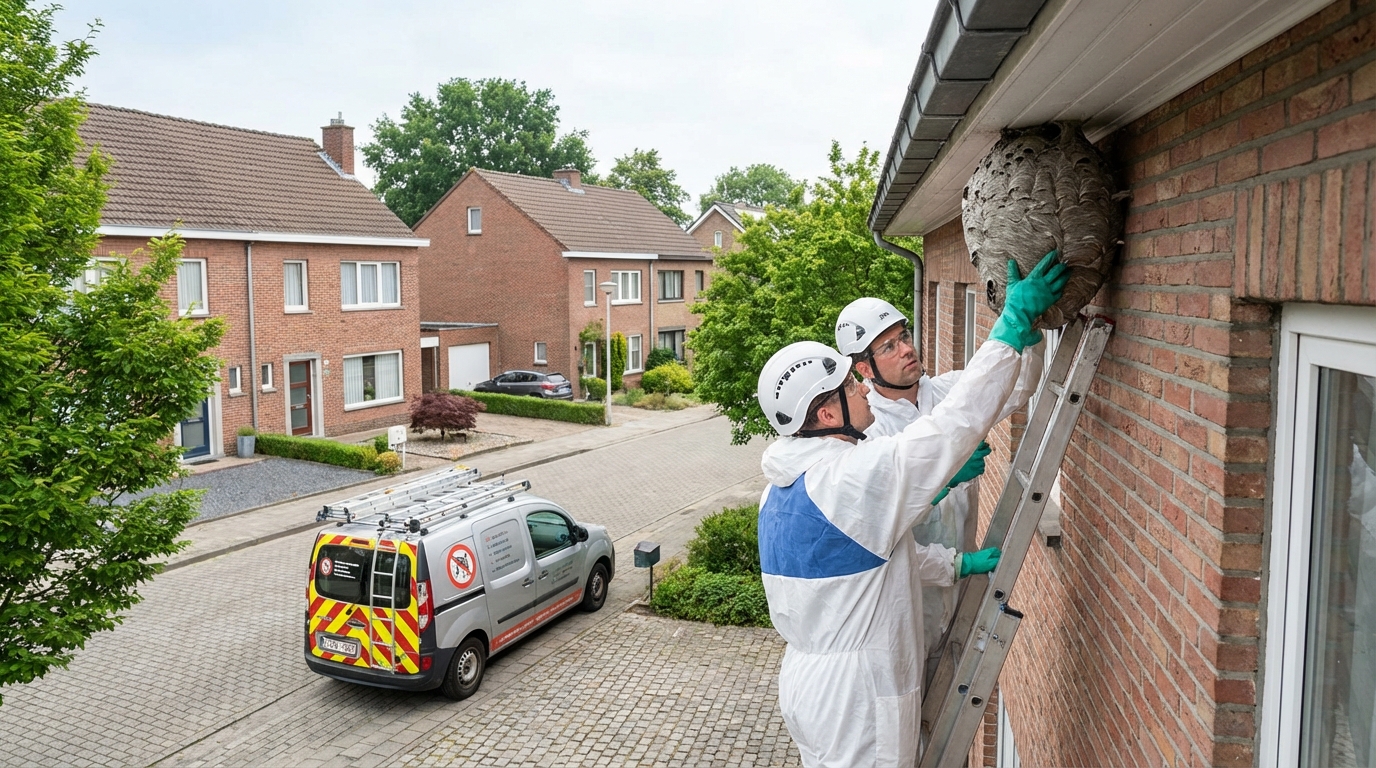
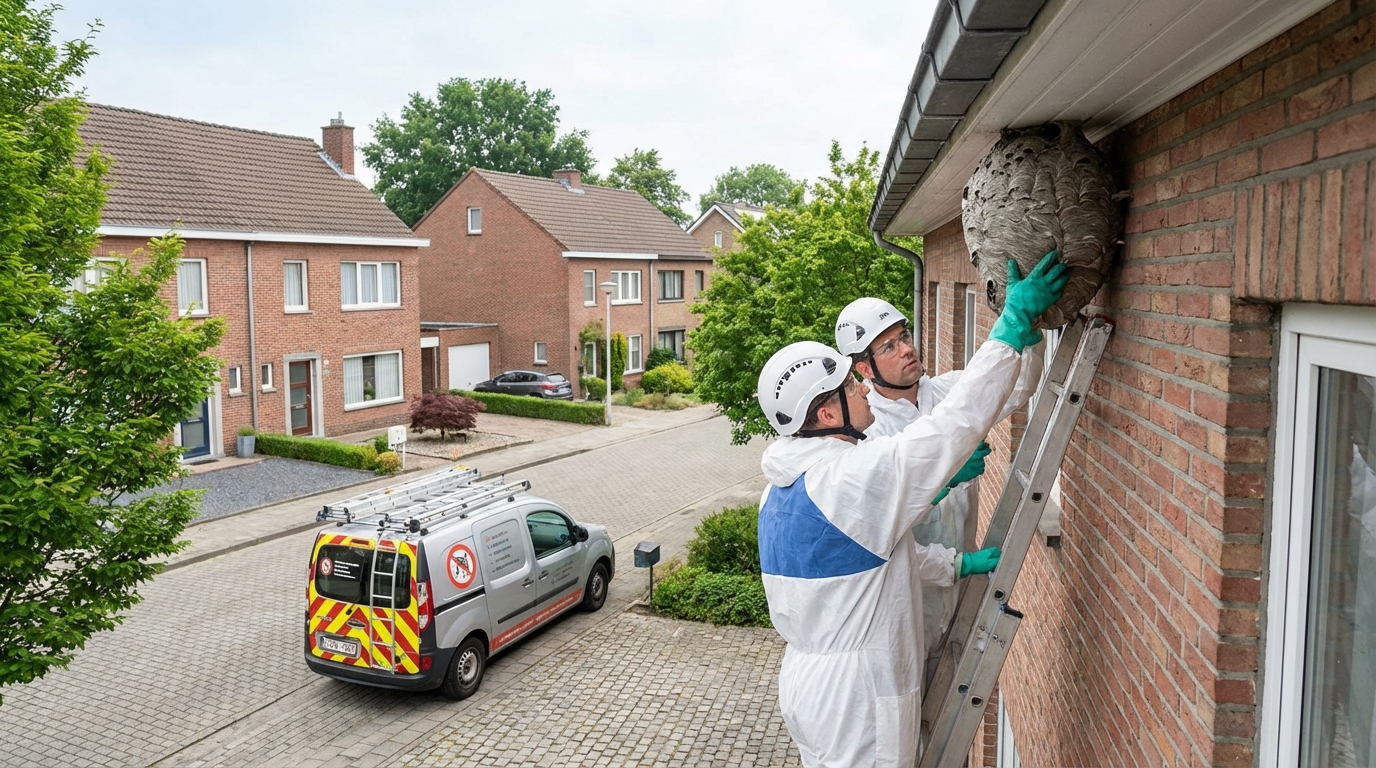
Wasp nest destruction in Neder-Over-Heembeek (1120)
Contents
A wasp nest under the roof overhang, a hornet colony in the garden shed, flying insects circling the table as soon as you go out to eat: in Neder-Over-Heembeek, this is a scenario that dozens of households experience every summer. And sometimes long before summer, too.
Things to remember
-
An ultra-local article focusing on a typical intervention in the 1120 area
-
The approach combines technical expertise and local storytelling, highlighting the year-round fight against the Asian hornet and differentiating itself from simple price pages.
-
Understanding wasps and hornets in Neder-Over-Heembeek
-
How a pest control service works in 1120
The classic reflex is to call the fire department. Except that in Brussels, the fire department now refers all wasp nest destruction to private professionals. As a result, you have to find a wasp exterminator in the 1120 area who knows the area, can intervene quickly and won't charge just anything. That's exactly what we do at Frelons.be, and not just in midsummer.
This article explains how we work in the field at Neder-Over-Heembeek, why some parts of the district are more exposed than others, and above all why the fight against the Asian hornet doesn't stop in September.
Understanding wasps and hornets in Neder-Over-Heembeek
Neder-Over-Heembeek is a neighborhood unlike any other in Brussels. Between the Royal Park of Laeken right next door, the semi-rural areas around Heysel and, above all, the proximity of the Brussels Canal, 1120 offers wasps and hornets exactly what they're looking for: water, vegetation and built nesting structures.
The canal plays a role that is often underestimated. Wasps need water to build their nests (they chew wood, which they mix with saliva to make a kind of papier-mâché). A permanent water source nearby is a magnet. The gardens along the river banks, the garages and attics of old houses along the Vilvoorde causeway are all places where hornet nests are regularly found in 1120.
So, how do you know what you're dealing with? Identifying flying insects is the first step, and it's not as straightforward as you might think. The common wasp (Vespula vulgaris) measures around 12 to 17 mm, with its contrasting yellow and black stripes. The Germanic wasp is very similar, but a hair larger. The European Hornet is one size larger: 25 to 35 mm, with more orange hues. And then there's the Asian hornet, recognizable by its dark abdomen with a single orange segment, and yellow-tipped legs.
Why are there sometimes so many wasps at once? It's a question of cycle. In June-July, colonies explode in size. A queen can lay up to 200 eggs a day. When the colony reaches 2,000 to 5,000 individuals, the comings and goings become highly visible. This is usually when the people of Neder-Over-Heembeek call us.
Another common question: why are European wasps so aggressive? In reality, they're not so aggressive in spring. It's in late summer, when the workers have no more larvae to feed and are looking for sugar for themselves, that they become insistent. They hover around your drinks, your fruit, your garbage cans. They're not attacking you out of malice, they're just hungry and disoriented. But that doesn't make them any less annoying.
A word on a point that often comes up: should wasps be killed? Wasps are pest predators and secondary pollinators. In absolute terms, they have their uses. But when a nest is located two meters from your front door, or in the roller shutter box in the children's bedroom, cohabitation is simply not an option. We don't destroy wasps for pleasure. We intervene when personal safety is at stake.
How a pest control service works in 1120
You've spotted a suspicious coming and going under your roof or in your hedge. What happens when you contact a wasp exterminator in Brussels like Frelons.be?
First, we ask you a few questions over the phone or via the online form. Where is the nest located? At what height? How long have you been observing the activity? Is anyone in the household allergic to bites? This information enables us to prepare the appropriate equipment and estimate the time needed to intervene. In 90 % of cases at Neder-Over-Heembeek, we can be on the scene within the day.
What exactly does rapid intervention in Neder mean? We arrive with our full protective gear (overalls, gloves, protective veil), a low-pressure sprayer or telescopic pole depending on the location of the nest, and an approved professional insecticide. No DIY, no supermarket bombs.
Here are the typical steps:
-
Visual inspection. We locate the nest precisely and identify the species. A common wasp nest in the shape of a grey balloon under a gutter is not the same approach as an Asian hornet nest high up in a tree.
-
Securing the perimeter. We ask you to stay indoors, with your windows closed. If the nest is on the street side of the building, the area is surveyed.
-
Treatment. The insecticide is injected directly into the nest or at the entrance. The insects die within minutes. For high nests, we use a pole that can reach up to 15 meters.
-
Nest removal when accessible. Otherwise, the treated nest decomposes naturally within a few weeks.
-
Verification. We come back if necessary, at no extra charge, to make sure there's no more activity.
Let's talk price. The cost of destroying a wasp nest varies according to the difficulty of access. A visible nest at ground level is the simplest case. A nest in a double wall, under tiles or 10 meters high requires more time and equipment. At Frelons.be, we announce the price before we intervene, so there are no surprises at the end. For Neder-Over-Heembeek, you should generally expect to pay between 80 and 150 euros, depending on the situation. This is at the lower end of the Brussels market, and includes travel.
An important point about extermination safety: never try to destroy a nest yourself. Every year, people end up in emergency wards after trying with boiling water, fire or a vacuum cleaner. A wasp colony under attack defends itself massively. A single sting can cause anaphylactic shock in an allergic person, and you don't always know you're allergic until the first serious reaction.
As for the Brussels fire department, they no longer intervene systematically for wasps. They can still be mobilized in the event of immediate danger (nest on the public highway, allergic person stung), but for disinsectisation in the 1120, you need a registered professional. It's faster, more effective, and the result is guaranteed.
Fighting the Asian hornet in Neder-Over-Heembeek all year round
The Asian hornet arrived in Belgium a few years ago, and it's not going away. In Brussels, reports are increasing every season. Neder-Over-Heembeek, with its green spaces and position in the north of the Region, is on the front line.
What makes the Asian hornet in Brussels particularly problematic is its impact on bees. A single colony of Asian hornets can decimate entire beehives as they post themselves in front of the entrance, capturing foragers one by one. Local beekeepers are well aware of this. But the Asian hornet is also a risk for local residents: it is more aggressive than the European hornet when you approach its nest, and its stings are painful.
What does the Asian Hornet life cycle look like? In winter, only fertilized queens survive. They hibernate in crevices, under bark, sometimes in attics. From February-March, they emerge and build a small primary nest, often the size of a tennis ball, in a sheltered spot: under an awning, in a garden shed, behind a shutter. This primary nest is easy to spot and, above all, easy to destroy. This is where prevention makes all the difference.
If you miss this window, the colony grows. In June, it may move to a secondary nest, the one you see at the top of trees, sometimes as big as a basketball, or even bigger. At this stage, intervention is more complex and costly. Hence the importance of acting early.
At Frelons.be, we don't just intervene in summer when everyone's panicking. Our expertise covers all 12 months of the year:
-
February to April : trapping of founding queens and destruction of primary nests. This is the most effective time to reduce the year's population.
-
May to September : intervention on active nests of common wasps, European hornets and Asian hornets.
-
October to January: identification of empty nests (leaves fall, nests become visible), inspection of at-risk sites, prevention advice.
Nest prevention is something we can all do. Just take a few simple steps: don't leave food outside, cover your garbage cans, and inspect your garden sheds and shutter boxes in spring. If you see a large, solitary wasp circling your house in March or April, there's a good chance that it's a founding queen on the prowl. Report it.
In fact, you may be wondering what that big, non-stinging wasp is that you sometimes come across? It could be the syrphid, a fly that imitates the appearance of a wasp to protect itself from predators. Completely harmless. Or a carpenter bee (xylocope), big, black and impressive, but very peaceful. If you have any doubts about identification, send us a photo. We'll get back to you as soon as possible.
The Asian hornet in Neder-Over-Heembeek is not inevitable. With regular monitoring and targeted interventions at the right time, its expansion can be considerably limited. Frelons.be works in coordination with regional monitoring networks, and reports every nest destroyed to feed the Brussels cartography of the species.
Conclusion
A wasp or hornet's nest in Neder-Over-Heembeek can't be dealt with using insecticide sprays and good will. It has to be dealt with by a professional who knows the area, intervenes quickly and guarantees results.
At Frelons.be, we're active all year round on the 1120 and throughout the Brussels region. Whether it's a wasp SOS in the middle of August or the destruction of a primary Asian hornet nest in March, we're there.
Do you have a doubt, a nest, a question? Contact us directly via Frelons.be. Free diagnosis, price announced before intervention, same-day service in the vast majority of cases.
Frequently asked questions
Why are there so many wasp nests in Neder-Over-Heembeek (1120)?
The proximity of the Brussels canal and green spaces such as the Parc Royal de Laeken provide an ideal environment (water and wood) for nest building. The residential areas around 1120, with their cornices and garden sheds, are ideal nesting sites for wasp and hornet colonies.
How much does it cost to destroy a wasp nest in Neder-Over-Heembeek?
At Frelons.be, the price for an intervention in the 1120 area generally varies between 80 and 150 euros, including travel costs. The price varies according to the height of the nest and the difficulty of access (roof, double partition, high tree), but is always announced before the intervention.
Are the Brussels fire department still responding to wasps in 1120?
The Brussels fire department no longer systematically treats wasp nests and redirects calls to registered private exterminators. For a fast and guaranteed response in Neder-Over-Heembeek, we advise you to contact a local expert directly to avoid waiting times for the emergency services.
How to recognize an Asian hornet in Neder-Over-Heembeek?
The Asian hornet can be distinguished by its very dark body, a single orange segment on the abdomen and yellow-tipped legs. If you see an imposing nest high up in a tree, or suspicious activity near your hives in the 1120 area, contact us for identification and safe eradication.
Is it dangerous to destroy a wasp nest yourself?
Yes, attempting to destroy a nest with water, fire or supermarket spray causes a massive attack on the colony to defend the queen. Without full protective equipment and professional techniques, you expose yourself to multiple stings that can lead to severe anaphylactic shock.
 French
  English
  Dutch
Dutch
0 Comments