

All you need to know about wasp nest destruction in Brussels
Contents
Every summer, it's the same story. You're having your coffee on the terrace, and there's a wasp. Then two. Then ten. And after a week, you realize they're not just passing by: they're living in your home. A wasp nest in Brussels can be anywhere. Under a roof tile, in a shutter box, behind siding, sometimes even in the ground. The problem is that most people wait too long before taking action.
Things to remember
-
An informative, locally-anchored guide that educates Brussels residents on the identification of urban pests (wasps vs. Asian hornets), while explaining the precise intervention process in the Brussels commune, highlighting our permanent availability and expertise in hornets.
-
Understanding the presence of wasps in the Brussels region
-
Guide to identifying a nest and assessing the risks in your home
-
How a professional pest control service works in Brussels
This guide is here to give you the keys. Identify what you really have in front of you (wasp, bee, hornet?), understand how risky it is, and above all know how a disinsectisation operation in Brussels actually works. No unnecessary jargon, and no panic either: just what you need to know to make the right decision quickly.
At Frelons.be, we operate all year round in Brussels and the surrounding area. We treat not only wasps, but also Asian hornets, which are becoming increasingly common in the region. We know the terrain, the buildings of Brussels and their nooks and crannies. And we know that a wasp problem can't always wait until Monday morning.
Understanding the presence of wasps in the Brussels region
Brussels is a green city. Parks, gardens, wasteland, green roofs: all spaces that attract insects. The common wasp (Vespula vulgaris) find exactly what they're looking for: abundant food (your garbage cans, fruit, barbecues) and nesting cavities. Brussels houses, with their cornices, poorly ventilated attics and old facades, offer dozens of perfect nesting spots.
Why are there so many wasps some years? The wasp's life cycle explains a lot. In spring, a fertilized queen emerges from hibernation and begins to build a small nest on her own. She lays her first eggs and feeds the first larvae. Within a few weeks, the workers take over. From July onwards, the colony explodes: a common wasp nest can reach 5,000 to 10,000 individuals at the height of summer. The mild winters of recent years in Brussels have enabled more queens to survive, multiplying colonies the following spring.
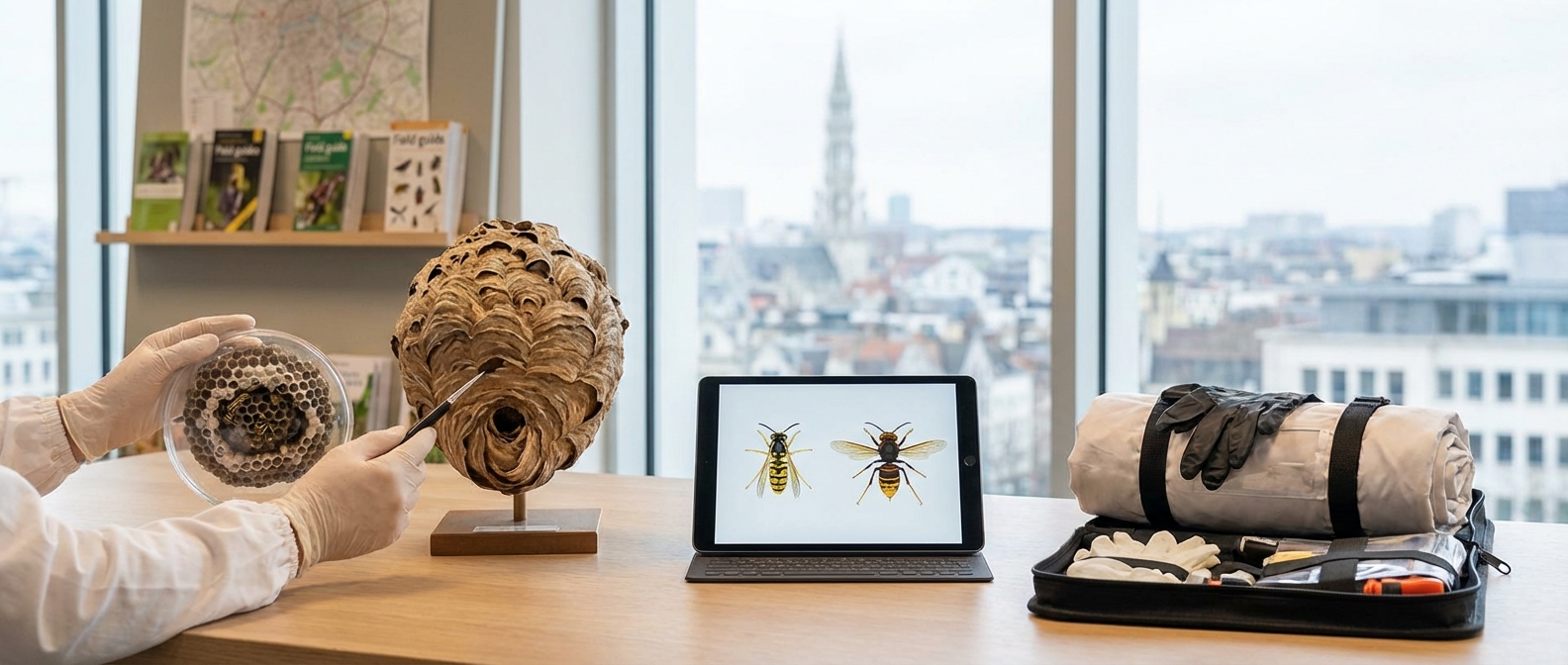
And then there's the Asian hornet. No longer a distant threat. The Asian hornet in Brussels has been a confirmed reality for several years now. Vespa velutina is on the increase in Belgium, and the Brussels region has not been spared. It builds nests high up, often in trees, sometimes over 15 meters away. Larger than common wasps, more aggressive when you approach its nest, and above all fearsome for bees, which it methodically hunts. If you see a large, dark insect with an orange stripe on its abdomen prowling around your hives or garden, it's probably him.
However, the common wasp remains the most common species in Brussels. It's opportunistic, adaptable and takes advantage of everything the city has to offer. Restaurant terraces, markets, organic waste containers: it's all part of the buffet. In dense urban areas, wasp populations can be more concentrated than in the countryside, simply because food sources are everywhere.
An important point to remember: wasps aren't there «by chance» or «just passing through». If you see them regularly in the same place, there's a nest nearby. Sometimes just a few meters away. The wasp's life cycle means that the colony grows exponentially between May and September. The longer you wait, the bigger the nest, the more complex the intervention. In October, the colony dies a natural death, but by then you'll have spent four months living with thousands of stinging insects. This is not a plan.
Guide to identifying a nest and assessing the risks in your home
Before calling anyone, the first thing to do is to identify what you really have at home. Because not all striped bugs are the same, and the answer is not the same depending on the species.
The difference between bees and wasps is fundamental. The bee is hairy, stocky and rather golden-brown. It forages for flowers and isn't interested in your food. The wasp is smooth, bright yellow with clear black stripes, and has a very slim waist (hence the expression «wasp waist»). If the insect is circling your glass of lemonade or your steak, it's a wasp. A bee couldn't care less about your meal. This distinction is important because bees are protected: you don't destroy a swarm, you move it. In most cases, a beekeeper will do the job for free.
Do mason wasps sting? Yes, technically they can. In practice, however, mason wasps are solitary and not very aggressive. They build small nests in earth or mud, often in wall joints or ventilation holes. You'll see it going back and forth with pellets of earth in its mandibles. It does not form a colony, nor does it defend a collective territory. In 95% of cases, you can leave it alone. It will disappear on its own in a few weeks.
To identify a nest of social wasps (common and Germanic wasps, the ones that cause problems), look for the following signs. A regular comings and goings of insects at the same precise spot on your facade, roof or garden. The nest itself is papier-mâché, grayish, with a texture resembling crumpled cardboard. It can be visible (hanging under eaves, in a tree) or completely hidden (in a hollow wall, under tiles, in the ground). Underground nests are the most treacherous because you step on them without knowing it, and the colony reacts violently.
Let's be clear about the risks. Is it dangerous to be stung by a wasp? For most people, a sting is painful but not serious. It's swollen, itchy and goes away in a few days. The real danger is for people allergic to the venom: a single sting can cause anaphylactic shock, an absolute medical emergency. In Belgium, it is estimated that 3 to 5% of the population have a significant allergy to Hymenoptera venom. If you don't know your allergy status, it's a risk you can't assess yourself.
The other risk factor is the location of the nest. A nest in a tree at the bottom of the garden, 20 meters from the house? You can sometimes wait until the end of the season. A nest in the children's bedroom shutter box, or next to the front door? There's no time to think about it: it's time to intervene. Wasps become aggressive when you get within 3 to 5 meters of the nest, and vibrations (closing a shutter, mowing the lawn) can trigger a collective attack. Dozens of simultaneous stings, even without allergies, can send you to the emergency room.
A word of advice: never try to destroy a wasp nest yourself with a product bought from a supermarket. Commercial insecticide sprays don't have the range or power needed. You'll irritate the colony without neutralizing it. We regularly see people arriving in emergency rooms after this kind of attempt. Leave it to the professionals.
How a professional pest control service works in Brussels
Many people in Brussels still think that the fire department comes to remove a wasp nest. This was true a few years ago. Today, the Brussels fire department no longer takes charge of wasp nest destruction except in situations of immediate danger (public highway, school, allergic person in distress). For everything else, they refer you to a private exterminator. That's the reality.
So what happens when you call in a wasp exterminator in Brussels like Frelons.be? Here's how it works.
You call us or fill in the online form. We ask you a few questions: where the nest is located (or where it comes and goes), how long you've been observing the activity, whether there are allergic people in the household, whether the nest is accessible. With this information, we assess the urgency and give you a time slot. For urgent wasp control, we can be at your home the same day. Yes, same day, including weekends. We're active all year round, not just in summer.
On site, the technician begins with a visual diagnosis. He precisely locates the nest, identifies the species (common wasp, German wasp, European hornet, Asian hornet) and assesses the size of the colony. This is a quick but essential step: treatment varies according to species and location. A nest accessible from above cannot be treated in the same way as a buried nest or a nest in a double partition.
The treatment itself is carried out with a professional insecticide in powder or aerosol form, injected directly into the nest or at the entrance. The products we use are reserved for certified professionals: they are far more effective than what you'll find in the stores, and they work within a few hours. The entire colony is neutralized, including the queen. The technician wears full protective gear (overalls, gloves, veil), because working on an active nest is anything but trivial.
The question everyone asks: how much does it cost to destroy wasps? The price depends on several factors. The accessibility of the nest (high up, in a wall, underground), the size of the colony, and the timing of the intervention (emergency evening or weekend). To give you an idea, expect to pay between 80 and 150 euros for a standard intervention in Brussels. This is an all-inclusive price: travel, diagnosis, treatment and follow-up if necessary. No nasty surprises on the bill. If the nest requires access by gondola or intervention on the roof, the price may be higher, but we'll tell you before we intervene.
After treatment, we recommend that you do not touch the nest for 24 to 48 hours. The wasps in flight at the time of treatment will return, come into contact with the insecticide and die in their turn. After two days, the nest is inactive. It can then be removed if you wish, but this is not obligatory: a treated nest will never be recolonized.
Why call in a pest control professional in Brussels rather than do it yourself? There are three reasons. Safety first: without the right equipment, you risk dozens of bites. Efficiency second: a professional treatment eliminates 100% from the colony in a single operation. And finally, a guarantee: if activity resumes in the next few days (it's rare, but it happens), we'll come back for free.
To remove a wasp nest in Brussels, don't wait until the situation becomes unmanageable. The smaller the nest, the simpler, quicker and more economical the intervention. A nest in June is equivalent to 50 wasps. The same nest in August, 5,000.
Conclusion
A wasp nest in Brussels is not inevitable, nor is it something to be taken lightly. You now know how to recognize what you have in your home, assess the level of risk, and understand what professional intervention entails. The most important thing is to act quickly. With each passing week, the colony grows.
At Frelons.be, we work all over Brussels, 7 days a week, all year round. Whether for wasps or for the extermination of wasps and hornets, including the Asian hornet which is gaining ground in Belgium. One call, one diagnosis, one intervention. Often on the same day. If in doubt, contact us: we'll tell you exactly what's involved, with no obligation. Better one phone call too many than one sting too many.
Frequently asked questions
How do I know if I have a wasp or bee nest?
The wasp is smooth, bright yellow and attracted by human food, while the bee is hairy, brown and only interested in flowers. This distinction is crucial, as the bee is protected: in the event of a bee swarm, contact a beekeeper rather than a bee-killing service.
Do the Brussels fire department still deal with wasp nests?
No, the Brussels fire department no longer comes to deal with wasp nests, except in cases of immediate life-threatening danger on the public highway or in a school. For any nest in a private dwelling, you must now call in a certified pest control company.
How much does it cost to have a wasp nest destroyed in Brussels?
A standard professional intervention in Brussels generally costs between €80 and €150, including travel and guaranteed treatment. The price may vary depending on the accessibility of the nest, for example if it requires a telescopic ladder or roof intervention.
Is the Asian hornet present in the Brussels region?
Yes, the Asian hornet is now well established in Brussels and represents a real threat to local biodiversity. It can be recognized by its dark body and yellow legs; if you spot an imposing nest high up in a tree, it's imperative that you contact fully-equipped experts.
Why shouldn't I destroy a wasp nest myself?
Using commercial insecticide sprays is often ineffective against a colony of several thousand individuals, and runs the risk of provoking an aggressive collective attack. A professional uses full protective suits and powerful insecticide powders that are inaccessible to the general public.
 French
  English
  Dutch
Dutch
0 Comments