
Asian hornets in Brussels: Emergency in schools and gardens
Contents
The principal of an elementary school in Brussels called me last week. Three children stung in two days in the playground, a nest spotted under the cornice of the playground. The kind of call we're receiving more and more often at Frelons.be. And it's no coincidence: Asian hornets in Brussels have gone from being an entomological curiosity to a real public health problem.
Things to remember
-
An unprecedented focus on the proliferation of Asian hornets in sensitive areas of Brussels-City, notably school playgrounds.
-
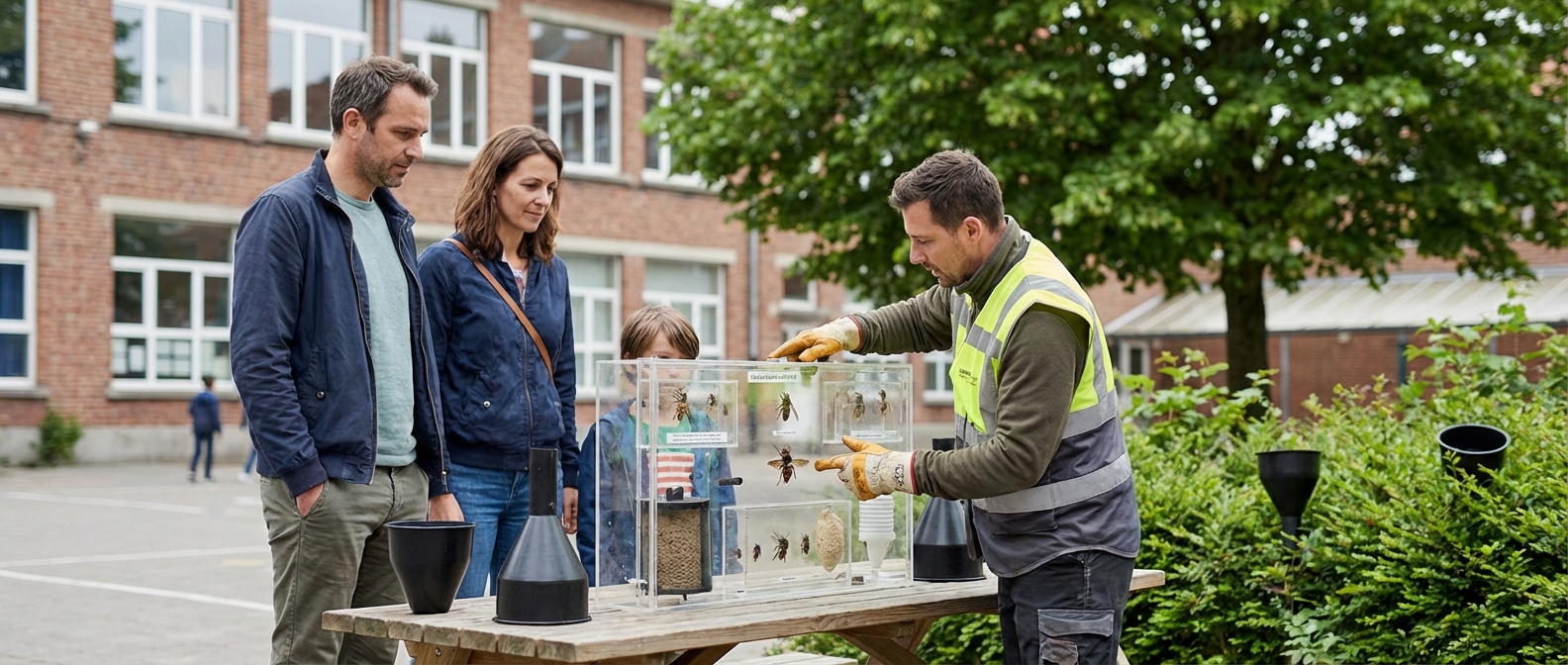
We combine the latest 4000 traps from Bruxelles Environnement with field expertise to reassure parents and school principals.
-
Understanding the invasion of the Asian hornet in the capital of Brussels
-
Managing children's safety in Brussels
Bruxelles Environnement has distributed over 4,000 traps this season in an attempt to contain the proliferation. This figure speaks for itself. But traps alone aren't enough, especially when a nest settles just a few meters from a playground or in a nursery garden. Parents want concrete answers. So do teachers. And frankly, they're right to be concerned.
This article reviews the situation as it stands in 2026: how to recognize the bug, what's really happening in Brussels schools, and above all, what to do if you discover a nest in your home or near a place frequented by children.
Understanding the invasion of the Asian hornet in the capital of Brussels
Yes, there are Asian hornets in Belgium. And not just a few. Visit Vespa velutina nigrithorax, its full scientific name, arrived in Europe via the south of France in the mid-2000s. Year after year, it slowly made its way back up to Belgium. Brussels has not been spared. Urban density, parks, shared gardens: all these factors create a favorable breeding ground for this species, which adapts at an impressive speed.
Identifying the Asian hornet isn't all that complicated once you know what to look for. It's smaller than the European hornet, around 3 centimetres for a worker. Its body is predominantly dark, almost black, with a prominent orange segment on the abdomen. The tips of the legs are yellow. An unmistakable detail. The European Hornet, on the other hand, is larger, yellower and more «giant wasp» in appearance. If you see a dark insect with yellow legs prowling around your beehives or fruit trees, it's most likely him.
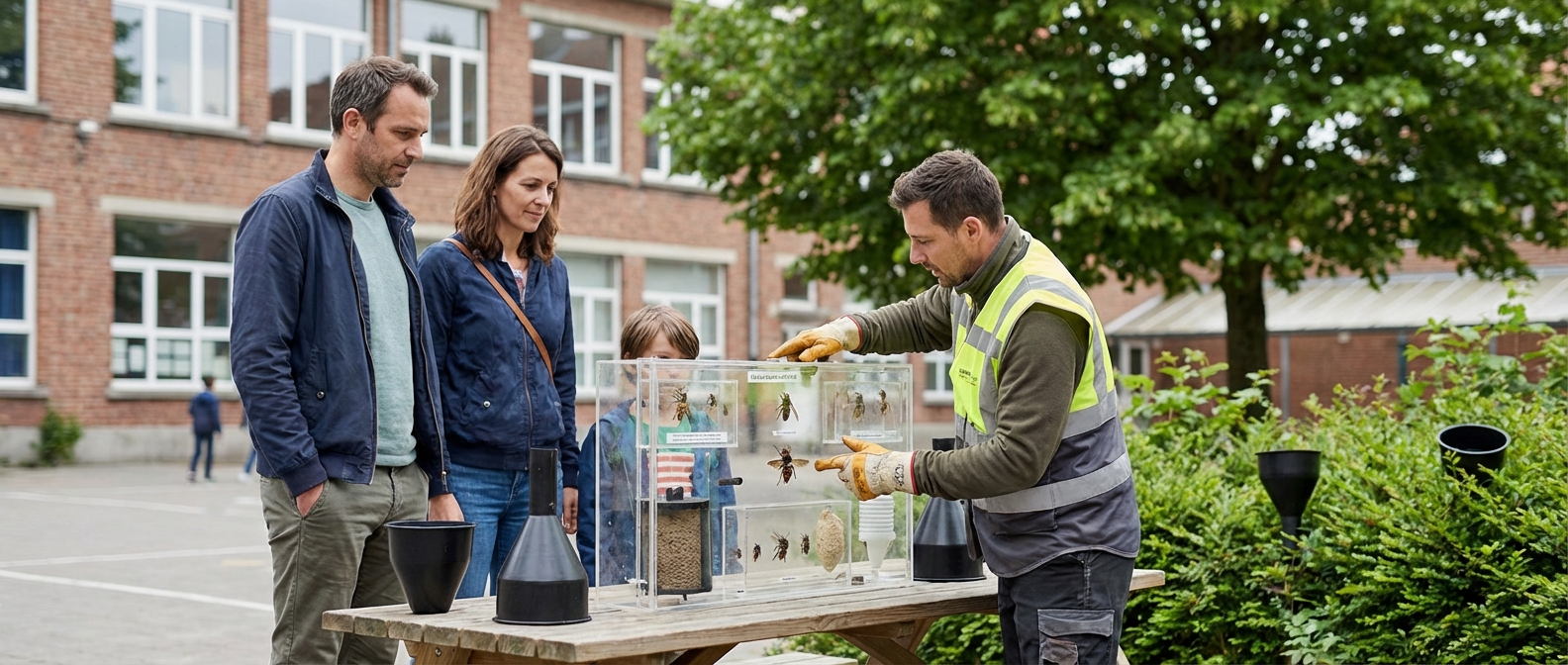
To recognize an Asian hornet nest, you need to distinguish between two phases. In spring, the founding queens build a primary nest, often the size of a tennis ball, in a sheltered spot: under an awning, in a shed, sometimes in a hedge. This nest is easy to miss. It looks like a small ball of grayish papier-mâché. In summer, the colony moves and builds a much larger secondary nest, sometimes as big as a soccer, or even bigger. This one can be found high up in the treetops, roofs or roof timbers. They can contain several thousand individuals.
Why shouldn't I kill a lone Asian Hornet? This question is often asked. Crushing a worker will do nothing to change the dynamics of the colony. Worse still, a stressed hornet releases alarm pheromones that can attract its congeners. The real issue is the nest. As long as the nest is active, the workers are renewed. The only effective strategy is to locate and neutralize the nest, or to trap the founding queens in the spring before they can build one.
The danger to bees is real and documented. A single Asian hornet nest can decimate several hives in a matter of weeks. Hornets hover in front of the hive entrance, capturing bees one by one. As Brussels beekeepers can see every year, the losses are mounting. It's as much an ecological problem as a safety issue for residents.
What makes the situation in Brussels special is the proximity between nesting areas and living quarters. In a rural setting, a nest in a tree 15 meters high poses fewer immediate problems. In the city, the same nest can be found above a restaurant terrace, in the ivy of a school frontage, or in the attic of an adjoining house. Cohabitation is simply impossible.
Schoolyard alert: managing children's safety in Brussels
72 reports of hornets in or near Brussels schools last year. This figure comes from data compiled by the communes, and is probably underestimated because many cases do not go beyond the janitor or principal.
Hornet safety in schools has become an issue that management can no longer ignore. A child stung by an Asian hornet is nothing like a classic wasp sting. The venom is different, the dose injected is higher, and the pain is far more intense. For the vast majority of children, a single sting is painful, but not medically serious. The real danger of stings in children concerns those allergic to hymenoptera venom, and parents are not always aware of this until the first severe reaction. Anaphylactic shock on the playground is the scenario everyone dreads.
Is it dangerous to be stung by an Asian hornet? For a healthy adult, an isolated sting causes sharp pain, local swelling and sometimes nausea. For a 6-year-old child weighing 20 kilos, the same dose of venom has a proportionally greater impact. And if the child unknowingly disturbs a nest, multiple stings are possible. This is a real danger zone, even without a known allergy.
What can you do if you're a school principal or teacher? The first thing to do is regularly inspect the area around the building, especially in spring when the primary nests are forming. Places to check: under roofs, in gutters, behind shutters, under courtyards, in hedges. A primary nest detected early is infinitely easier to manage than a secondary nest 40 centimetres in diameter in the middle of September.
If a nest is discovered, the rule is simple: don't touch it. Secure the area, keep children away, and call in a professional. Intervention in Brussels-City can take place through several channels. Some communes cover the cost of destroying a nest on a public or school building. The Brussels fire department also intervenes on hornets in certain cases, notably when there is an immediate danger to people. However, their role has evolved: they are increasingly redirecting customers to specialist insect killers who have the right equipment to work at height and neutralize the nest without dispersing the colony.
A point close to my heart: communication with parents. When a nest is reported near a school, transparency always works better than silence. Informing parents that the problem has been identified, that a professional will intervene within 24 or 48 hours, and that the area is secure in the meantime, defuses 90 % of panic. What you really mustn't do is minimize. Parents can sense when something is being kept from them, and lost trust is hard to rebuild.
Another useful reflex for schools: train the basic staff. You don't need a degree in entomology. They need to know how to distinguish an Asian hornet from a wasp, how to give first aid in the event of a sting (remove the stinger if present, apply cold, watch for signs of allergy, call 112 if in doubt), and who to contact for rapid intervention. These simple reflexes make all the difference.
Practical guide: trapping and destroying nests in Brussels
What to do in the event of an Asian hornet attack in Brussels? Before we get to that, let's talk prevention. Spring trapping remains the most effective method of reducing the number of colonies before they become established. This is exactly the logic behind the 4,000 traps distributed by Bruxelles Environnement: capture the founding queens between February and May, when they emerge from hibernation and seek a place to build their primary nest. One queen captured in spring means potentially 2,000 to 3,000 fewer individuals in the colony in autumn.
The traps supplied by Bruxelles Environnement are designed to be selective. This is a crucial point. A poorly designed trap also catches useful insects: bees, butterflies and hoverflies. Recommended models use a bait based on dark beer and syrup, with an entry system that limits by-catch. If you set up a trap at home, check it every two days and release any non-target insects. It's a simple gesture that makes a real difference to local biodiversity.
When it comes to destroying an active nest, don't be a hero. I insist on this. Every year, we see people trying to unhook a nest with a pole, smoke it out, or worse, spray it with a consumer-grade insecticide. The result: hundreds of furious hornets that spread out and attack anything that moves within a 10-meter radius. Neutralizing an Asian hornet nest requires special equipment: a full-body sting-proof suit, telescopic pole and a suitable biocide injected directly into the nest. It's a professional job, period.
How do I call in a pest control expert in Brussels? At Frelons.be, we intervene all year round. The process is quick: you report the presence of a nest, we assess the situation (often a photo is enough to confirm that it's indeed Asian hornets), and we schedule the intervention, usually within 24 to 48 hours. For urgent situations, such as a nest in a schoolyard or busy public space, we accelerate the timetable.
Professional insect control generally takes place at the end of the day or early in the morning, when most of the workers are in the nest. The operator injects a product that eliminates the colony within a few hours. The nest is then removed if technically possible. In some cases, when the nest is located high up in a tree, it is left in place after treatment: without occupants, it will never be used again. Hornets will not reoccupy an old nest.
Budget-wise, prices vary according to the accessibility of the nest and the height of the intervention. On average, you should expect to pay between 100 and 200 euros for a standard job in Brussels. Some communes offer bonuses or partial reimbursements. Check with your local authority, as these schemes change from year to year and are not always well communicated.
One last practical point: reporting. If you spot an Asian hornet nest in Brussels, report it. Even if you're not directly affected, even if it's in a neighbor's tree or in a public park. Brussels Environment centralizes observations, and every report contributes to mapping the invasion. The more data we have, the better we can target trapping zones the following year. You can also contact us directly via Frelons.be: we pass on reports to the relevant authorities at the same time as we take action.
Conclusion
The Asian hornet situation in Brussels is not dramatic, but it is serious. Nests are multiplying, sensitive areas such as schools and gardens are being affected, and a wait-and-see attitude is not an option. Spring trapping, collective vigilance and swift recourse to professionals for nest destruction: this is the trio that will keep the problem under control.
If you've spotted a nest or suspect the presence of Asian hornets near your home, near a school or in your garden, don't wait for the colony to grow. Contact Frelons.be. That's what we're here for, all year round.
Frequently asked questions
How can you tell an Asian Hornet from a European Hornet?
The Asian Hornet is smaller and darker: its body is almost black with a single orange segment on the abdomen. Its most reliable distinguishing feature is the bright yellow tips of its legs, whereas the European Hornet has entirely brown or red legs.
Is it dangerous to have a hornet's nest in a school?
Yes, because proximity increases the risk of multiple stings. Although an isolated sting is rarely fatal for an adult, it is much more painful than a wasp sting and can cause severe anaphylactic shock in allergic children or if nests are inadvertently disturbed.
What should you do if you discover a nest in the playground?
The golden rule is to stay away from them. Immediately set up a safety perimeter to keep children away, and contact a pest control professional or the local authorities. Never try to remove or spray the nest yourself, as this will provoke a massive attack.
Why is Brussels Environment installing 4,000 traps?
The aim of this campaign is to capture founding queens in the spring (between February and May), before they create their colonies. Effective selective trapping at this time can eliminate thousands of future hornets, thus protecting local biodiversity, particularly bees.
 French
  English
  Dutch
Dutch
0 Comments