
Asian hornets in Watermael-Boitsfort: Taking action against the threat
Contents
-
A practical guide to identifying and reporting a nest near you
-
Nest destruction in Watermael-Boitsfort: prices and procedures
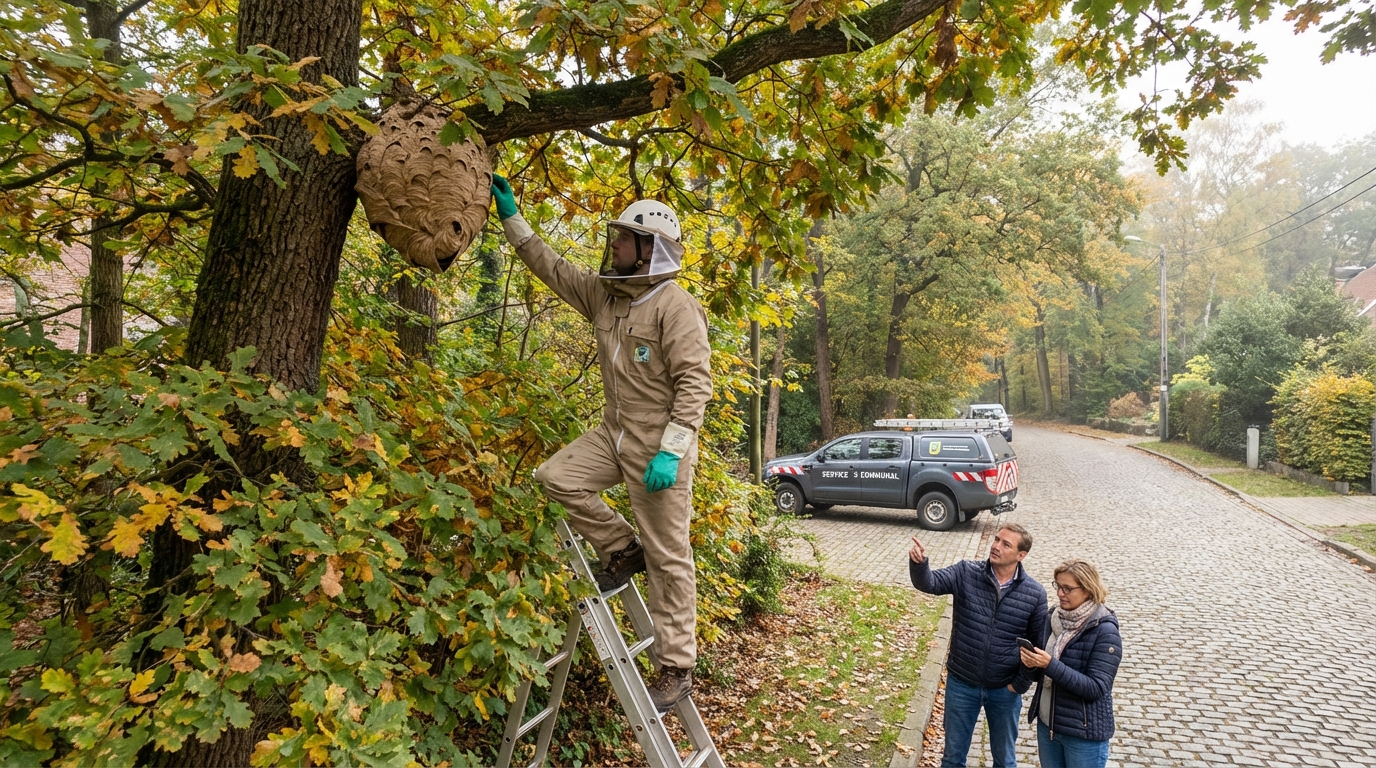
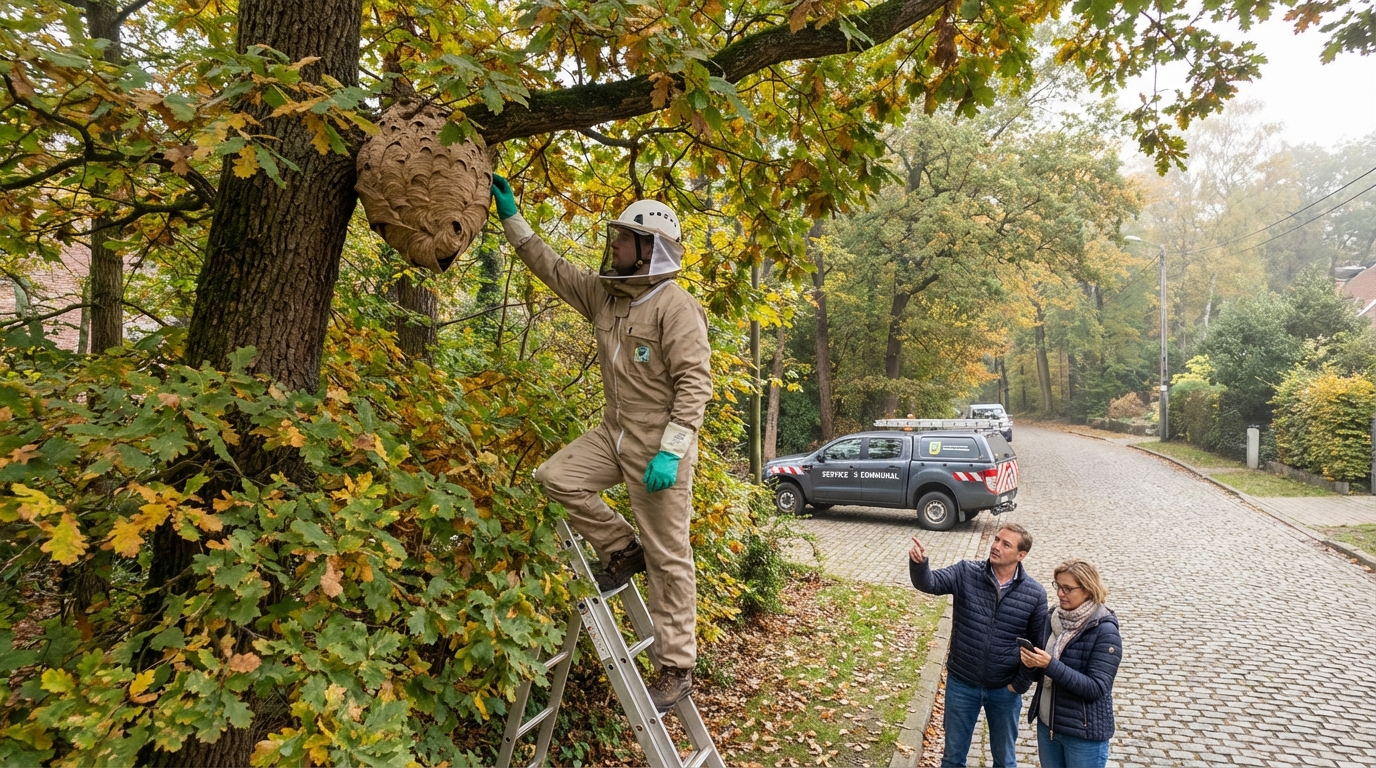
Last summer, a beekeeper at Le Coin du Balai lost three hives in less than two weeks. Not because of a classic parasite or a difficult winter. No. Asian hornets, posted in squadrons in front of the entrances, were decimating his bees one by one. When he called us, the nest was hanging twelve meters high in an oak tree, as big as a basketball. This kind of scene is increasingly common in Watermael-Boitsfort.
Things to remember
-
An ultra-local article combining an account of real-life intervention in Boitsfort's wooded neighborhoods (such as the Coin du Balai) with a comprehensive practical guide to help local residents identify, report and treat nests safely all year round.
-
Why has the Asian hornet invaded Watermael-Boitsfort?
-
A practical guide to identifying and reporting a nest near you
-
Prices and procedures
The commune is an ideal breeding ground for Vespa velutina: lots of trees, mature gardens and the Forêt de Soignes just around the corner. Asian hornets have everything they need to make a lasting home here. And the problem isn't limited to summer. From spring onwards, the founding queens seek shelter to build their first nests. In autumn, colonies reach their maximum size. In short, it's an issue that concerns local residents year-round.
We've written this article to give you a practical guide. Understand why the proliferation is affecting your neighborhood in particular, know how to recognize a nest and report it correctly, and above all know the prices and procedures for safe hornet nest destruction. No abstract theory, just practical, on-the-ground information.
Why has the Asian hornet invaded Watermael-Boitsfort?
Arriving in France in 2004 in a consignment of Chinese pottery, Vespa velutina took less than twenty years to colonize all of Western Europe. In Brussels, the first reports date back to 2016. Since then, the proliferation of the Asian hornet in Brussels has continued unabated. Watermael-Boitsfort is one of the municipalities most affected, and not by chance.
Take a look at a map. The commune is bordered by the Forêt de Soignes, criss-crossed by green corridors and dotted with old gardens with tall trees. For a founding queen looking for a quiet, wooded spot to set up her colony, this is the jackpot. Neighborhoods like the Coin du Balai, with their wooded plots and dense hedges, offer dozens of potential nesting sites per hectare.
One thing many people don't know: Vespa velutina in Boitsfort is not confined to forest areas. Nests can be found under roofs, in garden sheds and even in low hedges in spring. Primary nests (those built by queens between March and May) are often at ground level, in sheltered spots. Only in summer does the colony move to a secondary nest, usually high up in a tree.
And local biodiversity is taking a serious hit. The Asian hornet is a formidable predator: it feeds mainly on bees, but also on wasps, flies and butterflies. A single colony can capture tens of thousands of pollinating insects in a single season. Brussels beekeepers are on the front line, some having lost up to 40% of their stock in recent years. Apiaries in the south of the Brussels region, particularly those near Watermael-Boitsfort, are particularly exposed.
Why does the situation worsen every year? Because a single colony can produce between 200 and 500 new queens in autumn. Even if the majority don't survive the winter, just a few dozen make it through to found as many new colonies the following spring. With no effective natural predators in our latitudes, there's nothing to stop this dynamic. Chickadees sometimes attack them, as do certain birds of prey, but this remains anecdotal compared with the rate of reproduction.
The local fight is being organized, but it relies to a large extent on the vigilance of local residents. That's where you come in.
A practical guide to identifying and reporting a nest near you
What should you do if you see an Asian hornet in your garden? First thing: don't panic, and above all don't try to kill it by hand or with a commercial insecticide. An isolated hornet is a scout. The important thing is to locate the nest. And to do that, you first have to be sure you're dealing with the right insect.
Recognizing the Asian hornet isn't all that complicated once you know what to look for. It is smaller than the European Hornet (around 3 cm vs. 3.5 cm). Its body is predominantly dark, almost black, with an orange stripe on the abdomen and yellow-tipped legs. The European hornet, on the other hand, is yellower, bigger and, frankly, less aggressive towards beehives. If you see a dark insect hovering in front of a beehive or flower bed, chances are it's Vespa velutina.
Now for the nest. In spring, look for a small round nest (the size of a tennis ball to a handball) in sheltered places: under an awning, in an open garage, behind a shutter. This is the primary nest. From June-July onwards, the colony often migrates to a much larger secondary nest (up to 80 cm in diameter), generally installed high up in a leafy tree. This nest is often spotted in autumn, when the leaves fall. It's too late to do anything about it, as the colony has already produced its future queens.
The reference tool for reporting hornet nests in Belgium is Vespawatch. It's an online platform managed by the Institute of Natural Sciences. You take a photo (even a blurry one, even from a distance), indicate the location, and experts validate the identification. It's free, fast, and feeds a precise map of the presence of Vespa velutina in Brussels and Wallonia. Vespawatch Brussels centralizes all observations and enables field teams to prioritize interventions.
You can also contact the municipality of Watermael-Boitsfort directly, which has set up a monitoring system. The environmental department relays reports and directs residents to authorized professionals. Some residents are reluctant to report because they're afraid of the costs or administrative complications involved. This is a pity, because the earlier a nest is detected, the simpler and less costly the intervention.
An important point: what scent does the Asian Hornet hate? We read a lot on the Internet, from cloves to burnt coffee. Let's be honest, none of these methods has been scientifically proven to keep a colony away for long. They may disturb an isolated individual, but they'll never replace destroying the nest. Don't waste your time with makeshift solutions when you have an active nest nearby.
Nest destruction in Watermael-Boitsfort: prices and procedures
75 to 150 euros. This is the price range for Asian hornet nest destruction in most standard cases in Watermael-Boitsfort. Prices vary according to nest height, accessibility and time of year. A primary nest two meters off the ground in May requires a thirty-minute intervention. A secondary nest fifteen meters up in a lime tree in September requires special equipment (cherry picker, telescopic boom, reinforced suit) and the price rises accordingly.
At Frelons.be, we work all year round. This is a point we insist on, because many people think the problem is limited to the summer. In reality, trapping the founding queens in spring and destroying the primary nests are the most effective actions to limit proliferation. Waiting until autumn means letting the colony produce hundreds of future queens who will go on to found new nests the following year.
The procedure is simple. You contact us with the location of the nest (a photo always helps). We assess the situation, often within 24 to 48 hours. The procedure itself takes between 30 minutes and 2 hours, depending on complexity. We use appropriate techniques: injection of a biocide directly into the nest, then removal when possible. The safety of local residents is our top priority. We secure a perimeter, intervene with professional equipment, and make sure the nest is neutralized before leaving.
A question that often comes up: why shouldn't you kill an Asian hornet yourself, or try to destroy a nest without a professional? There are two reasons. The first is the danger. A mature nest can contain several thousand individuals. When they feel threatened, they attack in groups. Multiple Asian hornet stings can cause severe allergic reactions, even in people who have never been allergic to wasps. The second reason is effectiveness. A poorly treated nest, where the queen survives, can be rebuilt nearby. We've seen cases where individuals have sprayed a nest with insecticide spray: the result was hornets scattered and aggressive all over the neighborhood, and a nest rebuilt two weeks later ten meters from the old one.
For financial assistance, contact your local council. Watermael-Boitsfort, like other Brussels communes, participates in the communal fight against the Asian hornet, and can in some cases provide subsidized interventions or cover part of the cost. The scheme evolves every year, so it's worth giving the environment department a call.
For beekeepers in Brussels, the situation is even more urgent. If you have hives and spot hornets hunting in front of your colonies, don't wait. Every day counts. Protective devices exist (muzzles, selective traps), but the only lasting solution is to destroy the source nest. We regularly work with local beekeepers to locate nests along the hornets' flight paths. It's a team effort.
Conclusion
Asian hornets in Watermael-Boitsfort won't disappear on their own. The Forêt de Soignes, the Coin du Balai gardens, the municipal parks: all the green spaces that make up the municipality's charm are also what attract Vespa velutina. The good news is that every nest destroyed in spring means potentially hundreds fewer queens in autumn.
Stay vigilant, report what you see on Vespawatch, and call in the professionals for any intervention. That's what we're here for, all year round. If you have any doubts about an insect or a nest in your garden, contact Frelons.be. Better a false alarm than a nest that grows quietly for weeks.
Frequently asked questions
Why is Watermael-Boitsfort a high-risk area for the Asian hornet?
The municipality offers an ideal habitat thanks to the Forêt de Soignes and its many wooded gardens such as the Coin du Balai. These green spaces provide founding queens with countless nesting sites and a rich biodiversity to feed their colonies.
How can you tell an Asian Hornet from a European Hornet?
The Asian Hornet is darker (almost black), with yellow-tipped legs and a broad orange stripe on the abdomen. It is slightly smaller than the European Hornet, which has more russet and yellow hues on its body.
What should I do if I discover a nest near my home in 1170?
Never try to destroy it yourself, as the Asian Hornet is very aggressive in groups. Take a photo from a distance, report it on the Vespawatch platform and contact a certified expert or your local environment department for a safe intervention.
Where do hornet nests usually hide in Boitsfort?
In spring, primary nests are found at ground level in garden sheds, hedges or awnings. In summer, the colony often migrates to a large secondary nest, hidden in the treetops of tall trees, often invisible before leaf fall.
How much does it cost to destroy a hornet's nest in Watermael-Boitsfort?
Rates generally range from €75 to €150 for a standard intervention. This price may vary according to the height of the nest (requiring a gondola or pole) and the urgency of the situation, particularly for the protection of local apiaries.
 French
  English
  Dutch
Dutch
0 Comments