
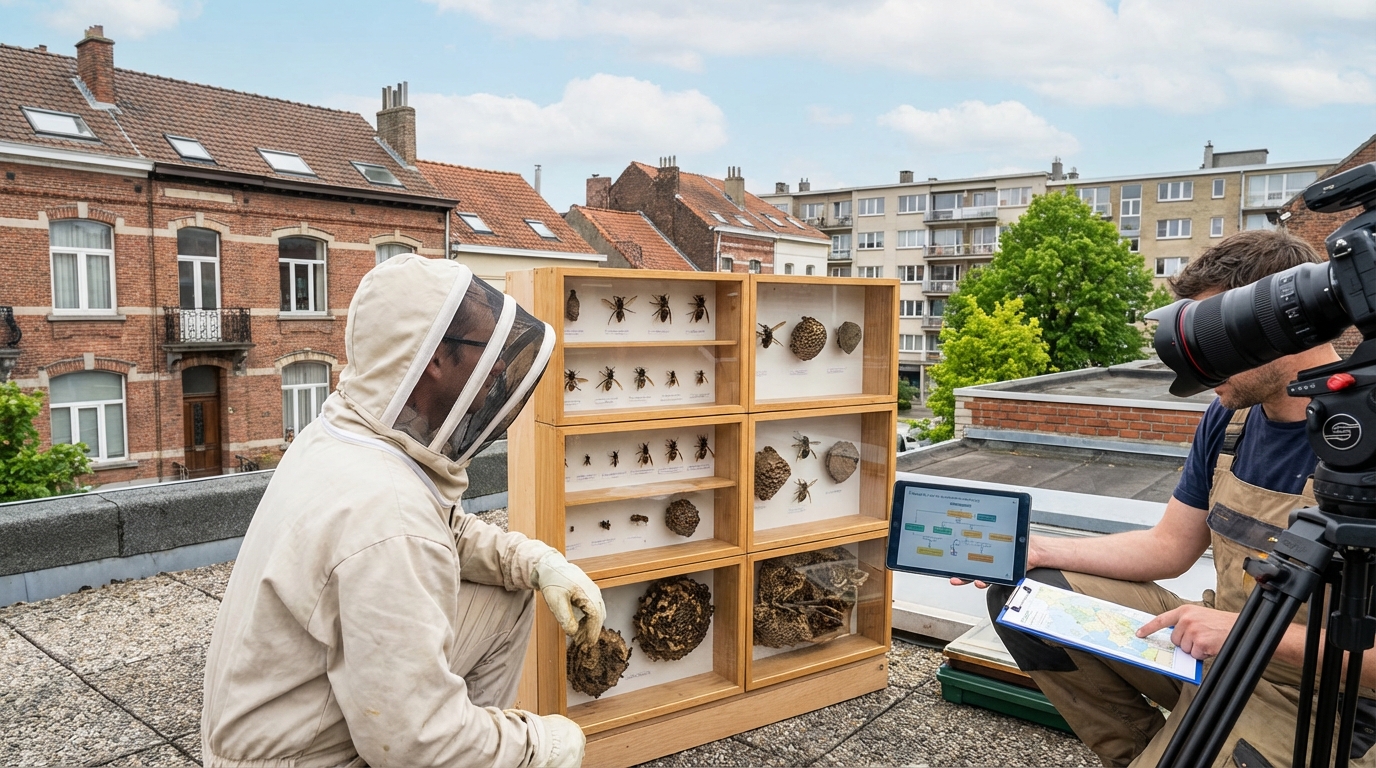
Asian hornets in Saint-Gilles: how to deal with a nest?
Contents
-
Identification and specific features of the Asian hornet in the urban environment of Saint-Gilles
-
Step-by-step guide: report and destroy an Asian hornet nest in Saint-Gilles
-
Security and prevention: why call on a local expert in Saint-Gilles all year round?
Last summer, a shopkeeper on the chaussée de Waterloo called us one Tuesday morning, a little panicked. His terrace customers no longer dared sit outside. The culprit: a nest of Asian hornets, hanging under the second-floor cornice, as big as a basketball. In Saint-Gilles, right in the middle of 1060, in the midst of the buildings of Brussels. This is no longer a report on the French countryside: the Asian hornet is here, and it's taking up permanent residence.
Things to remember
-
An ultra-local account of intervention in the heart of 1060 Saint-Gilles, transformed into a practical guide.
-
The article humanizes technical expertise by recounting a real-life operation, while explaining the administrative and climatic specifics of the commune for year-round protection.
-
Identification and specific features of the Asian hornet in the urban environment...
-
Report and destroy an Asian hornet nest in Saint-Gilles
We're seeing this kind of situation more and more often. Reports of hornet nests in Saint-Gilles have risen sharply in recent years, and the trend is not slowing down. The problem is that many people don't know what to do when they spot a nest. Call the fire department in Brussels? Contact the local council? Try to deal with it yourself? Spoiler: the last option is no. We'll break it all down here, step by step, so you know exactly what to do if an Asian hornet nest appears near you in Saint-Gilles.
Identification and specific features of the Asian hornet in the urban environment of Saint-Gilles
Three centimetres. That's the average size of a female worker. Vespa velutina, the Asian Hornet. Smaller than the European Hornet, contrary to popular belief. It's often the first surprise when you show a photo to the locals: «Oh, it's that one? I thought it was bigger». No. It's darker, stockier, with a distinctive orange face and yellow-tipped legs. That's how to recognize an Asian hornet without hesitation.
The European hornet, on the other hand, is redder, larger and, frankly, less aggressive towards humans. Confusion between the two is common, and has consequences: people destroy European hornet nests (which are useful to the ecosystem) thinking they're doing the right thing, whereas the real hornet is not. Vespa velutina thrives quietly two streets away.
In Saint-Gilles, the dense urban environment creates special conditions. Primary nests, those built by the founding queens in the spring, are found in unsuspected places: under a garage awning, in an outdoor electricity meter, behind a roller shutter no longer in use. These nests are small, about the size of a tennis ball. Easy to miss. It's only in summer, when the colony moves and builds a much larger secondary nest, that people start to notice the comings and goings.
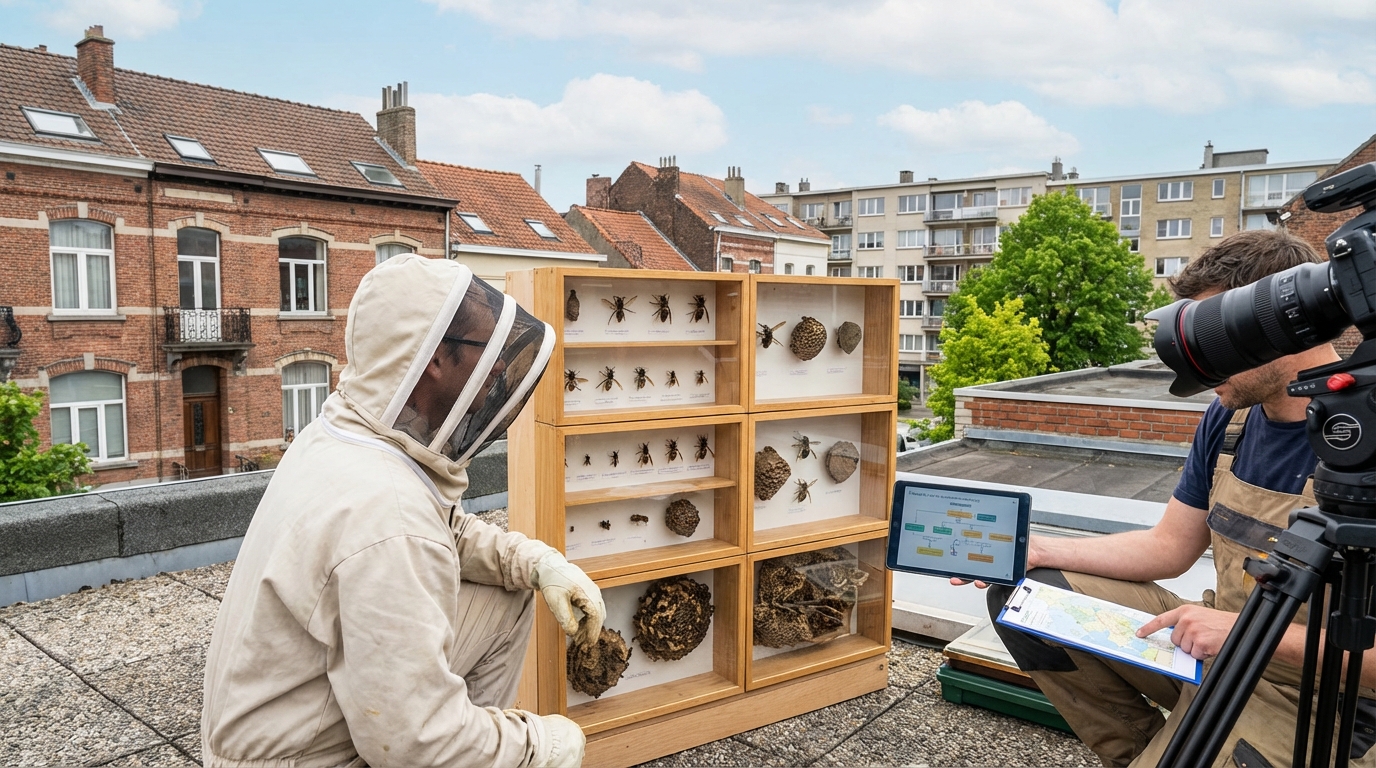
An urban nest of Asian hornets in Saint-Gilles is typically found high up: under roofs, in the tops of the few tall trees in nearby Forest Park, or clinging to the facades of the neighborhood's Haussmann-style buildings. Building density plays a paradoxical role. On the one hand, there are fewer tall trees than in rural areas, so nests are often more visible. On the other hand, the architectural nooks and crannies of old Saint-Gilles houses offer dozens of perfect hiding places.
This makes the presence of Vespa velutina in Brussels is the proximity to people. A nest in the middle of a forest is one thing. A nest three meters from a schoolyard or above a restaurant terrace on the square in front of Saint-Gilles is an emergency. The Asian hornet is not spontaneously aggressive when foraging, but approach within five metres of its nest and the reaction is immediate: the sentinels attack in groups. And unlike bees, hornets can sting several times.
Is it dangerous to be stung by an Asian hornet? For most people, an isolated sting causes intense pain, local swelling and nothing more. The real danger is a multiple sting (when you unknowingly disturb a nest) or an allergic reaction. Around 3 % of the population is allergic to hymenoptera venom, and in this case, a single sting can trigger anaphylactic shock. Every year in Belgium, people end up in emergency wards because of this.
A final point that directly concerns Saint-Gilles: shared gardens and urban apiaries. In recent years, the commune has encouraged beekeeping in the city. The Asian hornet is a formidable predator of bees. It hovers in front of beehives and captures foragers one by one. A single active nest can decimate several colonies in a matter of weeks. Protecting local bees is also a reason not to leave a nest lying around.
Step-by-step guide: report and destroy an Asian hornet nest in Saint-Gilles
You've spotted a suspect nest. First and most important rule: don't touch anything. No water jets, no smoke, no sticks. Every year, people end up in hospital because they tried to deal with the problem themselves. A mature nest can contain over 2,000 individuals. When they feel threatened, they all come out at once.
Here is the concrete procedure for reporting to 1060:
-
Take a picture if possible, without getting closer than five meters. Your phone's zoom is more than enough. This photo will serve to confirm that it is indeed an Asian hornet nest and not a wasp or European hornet nest.
-
Report the nest on the official platform. In Belgium, you can report a hornet nest via the iNaturalist application or directly to the surveillance network. Vespa-Watch, managed by the Royal Institute of Natural Sciences. It's free, and helps map the progress of the species.
-
Contact the commune of Saint-Gilles. The Environment Department at 1060 can help you. Some Brussels communes contribute to the partial financing of the destruction, but the terms and conditions vary from year to year. Call them directly to find out what's applicable.
-
Call in a specialist exterminator. That's where we come in. Destroying a nest of Asian hornets in Saint-Gilles is not a conventional pest control job. It requires special equipment (ventilated full-body suit, telescopic pole, appropriate biocidal product) and a real understanding of the insect's behavior.
What about the firefighters in Brussels, do they intervene for hornets? It's a question we get asked all the time. The answer: the fire department can intervene in cases of immediate danger to public safety, but in practice, they almost systematically redirect to private professionals for the destruction of hornet nests. They simply don't have the resources to deal with every single report, especially during the summer peak.
The actual destruction procedure depends on the location of the nest. If the nest is less than ten meters high, the procedure is fairly straightforward: an insecticide is injected directly into the nest using a pole, activity ceases (generally within 24 to 48 hours), and the nest is removed. A nest perched twenty meters up in a tree in the Pierre Paulus park is a different story: a cherry picker or other high access techniques may be required.
As for timing, don't wait. A nest spotted in June is the size of a grapefruit. By September, it can reach 80 centimetres in diameter. The larger the nest, the more complex and costly the intervention, and the greater the risk to the neighborhood. If you see an Asian hornet regularly entering the same spot, there's a nest. Report it immediately.
What should you do if you see isolated Asian hornets with no visible nest? Note the location, time and direction of flight. Workers follow regular trajectories between the nest and their hunting grounds. By cross-referencing several observations, you can often locate the nest. Pass on this information when you report a sighting, it saves us precious time.
A word on a common misconception: why shouldn't we kill individual Asian hornets? In reality, crushing an isolated hornet poses no problem in itself. What's pointless is believing that killing a few workers will solve anything. A nest produces thousands of individuals. The only effective solution is to destroy the nest. Anything else is a band-aid on a wooden leg.
Security and prevention: why call on a local expert in Saint-Gilles all year round?
42 stings. That's what happened to a resident of the Brussels region last year when he tried to remove a nest with a ladder and a garbage bag. He was hospitalized and spent three days in observation. The nest was still there when he returned home. We hear stories like this all the time, and it reminds us why our job exists.
The danger of an Asian hornet sting is real, but it's mainly a matter of context. A sting while walking in the garden is painful, but generally without serious consequences. Twenty simultaneous stings after shaking a nest are potentially fatal, even without a known allergy. The amount of venom injected is more than the body can handle. Children and the elderly are particularly vulnerable.
Calling in a hornet exterminator in Saint-Gilles is not a luxury: it's the only sensible option. You wear sting-resistant coveralls (a hornet sting can easily penetrate jeans), you use approved products, you secure the perimeter, and you know exactly how the hornet will react at every stage. Zero improvisation.
Let's talk about the cost of destroying a hornet's nest. This is the number one question we get on the phone. The cost of destroying a hornet's nest varies according to a number of factors: the height of the nest, its accessibility, and whether or not special equipment (gondola, rope) is required. For an accessible nest, generally count between 100 and 200 euros. For an intervention at height with a nacelle, this can rise to over 300 euros. Beware of abnormally low prices: some non-specialized operators use unsuitable products, don't remove the nest, or don't come back to check that the colony has been eliminated.
At Frelons.be, we work all year round in Saint-Gilles, and that's an important point. Many people think that the Asian hornet problem is limited to the summer. Wrong. The cycle starts as early as February-March, when the founding queens emerge from hibernation and look for a place to build their primary nest. This is when we can take preventive action, by installing selective traps and monitoring high-risk areas. In autumn, the nests produce the future queens that will overwinter. And in winter, abandoned nests are removed to prevent them from being used as a marker the following year (hornets don't reuse an old nest, but they often set up shop nearby).
Prevention is the key. A few simple steps can reduce the risk of a nest becoming established in your home:
-
Regularly inspect the nooks and crannies of your facade, sheds and roof overhangs from March onwards.
-
Don't leave ripe fruit lying around your garden or patio: it's a hornet magnet.
-
Cover your garbage cans. Asian hornets love proteins (meat, fish) as much as sugar.
-
If you're a beekeeper in the 1060 region, fit your hives with anti-frelon muzzles. It costs next to nothing and saves entire colonies.
One advantage of working with a local exterminator in Saint-Gilles is that we know the terrain. We know which neighborhoods are most affected, which types of building pose the biggest problems, and we can intervene quickly. When a nest is reported, every day counts. An active Asian hornet nest next to a school or crèche can't wait a week.
We're sometimes asked who to call when you have Asian hornets in your home. The most straightforward answer: contact a professional hornet exterminator on 1060. Not your DIY neighbor, not YouTube, not a forum. Just a professional. The commune of Saint-Gilles will also be able to tell you about any financial assistance available. In some years, Bruxelles Environnement has contributed to the cost of our work. It's worth asking.
Cohabitation with the Asian hornet is no longer a hypothesis. Vespa velutina is in Brussels for good. The question is no longer «is he coming? but »how do we manage his presence intelligently? And the answer lies in the vigilance of residents, the responsiveness of professionals, and good coordination with local authorities.
Conclusion
An Asian hornet nest in Saint-Gilles is neither inevitable nor a catastrophe, provided you react quickly and effectively. Identify the insect, keep your distance, report the nest to the authorities and a professional. Never attempt to destroy the nest yourself. At Frelons.be, we're active all year round in the 1060 area, from trapping queens in spring to eliminating nests in midsummer. If you have any doubts about what's flying around your home, give us a call. Better a false alarm than a nest of 2,000 hornets above your front door.
Frequently asked questions
How to recognize an Asian hornet in Saint-Gilles?
The Asian hornet (Vespa velutina) is smaller and darker than the European hornet. It is easily identified by its black body, orange face and yellow-tipped legs (hence its nickname, the Yellow-legged Hornet).
What should I do if I find an Asian hornet nest in my 1060 home?
Never approach closer than 5 meters and do not attempt to destroy it yourself, as hornets will attack in groups if they feel threatened. The correct procedure is to report the nest on Vespa-Watch and immediately contact a professional exterminator, such as frelons.be, in Saint-Gilles for safe destruction.
How much does it cost to destroy a hornet's nest in Saint-Gilles?
The cost of an intervention in Saint-Gilles generally varies between €100 and €200 for an accessible nest. This rate may increase if the nest is located at a significant height (roof, treetop) requiring the use of a nacelle or specific pruning equipment.
Do the Brussels fire department respond to hornet nests?
The Brussels fire department will only intervene if there is an immediate and vital danger to public safety. In most cases, they will refer you to specialized private companies, as the management of invasive species is not part of their traditional rescue missions.
Why is the Asian hornet dangerous for Saint-Gilles?
In addition to the risk of multiple stings for residents, it represents a major threat to biodiversity and the urban beehives of 1060. A single nest can decimate thousands of local bees, essential for the pollination of local gardens and parks such as Forest Park.
 French
  English
  Dutch
Dutch
0 Comments